
It's weird visiting a doomed museum. Not one that's slowly dying, with money and volunteer enthusiasm gradually ebbing away, where you sort of know in the back of your head that if there's a catastrophe with the roof or something like that, there may not be enough money to fix it. I've been to a few of those over the years. In those cases, there's always hope. Maybe a donor can be found, or new leadership can turn things around. This wasn't that. This was a museum that is already dead, and we're just waiting to pull the plug.

A week ago, I visited the Puget Sound Coast Artillery Museum in Fort Worden, Washington, at the gateway to Puget Sound. Tomorrow, September 7th, 2026, is their last day after 50 years.1 And I, crazy person that I am, said "well, I'm going to be on the West Coast anyway, might as well tack on a couple days and see it before it closes." So I left Lord Nelson among the Pokemon people of San Francisco and flew up to Seattle, then drove out to see what there was. And it was a nice little museum. It's clearly a smaller operation, with laminated printouts for signage and displays that show what they have, rather than a carefully-selected subset of the collection to best tell the story they're trying to tell. But those can be lovely and charming. That was more or less how the 45th Infantry Museum felt, and I regularly miss it now that it's been replaced by something more modern and sterile. As for this museum, well, it wasn't going to set the world alight. It wasn't even the best one I visited that day. (Turner Joy down in Bremerton is one of the best-executed museum ships I've ever seen. Review coming at some point soon.) But they did a pretty good job of telling the story of coastal defenses in the early 20th century, and it's a story that is pretty hard to find elsewhere. I've tried quite often to visit coastal fortifications, and it's generally been a frustrating experience in some dimension. The concrete may be there, but the stories aren't. The Fort MacArthur museum seems to have folded at some point in the last couple years, and there wasn't anything in the area around San Francisco except for Fort Point, which is from an older generation. Here, there was not only a place to learn the stories, but also several lovely batteries to go hike around, and I'm sad that only the second half will remain for visitors after tomorrow.
But at the same time, isn't this the fundamental paradox of working in history? I'll never see a battleship at sea, her broadside throwing a dozen tons of steel and explosives at the enemy and shaking everything around. I was born too late for that, but I'm still fascinated by it, and I've spent a decade trying my best to capture a facsimile of that and so much else that is, fundamentally, lost to the mists of time. Museums are some of our best tools to fight back against time, to preserve bits from the flow and show them off to the public. I think that's why I love them so much. At their best, they're shrines to the past, to things interesting in their own right, things worth remembering.
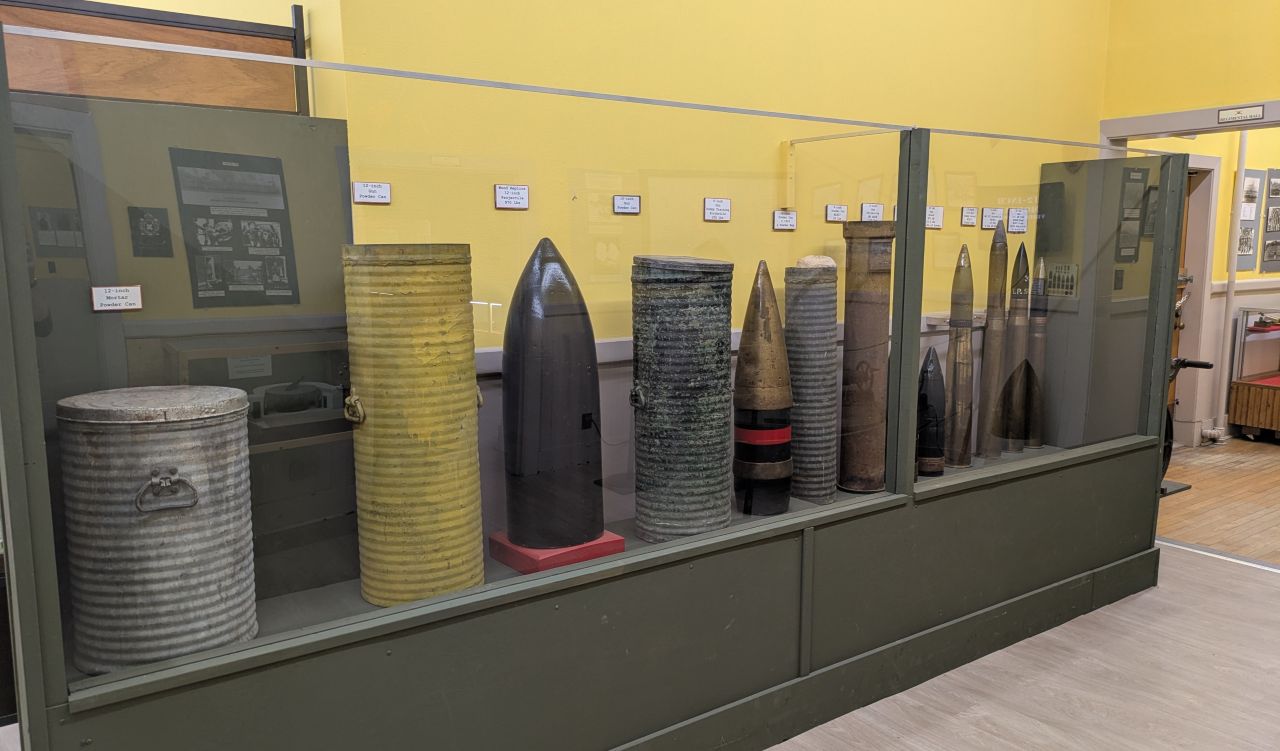
So I came here, to this little town on the edge of Washington State, to take a look at this before it's gone. To capture that experience for myself before it's gone, and to share what I can of that with the internet. And maybe, if I'm very lucky, with readers in the distant future who are, for whatever reason, interested in this little museum that, for half a century, told the story of the men who guarded Puget Sound. They created a lovely little space, covering everything from the strategic reasons for the fort to the man it was named after to the experience of being stationed there throughout the fort's history. There was a little bit of detail on the weapons, and some lovely dioramas of the various batteries installed over the years. There was a room with a fire control table, although annoyingly little detail on how the process worked, and a room full of a random collection of guns that someone had, most of which had no connection to the fort. There was a rack of fake shells and real powder cans, and a video that explained that the coastal defense mortars worked because "although the sides of the ship were armored, most ships at the time still had wooden decks".2 It had docents who were very nice, even when I insisted on arguing with their video. It was slightly weird and charming and I'm glad I got to see it before it was gone, and to write this obituary, at least for the physical space. They're going to try to continue digitally at https://coastartillery.org/, and I wish them the best of luck.
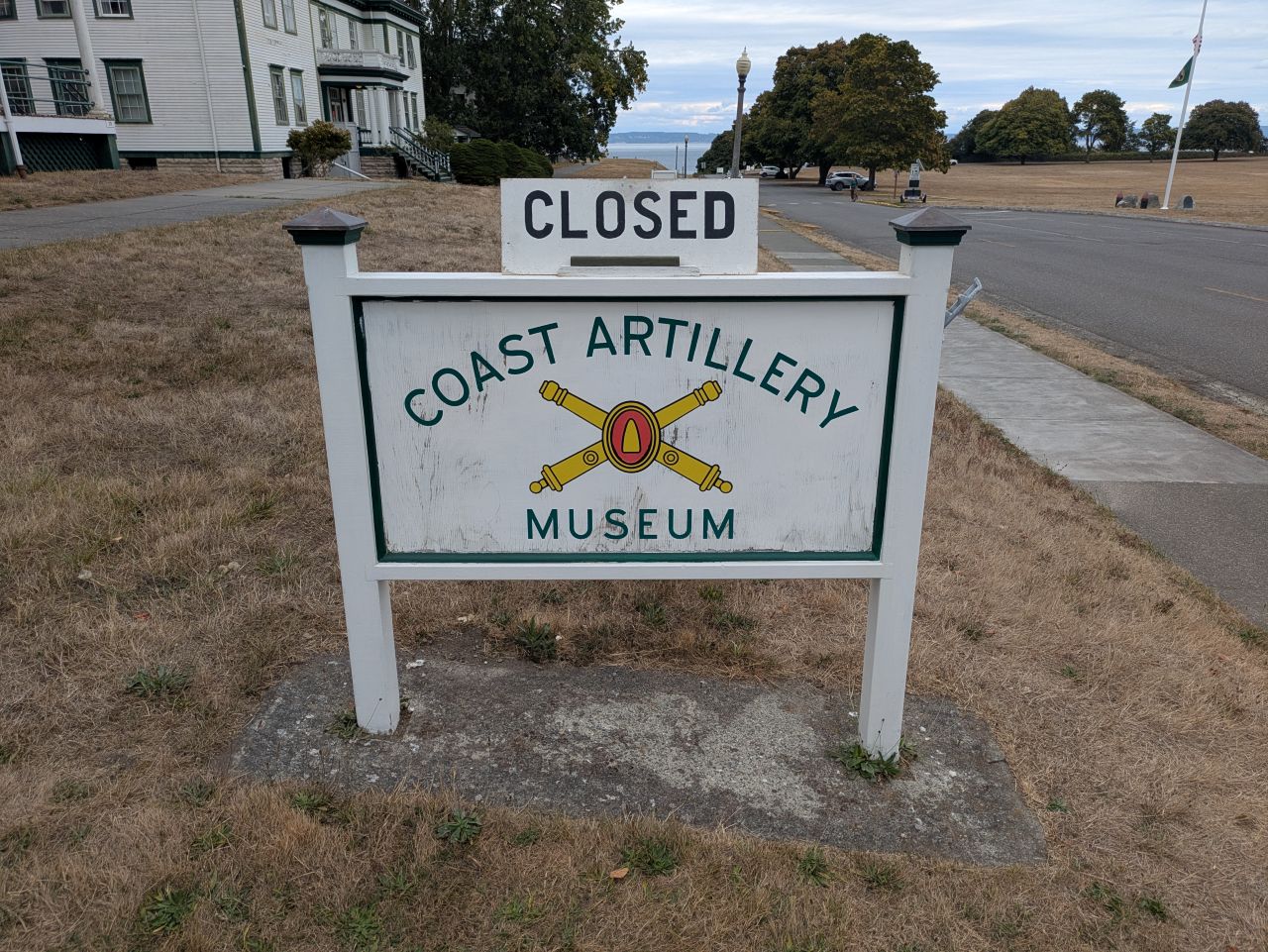
But it's also a lesson for those who are interested in history.3 Keeping this stuff doesn't just happen. It takes work to keep open the peepholes in the curtain of time, and to get people to look through them. And, yes, the artifacts will go off to different places, and the books will still exist, but it won't be here, within an easy hike of one of the best collections of preserved concrete in the country. And we'll lose the men and women who spent years working with the material, and who probably heard some stories from the men who were there that never got written down. So if you have the ability, support preservation efforts. Volunteer. Donate. Go visit, and see this stuff, so that if someday that museum shuts down, at least you can say you went and peeked through before time won and closed the hole.
Comments
Thanks for the review, at least!
I have never visited the museum (and I guess I never will). A great park for seeing emplacements in the Puget Sound area is Fort Casey. I worked a summer, too many years ago to count, for the Youth Conservation Corps at Ft. Flagler, the third of the three forts protecting Puget Sound. At the time many of the batteries were still overgrown. I think they've largely been uncovered now.
The Turner Joy was a fun tour, especially with my young kids (also more years ago than I want to remember). Do they still have "SOS" on the mess room menu board?
I agree, you are a crazy person. But you've written a moving tribute not just to this military museum but to all of them, and to the volunteers who give up a chunk of their lives to keep the place running. Even when the place is about to stop running. Thanks to you, we know that the docents at the Puget Sound Coast Artillery Museum remained at their stations until the end.
@Lee
What makes you think I didn't make it to Fort Casey? That post is coming at some point, but I wanted to keep "here's my analysis of an actual thing you can see" separate from the obituary for the Cost Artillery Museum. Didn't get to Flagler because of time.
Don't remember if Turner Joy still had that on the mess menu board. I was moving pretty fast.
@Steve
You're welcome.
I visited Fort Worden a few times when I was growing up in Washington. It was fun and fascinating, and I'm sorry to hear it's going away. Thank you for providing this vignette.
Your account makes the loss of a museum tangible beyond the fate of its objects. Preserving the labels, photographs and recorded explanations of volunteers would also preserve the context that makes those objects understandable. A note on where the collection and its documentation will go would be a valuable addition for future visitors and researchers. Best wishes from the Gefechtsklar editorial team.
I'm glad you could make it out to Fort Wordan: I have some fond memories of the place, I visited it a few times in my youth. Not the museum though, we were just there to run around the old batteries. It was an excellent place for rowdy teenage boys to explore, and occasionally stare at the sea imagining what it would be like to fire a barrage into an enemy ship.
Many, many, many such cases. It's unfortunate the number of things in society that as the Boomers die off, will not be tenable anymore. Although great news if you're a fan of collecting say, classic cars or coins, because the market is about to collapse!
That's a real shame: I never made it out there, only to fort Casey. And yeah, the loss of an entire generation of volunteers is going to hit hard soon.
When I was a kid the railway museums in England were full of middle aged men who rebuilt steam engines on their days off, even though their companies had stopped working with steam before they were born. Now there's hardly any engineers at all, and the ones there are have no interest in old locomotives. So the museums are coasting along with less and less working history until some councilor with a Star Wars name pulls their funding.