
In mid-October 1944, the American carriers under Admiral Halsey were operating in the waters between Taiwan (then known as Formosa) and the Philippines, to destroy Japanese power in the area before the US invasion of Leyte. Unfortunately, on October 13th, the heavy cruiser Canberra was torpedoed by Japanese aircraft, flooding both engine rooms. Normal practice would have been to take the crew off and abandon her, but Admiral Halsey decided to tow her clear by cruiser Wichita instead. The next day, light cruiser Houston was also torpedoed, losing not only her engines but also all of her boilers, which meant there was only emergency power available throughout the ship. She was in considerably worse shape than Canberra, with serious concerns that she would break up early on, leading most of the crew to abandon ship before the decision was made to try to tow her clear as well.
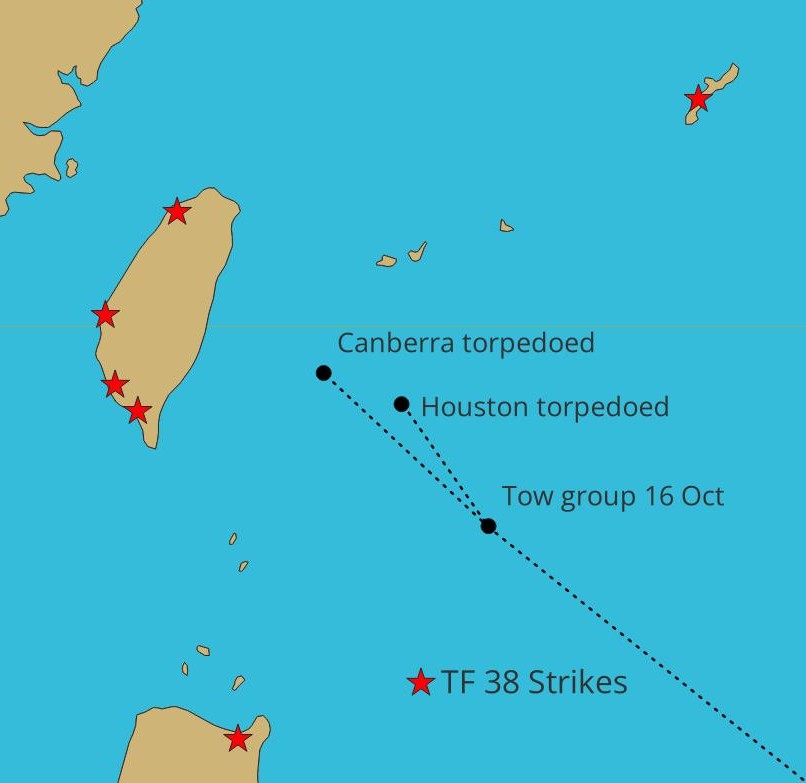
The path of CripDiv 11
On the morning of October 15th, a group, dubbed "CripDiv 1", was formed to protect the two crippled cruisers, with three light cruisers and eight destroyers to provide close cover. Light carriers Cabot and Cowpens, with a separate group of escorts, would provide air cover. Houston, towed by heavy cruiser Boston, spotted the group shortly after Wichita passed the tow to tug Munsee, and finally reached her station around noon. Meanwhile, Radio Tokyo was putting out increasingly outlandish claims about the damage inflicted on the Americans, prompting parties in the streets. Halsey's staff wondered about how much was deliberate propaganda and how much the Japanese genuinely believed. If they were taking their more outrageous claims (half a million tons of shipping sunk, 53 ships including 16 carriers on the bottom) seriously, then it was plausible that they'd send surface forces out to mop up. One carrier group was sent to hit airfields around Manila on the 15th and 16th, while two others were pulled out of range of Japanese search planes in the hopes of luring them out. Only one was left in position to protect CripDiv 1, an understandably unpopular move among the men of the group. One of the captains of the escorting light cruisers commented "Now I know how a worm on a fishhook must feel" and the name "BaitDiv1" began to circulate.
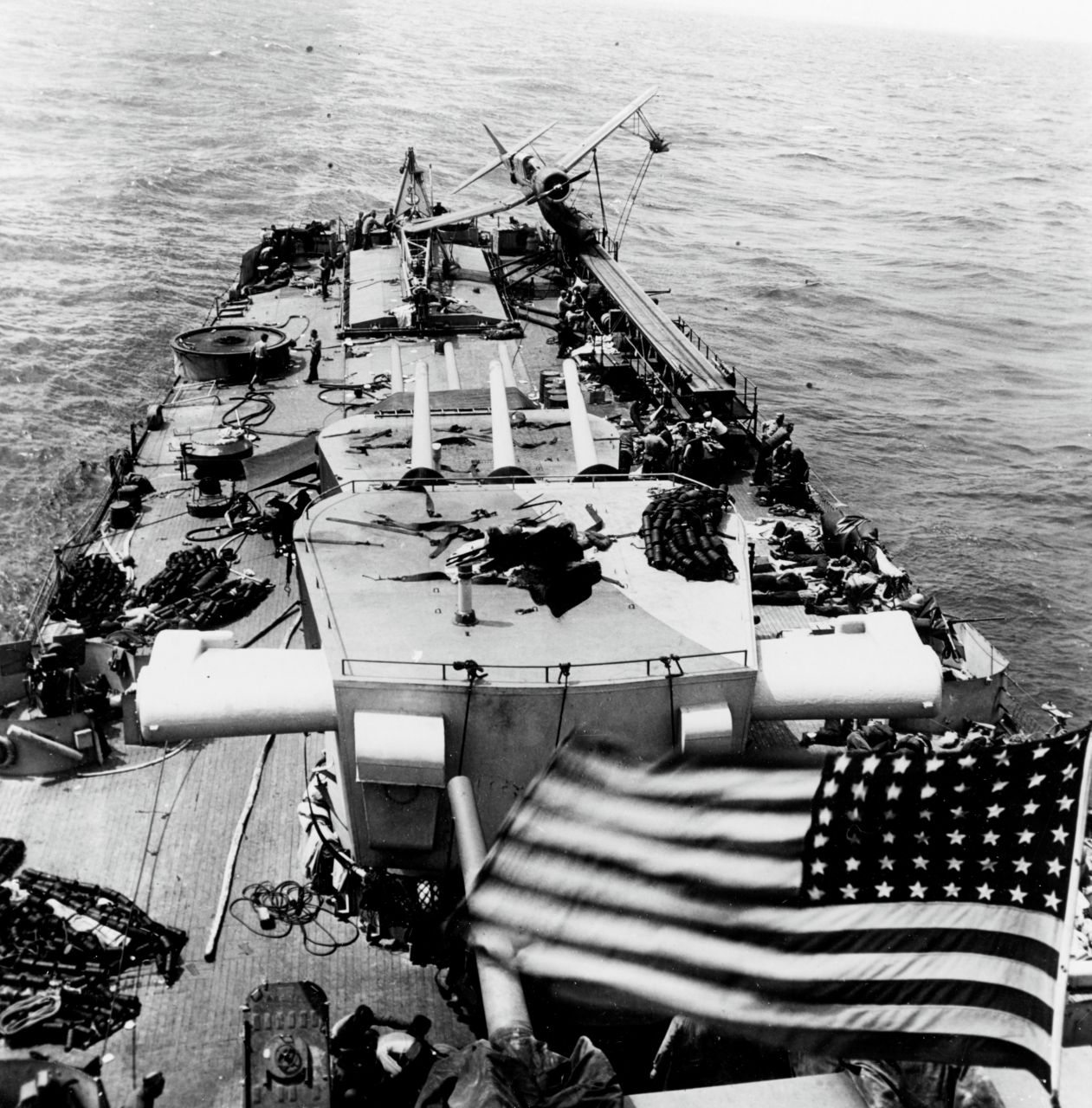
Houston after the catapult was jettisoned
The men aboard Houston were too busy to think much about that. First, there was still the matter of flooding. They had done a good job stopping the spread of water through the ship, but there were still 6,400 tons of extra water aboard a ship that normally displaced 13,900 tons fully loaded, and a 12° list to starboard. Normally, this might have been evened out by pumping fluids around, but concerns about the ship's structural integrity and the fact that all of the pumps were busy trying to dewater flooded compartments meant that they would need to jettison weight on the starboard side instead. Over the side went the starboard catapult and float plane, searchlights, one of the ship's boats and even some armored doors. The lack of power meant there was no ventilation down below, and crews worked to dewater compartments on the 3rd Deck in conditions so humid that electrical fires spontaneously broke out. There was little fresh water, and the only noise besides that of the damage control efforts was the creaking of the ship's hull. But they were clearly winning their battle, and during the 15th managed to seal off and drain most of the flooded compartments on the 3rd Deck, lightening the ship by 1,900 tons and reducing the list to a mere 8°.
The Japanese hadn't given up on sinking the "remnants of the American fleet", although their efforts on the 15th were less than successful. Three air attacks were launched, although the first failed to locate them, the second ran into the buzzsaw of the one carrier group providing a distant screen for CripDiv 1, and the third turned back after the flight leader developed engine trouble. The 16th dawned inauspiciously aboard Houston, with a major electrical fire breaking out in the emergency steering space. It was brought under control fairly quickly, although it disrupted the power supply from the main emergency generator aft. But the forward generator was still operational, although power available was limited because of contaminated fuel, and it provided power to haul in the anchor chain as the crew prepared to transfer the tow from Boston to tug Pawnee, which had finally arrived to release the heavy cruiser for duty as flagship of CripDiv 1.
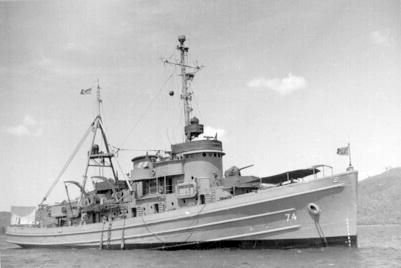
Pawnee
Passing the tow was difficult, as there was still a heavy swell, and the fire had disabled Houston's rudder control. As Pawnee came alongside, a wave slammed her into the cruiser's side, where the bigger ship's anchor became entangled on the tug's bulwark. When the seas reversed and the two ships parted, the anchor tore loose and went crashing through the tug's deck. Aboard Houston, the anchor chain went whipping across the deck, threatening the legs of any man who didn't jump over it. Fortunately, there were no actual injuries, and the rest of the process proceeded smoothly. An hour and a half after they started, Pawnee was pulling Houston into position a mile from Canberra, and took over as the guide ship for the group, as the jammed rudder made Houston the more difficult ship to tow.
Unfortunately for everyone involved, the Japanese weren't quite done with the group. On the 15th, they had dispatched the Second Striking Force, a pair of heavy cruisers, a light cruiser and a destroyer screen, to annihilate the "remnants" of the fleet. This was exactly what Halsey had wanted, a chance at more of the Japanese surface fleet, but it obviously made the men of CripDiv 1 rather nervous. Another threat came from the other string on Japan's bow, the air attacks they were still sending against the force. For some reason the first strike, 99 planes flying from southern Japan, was recalled before it found the target. The same happened to the Second Striking Force shortly thereafter, when it came under attack by a few planes from Bunker Hill, and the decision to withdraw was confirmed a few hours later when Japanese scouts spotted some of the waiting carriers. They would survive to take a rather inglorious part at Surigao Strait later in the month.
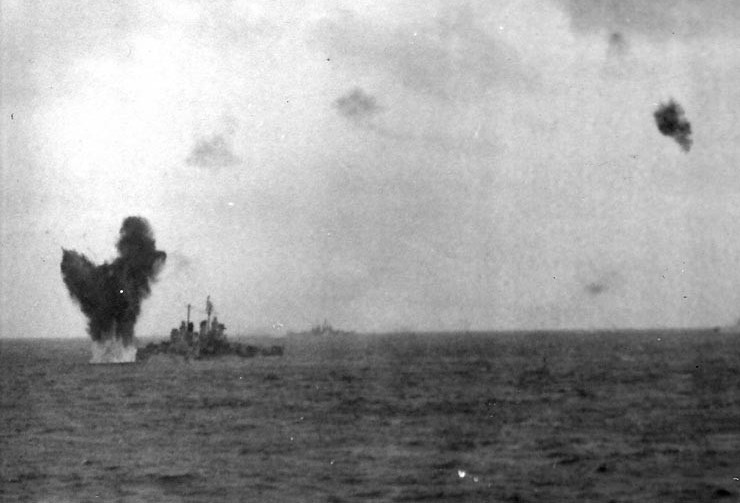
But the second airstrike, 107 planes from Formosa, was more successful, arriving overhead around 1300. The outnumbered fighters from Cabot and Cowpens did excellent work, shooting down many of the attackers2 and scattering most of the rest, but a trio of land-based torpedo bombers penetrated the screen around the crippled cruisers. Houston, without power, had to rely on her 20mm guns and what her 40mms could do in manual mode. It wasn't enough, and one of the bombers, a Fran, dropped a torpedo dead astern before crashing a few moments later, riddled by AA fire from the cruiser. The 20mm gunners switched their fire to the torpedo, but their efforts were in vain, and the weapon struck on the starboard side of the stern, underneath the floatplane hangar that took up a lot of the stern and, more importantly, underneath the supply of aviation gasoline for the floatplanes. The hangar hatch was blown into the sky, slicing the crane in two as it went, and most of the men who had been manning the aft pair of 20 mm guns were blown overboard. A massive fire erupted from the volatile avgas, soon spreading to the oil slick that Houston had been trailing, and endangering the men in the water.3 Forward of Houston, Pawnee was also in a tricky situation. She, like Houston, had weathered an air attack at only 4 kts, unable to dodge, and she was shackled to a now-burning cruiser of unknown structural integrity. Her captain ordered the message "WE'LL STAND BY YOU" transmitted to Houston, but also stationed a sailor with an acetylene torch to cut the towing cable in case the cruiser sank.
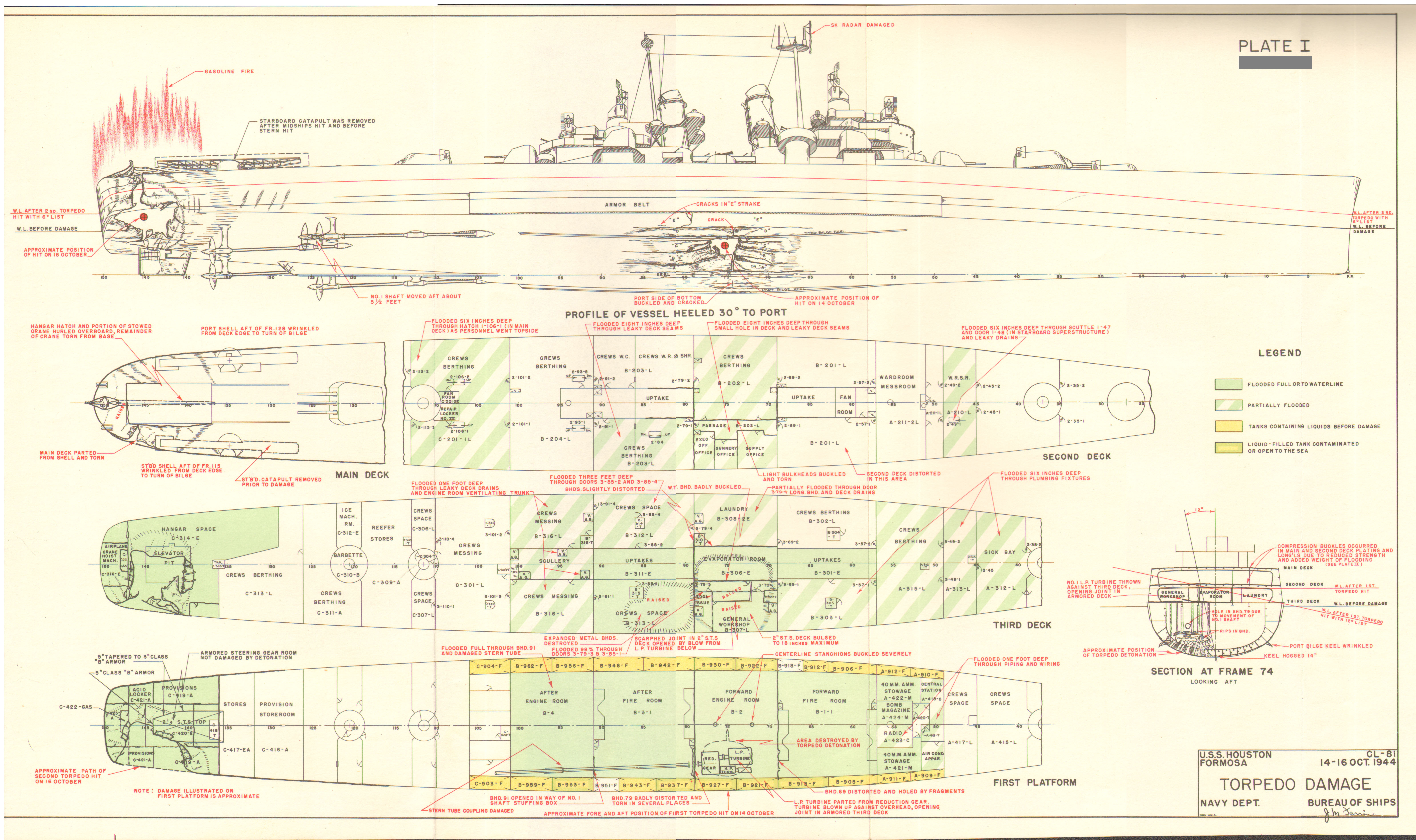
The diagram from the damage report. Click to enlarge.
But the men still aboard Houston had bigger things on their minds. After the initial shock of the torpedo hit, they rallied, laying out the fire hoses (previously kept rolled up for fear they would be cut by shrapnel during an attack) and rigging pumps. Foam quickly brought the fire, already dwindling as the avgas burned itself out, under control, and within 20 minutes, the crew could turn their attention to the other effects of the hit. The most obvious was that the hangar was now flooded, adding a thousand tons or so to the ship and basically undoing all of the pumping and jettisoning the crew had done so far. To make matters worse, the water in the hangar was sloshing back and forth, not only adding significant free surface to the problems facing the ship, but also threatening to smash through the bulkheads. We'll pick up the story with their attempts to deal with this threat next time.
1 Own work, based on Natural Earth Data. ⇑
2 American claims were 41, the Japanese admitted to the loss of 27. ⇑
3 Ultimately, only four of the ten men blown overboard from the fantail survived, but several were killed immediately. ⇑
Comments
I'm surprised they were still carrying avgas two days after having been crippled by the first hit, in an active war zone where they clearly anticipated further attacks. It's not like they were going to be flying Houston's seaplanes any time soon.
I suspect it was mostly that they hadn't gotten around to jettisoning it, and had bigger problems on their hands.
That was my first thought too. How much work is it to drain tanks like that? Is there a little valve with a note saying "plz do not turn unless you know what you're doing"? Or do you have to pump out the tank?
Given how dangerous the avgas is, I expect it to be pretty easy to get rid of. "Open these two valves to dump avgas" levels of easy, no pump or anything. I suspect that not dumping it was two factors. First, people were very busy with actual problems, and it's only a potential one. Second, when you're being towed at 4 kts, "we dumped the avgas overboard, but some of it was still clinging to the hull half an hour later and then someone threw a cigarette over the side" is a serious worry.
Surigao, surely, not Suriago? (Thus also in the title of the linked part 3 of "The Battleships of Pearl Harbor.") Quite the read, though: that the ship survived even after the torpedo strike on the avgas is remarkable.
In a Cleveland class light cruister the AvGas is not that easy to get rid of, because AvGas is stored below the waterline in a void on the first platform at the very stern of the ship. It would have to be pumped out. The two compartments labelled "C-422-GAS" on the damage diagram sit directly above AvGas storage; they're the path to pump it up to fuel the planes. So you cannot just open a valve and let gravity drain it away. In most situations this is probably a very safe place to store volatile fuel, surrounded by water and far from anything else, however Houston was unfortunate that the second torpedo basically hit the AvGas storage (right above and behind the rudder) and blew the fuel up into the ship.
I would also not assume that the fuel would designed to be easy to get rid of. Although we know in hindsight a 'quick release' for AvGas would be beneficial, engineers are not always so prescient. I could easily see a naval architect thinking "I put the dangerous flammable stuff below the water at the very end of the ship" and then moving on assuming that was double mitigation of the risk. Emergency-backup-to-the-redundant-alternate is the kind of effort that goes into nuclear power plant design and aviation flight controls, but not every system gets that attention (plus Fukishima and the 737 MAX saga show that even then the engineers are not perfect).
What's more, you might not want that kind of quick release feature. If dumping the AvGas were that simple you run the risk that a confused sailor turns the wrong valves and suddenly you can't fly your floatplane when you need it (not that any USN surface ship actually needed floatplanes at this stage of the war given how many CVs, CVLs, and CVEs were in service, but the premise is valid). Or the risk that shock from a near miss opens the valves and mission kills your aviation. Releases like that could even be counterproductive if a Chief concerned about confused sailors makes "improvements" to prevent accidental release, and a pressure spike causes the modified valve to fail and spray AvGas everywhere, or even just open and dump all the fuel when the point was not have it dumped.
Maybe I was getting confused with British practice, where being able to easily jettison the AvGas was a major requirement. (Or possibly with battleship practice, which may have been slightly different.) My sources weren’t terribly clear about exactly where it was stored, and I assumed it was above the waterline. If it was, I suspect it would have been fairly easy to dump (not necessarily one valve, but 2-3, all clearly labeled), but if it’s below, then you’re using pumps and all of those are busy keeping the ship afloat.
@Goose
My bad. Fixed.
'not necessarily one valve, but 2-3, all clearly labeled'
Chief: "Sailor, go and turn these exact valves I've marked on this plan. Do not turn any other valves. Especially do not turn the three valves clearly labelled with 'AvGas' in purple".
Sailor: "Aye, aye Chief!"
Chief: "Which valves will you turn?"
Sailor: "The ones marked here."
Chief: "Which valves will you not turn?"
Sailor: "The purple ones that say AvGas."
Chief: "One more time, what do you do with the purple valves?"
Sailor: "Nothing!"
[several minutes later]
Sailor: "Chief, I turned those three purple valves you wanted, but don't worry, not the valves you marked on this plan!"
If you think the above is implausible, you have never served in the military.
'that the ship survived even after the torpedo strike on the avgas is remarkable.'
I'm surprised they kept trying to save the ship after the second torpedo hit. The war wasn't quite over, but the writing was on the wall, the US was about to start cancelling ships in droves, and Houston wouldn't be back in service before the war ended. USS Youngstown, CL-94, had been laid down a month before and would be scrapped at 54% complete next year. I wonder how the cost and effort to repair Houston would have compared to just finishing Youngstown instead and having a brand new cruiser incorporating all of the lessons from the war.