
In the comments recently, someone made reference to Oriskany receiving an aluminum deck as part of her SCB-125A refit. And something smelled off about that claim. It was the sort of thing I really should have remembered if it was true, because it's such a delightfully weird bit of trivia. So I started digging.
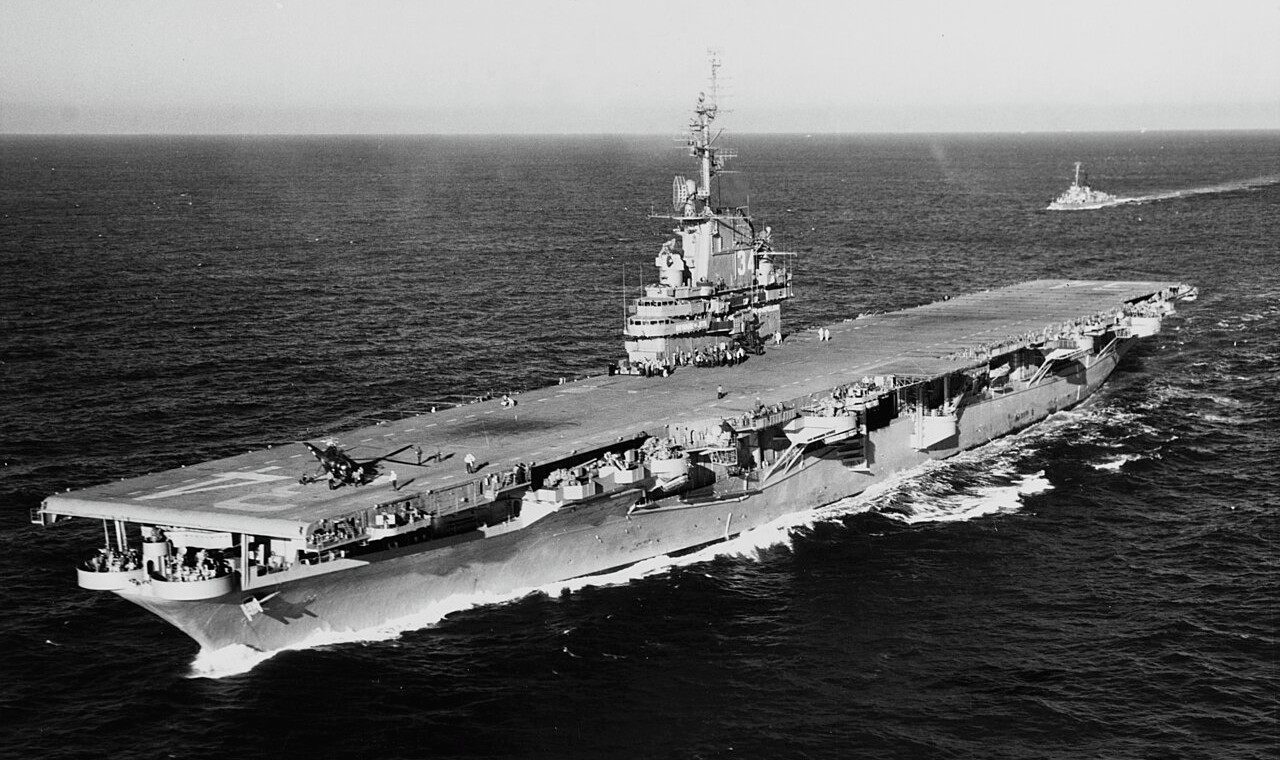
Oriskany in her original configuration
Now, before I go further, I should probably explain what I'm talking about. Oriskany was one of the Essex class carriers, famous as the backbone of the carrier task forces in WWII. But she had a rather unique history. She was still incomplete at the end of the war, and it was becoming obvious that significant modifications were going to be required to allow the existing carriers to operate the new jets entering service. So in 1947, she became the prototype for what was known as SCB-27A, refitting the Essexs with more powerful catapults, improved arresting gear, stronger elevators and flight deck, and an island rebuilt to be smaller and have better spots for radar. All of this added significant weight, requiring the ships be blistered to compensate despite the removal of the armored belt. But it was also necessary to keep the numerous Essexs viable in a world where funds for newer ships were difficult to find.
But the development of faster and heavier jets quickly outstripped the capabilities of SCB-27A, and something more was needed. Starting in 1951, ships were modernized to the SCB-27C standard instead, which included steam catapults in place of the previous hydraulic units, further strengthening of the flight deck and arresting gear, fitting bigger blisters and moving the aft centerline elevator to the starboard side to improve aircraft flow. Six unmodified ships received this upgrade, the last three in combination with a later upgrade known as SCB-125, which enclosed the bow to better deal with heavy weather and fitted the newly-developed angled deck and mirror landing system. With the exception of Lake Champlain, all of the other modernized ships also received SCB-125, with the aft elevator on the SCB-27A ships being moved as part of the upgrade. Uniquely, Oriskany received what was known as SCB-125A, an upgrade that also included steam catapults and the various other changes included under SCB-27C. She was the last of the Essexs to be modernized, and these changes allowed her, along with the SCB-27Cs, to serve as attack carriers through the early 70s, while the SCB-27A ships were relegated to anti-submarine duties, where their less powerful catapults were adequate.
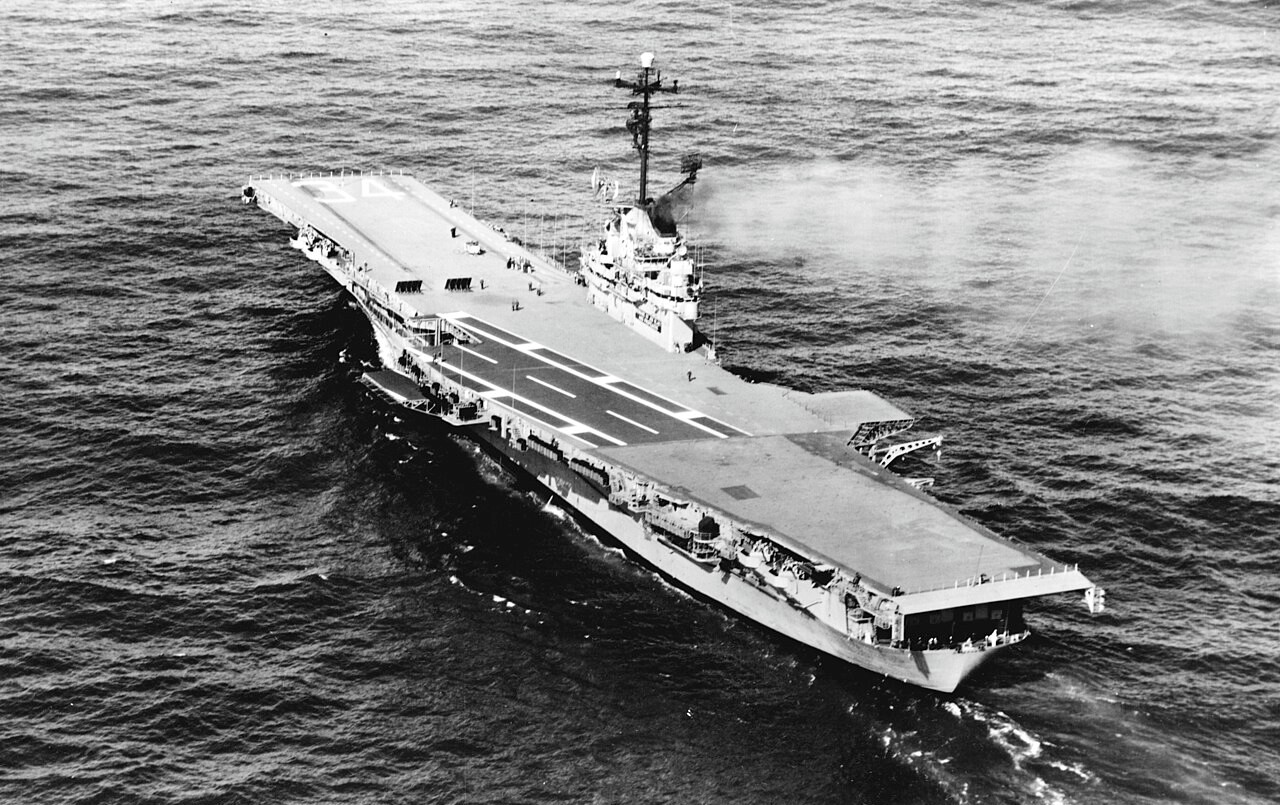
Oriskany shortly after the SCB-125A upgrade
But that brings us back to the aluminum flight deck claims, and I wasn't sure what to make of them. My first stop, of course, was Friedman's US Carriers, which was completely silent on this. The only notable fact he had was that unlike the other SCB-27C ships, Oriskany was down to two 5"/38 guns by the time she retired, instead of four for the others. This was enough to make me skeptical, as the obvious reason for installation of an aluminum flight deck would be to reduce topweight, and the removal of guns strongly suggests Oriskany had more trouble there than did the others. A search online didn't turn up anything in independent sources like DANFS, and while it was on several different pages on Wikipedia, it was either unsourced, had a reference to a Proceedings article that didn't mention anything about aluminum or was a bare reference to Friedman, which is what warship Wiki does when it's making things up.1 More than that, the various pages weren't particularly clear on exactly what had been done, with most at least implying that the deck had been replaced by aluminum and some stating it outright. Fortunately for me, Oriskany was sunk as a reef, which meant that there was environmental paperwork available, and the risk assessment confirmed (p.39) that there was wooden flight decking aboard until it was removed to limit the amount of PCBs released by the sunken ship.2
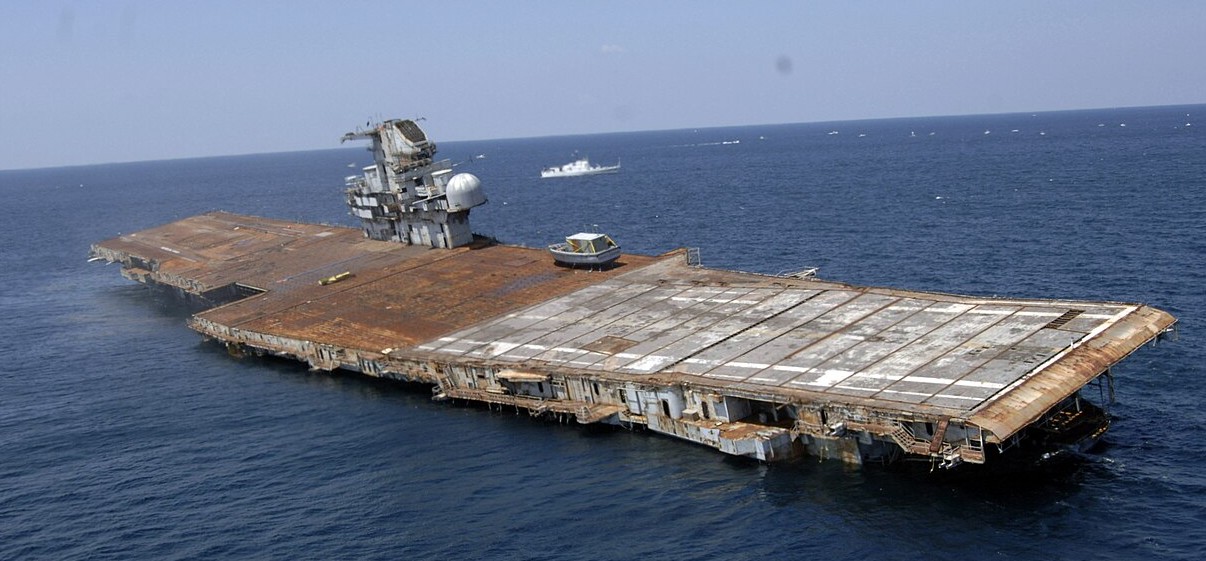
Oriskany being scuttled as a reef3
The only possibility left seemed to be that they'd rebuilt the understructure of the flight deck with aluminum in place of steel during the refit, presumably to save topweight.4 But that would be an enormous undertaking, the sort of thing that would definitely be discussed at length in Friedman, and probably mentioned in places like DANFS, too. There would be serious concerns about bimetallic corrosion, aluminum's different structural properties, and the fact that it softens much more quickly in a fire. So, with all of that taken into account, I was reasonably certain that Wiki had gotten it wrong. I was able to trace the original mention in the Oriskany article back to an edit made in 2006, when citation standards weren't what they are today. But just to be sure, I ordered a couple of books on the Essex class, by Alan Raven and Andrew Faltum. I didn't see anything in either book about this, and thus started work on this post to expose the error.
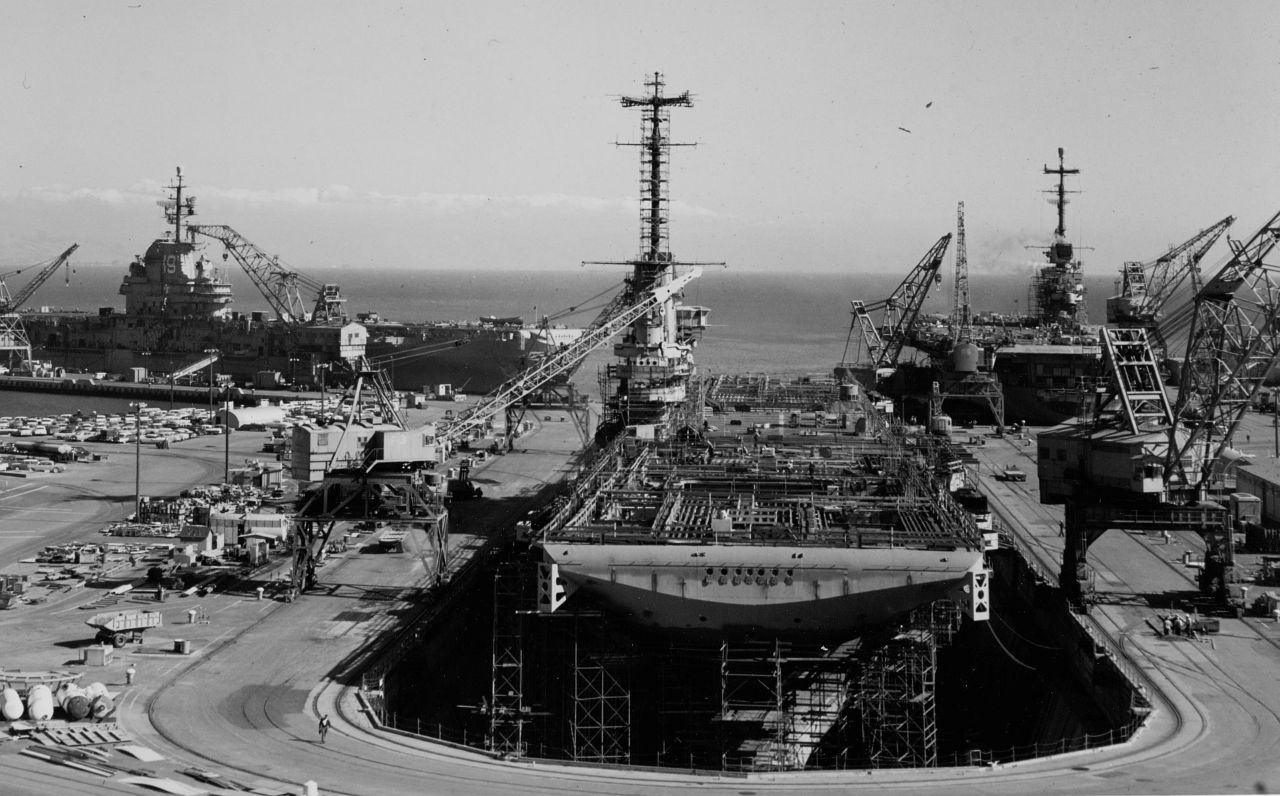
Oriskany getting her SCB-125A refit
And it was while I was preparing the summary of the Essex modernization at the top of this post that I realized I'd overlooked something. In Faltum's summary of the SCB-125A modification on p.159, when listing differences from SCB-27C ships, he states "CV-34 had a light metal cladding for the flight deck." Now, this would explain both the aluminum and the continued presence of wood on the flight deck, and is what at least some of the Wiki articles mention. "Light metal" is somewhat ambiguous, and while it could mean thin steel, it's also frequently used to refer to a group of metals significantly lighter than steel, typically aluminum or magnesium. Magnesium can be ruled out for obvious reasons, but I still wanted more evidence that we were talking about aluminum, and I found it in the Raven book. On p.182-183, there's a diagram of the deck coverings on an SCB-27C, which shows that much of the deck is wood underneath various thicknesses of polyurethane overlay. A few areas, mostly the catapult section, landing area and elevator tops are steel,5 while there's one small section that has aluminum over the wooden deck, and no sections where steel is used this way. Checking more of Friedman turned up a discussion on p.351 of a proposed refit of the SCB-27A ships to keep them active after plans for new anti-submarine carriers fell through, with a mention of a plan to replace the wooden deck with "aluminum-clad hickory" to reduce the maintenance burden. That dates from the mid-60s, but it would make sense that Oriskany, the last of the ships to get modernized, might well have gotten something similar.
And I was all ready to leave it there, having solved the mystery, before I decided to see if I could find some confirmation of this theory by looking at reports of the fire aboard Oriskany in October 1966. Unfortunately, there wasn't much technical on the fire. But while looking into it, I found a long article in Life magazine. As Life was a general-interest publication, the article focuses on the story of the men involved, and lacks basically any technical detail. But it does start with a few very nice full-color photos of men working on deck, which very clearly show wooden planks.
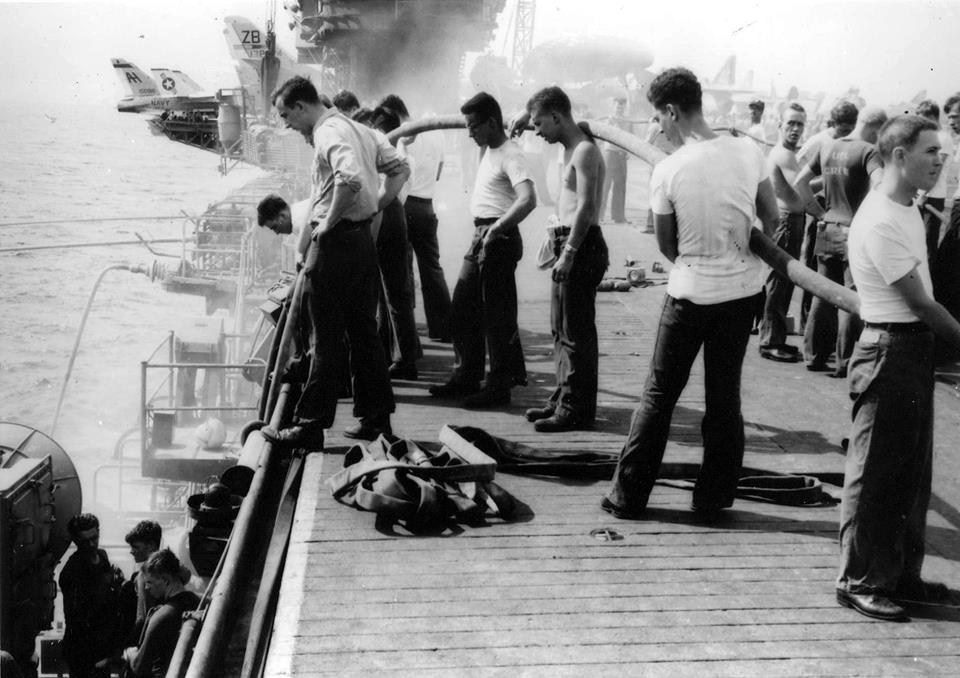
Men fight the fire aboard Oriskany. The deck is very clearly wood planks.
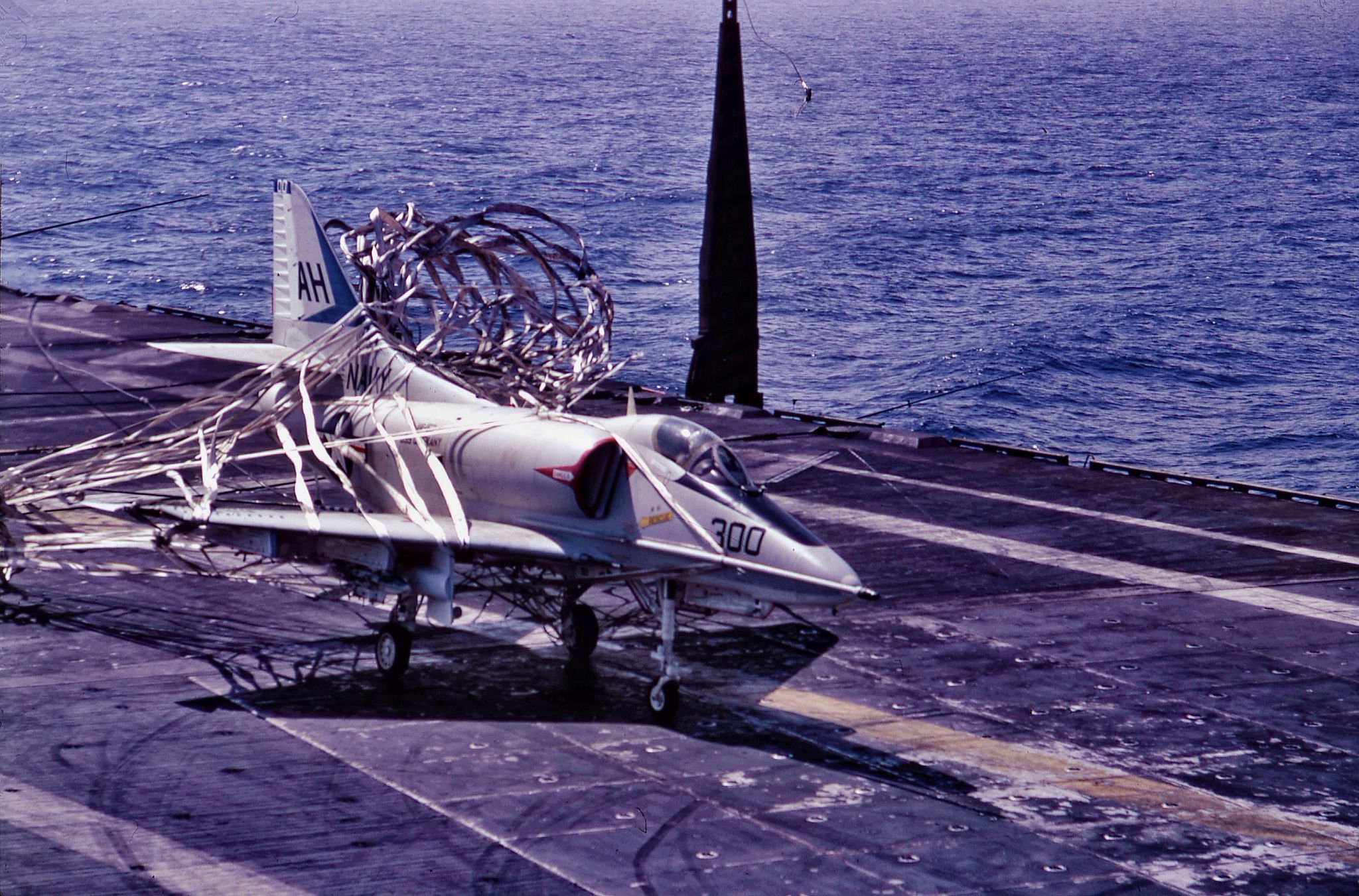
In despair, I went to NavSource to see what sort of photos they had of the flight deck, and found what appeared to be the solution to my problem. A picture of a 1957 BuShips journal article says "aluminum decking will be added to the landing area," which would square the various circles nicely. Except that I then started going through other photos on NavSource, and a lot of the landing ones clearly showed wood in the area where planes were touching down. Eventually, I was able to find a few that did show some sort of metal in the landing area, such as the one below of a Skyhawk going into the barrier in November 1967. Presumably this is the aluminum mentioned by BuShips, but coverage is nowhere near what the diagram in Raven led me to expect. It's the kind of minor change that happens all the time as ships go through yards, and not worth mentioning unless you're working at the sort of detail that tracks, say, every change of radio equipment. The planes are still clearly touching down on wood, while Raven has pretty much the whole landing area as STS, which makes a great deal of sense in an area where tens of thousands of pounds of planes are slamming into it. But that's obviously not what's going on here. The wood stays visible on parts of the deck as late as 1976, during the ship's final deployment.


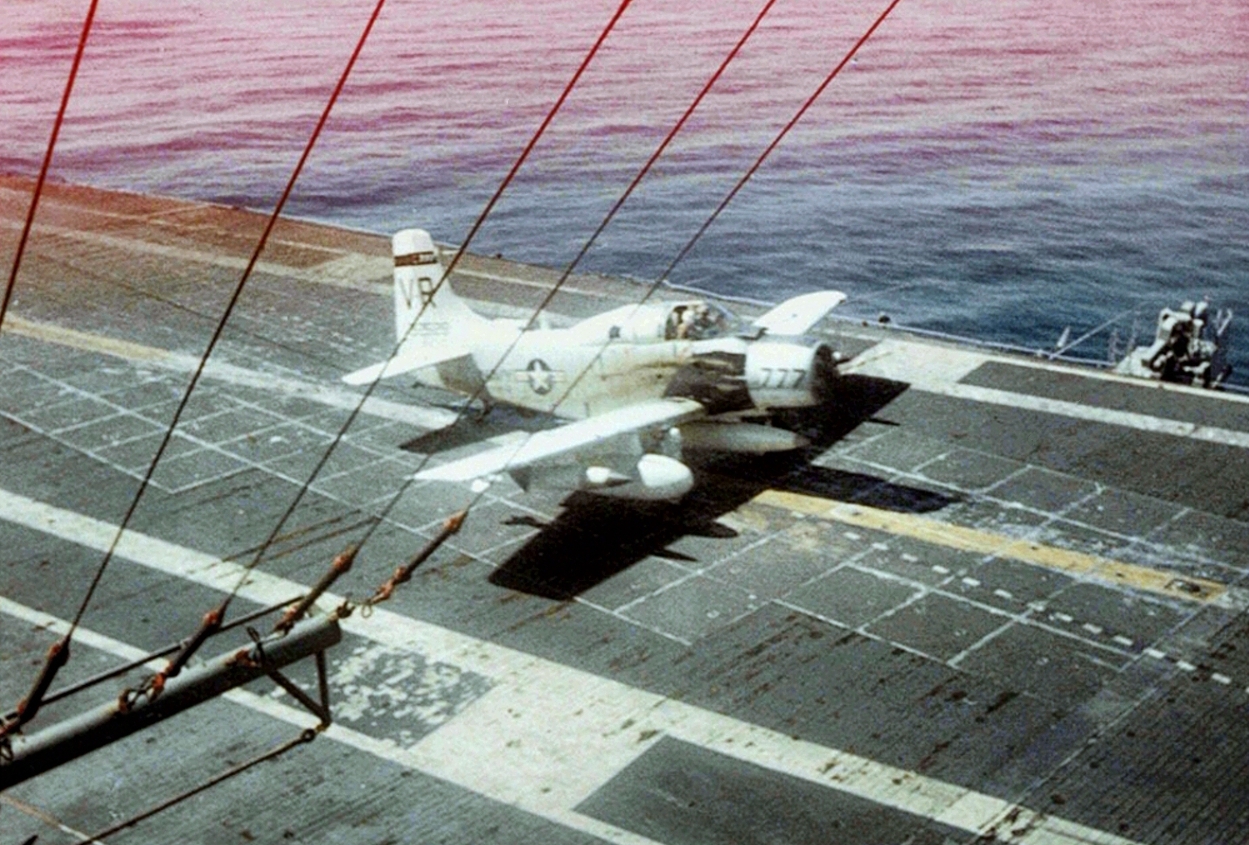
At this point, I started asking questions about Raven. My initial assumption was that his diagram described a configuration used on one of the other SCB-27C ships, most likely Lexington, which stayed in service until 1991 as a training carrier. But this doesn't work either. The diagram shows the deck-edge elevators as being nonskid paint on steel, but there's a 1975 photo of a T-2 Buckeye clearly showing wood on Lady Lex's elevators. And Raven credits almost everything forward of the angle as being STS, but this 1985 photo shows wood running between the catapults all the way to the bow. It's possible that one of the other ships was configured this way, but I don't feel like doing detailed checks of the photos of every SCB-27C, particularly given how hard it is to see the wood in some photographs.


The entirety of the fabled "aluminum deck," clearly surrounded by wood. Click to enlarge.
Having gone through all of that, I can come to a simple conclusion. My initial suspicions were correct, and Oriskany never received anything that could be described as an aluminum flight deck. There was at most a small amount of the metal in the rollout area forward of the arresting gear, but nothing worth talking about unless we're getting way deeper into the weeds than any source I have does. I suspect Faltum may have run across the BuShips article and described it poorly, and the other sourcing flows from there. But the photos are clear that her flight deck remained primarily wood to the end of her life. I'm not sure why the Navy never got around to replacing it, but the evidence on the matter is clear.
1 Well, usually. Sometimes, there's a specific page number that doesn't actually check out. One example is in the page for Kennedy at time of writing, where it claims that the ship was originally ordered as a nuclear carrier, and only converted to conventional power after construction began, citing p.387 of Friedman. It also cites this same page for the claim that she was developed under SCB-127C, and that she was 12' shorter than the Kitty Hawk class. The page contains none of these claims. It's in the appendix about magazines, and while it mentions SCB-127C, it has no mention of Kennedy herself, and certainly nothing about either the ship's length or her being ordered as a nuclear carrier. On p.399, Friedman gives a specification block for the ship, with overall length being 1051' 3", with a footnote saying she was 1072' 1" over the catapult booms, while America, the previous ship, is listed as 1069' 9" overall, and Constellation, the closest he lists to Kitty Hawk, is 1047' 6". I'm not quite sure what to make of these numbers, particular as Andrew Faltum's book on the ships gives LOAs of 1062'8" for Kitty Hawk, 1072'6" for Constellation and 1047'7" for both America and Kennedy.
Also on p.399 of Friedman, there are specifications for SCB-203, which is listed as having 4 A3W reactors, the same configuration Wiki gives for Kennedy's original design. More than that, the claim that she was ordered as a CVN and then changed at the last minute (I've heard versions that it was because the Kennedy family didn't want his name on a CVN for some reason) is obviously false given how ships are actually designed and built. The reactors are pretty much the first components ordered, and nuclear power is built into the basic fabric of the design. A CVN doesn't need boiler uptakes or nearly as much fuel storage as a dinosaur-burner, but it also has to house reactors that are not very power-dense compared to diesel boilers. On p.283, Friedman confirms that CVA-67 was ordered as a conventional carrier by SecDef McNamara on 9 October 1963, despite the Navy's desire for a CVN, which also rules out political pressure by the Kennedy family (as if that wasn't obvious nonsense anyway). He does credit it as SCB-127C on p.285.
I first noticed this back in 2012, and sat on it because Wiki editing was kind of a mess even back then and I wanted to see how long it persisted. But that was 14 years ago, and I think the experiment has run its course. Odds are it's been corrected by the time you read this. ⇑
2 I'm genuinely confused why the refitted ships continued to have wooden flight decks. Sable pioneered metal flight decks for the USN in the early 40s, and Midway commissioned with one in 1945. Unfortunately, this doesn't appear to be answered by any of my sources, and Lexington and Intrepid never got back to me when I asked them. ⇑
3 It appears that they didn't actually remove all of the flight decking, given the markings aft, which for a moment I thought would force me to reopen this. Fortunately, an inspection of a high-res version revealed that the aft section was wood, as best I can tell. Maybe there were no PCBs there. ⇑
4 Given that Oriskany is a reef, I briefly considered sending John Schilling down with a magnet to check, but it turns out that her flight deck is too deep for most recreational divers. ⇑
5 Interestingly, I discovered that the USN made early elevator tops out of aluminum, to save weight and reduce cycle time. This was discontinued, I think with the Midways, due to concerns about protection. ⇑
Recent Comments