
During strikes against Formosa in October 1944, two American cruisers were torpedoed, Canberra and Houston. Both suffered damage that took their engines entirely offline, and Houston lost her boilers as well, leaving her almost entirely without power, but instead of taking the crews off and scuttling the ships, the decision was made to tow them home. Two days after the original torpedoing, Houston was struck again, this time in the stern. The resulting avgas fire was quickly dealt with, but it left the hangar flooded and threatening the stability of the ship thanks to free surface as well as the structural integrity of the adjacent bulkheads.
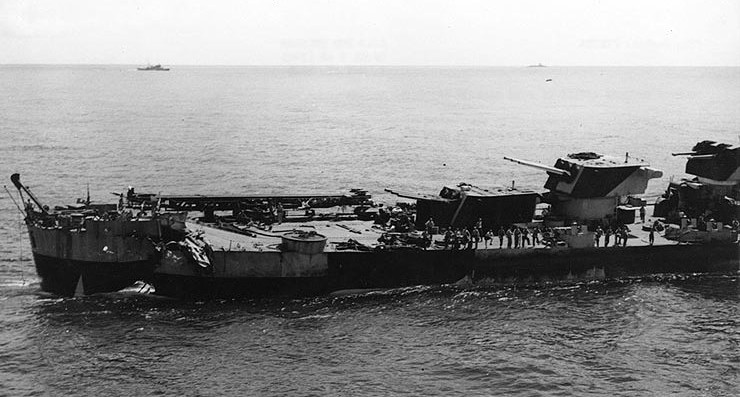
Damage to Houston's stern after the second torpedo hit
The crew quickly swung into action, building shoring around the forward bulkhead of the hangar to make sure that the flooding didn't spread, using up the last of their materials in the process and having to scavenge whatever wood they could find elsewhere on the ship, including 14 planks usually used to support men cleaning and painting the sides. But there were other problems to deal with. The hit aft had sent shocks ripping through the ship, exacerbating the structural damage caused by the first torpedo hit, although the stress amidships was reduced by the additional weight aft. More urgently, leakage from the hit had shorted out the main emergency generator, and with only the secondary generator, there wasn't enough power to provide the crew remaining onboard with anything like adequate sanitation or food. 300 of the 550 men aboard would need to be transferred to the escorting destroyers, but the seas were too rough for them to come alongside.
The solution was simple, if a bit odd. Each of the three destroyers receiving the transferred crew would come astern of the towed cruiser in turn, and 100 sailors would be ordered over the side, where the destroyer would fish them out of the water. Everyone who remained aboard would be a volunteer with useful skills for saving the ship, and there were more than enough candidates. Houston was low enough in the water that the transfer was a simple matter of putting on a life jacket and stepping into the ocean, then waiting for the destroyer to show up. One sailor used the process as an opportunity for a nap, only to be awakened by rifle fire from the destroyer. He initially thought they had mistaken him for a Japanese sailor, but after being brought aboard, learned that they had spotted sharks in the water near him. Despite this, the process went smoothly, and all 300 men had been transferred within an hour.
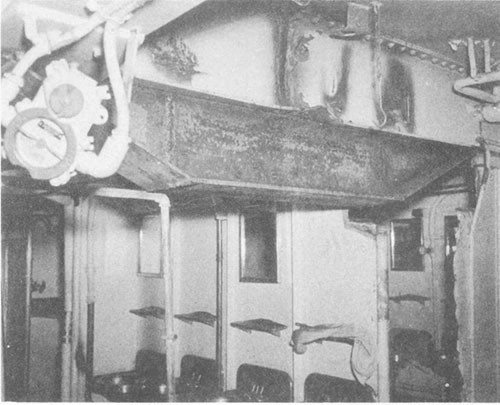
An improvised stiffener on a cracked longitudinal
The bulk of the remaining sailors were divided into three salvage crews, spread out throughout the ship to prevent a third hit from killing all of the experienced people still aboard. Their main task was to preserve the ship's stability, with reinforcing the ship's structure, wracked by the two torpedo hits and battered by the sloshing water, a close second. One by one, partially flooded compartments were entered and the leaks, often sprung rivets, were plugged, and then pumps were brought in to empty them out. Elsewhere, broken longitudinal beams were reinforced by welding plates together to make new girders. Thanks to "midnight requisitions" at Boston Navy Yard, Houston had significantly more than her normal outfit of the plates normally used to make such repairs, as well as a pair of high-capacity welders, but even the excess plates were quickly used up, and the salvage crews had to begin scavenging from the ship's non-essential structure for further reinforcements.
This allowed them to help solve another problem: stability. The sloshing water meant that Houston was still in danger of capsize, and the scavengers concentrated their efforts as high as possible to reduce topweight. 200 tons of 6" shells from the 2nd and 3rd shell decks were moved down to the lower handling rooms, an effort which produced many sore backs among officers and chiefs unused to manual labor. And every piece of spare equipment topside was heaved overboard, down to the searchlights and their platforms. Belowdecks, poor ventilation meant that there was constant risk of electrical fires, and emergency power systems were strung along the overheads to reduce the risk, while flammable materials were jettisoned and compartments soaked in fuel oil after the hit were scrubbed down.
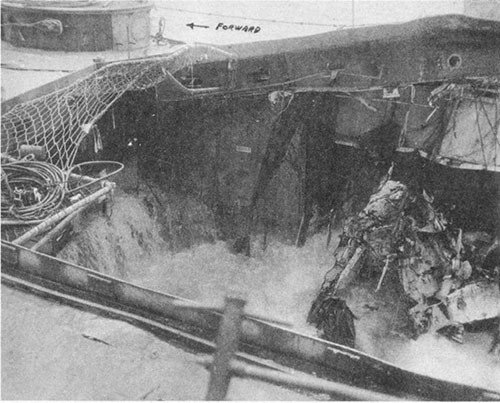
Water sloshes in the hangar
The lack of ventilation meant that sleeping in the normal quarters was impossible, so the remaining crew moved into temporary quarters in the superstructure. But life aboard wasn't all bad. The refrigerators were still working, as were the electric ranges, so steak was the order of the day, and the beer aboard for the occasional "steel beach" was served with dinner to anyone who didn't want the slightly oily water from the void tanks. Finally, on the morning of the 17th, the seas moderated enough for a boat from Pawnee to come alongside and pass over extra pumps and uncontaminated fuel. Soon, a steady stream of other material, be it shoring, welding equipment, breathing apparatus or the vital pumps, came aboard via high wire from the other ships of CripDiv 1.
Houston was finally drawing clear of the biggest threat. Despite the occasional electrical fire, and the presence of Japanese snoopers throughout the 17th and 18th, things were fairly calm. More importantly, while they were still well over a week away from Ulithi and safety, the Japanese had bigger problems to worry about. The Japanese had sighted the vanguard of the 7th Fleet, heading for the landings at Leyte, and realized that Halsey was also "RETIRING TOWARD THE ENEMY FOLLOWING THE SALVAGE OF ALL THE THIRD FLEET SHIPS RECENTLY REPORTED AS SUNK BY RADIO TOKYO." Two damaged cruisers were small fry compared to the need to finally fight the "Decisive Battle" that the Japanese Navy had planned for so long.
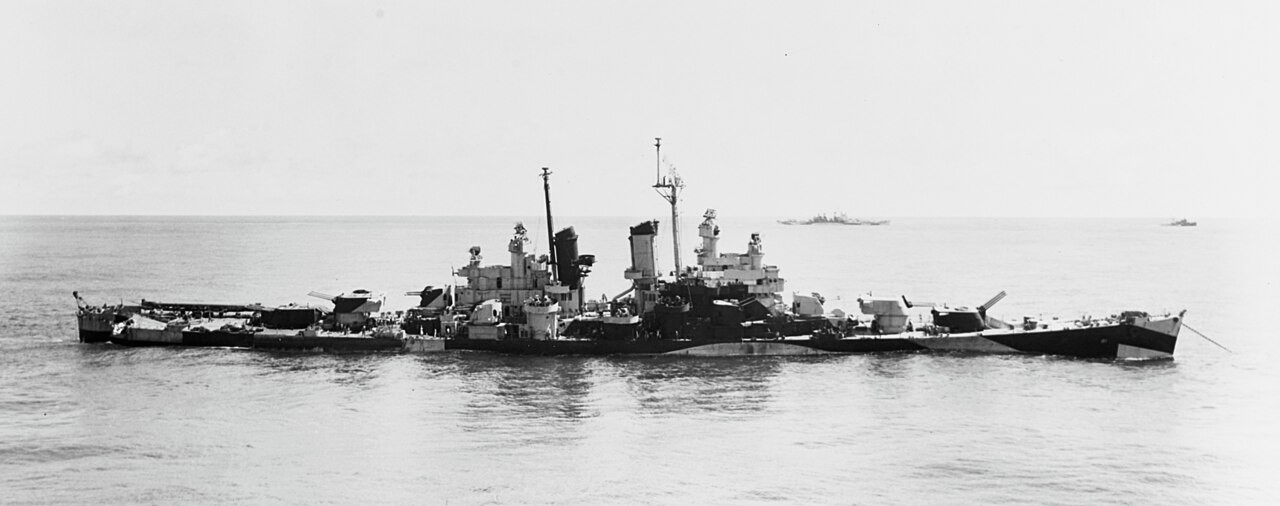
''Houston' under tow
But they weren't entirely out of the woods yet. On the evening of the 18th, CripDiv 1 turned south, lengthening the trip to Ulithi to dodge a typhoon coming out of the southwest Pacific. Despite the efforts of the salvage crews to reinforce the cracked longitudinals, the bow and stern were still visibly working independently, and her odds of surviving a serious storm were low. The detour lasted 30 hours, but kept the ship safe. And in better news, on the morning of the 20th, another pair of tugs arrived to supplement the hard-working Munsee and Pawnee. By taking the tow in tandem, the formation's speed could be increased to 6 kts, a welcome relief for everyone in CripDiv 1.
That same day, with the group well clear of any Japanese air threat, the carriers Cabot and Cowpens were detached. Now, the only real option the enemy had for striking them was submarines, and a group built around escort carrier Hoggatt Bay moved in to screen against them. Morale aboard Houston began to improve, even as the work of keeping the ship afloat continued. The pace of jettisoning had slowed slightly, and valuable bits of salvage were now being passed to accompanying destroyers. The cooks had gotten the ovens working and could make bread, although 20 gallons of ice cream from the destroyer Bell were still welcomed with open arms. The lack of fresh water meant that hygiene remained a problem, particularly for men who worked in oily water. Many found that cleaning clothes was too difficult, and simply scavenged new uniforms every day. Belowdecks, the crews had managed to free the rudder, but experimentation found that the ship towed the best with the rudder set to right 23°, suggesting it had been bent by the second hit.
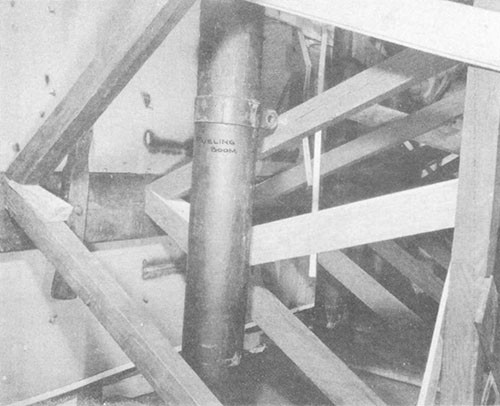
Shoring on the forward bulkhead for the hangar
On October 23rd, the gunnery officer attempted to help their progress along by rigging an improvised sail. To nobody's surprise, it did nothing to propel the ship, but the pressure did help her ride a bit better. That evening, one of the screening destroyers thought it made a submarine contact, and the men aboard the cruiser made her as watertight as possible and prayed they wouldn't have to deal with a third torpedo hit. Fortunately, it appeared to be a false alarm, but further contacts over the next few days, along with fires, the pervasive stench of dead bodies and the grinding work of keeping the ship afloat meant that the crew was on the edge of breakdown by the time they reached Ulithi on October 27th, 1944. But the salvage officer dispatched to look over the crippled cruisers was initially unsure if he could even keep her afloat inside the harbor. Getting her ready for a tow to the nearest drydock, 900 miles away in Manus, would be an enormous job, and we'll pick up the story there next time.
Recent Comments