When Iraq's 1980 invasion of Iran ended in a bloody stalemate, it was natural for both sides to turn to other ways of bringing pressure on their enemies. These ranged from firing missiles at the other guy's cities to attacking the oil exports that fueled their economies. Iraq had started to route its exports through Kuwait and Saudi Arabia, and as Iran expanded its attacks to include neutral shipping, the US grew increasingly concerned, both about the flow of oil from the Arabian Gulf,1 and potential Soviet influence in that vital region. As a result, the Administration agreed in March 1987 to reflag 11 Kuwaiti tankers as American vessels, allowing the USN to escort them through the Gulf.
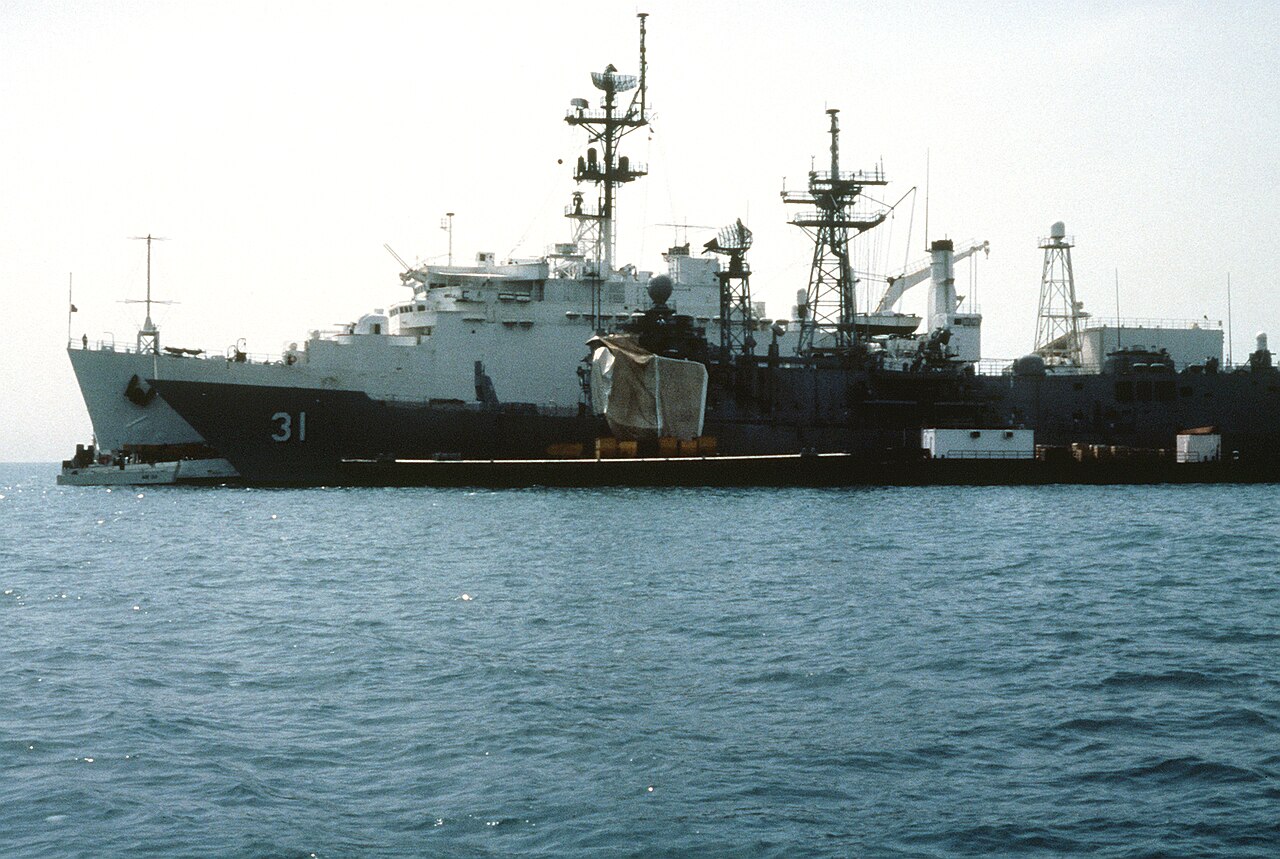
Stark next to flagship La Salle in Bahrain
Two months later, even before the escort operations began, the frigate Stark was accidentally attacked by the Iraqis in a tragic case of mistaken identity. Previously, the increasing US involvement in the Gulf had been a matter of little concern, but 37 dead sailors was enough to get the country's attention. Opponents of the administration charged that it was involving the US in an open-ended war against Iran without thinking through what would be needed to win or getting the approval of Congress. Many compared it to the Administration's bungled Lebanon strategy of a few years earlier. A particular concern was that the Iranians usually attacked tankers in retaliation for Iraqi strikes, so the vulnerability of American ships depended heavily on what Saddam did, and he wasn't even vaguely an ally. But he was smart enough to pause attacks on Iranian shipping as the escort operation began. The Iranians were obviously upset, but their actions rarely matched their rhetoric, so the reflagging went ahead and the first convoy was scheduled for late July 1987.
There was controversy over the management of the escort operation even before it started. Central Command (CENTCOM), which controlled forces inside the Gulf, had been set up only four years earlier, and many in the Navy believed that the convoy operation, named Earnest Will, should be run by Pacific Command (PACOM), which was vastly more experienced and controlled everything up to the Strait of Hormuz. Ultimately, though, the existing command structure would be respected, which meant that while the actual convoy would be under CENTCOM control, the bulk of the air support would be provided by the PACOM-owned carrier Constellation in the Arabian Sea. Unfortunately, this was the only air support available, as both Kuwait and Saudi Arabia refused to let the US use their bases, which meant that north of Bahrain, the convoy would be more or less on its own in the face of potential Iranian threats.2 The biggest concern was the Chinese-made Silkworm missile, primarily positioned to cover the strait of Hormuz. Elsewhere along the route, the main threat came from the armed speedboats known as "Boghammars".
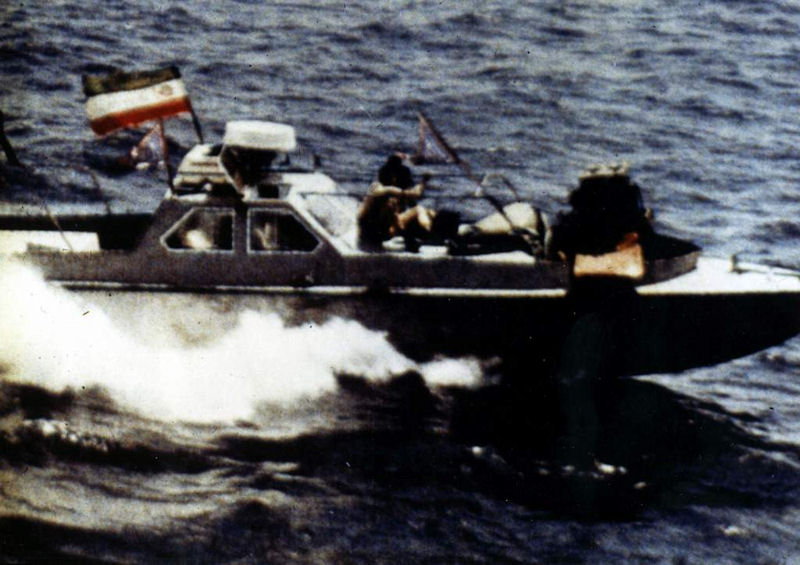
A Boghammar at sea
Unfortunately, the USN didn't have a great answer to either threat with the available forces. Aegis was not in wide service yet, and while shooting down a Silkworm wasn't impossible, it also wasn't something they could count on. The Boghammars were an even more serious problem, as American training and doctrine had emphasized open-ocean warfare against the Soviets, not fighting speedboats in the confined waters of the Gulf. One thing not well-addressed by this plan was mines, which both Iraq and Iran had laid in considerable quantities. The USN hadn't commissioned a new minesweeper since 1958,3 preferring to rely on NATO allies for the job, but that was obviously impossible here. They did provide some aid to the Saudis and Kuwaitis in clearing a minefield laid by the Iranians near the shipping channel, but mine protection for the convoy would come solely from sailors in the bows with binoculars and rifles, a tactic mostly effective against mines that had come loose and were drifting. The only real solution they had to this was deterrence, threatening severe retaliation against Iran for any attack on the convoys.
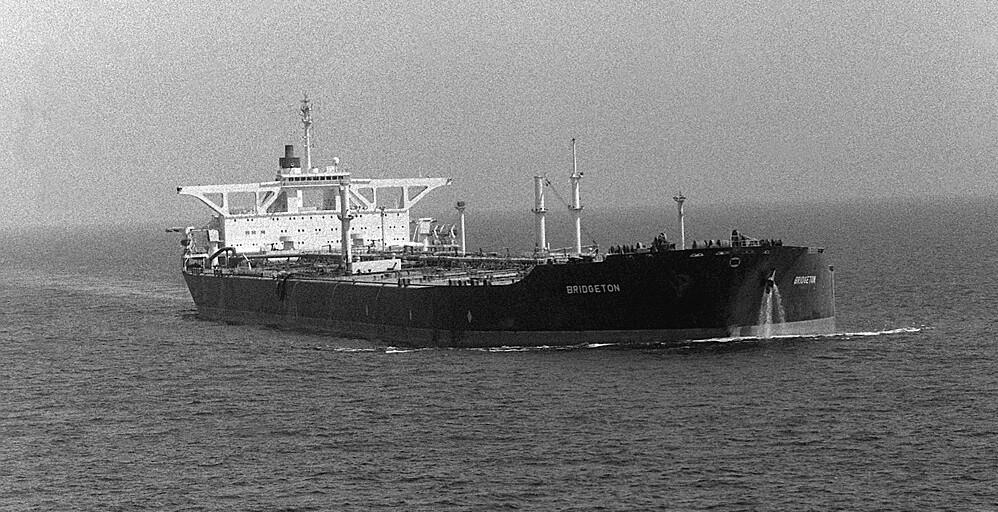
Bridgeton
The first convoy would include only two merchant ships, supertanker Bridgeton and LNG carrier Gas Prince, protected by cruiser Fox, destroyer Kidd4 and frigate Crommelin. Things didn't get off to a good start when House Armed Services Committee Chairman Les Aspin told reporters about the convoy's July 22nd departure date a week before it sailed, but that morning, Fox led the other ships into the Strait of Hormuz. Fighters from Constellation prowled overhead, and radars probed for Silkworms. In the heart of the missile envelope, the escorts moved in close, hoping that if a Silkworm leaked through, it would head for the larger and less vulnerable merchantman. Other merchant ships generally steered clear of the area, with traffic falling to a third of its normal level, but the only opposition was a trio of Iranian Phantoms, quickly scared off by the fire control radars of the escorts.
The next challenge was the Iranian Boghammar base on Abu Musa Island, just outside the western entrance to the Strait, and they passed it shortly after darkness fell. To make things more nerve-wracking, the area near the island was teeming with fishing boats and dhows, and it was impossible to tell on a radar screen if a small boat that refused to get out of the way was attempting to attack or just a sailor who was going on as his ancestors had for centuries. But no Iranians appeared, and the daytime passage past Bahrain went smoothly, even as the Iranians declared it was carrying "prohibited goods of some sort". The only remaining obstacle was a second Boghammar base on Farsi Island, smack in the middle of the Gulf about halfway between Qatar and Kuwait. The original schedule also had the convoy passing Farsi at 3 AM, at least until AWACS covering the area picked up Iranian speedboats operating in the area. Nobody was particularly interested in a night battle with the Boghammars, so the convoy was ordered to stop for a few hours and make the passage after daybreak.
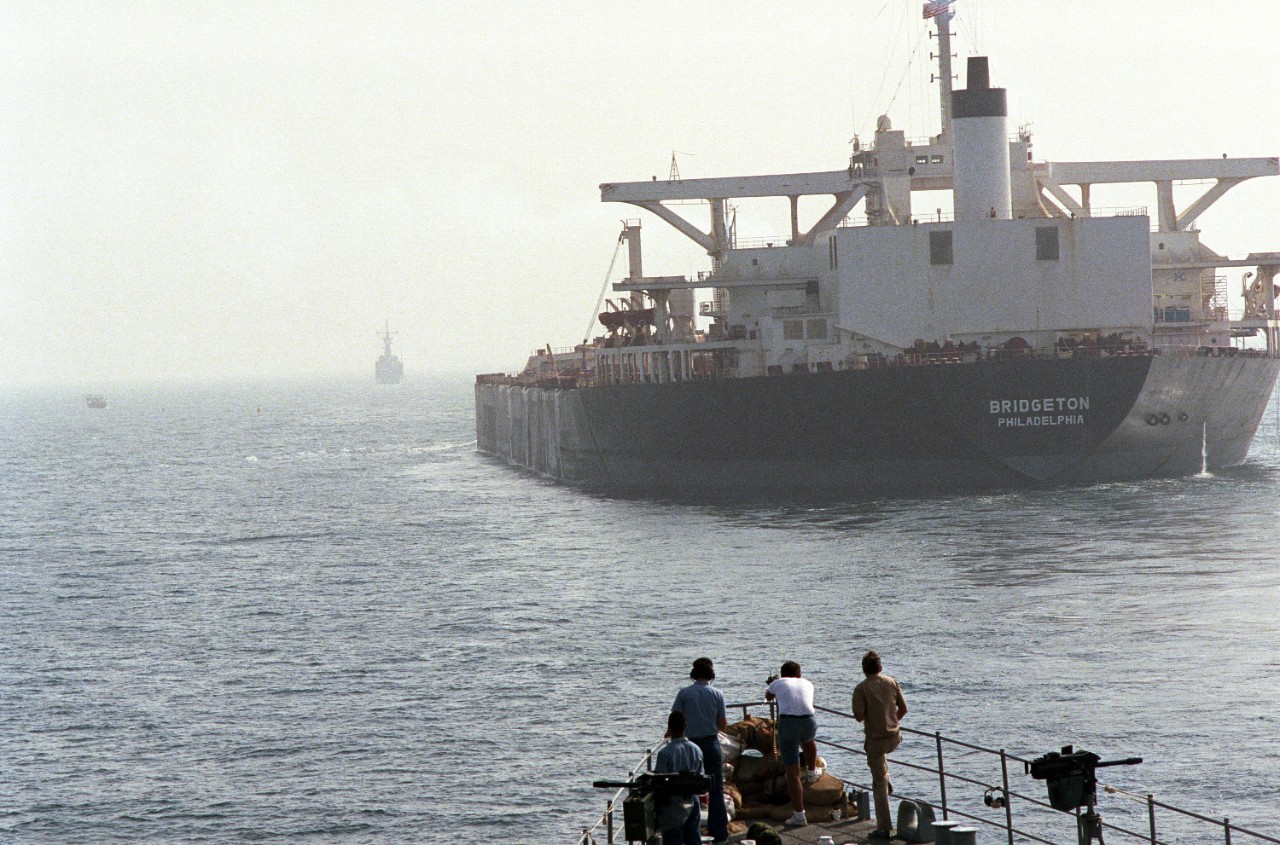
Bridgeton as seen from Kidd
The Iranians had gone home by the time the sun rose, and Fox led the convoy past Farsi Island, with Bridgeton a thousand yards behind her. A few minutes before 7, the temperature had just hit 100°F, and breakfast was being served aboard Bridgeton when an enormous shock struck the ship near the bow, sending objects flying on the bridge a thousand feet aft and knocking a sleeping crewman out of his bunk. Fortunately, nobody was seriously injured, but it soon became clear that the tanker had hit a mine, laid by the Iranians the previous night. Fortunately, being enormous meant that despite taking on 20,000 tons of water, more than the combined displacement of the escorts, Bridgeton was still basically intact and able to continue to Kuwait. Bridgeton's captain, a retired USN officer, suggested that the other vessels get in behind her, using his ship as a "deep-draft minesweeper". The suggestion was accepted with alacrity, although the convoy commander chose to press on, assuming that the Iranians had laid only a single line of mines across the shipping channel. Sentries were stationed in the bow with rifles, but no further mines were encountered5 and the convoy reached Kuwait without further incident.
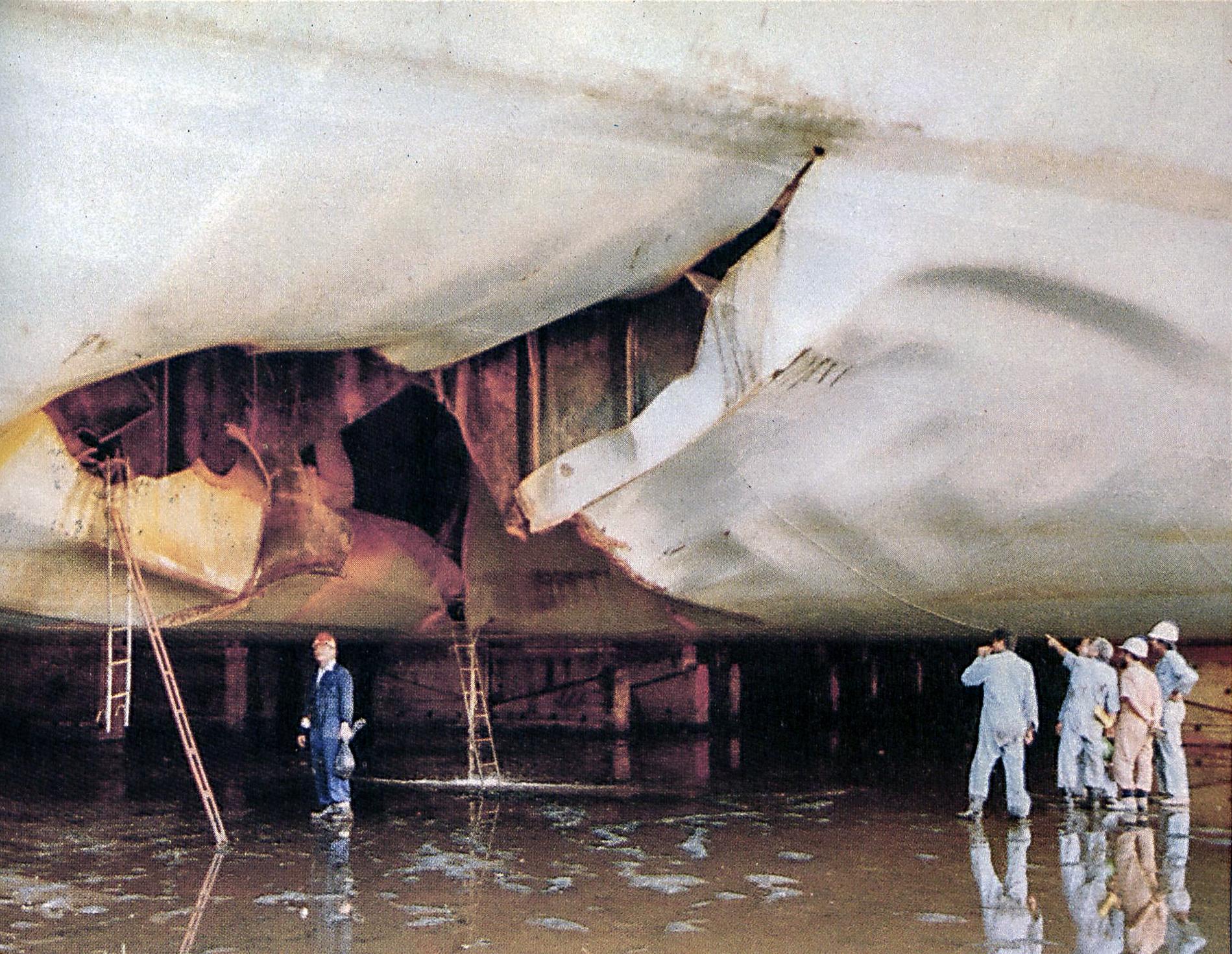
Mine damage to Bridgeton, from a Proceedings article by the ship's captain
But while the damage to Bridgeton was ultimately pretty minor, the damage to the USN's reputation was not. The first convoy had been the subject of considerable media attention, with a number of journalists aboard both Fox and Kidd, and they quite reasonably pointed out the USN's complete lack of preparation for what was in retrospect a pretty obvious threat. The Reagan Administration tried to downplay the whole thing, refusing to retaliate due to the lack of American casualties, while the Iranians blamed it on "the Hand of God" and avoided too obviously gloating about their victory. But it was apparent that if the convoy operation was to continue, the US would need not only better minesweeping capabilities, but also new tactics to deal with the Boghammars. We'll take a look at those next time.
1 Though it's worth noting that this is easy to overstate. While the start of the Iraq-Iran War triggered a major oil price spike, by 1986 that had turned into a glut, and prices were falling rapidly. ⇑
2 The Saudis did allow a long-term deployment of E-3s to provide AWACS support to US forces in the area, and while this was useful, an E-3 isn't capable of shooting down an Iranian fighter on its own. Kuwait was also wary of appearing too close to the US, and insisted that the warships stay outside its territorial waters. They did at least provide an oil tanker to make sure they were fully fueled for the trip home. ⇑
3 In fairness, the USN's main mine warfare force was helicopter-based, and using them was impossible because of the diplomatic issues that kept US fighters out of Kuwait and Saudi Arabia. As for ships, the Avenger class was under construction, and the first one commissioned in September 1987. ⇑
4 Amusingly, Kidd was originally ordered by the Shah of Iran, and taken over by the US after his government fell. ⇑
5 This was at least in large part down to luck. The Iranians had actually laid two lines of mines, and they simply passed through the second one. ⇑
Comments
Huh?
I guess this is part of the reason you keep beating the USN-needs-get-better-at-ASW-drum.
Yeah, this is one of several incidents that inform my view of "we probably don't have enough mine warfare stuff".
@ike: MIW, not ASW (the USN should get better at that, too, at least surface/aerial ASW)
https://en.wikipedia.org/wiki/UnitedStatessupportforIraqduringtheIran%E2%80%93IraqWar
Sadaam not an ally? Maybe someone ought to have told him that...? Yes, you could probably say he was "not a very cooperative ally."
Great article. I really like this series. I recently played the Bridgeton & Gas Prince escort scenario in Sea Power and thoroughly enjoyed it... even if the Fox took a couple of hits that sent her limping back to port. =(
Mine Information Warfare?