
There have been a few news stories lately about General Motors producing missile casings for the PAC-3, and delivering the parts within 22 days of the contract being signed. And, obviously, there has been commentary overinterpreting this as being a sign that players outside the traditional defense industry are better and that the glorious dawn of fast weapons manufacturing is just around the corner, if we embrace new, agile companies like... General Motors.
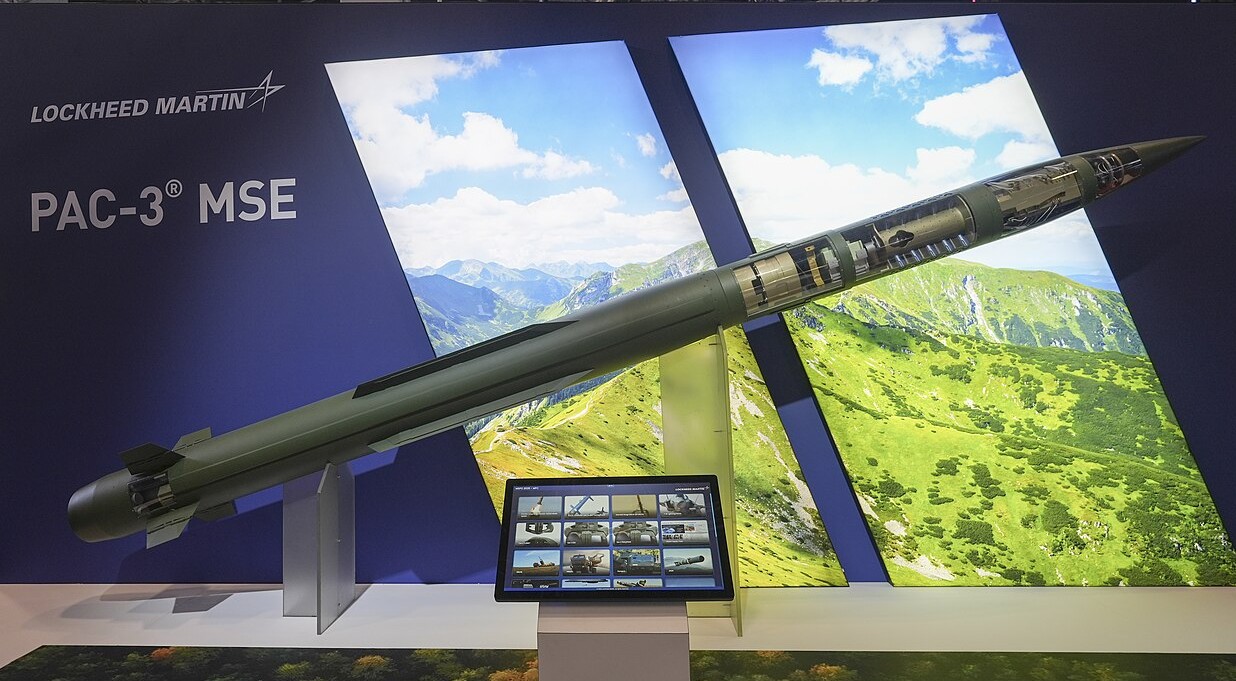
A PAC-3 missile with a defective casing
Obviously, I think all of this is nonsense. First, let's be clear what we're talking about. These are missile casings, basically mildly specialized pieces of metal. Shaping metal is not a particularly new technology, and I find it hard to believe that casings are the main limiting factor in expanding PAC-3 production. Seekers, warheads and motors are all much more specialized and much harder to expand. The most likely reason behind all of this is that there was some hiccup on the part of whoever normally makes the casings, and Lockheed turned to GM to bail them out. I spoke to an industrial engineer who has experience in missile production, and she said that 3 weeks would be a reasonable turnaround time for this kind of thing in the civilian world if the customer supplied the tooling. GM probably did some extra work to avoid the delays you frequently get on defense projects, but it's either a short-term stopgap or the whole thing was a publicity stunt, and Lockheed is now holding onto a bunch of casings that they won't use until mid-February.
But it's also worth noting that this isn't GM's only foray into defense production. They famously built a lot of stuff in WWII, everything from trucks to airplanes to weapons. After the war, they stayed in the industry. Besides building various vehicles, they owned Allison, a major jet engine manufacturer, as well as being heavily involved in military electronics, most notably inertial navigation systems, through its AC Spark Plugs/Delco division. In the mid-80s, they bought Hughes Aircraft, becoming a major player in the satellite and missile spaces. But as GM got into deeper and deeper financial trouble during the 90s and 00s, these were all sold off, with Allison going to Rolls-Royce, the satellite divisions to Boeing and most of the rest of the business to Raytheon. The last bit to be sold was the ground vehicle group, which became part of General Dynamics Land Systems shortly after it won the contract for the Stryker.
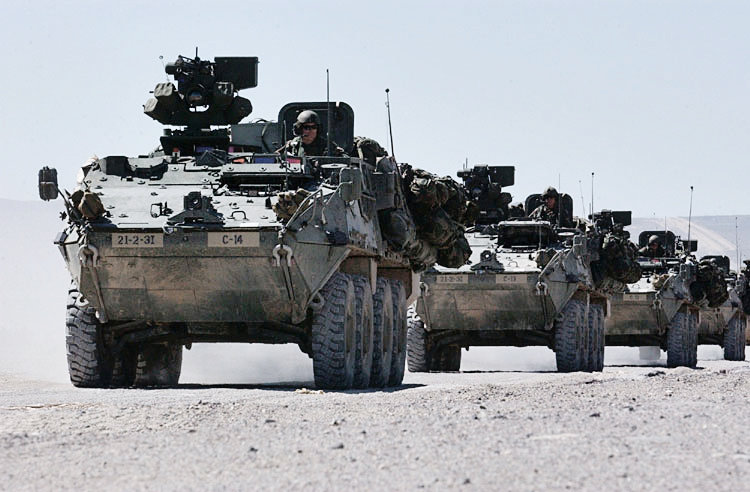
An early Stryker exercise
I bring this all up mostly as a way to remind people that the history of the defense industry is complicated, and that a lot of the reports of consolidation are overblown. Many of you have probably seen the chart from the "18 theses" advertisement for Palantir, which shows 51 primes falling to 5. At least three different groups mentioned in the previous paragraph are listed separately among the 51, and the people who made said chart played similar games elsewhere. Most notably, at least three different divisions of General Dynamics are shown as separate "primes", rolling up to Lockheed and Raytheon, even though GD is one of the 5 current primes. And Avondale Industries, Litton Industries and Newport News Shipbuilding are all shown rolling up into Northrop Grumman, even though the vast bulk of those businesses was spun off as Huntington Ingalls in 2011. Yes, I'm sure they can point to some bits of those companies that Northrop kept, but HII is the 7th largest defense contractor, behind the big 5 and L3Harris.
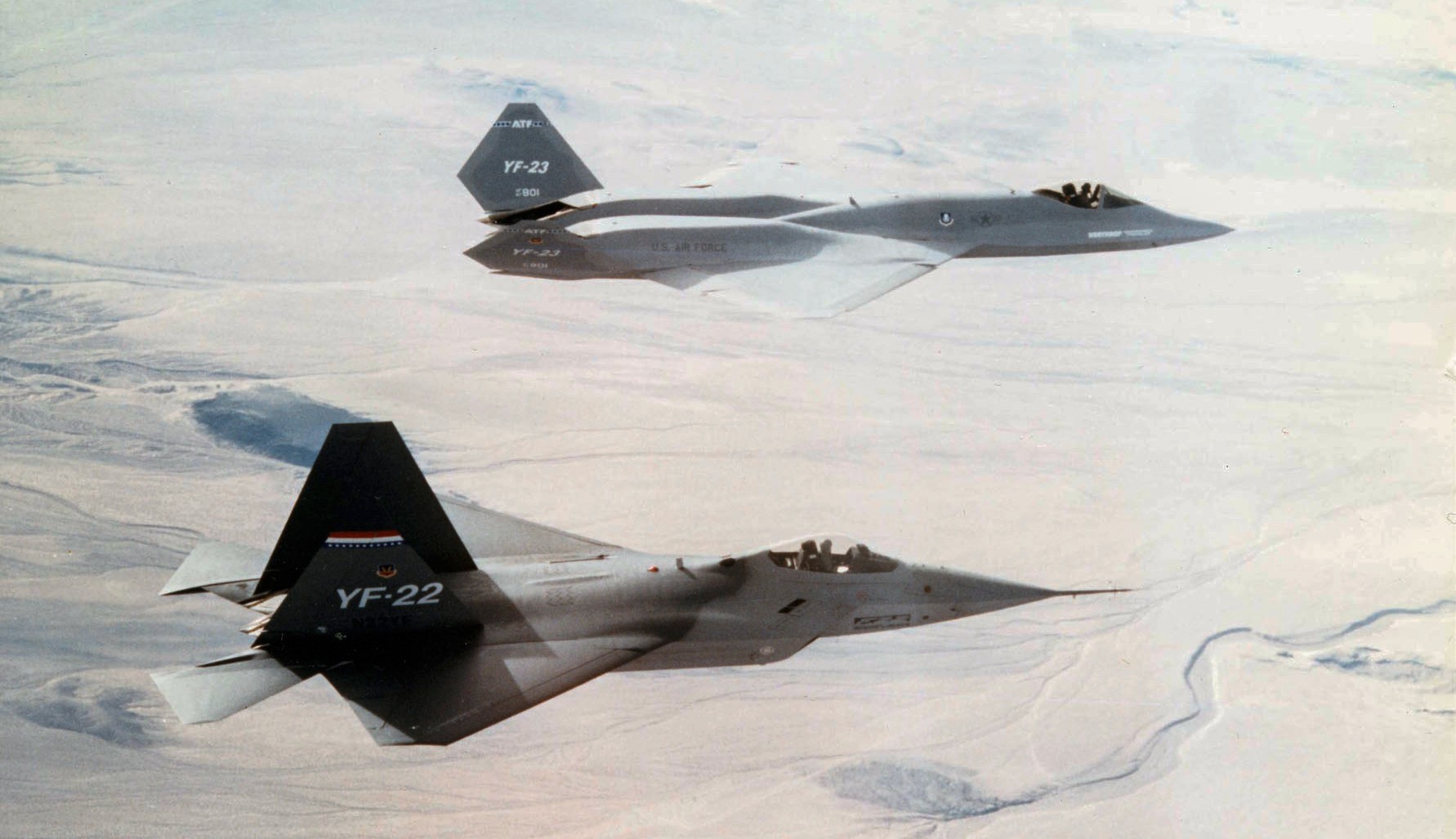
ATF prototypes
But even if we ignore the many flaws in the chart, the basic thesis behind it is deeply flawed. 1980 wasn't some golden age when "51 primes" rushed in to bid on every possible defense contract. The defense industry is big and specialized, and many of the "primes" in question only did one or two things. Boeing didn't build tanks, Chrysler didn't build airplanes and "Jappesen Sanderson" didn't exist.1 A lot of the movement on the chart is reflective of the stock market's growing distaste for general-purpose conglomerates, which has applied far outside the defense industry. This isn't to say that there hasn't been actual consolidation in terms of "how many companies could plausibly bid on this contract", because there absolutely has been, but it's closer to 50% than 90%. For instance, in 1986 the Advanced Tactical Fighter program that ultimately became the F-22 attracted bids from Boeing, General Dynamics, Grumman, Lockheed, Northrop, McDonnell Douglas, and North American Rockwell, whereas the only competitors for a similar program today would be Boeing, Northrop Grumman and Lockheed Martin. But this mirrors a general drop in budgets. Keeping design and production capability around is expensive, and if we wanted more people able to do it, we would need to pay for it somehow.
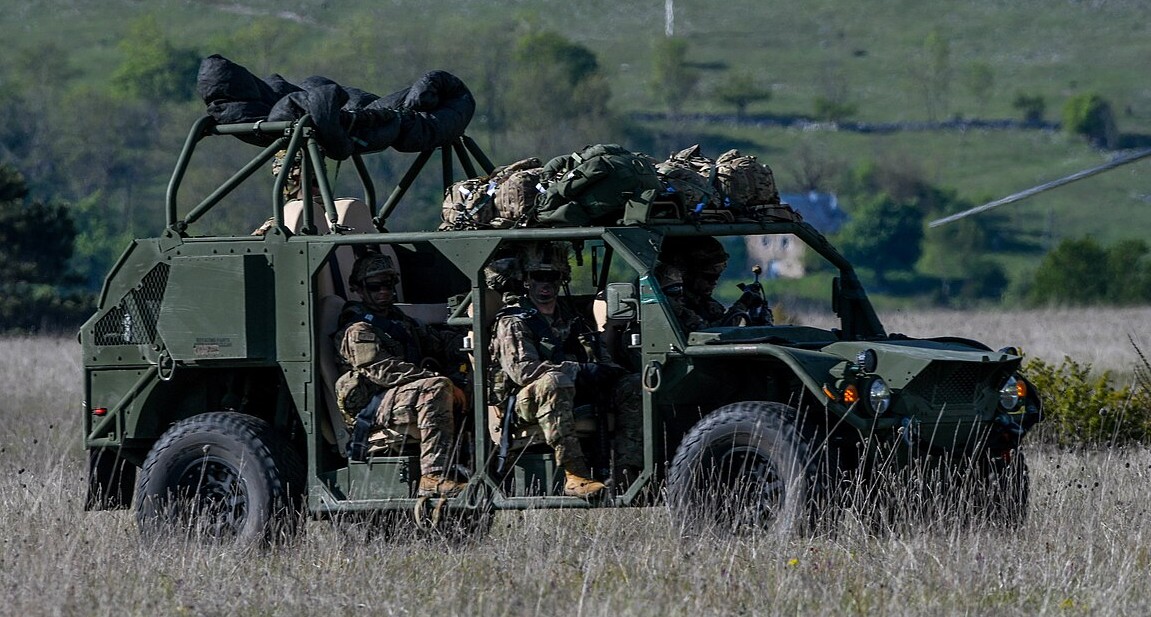
An M1297 Army Ground Mobility Vehicle
But another part of the "defense reform" thesis is that outside companies are somehow more efficient, because they're subject to market discipline rather than being able to grow fat and lazy servicing the undemanding DoD.2 But GM itself gives us one of the better tests of this. They returned to the defense business 10 years ago, focusing on military applications of their existing automotive technologies. And while they've done some development work, their main focus has been on competing in the Army's ongoing efforts to provide a light, airmobile vehicle for its normal "leg" infantry. The first competition was held in 2014, and while GM entered a vehicle based on their Chevrolet Colorado ZR2 off-road truck, they found themselves up against a field largely of more bespoke off-road vehicles, including the purpose-built General Dynamics Flyer 72, Polaris DAGOR and Boeing Phantom Badger. The Flyer won the initial round, becoming the M1297 Army Ground Mobility Vehicle, but a second round saw GM triumph with the M1301 Infantry Squad Vehicle.
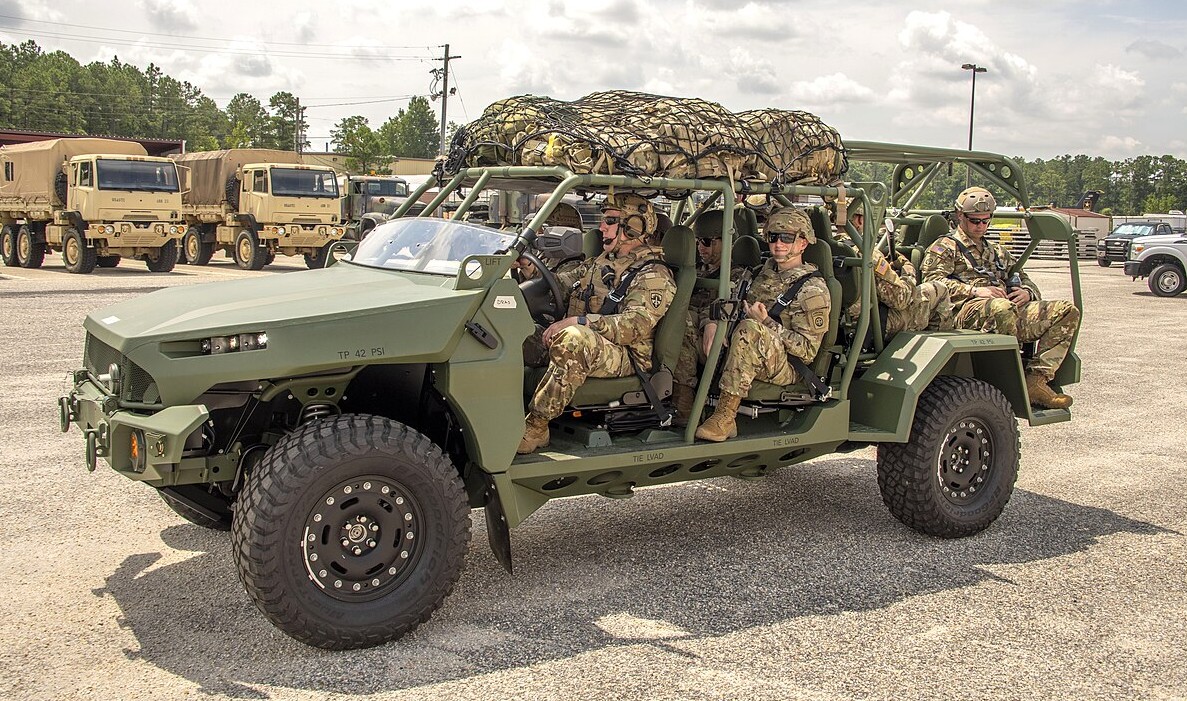
M1301 Infantry Squad Vehicle
I don't want to get into the debates about the soundness of the idea behind the M1301,3 and instead look at the finances, at least as far as that makes sense given the usual wackiness of military pricing. For a start, a civilian Colorado ZR2 looks to be running $50-55k, while the cost of one M1301 per the FY 2027 justification book is about $190k. I honestly don't find this all that surprising. GM may claim 90% off-the-shelf parts, but I think some of those aren't on the base ZR2, and the military is a terrible and annoying customer, so 3x the price isn't that weird.4 Perhaps a better comparison is how the cost of GM's approach compares to other vehicles. One place to look is at Army budget projections before and after the contract went to GM in 2020. The FY21 book, submitted Feb 2020, shows a predicted FY21 cost of $190k per ISV, while the FY22 book, submitted in May 2021, shows only $150k per vehicle in FY 21. So it does look like this produced some real savings relative to what the other options probably would have cost, although it's on the order of 20-25%, and we don't know what other tradeoffs the lower-cost vehicle may have required. But it's also worth noting that the same FY22 book shows the per-unit cost for the new-production M1152A1 HMMWV, a significantly larger vehicle without a civilian production line to draw from, at $144k per unit.
The lesson that should be drawn from all of this is that there is no silver bullet for the problems plaguing American defense procurement. Outsiders may have advantages over the incumbents, but these tend to be small and swamped by the mess built into the structure of the system. If all you look at is the headline figures, you'll be deeply confused about the problems, which in turn leads to ineffective solutions.
1 Jeppesen Sanderson, which did exist, made navigation and flight planning products. It's now part of Boeing, consolidated with the mythical division of Boeing that previously made navigation products. ⇑
2 People who claim this never seem to talk about Boeing, which alone among the major primes makes about 50% of its money in non-defense businesses. By all rights, it should be head and shoulders above everyone else, which I don't think is the general consensus. ⇑
3 The Pentagon's evaluators viewed it as "not survivable", which is probably true. On the other hand, it's also a lot faster than walking, and easier to airlift than other vehicles. ⇑
4 If you go fishing for per-unit numbers, you'll find ones that are a lot higher, because people are just dividing the annual topline by the total procurement number, which is going to roll in a lot of sustainment that isn't included in actual procurement. Because of how variable that work is, it's easy to get numbers that are all over the place. ⇑
Comments
I wonder if the Japanese war industry works any better or worse.
@Ike Japan works much faster see https://grokipedia.com/page/Aegissystemequippedvessels(ASEV)
What looks like a new design, first ship (of two) laid down in 2024 with an expected commission date in 2028.
The US seems to be still working out the details for DDX, with the first to be launched in 2032. Given the 'success' of the Zumwalt class, the littorals and the Constellation class frigate, I'm not optimistic about 2032.
I think another part that people outside the defense industry miss is that a lot of the consolidation is very superficial. Within a given supplier, you have lots of teams that still think and operate as semi-autonomous silos based on who they worked for in the late 80s, several rounds of M&A not withstanding.
Even at Boeing there is a big cultural difference between the legacy Seattle/Boeing and McDonnell/St Louis cultures.
I personally think the defense industry suffers from a few problems that are intertwined: 1. There is effectively only one customer (possibly two or three if you view the services separately, though they don’t have that much overlap in terms of equipment. 2. Defense acquisition does double duty as American industrial policy, often to its detriment. 3. There is a certain amount of “we are already on the cutting edge, so any new thing needs to be X% better at everything, rather than just X% better at one thing, or trying to get to the frontier.” 4. On the other hand, I think government contracting in general has become too focused on contracting proceduralism, rather than substantive outcomes.
The other part of it (less so for missiles, which are consumable, but definitely for platforms) is that R&D and even production get the most press, but are only a fraction of the budget for a given program - sustainment and manpower are where the dollars and outcomes are really driven. (Cf. the maintenance problems the Navy is facing)
@ike
I think it works differently. Their shipbuilding system is probably in somewhat better shape than ours, but I also know that they build their ships to rather different (lower) standards, and have been known to play games with what "completed" means to pad their schedules. (The US is, if anything, in the opposite place right now thanks to Congressional mandates.)
@redRover
That's as good a short list as I think I've ever seen.
ike:
The F-2 costing as much as an F-15 while being less capable would seem to argue for worse.
As a sitting, serving DOW AWF guy, I wholeheartedly endorse redRover's list.
I would delete “American”. Defense acquisition does double duty as industrial policy all over the world. I would, in fact, say that the US is better about that than many other world powers, notably the EU, the UK, and India to pick three particularly egregious examples.
This is partly understandable - no country wants to wager its national survival on the favor of any other, regardless of how closely the two may be allied at the current moment. But there is something vaguely ridiculous, for example, about France and Germany each insisting that it is impossible to build a fighter aircraft jointly (archive) because their requirements are so different and special.
@quanticle
Sort of - I think there is the general domestic capability part of it, which, as you say, is common across countries.
But there is another level below that, particularly once you move below the prime contractor level, where there are incentives and offsets for contractors located in HUB Zones, veteran or woman owned businesses, small business inclusion, etc.
On the one hand you get it - defense is the largest non-transfer spending the government does, so it makes sense to get some secondary benefits if possible (at least for Congress). But the other side of it is that you end up with non-core objectives driving outcomes on the margin.
@redRover: in fairness, we don't always have to do socio-economic set-asides; they don't apply at all under the Micro-Purchase threshold (where my work mostly lives) and even above it in Simplified Acquisitions, you can justify solicitations without them under specific circumstances. Probably does have some impact beyond the margins, but if we changed the ruleset to get rid of that, I'm not sure
To me, Point 4) is the biggest killer. The FAR currently runs about 2400 pages (and I have three echelons of instructions below that as well!) worth of instructions that I have to follow to write an award! Fortunately the Revolutionary FAR Overhaul will shrink this down to only 1600.
I also spend a lot of time working to edge out 95ile cases that are easy to solve but require lots of documentation to "prove" satisfactorily. Generally this seems to be a problem of most bureaucracies.
@blackshoe
The existence of DAU always seems like the best example of this - the DFARs are so complicated you need a college with 200 staff to train your acquisition function!
Like, defense contracting is more complicated on a lot of axes than buying paper for Staples (80 year lifecycles are not unreasonable for e.g., carriers, nuclear weapons and secret projects require a separate apparatus that you don’t really have in the private sector, lots of DMS, etc.), but it shouldn’t be as complicated as it is, particularly for non-core purchases of fuel or whatever that are closest to civilian economy purchases.
@quanticle
France has had its nuclear-capable carrier fighters for multiple design generations now. Of course they will want another, and will not settle for something that lacks these features.
Meanwhile, if I understand this correctly, Germany has had its land-only fighters designed jointly with the UK and Italy for some design generations now (the Panavia Tornado and the Eurofighter Typhoon). So obviously now that they want the next generation thereof, they teamed up with the UK and Italy (and Japan, who also want a land-only design), right? Er, no, for some reason they entered the French nuclear-capable carrier fighter program, then act surprised when it makes design tradeoffs to get these features the Germans don't care about.
Ceterum censeo, the EU should become a federation with one military. The EUN (European Union Navy) will probably fly Dassault Rafale N+1s off its CVNs (and those lighter CVs that already exist in the various members). The EUAF will need a mostly-domestic gen5.5 land fighter, too.
That was what I found the most mystifying about the collapse of the FCAS program. The objections that the Germans cited as the reason for their withdrawal were objections that any reasonable analyst could have made in 2017, when the program was begun. Like you said, it's not like the French sprung this requirement on them out of the blue, at the last minute, right before it was time to actually construct the aircraft. They had stated from the beginning that it was to be a nuclear-capable, carrier-launched fighter aircraft.
The more conspiratorial part of my mind thinks that the real reason was that Airbus wasn't well prepared to make combat aircraft, and, rather than admit that and accept that it was right and proper for Dassault to take on the majority of the work, the German government chose to cancel the program altogether rather than accept its national champion being a junior partner in a major international program.
That would be particularly perverse, since Airbus is as French as it is German. And of course, "industrial policy" being applied to everything used to be called "pork barrel", back when it was seen as unethical, rather than the main job of politicians.
Another opportunity would have been to -- just as Airbus wasn't a single project to create the A300, but a permanent program to create a multitude of aircraft -- to set up the Panavia or Eurofighter cooperations as not one-and-done projects, but as permanent features. Then, after the Tornado and the Typhoon, maybe the Tailwind and the Thermal would have been almost straightforward to develop?
Incidentally, regarding sustainment vs. procurement, my impression is than an outright majority of households badly underestimate the total cost of ownership of their cars.
Another thought is that even if it were true that military procurements were 3-4x overpriced, my answer would be:
"Er, no, for some reason they entered the French nuclear-capable carrier fighter program, then act surprised when it makes design tradeoffs to get these features the Germans don’t care about."
Like, er, the Panavia Tornado?
@Basil
The problem is that these are companies operating in extremely different markets with very different political drivers. First, airliners are a lot more generic than fighters. You basically decide how big one is, and then things go from there. With joint military aircraft production, you need everyone to want the same kind of plane (more or less, and yes I know about the Tornado ADF) at the same time. That's easier to negotiate on a case-by-case basis, or you risk ending up with a multinational company that suddenly has one nation wanting something very different from the other two. Then there's the issue of funding. With Airbus, it's supposed to make money selling planes to airlines, so the governments in question work out who is investing what, set things up, and let it run. But something like Panavia or Eurofighter is basically a means of spending government money, and each government wants as many jobs as possible out of it. If Italy does tails for our continuing Eurofighter conglomerate, but the Italian government decides they don't want to buy the next plane (and see above for why that's pretty likely) then there's a serious problem. Easier to just negotiate fresh each time.
And what if Pennsylvania suddenly has very different foreign policy interests from New York?
Or to ask about Europe: why don't Baden-Württemberg and Bavaria have separate militaries?
I happen to live in Hungary. By population, it is smaller than three German Länder. Its almost sole security interest, shared with all other ex-Warsaw Pact countries (and the Baltics, and...) is to prevent Russia from dominating us as they did before 1990. (Any other interests are also shared, if anything even more widely, e.g. participation in coalition interventions in the Middle East.) So why does Hungary have its own military, and its own foreign policy? This is the source of only problems (from normal friction, through some politicians playing holdout only for the sake of being bought off, to the scenario where Hungary's previous government started consistently pursuing the opposite of Hungary's interests and willingly became Russia's actor inside the EU) and no benefit. The proper level at which to conduct foreign policy is the EU. Correspondingly, the military should be EU-level. That would, almost incidentally, also solve several other headaches.
Basil Marte:
That they speak the same language helps with having a common military and the EU isn't willing to be very coercive on that topic.
Their Congressional delegations can debate it all they want. The US still (in theory) has a single policy.
I agree that if there was a single EU-level military, it would also make some degree of sense to perform procurement at that level. But that's not the case (yet?), and thus any intra-European procurement will of necessity be temporary for political reasons.