
Hornet wasn't the only museum I visited during my recent trip to San Francisco. There were three others, all on the San Francisco side of the Bay, and all confused about what sort of museum they were. Despite that, two are reasonably strong recommendations, while the third was fine, though I wouldn't recommend going out of the way for it.

The best of the three was the Hiller Aviation Museum in San Carlos, about 30 miles south of San Francisco. It's firmly at the upper end of the medium air museum category, although it's not entirely sure if it wants to be an air museum with a major focus on children, or a children's museum with airplanes. Fortunately, it looks like they're the former for now, in addition to having probably the world's best collection of insanely dangerous rotorcraft.
Stanley Hiller was an American engineer and a pioneer of the helicopter, who managed to get a draft deferment by showing the Army his design for the nation's first coaxial-rotor helicopter. He spent the next two decades building helicopters of various kinds, routinely pushing the boundaries of sanity in rotorcraft design, before selling his company and going on to work as a corporate turnaround specialist. The museum that bears his name is one of the better medium-sized air museums I've ever been to. I went in expecting a large collection of weird and dangerous rotorcraft (to the point that this is how I mentally have the museum tagged) and I wasn't disappointed. There was basically every possible variety of "how could they possibly think that was a good idea?" with helicopters, from "guy standing over a ducted fan" to "two ducted fans on the back" to "let's power the helicopter with ramjets on the rotor tips, then fly around firing rockets at ground targets".

But it's not just helicopters where the museum's collection is full of oddities and one-offs. There's a good section on early flight with a focus on work done in California, which was a place of daredevils and nutjobs. Some were successful, like Eugene Ely, who they have a number of artifacts from, and others were less so, like the madman who tried to build a weird quasi-helicopter paddle-wheel thing in 1908. Fortunately for him, it didn't get off the ground, and thus didn't kill him, and he apparently learned enough from the experience to stop building things like that. The rest of their fixed-wing collection is eclectic to say the least. They've got everything from tiny homebuilts to a giant UAV to a NASA experimental plane that pivoted a single wing in flight. They did have a Mustang, but it was an air racer and suspended instead of being the focus of veneration, so points for that.
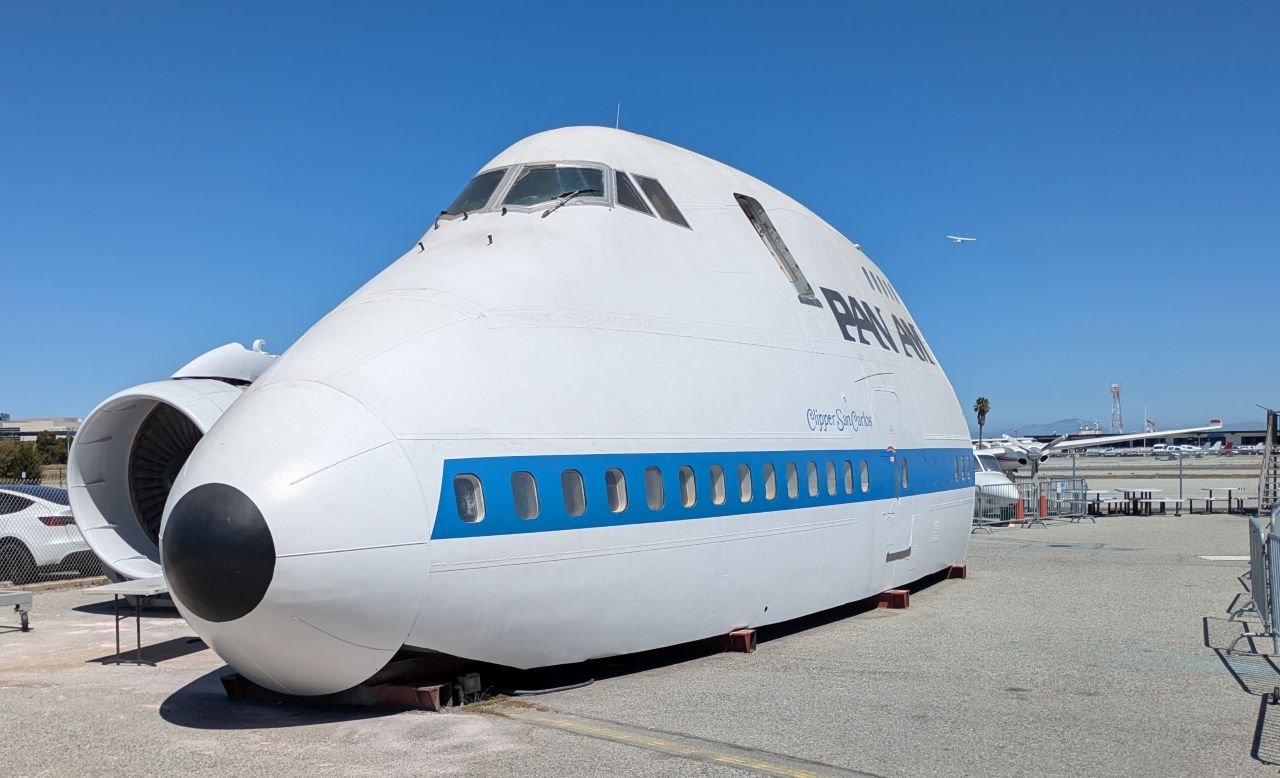
Beyond that, as I mentioned at the start, they've done more to integrate kid-friendly activities than any air museum I can remember. Most have a few things off to one side, but Hiller has their stuff spread throughout, including a tower to drop parachutes off of, a paper airplane launcher thing, and a lot of simulators, several of which were free. It almost felt like it might have taken over the museum, but they stayed just on the "still an air museum" side. There's also a 747 fuselage outside with the cockpit opened up, and a restoration hangar you can see into. Signage is uniformly good, and the atmosphere is great, with lots of close-packed planes. On the whole, I think it's probably my favorite air museum ever that has no supersonic aircraft, although it's not really worth traveling for in and of itself. If you're in the Bay Area and want to see something military/aviation adjacent, I think Hornet is probably the better choice, but Hiller is a pretty strong candidate, too.
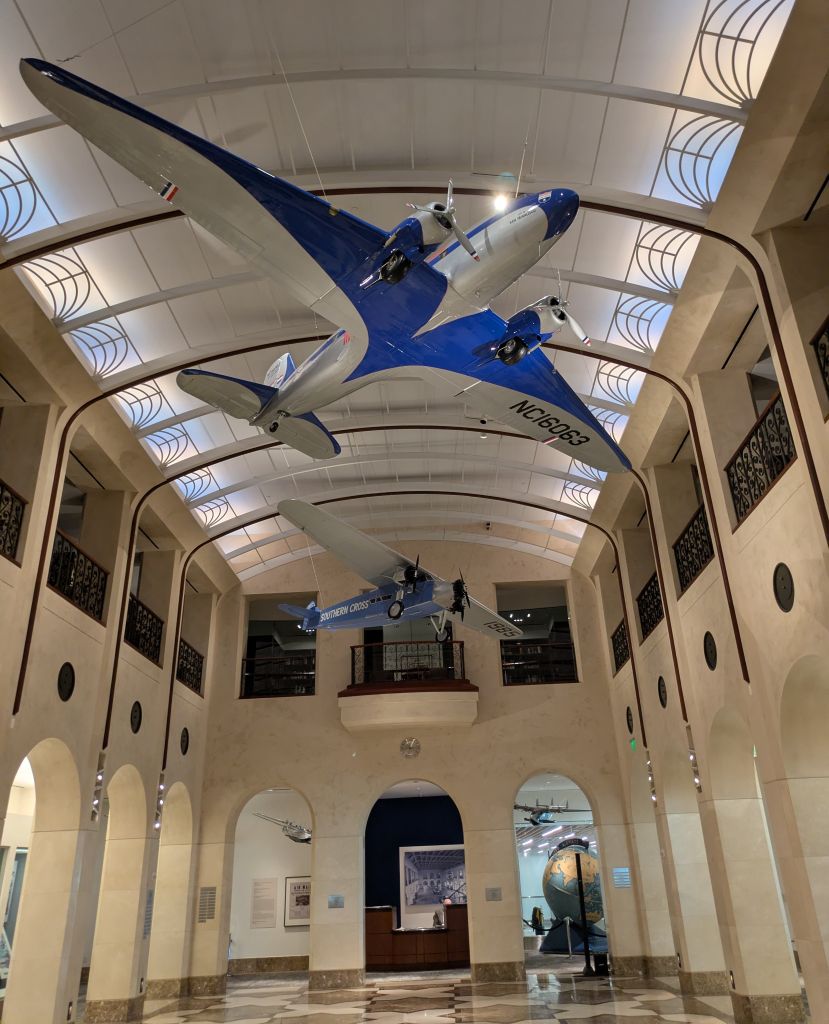
A dozen miles north of Hiller is San Francisco International Airport, which is home to the SFO Museum, apparently the first museum subsidiary of a major airport. And it's probably unfair to characterize this as confused about its identity. It's not. It's an art museum unconvincingly wearing the mask of an air museum. There's a bunch of different stuff scattered throughout the terminal, including a couple of galleries airside in Terminal 1, but it's all just art. There is a small aviation section just outside security in the international terminal that is trying to be about aviation, but they rather gave the game away when an engine on display had its materials listed like it was a sculpture or something. They did have a cool Pan Am globe, and the space itself is gorgeous, but the displays are on things like historic travel brochures about San Francisco and photos of the city instead of "here's how the airport runs", like it should be. There's also a very nice aviation reference library on the upper level, but it's all in locked cases and requires a reservation because whoever runs the place is clearly a sadist taking out their frustrations on aviation enthusiasts. If you don't have an appointment, it's still not a bad place to spend an extra 15 minutes (plus however long it takes to get to/from your terminal) at SFO, but I wouldn't go out of my way to visit if I wasn't flying through the airport.
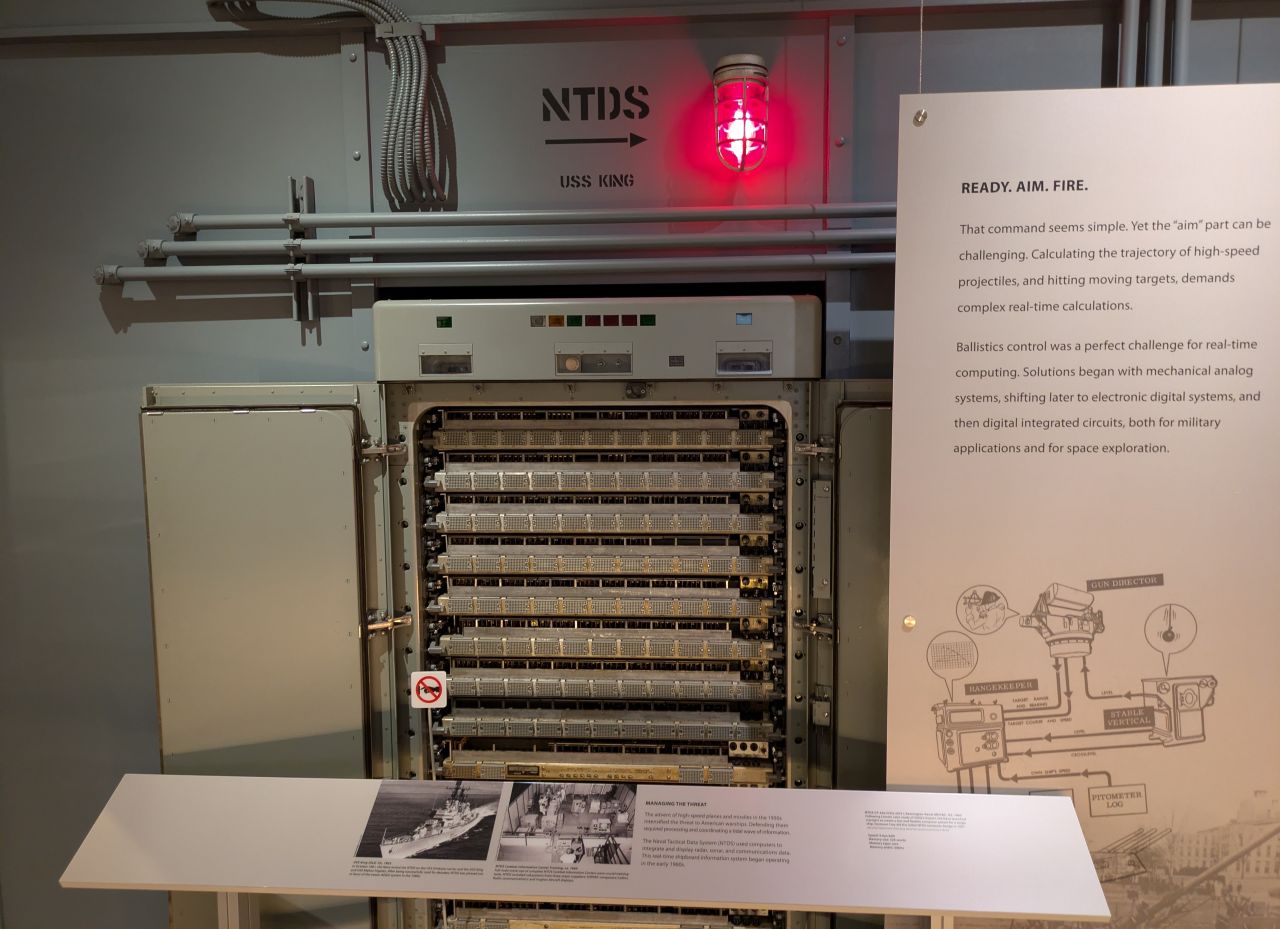
The last museum is further south in Mountain View, and while the Computer History Museum may not be squarely in scope, they do have an NTDS rack and a bunch of stuff from SAGE, so I can shoehorn it in. On the whole, I enjoyed it, particularly the look through the early history of computing, which they take back to the abacus and the slide rule. But while the stuff through the introduction of the PC feels fairly coherent, after that, the museum becomes extremely unsure what story it's telling. Museums are good at presenting hardware, but as software comes to dominate and computers become more widespread, it starts to ramble. There are other issues, too. The signage on the NTDS rack is woefully lacking, and it's right next to a sign about fire control that isn't much better. Oh, and they don't actually have any of the good fire-control computers. Seriously, I'm sure they could scrounge up a Mk 37 system from somewhere and open up the case. The main gallery also looks to have been last updated in about 2010, and while this doesn't really matter to the first half of the museum, it's rather weird that the name "Facebook" isn't mentioned anywhere in the main museum. Also, the layout is one of the most baffling I've ever seen. There are all sorts of blind alleys, and it often felt like the big "route this way" signs on the floor were telling me to skip things. All that said, it's not a bad museum, and if you're interested in the olden days of computing and happen to be in the area, I would recommend it.
Recent Comments