
I've been busy the last few weeks, and the blog post I had planned didn't quite come together in time, so please have this extract from the tour I did at the National Museum of the US Air Force in Dayton back in May. (I'm also still working on editing the audio recording of the tour. As I said, I've been busy.)
At the dawn of the 20th century, it looked like man was finally on the verge of fulfilling his dream of flying like the birds. The first people to disconnect themselves from Earth's surface by a means other than falling off something were Jean-François Pilâtre de Rozier and the Marquis d’Arlandes, who rode the Montgolfier brothers' hot air balloon in 1783, but most people soon realized that this mechanism wasn't very good, and many of the greatest scientists and engineers of the age turned their attention to the problem of flight using lift instead of buoyancy. Among those interested in the problem were a pair of brothers, proprietors of a bicycle shop about six miles from where you are standing right now.
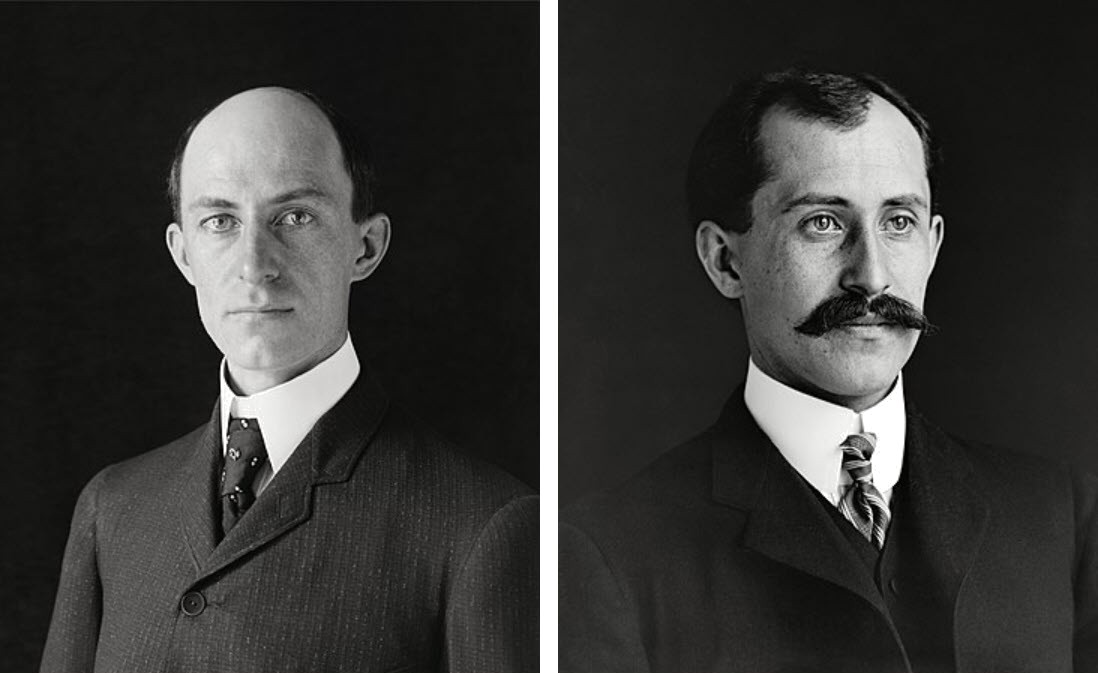
Wilbur and Orville Wright
Orville and Wilbur Wright first became interested in the problem of powered flight in 1899, reading everything available on the subject and then beginning their own experiments with gliders. Ultimately, they made two major innovations. First, unlike most other prospective airplane designers, they realized that the biggest problem would be controlling the airplane in the air, and developed a method of warping the wings to control roll. Ailerons eventually turned out to be a better option, but it was a significant breakthrough at the time. Second, after a series of experiments with full-scale gliders in 1901 in a windy town on the coast of North Carolina known as Kitty Hawk,1 they realized that the aerodynamic data they had been using wasn’t very good, and set about gathering their own, first conducting experiments using a bicycle to generate airflow and then building their own wind tunnel to study possible airfoil shapes.
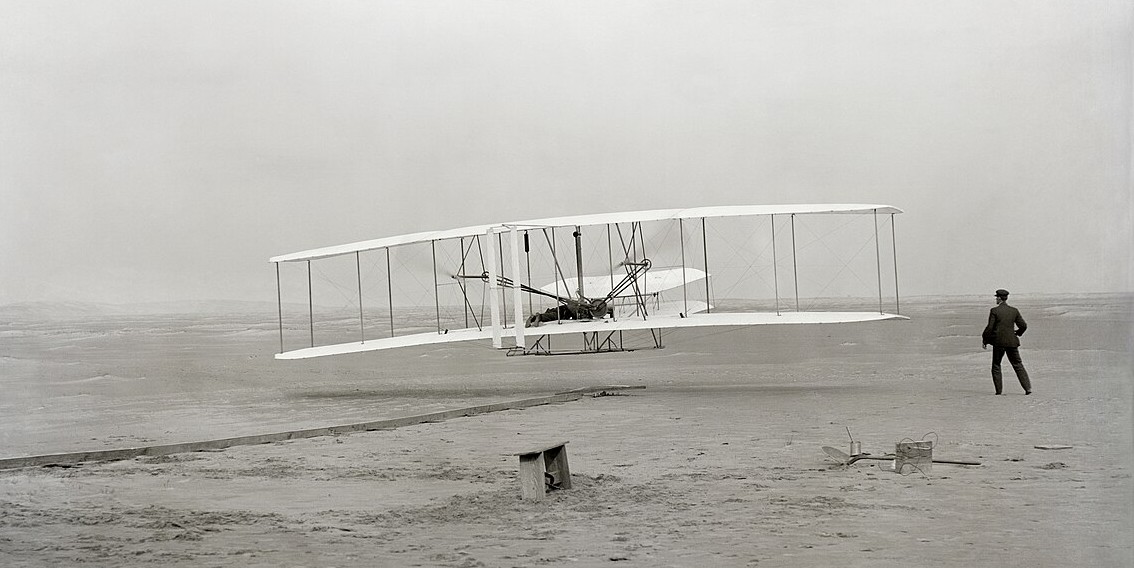
Orville makes man's first powered flight
Armed with this data, their 1902 glider was a success, and after adding an engine and designing a propeller, they returned to Kitty Hawk in 1903 with their Wright Flyer. On December 14th, Wilbur won the coin toss for the first true powered flight, but promptly crashed. Three days later, after the damage was repaired, Orville took the plane down the track they had laid in the sands and into history. The brothers made three more flights that day, the last one, piloted by Wilbur, lasting almost a minute and traveling 852 feet. They did announce the flight, but after the very public crash of Samuel Langley's attempt at a flying machine a few days before, public interest had cooled. The Wrights decided to keep their invention largely secret for fear of it being stolen, and spent the next two years refining their design, mostly working out of Huffman Prairie, a field about three miles northeast of here. Their efforts culminated in a 40-minute, 24-mile flight in October 1905.
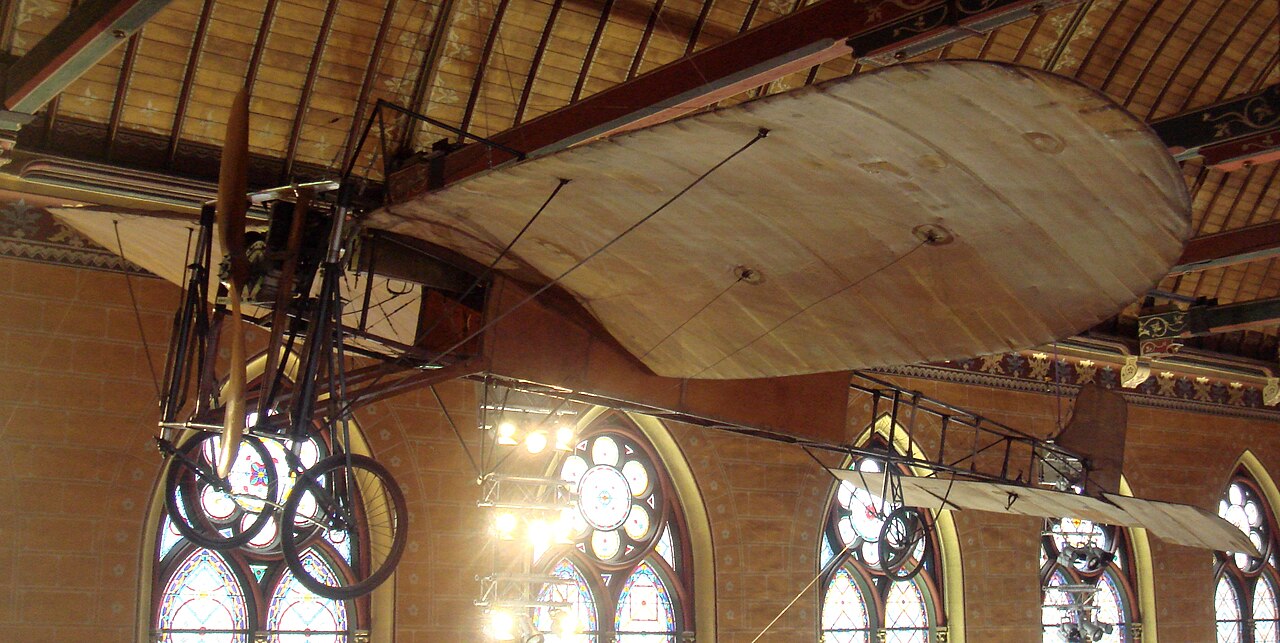
The plane Bleriot crossed the Channel in
The next year saw Alberto Santos-Dumont make the first public flight near Paris, although his machine was primitive compared to what the Wrights had, and the center of aviation activity quickly moved to France. In 1909, Louis Bleriot flew a machine of his own design across the English Channel, the first significant demonstration that the airplane might be more than just a curiosity. That same year, the US Army Signal Corps procured the world's first military aircraft, the 1909 Wright Military Flyer. This is not that plane. That plane belongs to the Smithsonian, and this is a replica, as are all of the planes in this particular section. The Army didn't buy any more for two years, before picking up several more planes, mostly from the Wrights' great rival, Glenn Curtiss. But the airplane remained a military curiosity in the years leading up to 1914, even as aviators continued to push the boundaries of flight. Although their machines were primitive and dangerous by today's standards, the foundation they built would prove vital when war broke out.
1 Technically, most of the work was done at Kill Devil Hills, a few miles from Kitty Hawk, but Kitty Hawk was the nearest settlement, and its name became attached to this story. ⇑
Comments
Delightfully True Story: When the Wrights came back from Kitty Hawk they started flying at Huffman Prairie, a large meadow now on WPAFB property.
They were actually able to take a trolley there from their home, where they built the first hangar, and then proceeded to push the envelope. And the best part is that at the time, one could stand on top of the Dayton Daily News building and see the Prairie with binoculars as the Wrights flew a little farther and a little faster every day.
And the Dayton Daily News was routinely printing stories that man would never fly.
Mike