The battleship Jean Bart was under construction when the German offensive smashed the French army in 1940. She was being built in Saint-Nazaire, on the country's Atlantic Coast, and after defeating the armies in Belgium, the Germans took some time to prepare for further offensives, giving the French a chance to get her to sea and safely out of German hands. This would only become possible around June 20th, when the tides were right, a channel to her building dock had been dredged, and last-minute efforts would make her about ready for sea.
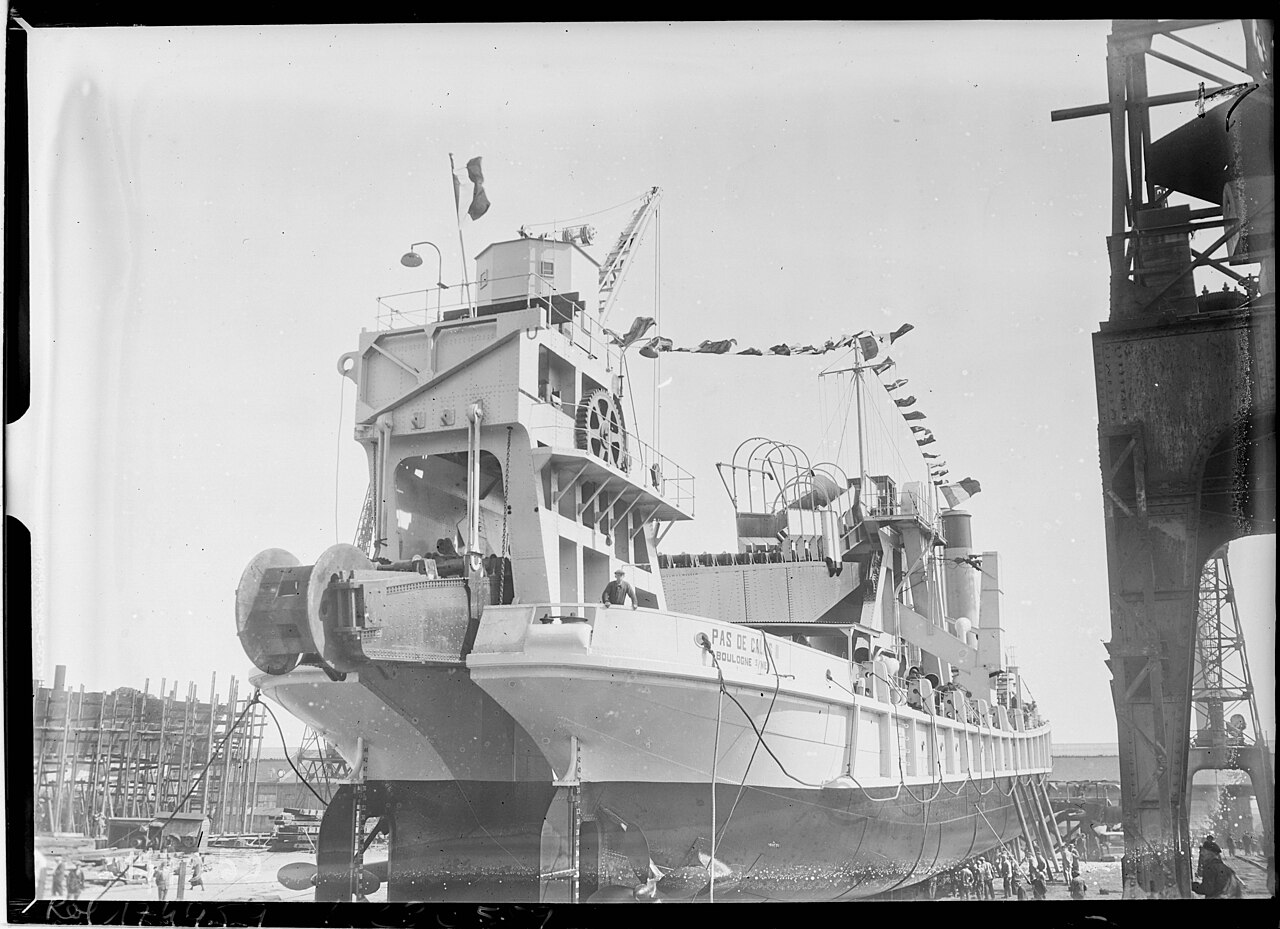
French dredge Pas de Calais II being launched in 1933
As the departure day approached, it looked like things were coming together. The channel was on schedule for completion, and Jean Bart would be met by HMS Vanquisher, who would escort her to safety on the Clyde. But the political situation was in flux, and on the 17th, her destination was changed to North Africa. The British were not informed. But bigger changes came the next day, when word reached Saint-Nazaire that the Germans were approaching, and the ship needed to leave as quickly as possible. The need to fill the dock meant they'd miss the next tide, so the first opportunity would come at 0300 on the 19th, and a bit of unfinished work in the channel meant that at one point it had lost 5m of its 50m width, making a narrow squeeze for Jean Bart's 33m beam. But the bigger challenge was that it would have to be navigated in the dark. Two teams spent the afternoon of the 18th frantically working, one to make the final preparations for sailing, the other planting scuttling charges in case she was unable to do so.
Problems continued to occur aboard in the last minutes before leaving. While an auxiliary boiler could provide steam for the turbogenerators, the circuit breakers had not been properly calibrated, and each time they tripped, the feed pumps for the boiler stopped, plunging the ship into darkness until an emergency diesel generator could be started. Restoring normal operations took an hour or so, and the decision was made to jam the circuit breakers closed to make sure it didn't happen again. And once the ship was afloat, it was realized that a slight list meant the draft to port was 20 cm greater than to starboard, cutting the margin on sailing from 40 cm to 25. Some quick rebalancing of fluids, with the results read by an engineer with a flashlight because the dock's power had already been sabotaged, raised the margin to 33 cm, but it was still going to be extremely tight.
Finally, at 0320, Jean Bart started to move. High water was only 40 minutes away, and an hour after that, she would either be in the main channel or stranded. Things had already begun to go wrong. Two tugs would control the battleship's bow, while a third would pass beside her in the drydock with only centimeters to spare to secure her stern. Unfortunately, that tug had grounded on the way in, and delayed things five precious minutes. Worse, as the tugs at the bow began to pull Jean Bart out, the hawser at the stern parted, and she cleared the dock at close to 3 kts. To make matters worse, the dock itself didn't align with the channel. A fan-shaped area had been dredged to allow the ship to be turned about 30° to align with it, but with the failure of the stern hawser, Jean Bart ran aground on the bank. But the tide was still rising, and the stern tug soon pulled her off, and the other tugs turned her to the appropriate heading. This was a tricky procedure in the dark, and the captain mistook debris for one of the channel markers, causing the bow to ground on the port side of the channel, followed moments later by the stern grounding to starboard. By this point it was 0345, and within 15 minutes, operations were complicated by a falling tide.
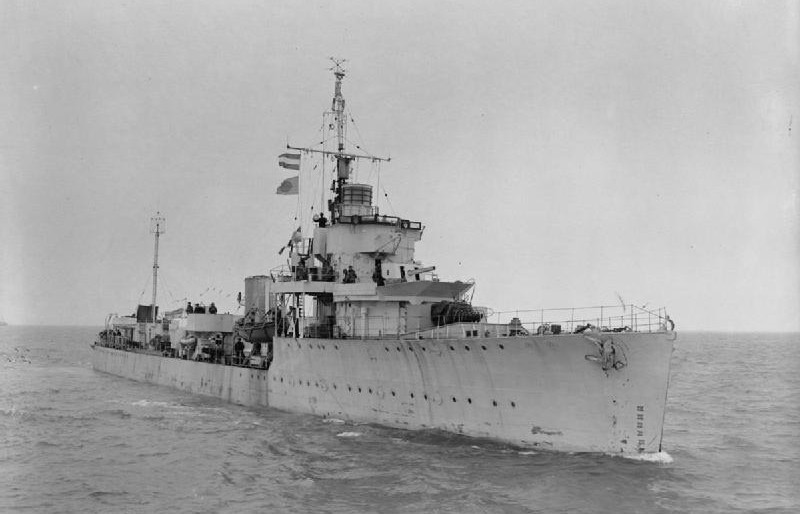
HMS Vanquisher
Other tugs were swiftly called in, and the mighty ship was finally pushed off at 0425. But she was now in the channel, and it was only about 10 minutes before she was finally free and orders were given to start the engines. A few minutes after that, a trio of Heinkel bombers appeared overhead, and although AA fire from various guns kept them at altitude, one bomb hit the ship between the two turrets, doing minor damage to the ship. French fighters soon appeared overhead, and the Germans headed for home, leaving Jean Bart free to move under her own power for the first time. The tugs were cast off, and she made for the open sea, picking up destroyers Mameluk and Le Hardi on the way. HMS Vanquisher also appeared with a pair of tugs, part of the abortive plan to move the battleship to British waters, but they were sent away, and operations began to transfer fuel from a fleet tanker to Jean Bart. This was complicated, as the French had only begun to experiment with underway replenishment a few years before,1 so both ships had to heave to about 60 nm out to sea, and it took 90 minutes to get the hoses across and another 6 hours to get all of the fuel and water transferred.
But even as the fluids were being pumped across, engineering problems caused by the Jean Bart's hasty departure were appearing. The steam-powered ventilators hadn't been completed, leaving only the electrical ones used when the ship was alongside, which were unable to keep up with the needs of a ship actually using her machinery. Temperatures in the engine room rose as high as 70°C before engineers managed to get one of the turbo-ventilators working. A bigger problem was leaks in the condensers, which were costing four tons of feedwater an hour. The ship was stopped, despite the threat of nearby U-boats, and the engineers managed to get things under control in only an hour, although overheating and vibration limited the ship's speed to no more than 12 kts, enough to make the Admiral nervous. Worse was to come 90 minutes later when the vacuum pump for the starboard condenser exploded, forcing that set of shafts to be shut down again and cutting speed to 7 kts.
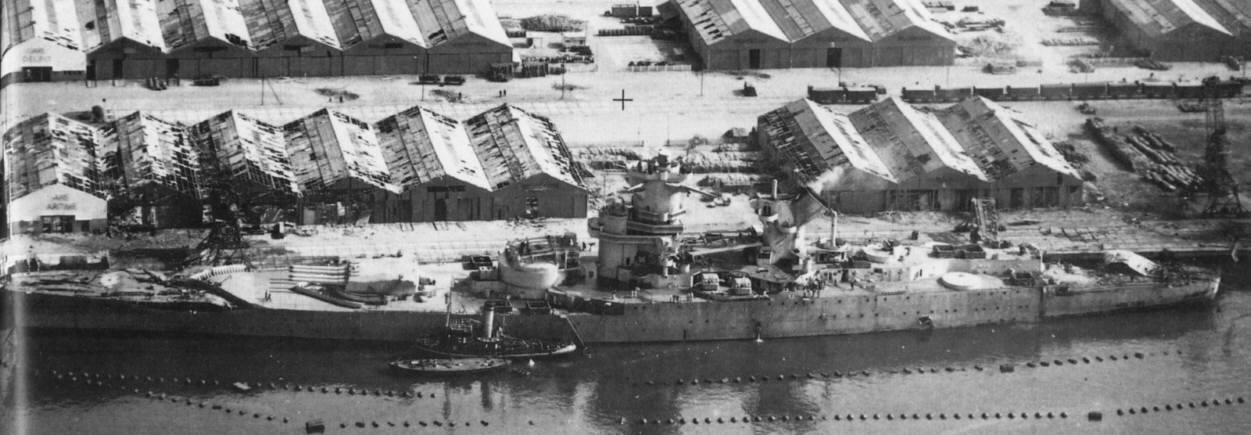
Jean Bart in Casablanca harbor
The engineers quickly concluded that the pump was beyond repair, and the only feasible option was to replace it with one scavenged from the inoperative aft turbines. But this was not a standard procedure, and it took 18 hours for the exhausted engineering team to get the new pump up and running. And while that work was underway, it became apparent that the condenser was leaking feedwater to a point where they would be unable to reach Casablanca. The solution was to run the fresh water provided for washing through an auxiliary boiler and use it as feedwater, along with water condensed out of the AC system for the boiler room, which was pulling out 800 L/hr. This wasn't great for the boilers in the long run, but that was a secondary concern.
After the vacuum pump was repaired, the revolutions were increased, although the ship soon ran into problems with vibration caused by a bent propeller blade, most likely a result of the second grounding during the launch. But despite this, she was soon able to make 21 kts, and maintained this speed for the next two days, finally dropping anchor at 1655 on June 22nd. Despite all of the problems, she had averaged 16 kts on passage, surely the speed record for a warship in her first three days afloat. Jean Bart would remain there for the next two and a half years, until the Americans appeared offshore and she fought Massachusetts, the only battleship to survive a gun action against an American counterpart during the war. After the French capitulated, she would spend the rest of the war providing parts for Richelieu before being completed by the restored French Republic, the last battleship to enter service with any nation.
1 Weirdly, it appears that all of their experiments from 1936 until March 1940 were between warships and not from dedicated tankers. I have no idea why. ⇑
Comments
The Jean Bart's escape would make an outstanding movie..... that a few hundred of us would watch. Lol.
Footnote 1 points nowhere.
Forgot to drop the right formatting in. Fixed now.
I commend you, Bean, for making a compelling story out of such unpromising material. Chad is right, though. Who would see this movie?
But if Hollywood made a Jean Bart movie (working title: Three Days of the Battleship), they’d add a love triangle (as in the Pearl Harbor movie) between a courageous French woman (loosely based on Rose Valland), a dashing officer on the Jean Bart, and a scrappy American ex-pat (loosely based on Charlie Allnut), who is a genius with pumps and condensers. These unlikely heroes must put away their differences to thwart the Nazis and sail the Jean Bart to safety.
As Bean wrote somewhere else, Americans don't understand WWII, so when the Massachusetts shows up she'll be German and played by the Salem, which has experience playing the Graf Spee. Then Jean Bart chills in Casablanca until the Allies win WII. Fade to black.
I so enjoy this blog. It’s like a graduate seminar with unruly students. Where else can I read about fugitive French battleships?
Wait until you hear about the Surcouf...