
By the mid-1850s, the telegraph was well on its way to uniting the world. In the previous decade, it had woven together the cities of the industrial world, and means had even been found to bridge the narrow seas. But the broad oceans remained a daunting challenge, and it would take a man of unusual drive to bridge them and bring Europe and America within seconds of each other.

The man in question was Cyrus Field of Massachusetts, who had made a fortune in the paper business and semi-retired by his mid-30s. While relaxing after a trip across the wilds of South America, he met a man raising money for a telegraph line from New York to Newfoundland, the closest point in North America to Europe. But Field, after studying his globe, thought that this wasn't going nearly far enough, and became obsessed with linking the two countries across the North Atlantic. With the backing of Samuel Morse and Matthew Maury, a Navy Lieutenant who had basically invented oceanography, he set about raising funds for first the completion of the Newfoundland cable, and then the link across the ocean. He was phenomenally successful at this, convincing not only many of the leading businessmen on both sides of the Atlantic to invest, but also getting promises of support from the British government, including a long-term operating subsidy and the use of warships to help lay the cable. The American government was far more reluctant to get involved, due to a mix of provincialism and anglophobia, but the bill squeaked through the Senate, and Field had the support he needed for the project.
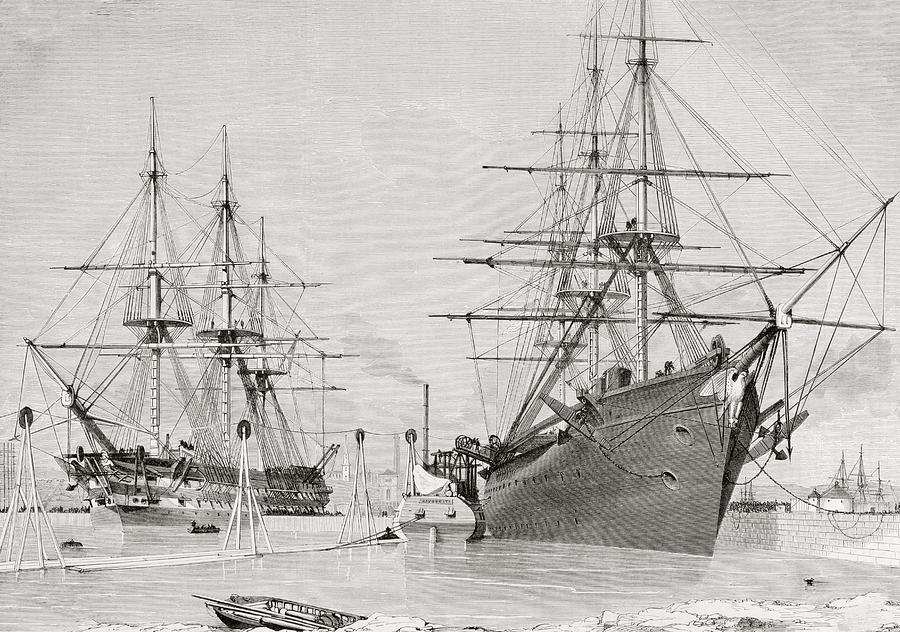
Agamemnon and Niagra taking aboard cable
Unfortunately, he had made all of these arrangements in 1856, and promised his backers that the cable would be complete in 1857, requiring the 2500-mile cable to be constructed in only 6 months. This did not produce a good-quality cable, as the impurities in the copper made certain sections much less conductive than others, while the armoring, farmed out to two different contractors, was twisted in opposite directions, which made splicing the sections together more difficult. The cable weighted about a ton a mile, and there was no ship afloat capable of carrying the entire thing. Instead, the job of laying the cable would be divided between the two nations involved, each of which donated the services of a large warship, HMS Agamemnon and USS Niagara, each of which was modified to carry and lay the cable. The basic plan was for the ships to sail together from Valentia Bay, Ireland, with Niagara paying out her cable first, then when her stock was exhausted, passing the torch to Agamemnon, who would take it the rest of the way. This had the significant advantage of keeping the ships in contact with Europe as they went, and things began well enough in August 1857. But several days in, with 300 miles having been laid, the cable was running out faster than the ship, and an attempt to slow it down went horribly wrong. There was no real prospect of recovering the cable from the seafloor two miles below, and the expedition had to be called off for the year.
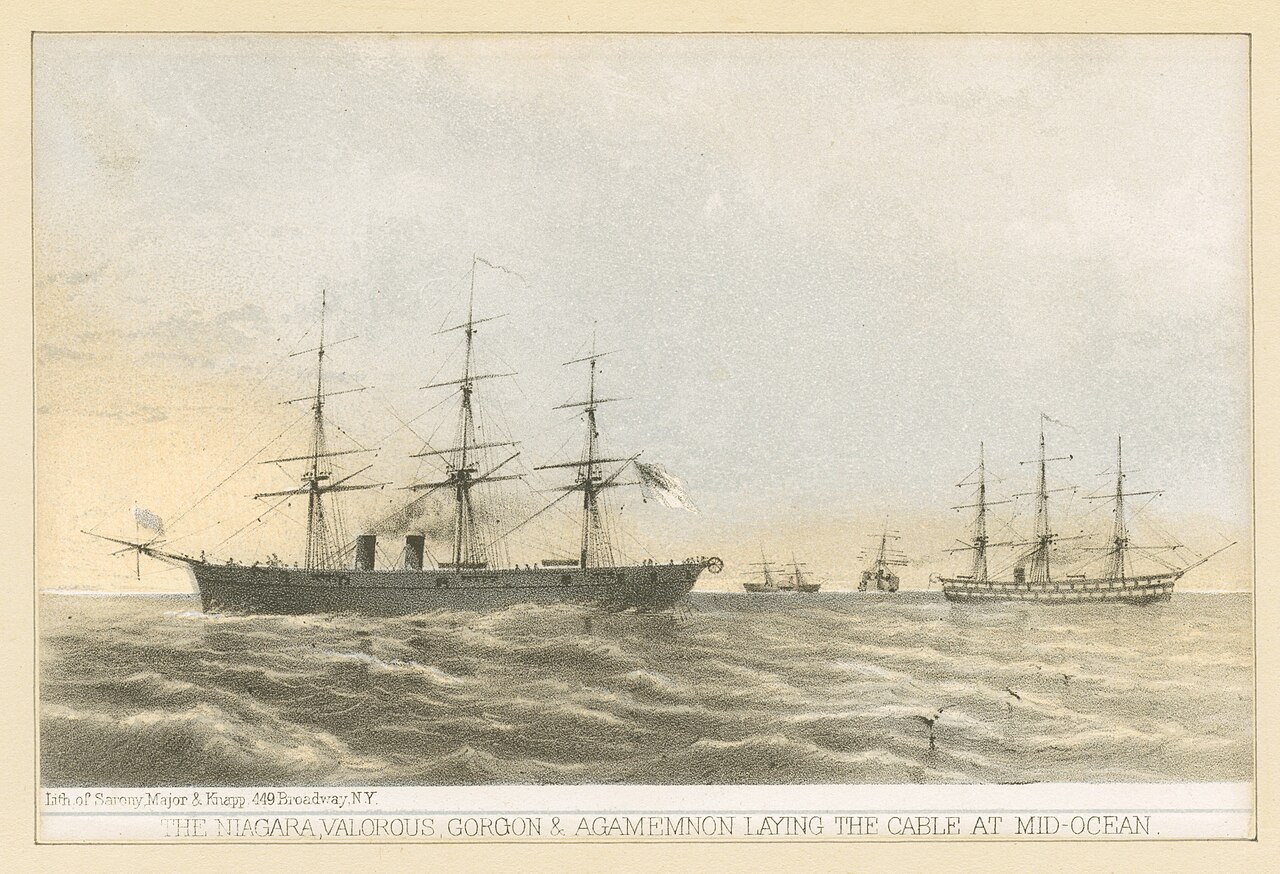
The splice being made at mid-ocean
Field began raising more capital for a second try the next year, and persevered despite a depression in America that had cost him much of his own fortune. Replacement cable was procured, and the two ships this time would splice their lengths of cable in the mid-Atlantic and then set out in opposite directions. Despite a massive storm on the voyage out from Britain, which posed a particular problem of Agamemnon, whose stability was compromised by 250 tons of cable coiled on her deck, both vessels reached the starting point safely. The splice was made, and each ship headed for home, only to be interrupted after three miles when a foul-up in the redesigned laying gear on Niagara snapped the cable again. Twice more during this effort the cable parted before the ships were forced to return to Ireland for supplies, although the total loss was only about 300 miles, and enough spare cable was in hand to allow efforts to continue. Many thought that these failures proved the entire thing was a fool's errand, but Field managed to convince his fellow board members to make a fourth attempt.
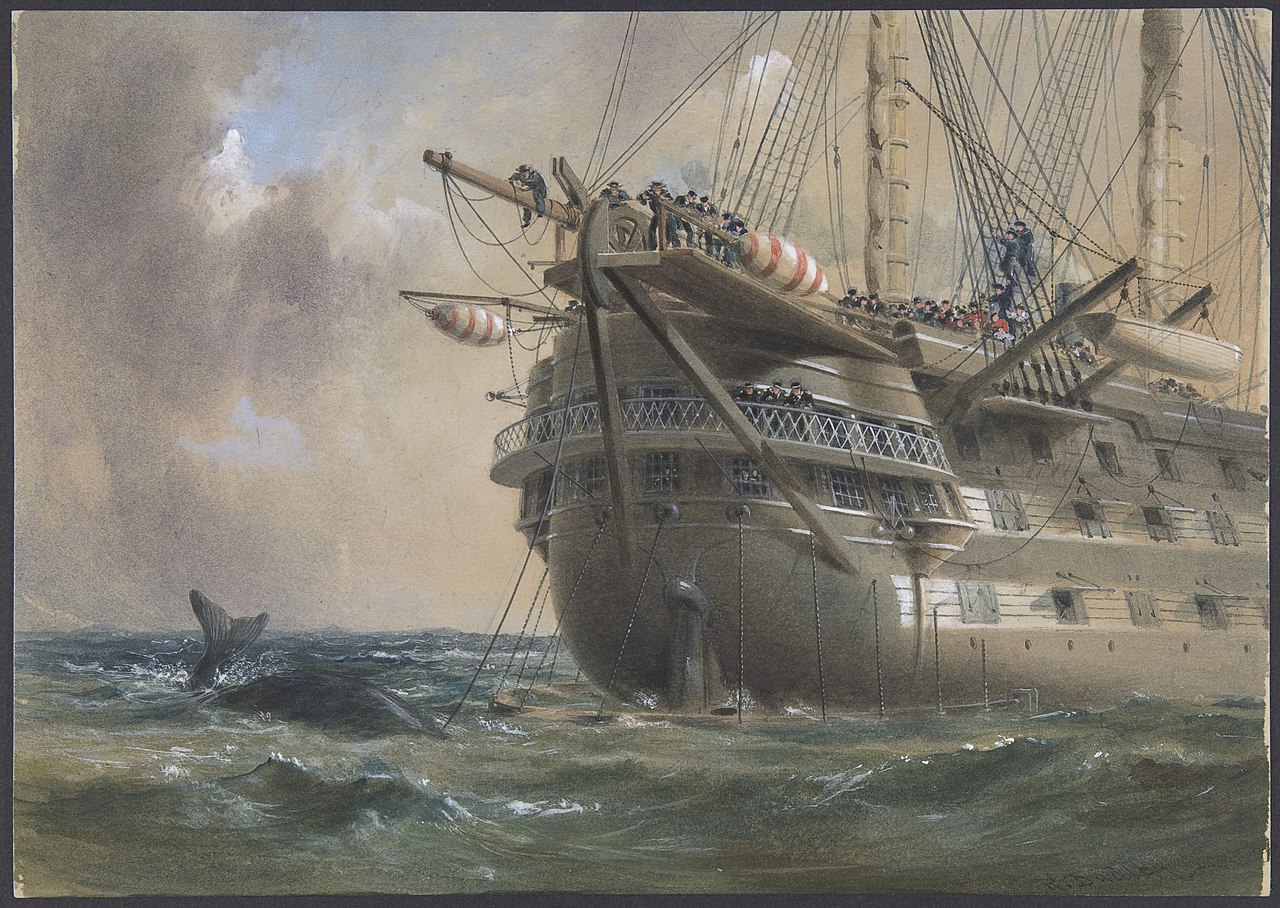
A whale crosses the line being laid by Agamemnon
This time, the splice was made cleanly, and Niagara had a smooth voyage to Newfoundland. Things were more exciting aboard Agamemnon, where a major storm required exceptionally careful handling of the cable mechanism to avoid snapping the cable again, but the storm was weathered and Ireland was reached with the cable still intact. Both ships made landfall on August 5th, 1858, creating a sensation on both continents, as the repeated failures had left few with any hope the project would succeed. But actually laying the cable was only half of the problem. The other half was passing messages through it, and it was here that trouble began.
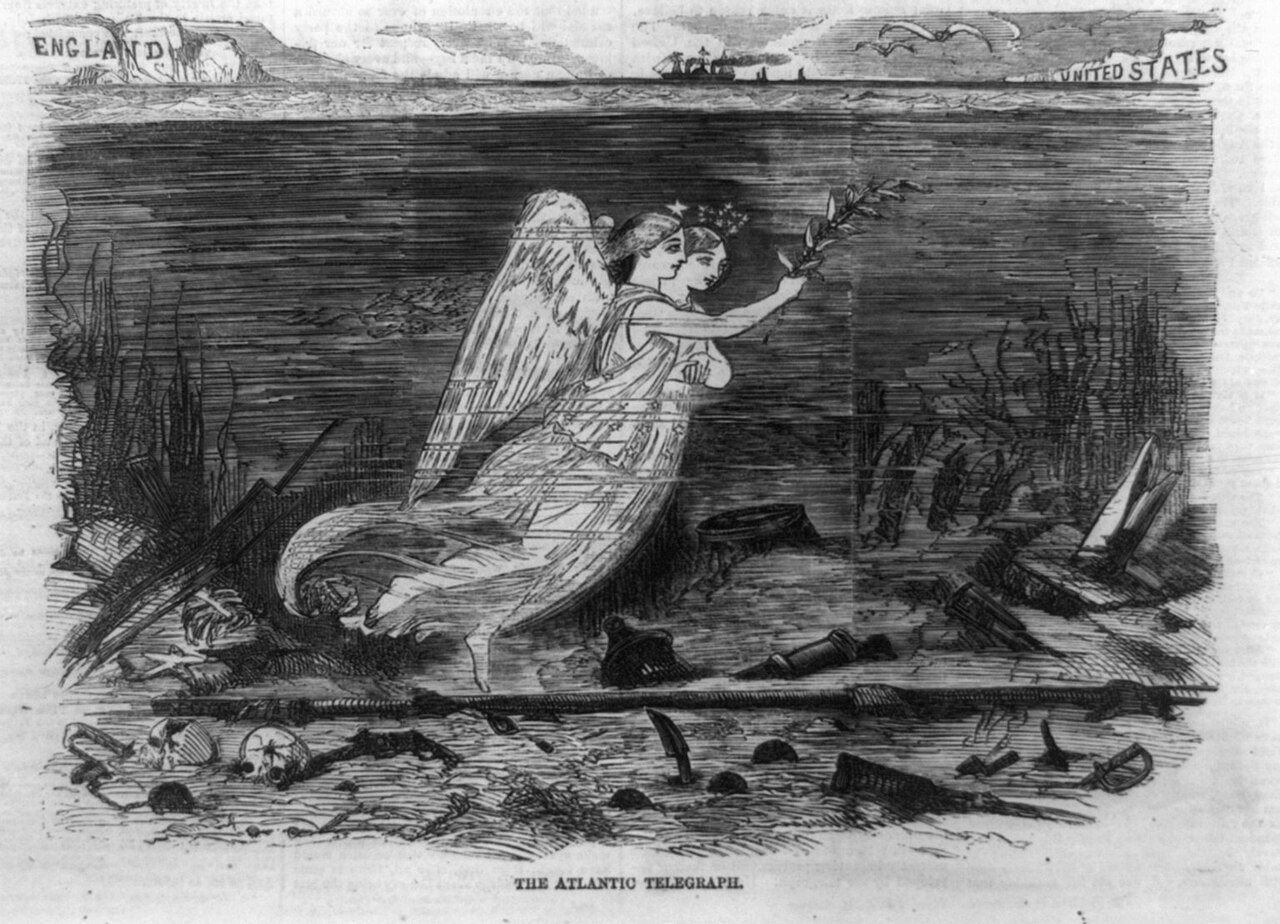
The length of the cable and the haste in which much of it had been constructed made it incredibly noisy, so that passing even a simple message might take hours. Matters were not helped by the company's chief electrician, Wildman Whitehouse, a surgeon and amateur electrical engineer who was insisted on using signalling equipment of his own devising instead of that provided by company board member William Thompson, one of the world's greatest physicists and later the first scientist raised to the peerage as Lord Kelvin. Whitehouse's automatic recorder worked on shorter lines, but was nowhere near sensitive enough to pick up the whispers of the Atlantic cable, while his theory that more voltage was the ticket to intelligible communication accelerated the breakdown of the cable. On August 16th, Queen Victoria sent a 98-word message to President Buchanan, a process that took 16.5 hours to complete. For another two weeks, messages passed back and forth, until on September 1st, the line finally went dead. One of the final messages had been orders cancelling the sailing of a regiment from Nova Scotia thanks to the defeat of the Indian Mutiny, which was estimated to have saved a full seventh of the cost of the cable by itself.
But ultimately, the failure of the cable, combined with the failure of an even more expensive cable through the Red Sea to India, contributed to widespread skepticism about the idea of oceanic cables, and although Field was determined to try again, it would be years before he could raise the money and assemble a team to do so. We'll pick up the story next time.
Comments
It has always struck me how less risk averse people were back in the day.
Or they were far more credulous. Not sure which.
It has always struck me how less risk averse people were back in the day.
Or they were far more credulous. Not sure which.