In the 1960s, as the British Empire came to an end, one of the great challenges faced by London was Rhodesia. It was ruled by white settlers, like several of Britain's African colonies, but uniquely, maneuvering by the colony's founder and namesake, Cecil Rhodes, had left it almost entirely self-governing. This greatly limited Britain's ability to bring Africans into the government, and any attempt to do so would push Rhodesia into declaring independence or possibly joining South Africa, already deep in the grip of apartheid. Negotiations dragged on through the early 60s, but no solution could be reached, and in 1965, Rhodesia unilaterally declared independence, although they completely failed to gain international recognition.
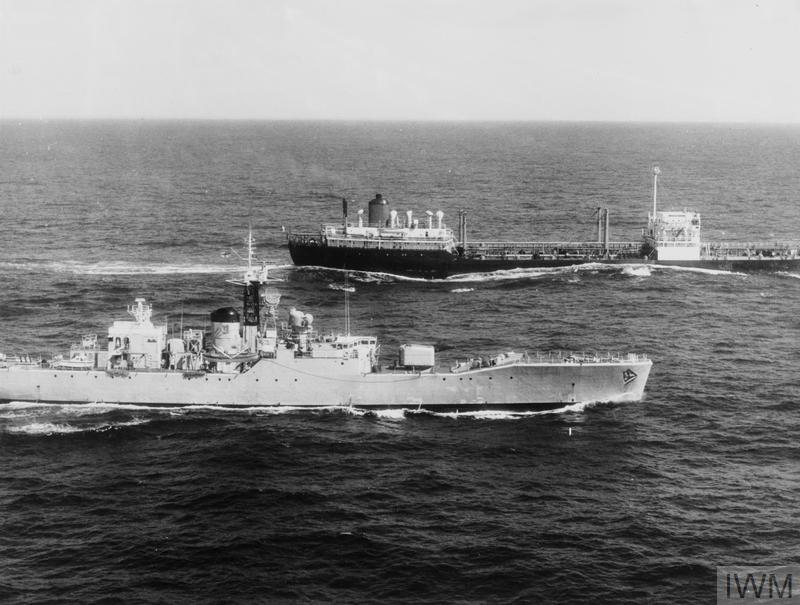
HMS Plymouth intercepts a tanker during the patrol
This left Britain with a problem. Most of the former colonies were now independent and had joined the Commonwealth, which London saw as a useful means of exerting soft power. But such organizations work both ways, and the presence of a white-dominated regime on territory that legally belonged to Britain was something that the former colonies were not prepared to tolerate, and they demanded that Britain do something. Rhodesia was landlocked, and the main connections to the outside world ran through either South Africa, which was increasingly hostile to Britain and friendly to the regime and had promised to be the second country to recognize them, or through Mozambique, still a Portuguese colony that Lisbon was trying desperately to hold on to. That meant direct intervention was out, and the British instead announced comprehensive sanctions, less because they expected them to work, particularly with Portugal and South Africa flatly refusing to cooperate, than because it was the only thing they could do at a reasonable cost.
Into this mess came the Royal Navy. They first got involved immediately after the Rhodesian declaration of independence, when the Zambian president asked for British fighters to protect from potential Rhodesian airstrikes. While the RAF could get fighters to Zambia almost immediately, it would take some time for their supporting elements to arrive, so the carrier Eagle was dispatched, with her Sea Vixens providing fighter cover over Zambia for a few weeks before the RAF finally turned up.
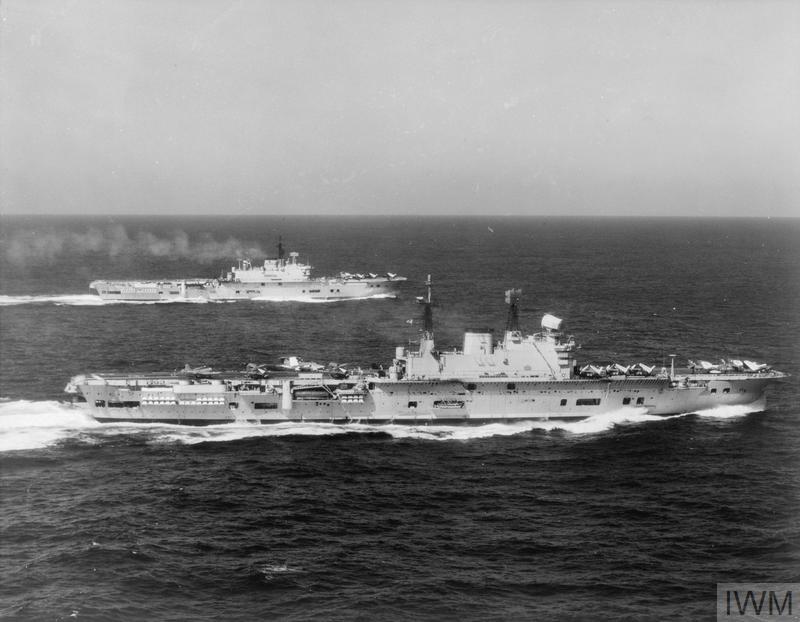
Eagle relieves Ark Royal in the Mozambique Channel
But more was to come a few months later when it became clear that the sanctions were completely ineffective, and that oil continued to reach Rhodesia via a pipeline from the port of Beira in Mozambique. In early 1966, carrier Ark Royal was dispatched to search for any tankers attempting to reach Beira, at least until the RAF could get a base set up for patrol aircraft in the area. The RAF was slow in getting set up, so Eagle had to return to the Mozambique Channel while Ark Royal went in for maintenance, and she set a record by staying at sea for 71 days, longer than any British warship since the days of sail. The process of the patrol was pretty straightforward. Gannet AEW aircraft would search via radar, then vector in Scimitar or Sea Vixen fighters to visually inspect contacts. Any tankers that weren't on a cleared list would be met by one of the frigates escorting the carrier. Eventually, Ark Royal was back, and she took over for the last three weeks of the carriers before RAF Shackletons were finally ready to take over the surveillance tasks at the end of May 1966, flying from bases in Madagascar.
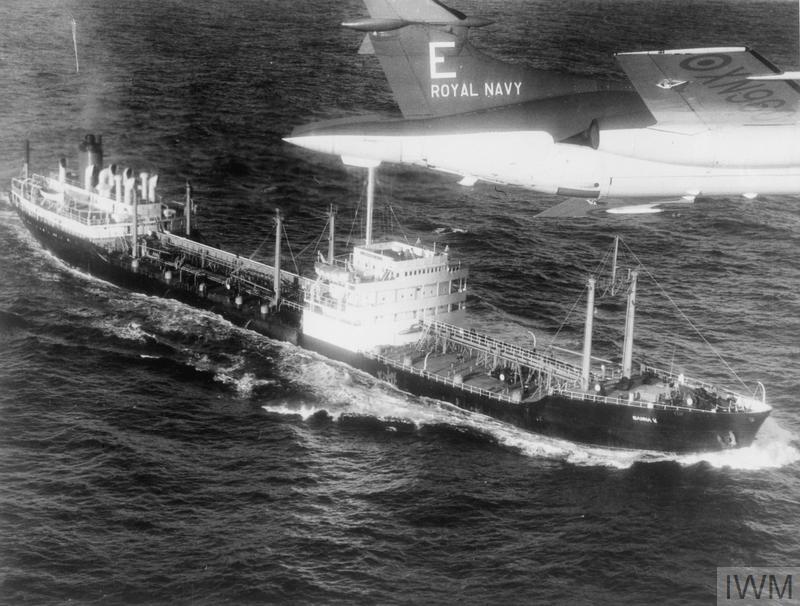
A Buccaneer overflies Joanna V
While the carriers were still on station, the first major test of the blockade came. Greek tanker Joanna V, outbound from the Persian Gulf, had been sold to a paper company and dispatched to Beira. On the way, she was intercepted by HMS Plymouth, but claimed she was taking on fuel, not discharging oil. The British asked the Greeks for permission to use force, but were turned down, leaving them impotent as the tanker sailed into Beira harbor. The British then had to turn to diplomatic pressure. The Portuguese pipeline company was no help, but the Greek government soon told the ship's owners that they would face heavy fines if any oil was unloaded. The ship's owners attempted to dodge this by reregistering Joanna V in Panama, but the British were ahead of them and Panama refused the registration. More than that, the incident convinced the United Nations Security Council to issue a resolution granting the British the right to stop by force any vessel believed to be carrying oil for Rhodesia. This was an almost unprecedented grant of power under international law, and after French tanker Artois ignored shots across her bow, the rules allowed the RN to eventually shoot to disable the target vessel.
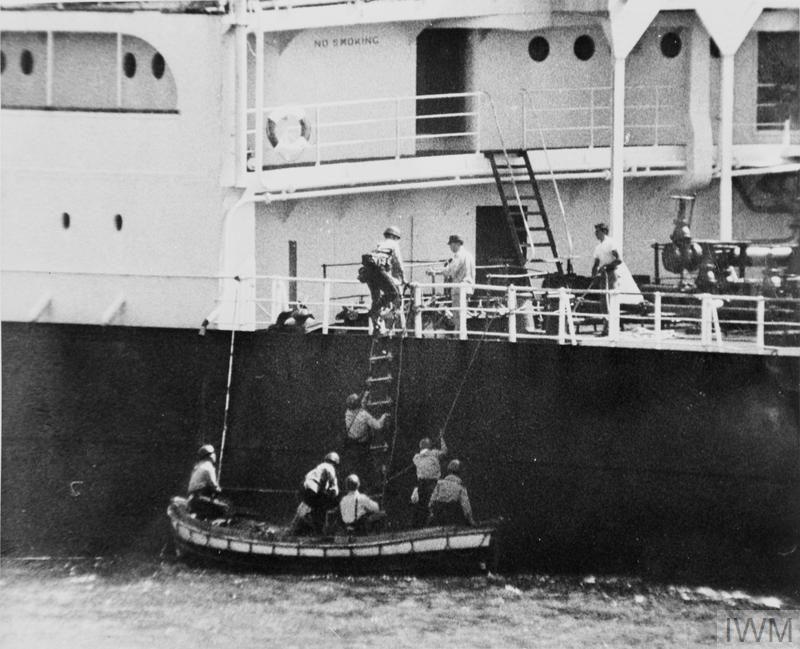
A boarding party from HMS Berwick goes aboard a tanker
After the first few months, things quieted down. With the RAF handling search, the patrol was slashed to two frigates to handle the interceptions, although they required a lot of support from vessels of the RFA. And once it became clear that there wasn't much chance of getting oil to Beira, tanker traffic dried up. This made the duty extremely boring, as demonstrated by a 1967 patrol when frigate Zulu spent 124 days on patrol off her namesake coast and made a total of four interceptions. The disappearance of the tankers didn't mean Rhodesia was completely cut off from oil. Supplies continued to arrive via train from South Africa and through other routes than the Beira pipeline, some even delivered by British companies. By 1967, it was clear to the British government that the sanctions were a failure, and the only reason that the patrol continued was to avoid the international condemnation that would follow its withdrawal.
In an attempt to end the crisis, and the ongoing drain on the RN's escort force,1 Prime Minister Harold Wilson made several settlement offers to the Rhodesian government, conceding most of their points at a pair of conferences in 1966 and 1968, held aboard Tiger and Fearless in the Mediterranean, the ships providing a private, secure location for the discussions. Astonishingly, the Rhodesians turned down both offers, and the patrol continued, although in March 1971, after 5 years and only 47 interceptions, it was reduced to a single ship.
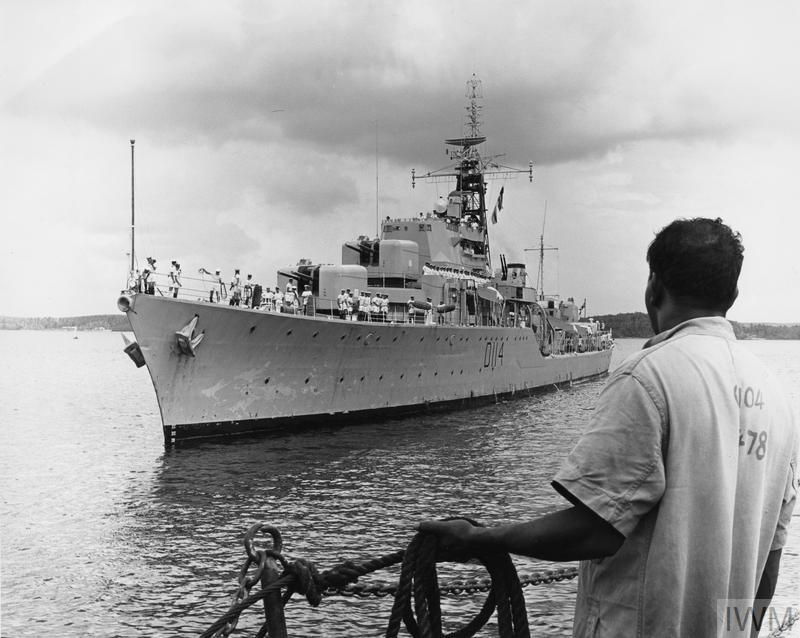
Daring pulls into Singapore Dockyard after spending time on the Beira Patrol
But things continued more or less unchanged for another four years. Oil continued to reach Rhodesia, the Royal Navy continued to sail around to prove to the world that Britain was taking the problem seriously, and a guerilla movement began to brew, putting more pressure on the Rhodesian government. But the big change from Britain's perspective came in 1974, when the dictatorship that ran Portugal was overthrown, prompting an immediate change in Portuguese colonial policy. A year later, Mozambique was independent, and the new African-dominated government was obviously not going to allow oil, or anything other than supplies for the guerillas, to pass through its territory. At last, the Beira Patrol could end. 76 ships had taken part, and the total cost had been in excess of 100 million pounds.
It took another five years for the Rhodesian government to recognize the inevitable. Caught between a growing guerilla movement and increasing international pressure, they finally gave in, agreeing to a referendum that placed Robert Mugabe, one of the guerilla leaders, in charge of the new country, which gained independence as Zimbabwe in 1980. The British had managed to handle one of the trickiest problems of decolonization with surprising skill, thanks in no small part to the men of the Royal Navy who had blockaded a landlocked country as a diplomatic signal.
1 The two-frigate force required about 7% of the RN's escort strength once ships refitting or training up were taken into account, and an even higher percentage of the RFA's tankers. ⇑
Comments
Shocking how much international power and money went into installing Mugabe, after which they all washed their hands of it and pretended there was nothing that could be done.
Doesn't that put the British on same side as the Russians and Cubans againt the Americans and Portegesse?
The Cold War was Weird.
@BerndL
There really wasn't a lot they could do short of overthrowing him, and that was something that pretty much everyone in the West had decided was a bad idea. I get that it didn't work out great for the people of Zimbabwe, but such is life.
@ike
No, the Americans weren't really on the side of Rhodesia, and played an important part in convincing them to finally come to the negotiating table. But that happened later, after Mozambique became independent and it's thus out of scope for me here.
@BerndL I do not think that anyone wanted Mugabe to be installed as the president. And Zimbabwe actually got a big amount of Western sanctions after Mugabe started to oppress the white minority. But it would look weird if you did very mild sanctions against the white oppressing black population and then massively intervene when the roles have changed.
Somewhat unrelated, but it's amazing how small the tankers are (and how much superstructure they have) compared to modern ULCCs.
@redRover: bigger and more modern-looking ones existed, but wouldn't fit into Beira.
@StupidBro
He won the first set of fair elections, a result that the book I was reading on this (random outside interest in history, happened to stumble across a fun naval story) attributed to the fact that he would probably go back to guerilla warfare if he lost, and people really wanted the war over. He definitely was not the one the British wanted to hand over power to, but they respected the election results.
I was part of the crew on HMS Grenville, an anti submarine frigate. We did 4 weeks on the Biera patrol in 1967, strangely there is no mention of my ship in any litrature.
The literature on this is pretty thin, and I'm not sure I ever found a full and comprehensive list of ships that participated in the patrol. Even if I had, I wouldn't have included it, because I have limited space.