
When the French resumed battleship construction in the 1930s after the lapse of the Treaty System, they were faced with a problem. A large infrastructure program in the early part of the century had left them well-equipped to build battleships 200 m long, but as ships got faster, they also got longer, and by the mid-30s, 200m was typical for a heavy cruiser, and battleships would need to be considerably longer. A few 250m drydocks were available, but most building facilities were still at the old limit. To get around this, Dunkerque, the first of the new ships, was built in two sections, a 197m main hull and a 17 m bow, the two then being attached in one of the longer drydocks.
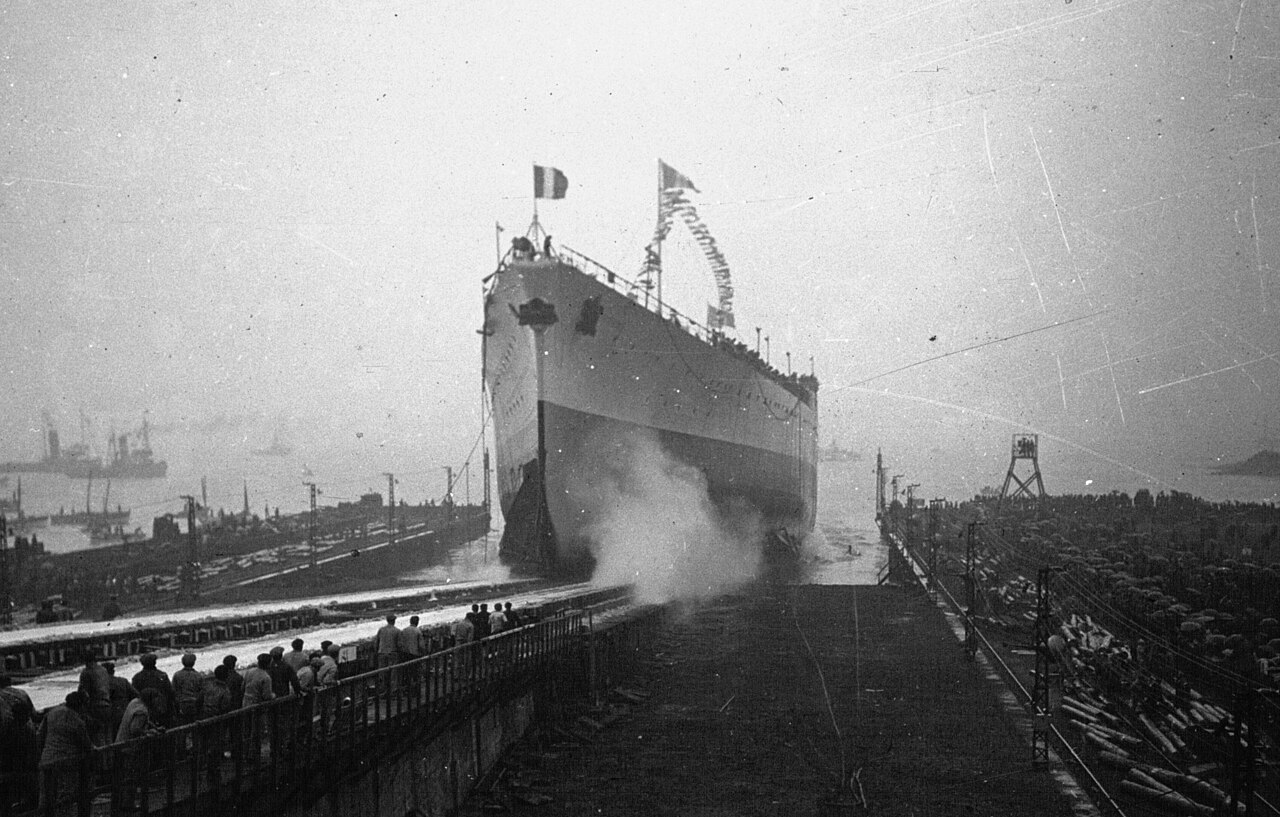
Strasbourg is launched in Saint Nazaire
This worked quite well, and when the only long set of ways available, originally used to build the liner Normandie, was taken up by Dunkerque's sister Strasbourg, the decision was made to build Richelieu, the first of their 35,000-ton treaty battleships, in the same manner. The center section, 197m long, was built in the same drydock as Dunkerque, while the 43m bow and 8m stern were built elsewhere and mated up in drydock.
But by the time they came around building Richlieu's sister, Jean Bart, the international situation had become critical enough to unlock some extra infrastructure budget, and she was to be built in a new and unique facility at Saint-Nazaire. It was composed of two parallel docks, one that was normally dry and where the basic assembly would be completed and another that was much deeper and typically kept full of water where final fitting out would be done. They were separated by a low platform a meter above the dry side, which gave the engineers a place to assemble materials and played host to five cranes, including the enormous Grue Gusto, capable of lifting 240 tons. After the hull was mostly complete, it would be floated from the dry to the wet side over the central platform.1 It's not entirely clear what advantage this had over just building a conventional drydock, but it's possible that it was cheaper and building mostly in the open was easier.
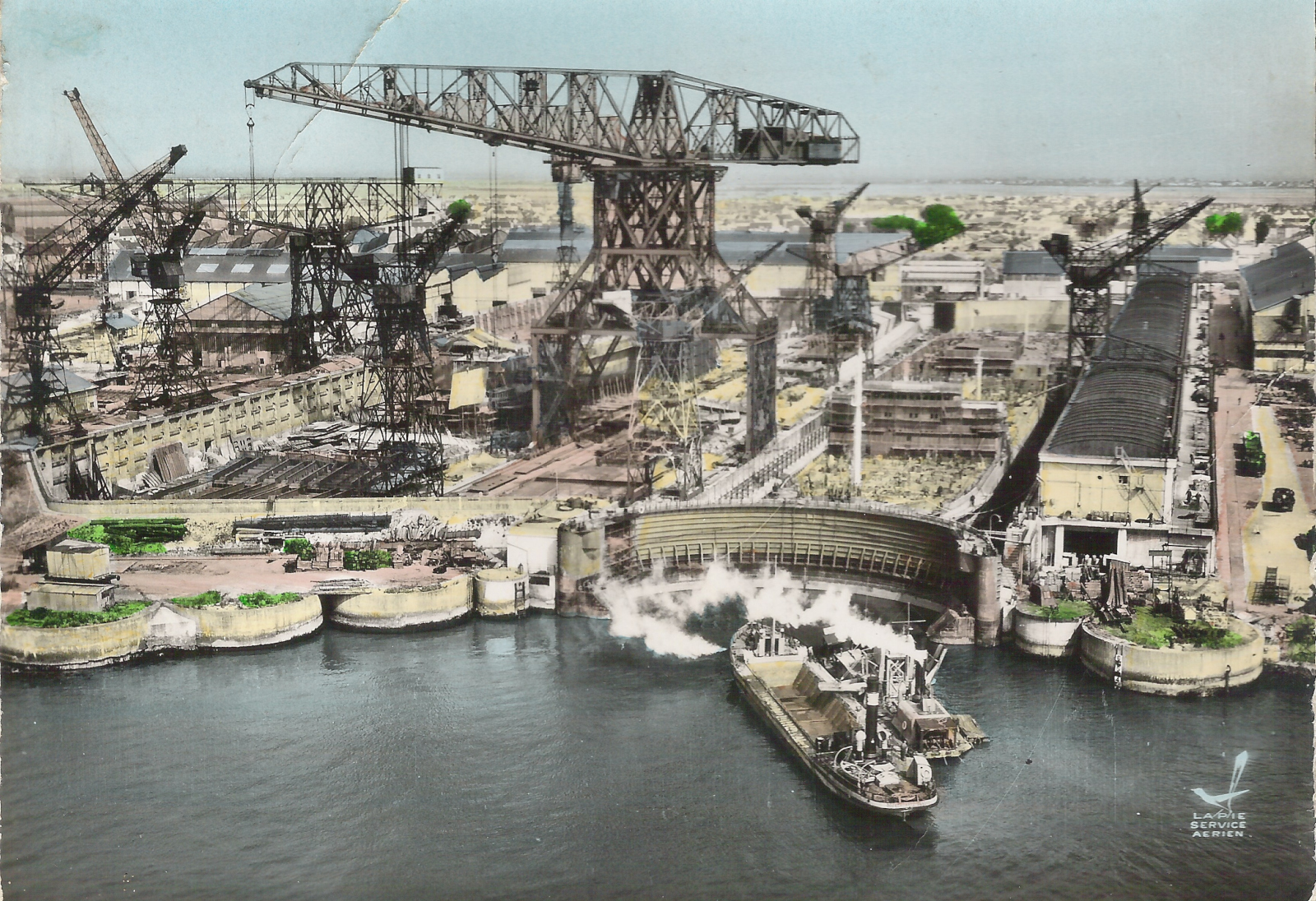
The construction dock used for Jean Bart postwar. The construction platform is on the left, the fitting-out dock on the right.
Another factor may have been the local geography. The shipyard, Ateliers & Chantiers de la Loire, was on the north side of the Loire estuary, almost a kilometer from the main shipping channel across relatively shallow water. This meant that a special channel would need to be dredged to get the ship out, probably acceptable for a ship launch every couple years, but a major pain for regular use of a drydock.
But it would also be a major pain for other reasons as Jean Bart neared completion in early 1940. She had been "launched" at the beginning of March, with seven months of fitting out ahead before she went to sea for the first time. Unfortunately, it was only two months later that the German offensive began, punching through the lightly-held Ardennes and outflanking the French and British armies before they had a chance to react. By the middle of the month, it was clear that all of France was at risk, and efforts began to make Jean Bart ready for sea in the hopes of keeping her out of Hitler's clutches. The highest tides on the Loire arrived at two-week intervals, and it looked like the best option was to shoot for a series around June 20th. The ship would obviously be far from finished, cutting the required channel depth by a meter, but it looked like she could be made ready to move under her own power and the dredging completed in time.
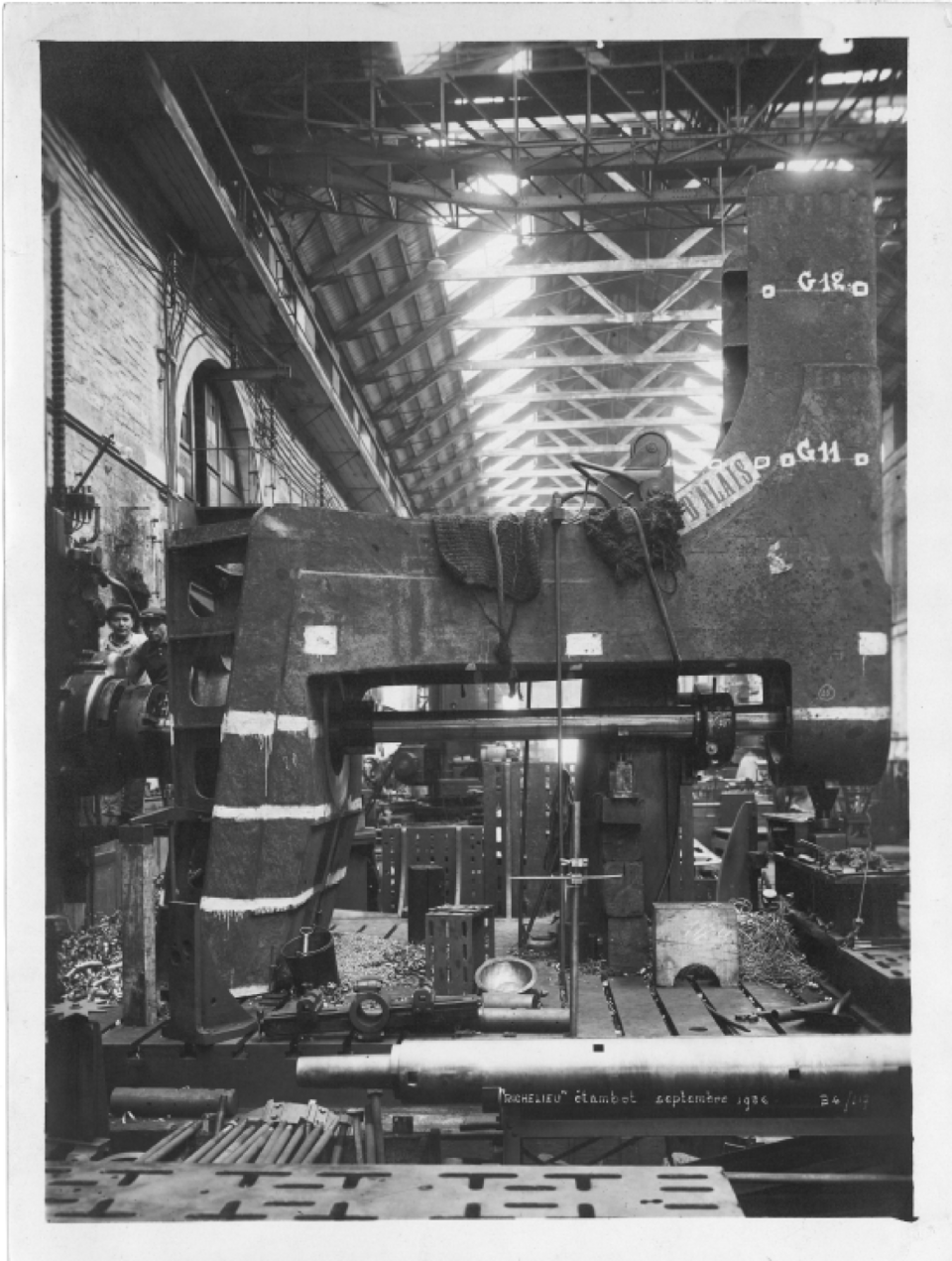
Richelieu's sternpost under construction, because I couldn't find anything more relevant
Immediately, the project to get the ship complete had top priority, with the number of assigned workers limited only by the need not to get in each other's way. The first priority was to get at least some propulsion completed, although the full system, with 4 turbine sets and six boilers, was quickly discarded in favor of just the outboard shafts, driven by 3 boilers, which should still let the ship make 25 kts. The work was down to the wire, with the propellers installed on June 7th, the boilers first being lit about a week later, and the final connection of the turbines to the shafts taking place on June 18th, 12 hours before the ship was scheduled to depart. Other systems were almost as close to the wire. The electrical generators were accepted that same afternoon, although the distribution system continued to have serious problems. The rudder and steering system was tested on June 16th, but it would be of limited use because the gyrocompass only turned up on the 18th and was taken aboard for later installation, while the magnetic compass had yet to be calibrated to account for the distortions of being on a massive steel ship. Other critical systems included internal communications and quarters for the reduced crew, but some really important features, like internal watertight bulkheads, had to be left unfinished to make the date.
One problem hovering over all of the planning and preparations was weight. A great deal was already aboard the ship, and the biggest variable was completion of the ship's armament. The secondary turrets were not available, so the openings were simply blanked off, while the turntables and gun mountings for the main guns had just been installed. Initially, the plan was to fit all eight guns and leave the turret armor off, but by June 10th, it became apparent that this wasn't feasible, and a switch was made to installing the guns and armor in Turret I, in the hopes that Turret II's guns could follow for installation wherever the ship ended up. This worked less well than expected, as the crane being used to move guns 5 and six broke after loading only the first one, and the second one was sabotaged before the Germans arrived. A pair of 90mm mountings, without fire control or ammunition, were installed, as were some lighter AA guns scavenged from around the dockyard.
But even as the projected date was drawing near, so were the German Armies, and getting her out would be an adventure in its own right. We'll pick up the story next time.
1 I am somewhat confused about the procedure here. My sources seem to suggest that this was done using a high tide, but the highest tides at Saint-Nazaire are only about 6m, and the top of the central platform was 4m above the low tide line. This would imply a draft of only about 2m for the ship. But Richlieu had a draft of just under 10m at 44,000 tons, so even if we are slightly generous and assume a constant cross-section and no margin, that would imply a displacement at the time of the transfer of 8-9,000 tons. The weight breakdown I have suggests this is basically the weight of the bare hull without armor, machinery, or weapons. Pictures from just before the transfer show a vastly higher degree of completion, including the internal belt, the barbettes and the superstructure. And the transfer was done on March 6th, 1940, only two months before her escape, so there's no way she was at the low level of completion implied by that weight figure. There's a thick wall around the entire complex, stretching to 12.5m above the low tide line, and it's pretty clear that extra water was pumped in to give enough margin for the ship to float across the central platform. This is confirmed by a photo showing water almost to the lip, although John Jordan in his caption merely remarks that the gate seems to be turned the wrong way to deal with tidal loads, not noticing that it is the way you would put the gate if dealing with what is essentially the world's largest bathtub. ⇑
Comments
The French have always had a great deal of difficulty enlarging their docks. Its been a thing, even into the 80's and 90's.
I am still confused by the drydock layout, both how it worked and why. Every decision the French make seems so bizarre and alien
This kind of dock presumably can build two ships at the same time (one on each side; while you can't transfer a ship to the deep side until it's complete enough to float, you can build one from scratch on the deep side), or more than two if you make the shallow side wider, so could make sense if building the wall is cheaper than digging out a second conventional drydock. However, I'm not aware of them actually doing that.
Given that it didn't become common, it presumably didn't turn out to be a good idea. Is it plausible that as ships reached the size where traditional slipway launching became structurally dubious, it was unclear what should replace it, and this was one option that looked worth trying??
Also, why put a shipyard (of any kind) there rather than somewhere that wouldn't require dredging for every launch? Was it a location that had been chosen when ships were smaller, that they now wanted to stay on because it was where their skilled workforce was? Or was land with deepwater access rare enough that it was essentially full of port facilities and hence expensive?