
I've previously covered a number of different exotic hull configurations in use today. But there have been a few from the distant past worth noting, most prominently the attempt by the Russians to build ships with circular hulls.
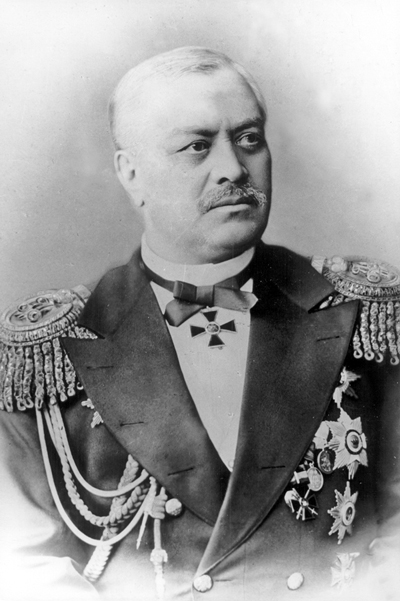
Admiral Andrei Popov
The story of these ships has its origins in the 1860s, when Russia was forbidden by the treaty that ended the Crimean War from operating more than half a dozen 800-ton1 coastal defense ships in the Black Sea. This was pretty small, particularly with the advent of ironclads, and thought soon turned to how to get the most out of this tonnage. It was clearly not enough for any conventional ironclad that could be competitive with vessels laid down by possible enemies like Turkey and Austria, so one Russian officer, Andrei Popov, proposed something radical. He had noticed that ironclads were generally growing shorter relative to their beam, as this made it more efficient to carry armor on a given displacement. Taken to its logical conclusion, a circular vessel would make most efficient use of armor, and while this would probably not be great for seakeeping or speed, a few small test boats worked well enough and it would also minimize draft, a serious concern for vessels designed to work in the shallow waters of the Crimean coast.
In 1870, as work was underway on early designs, Popov's job was made easier when Russia repudiated the restrictions on naval forces in the Black Sea. Prussian forces were currently besieging Paris, and Russia had helped them out by mobilizing troops on the Austrian border, leaving Britain diplomatically isolated. This was soon confirmed, with the only restriction being that any Russian warships built in the Black Sea had to stay there. But the Russians had fastened onto the circular design, soon christened popkovas by the Emperor in honor of their designer, and their finances were not in a state to support a proper seagoing fleet in the Black Sea, so they ordered one of the strange ironclads built in St. Petersburg, then disassembled and transported to Nikolaev, in modern Ukraine, where it would be reassembled. The ship, named Novgorod and placed into service in 1874, was 101' across and displaced 2700 tons fully-loaded. Armament was a pair of 11" breech-loading rifles mounted in a central barbette, with the circular design providing an unmatched field of fire, while a 9" belt protected the entire hull. Six shafts drove the ship to the rather dismal speed of 6.5 kts, although tests later showed that the outboard pair of shafts contributed very little, and the propellers were removed in 1876.
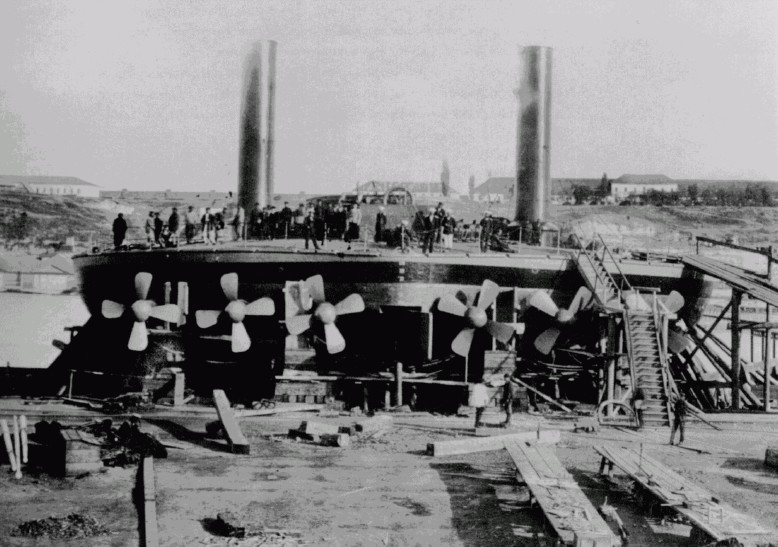
Novgorod under construction showing her six props
Originally, the plan had been to build a second unit, Kiev, to the same design, but after a pause to ensure that Novgorod was completed vaguely on schedule, Popov convinced the Emperor that the new ship should be made bigger to carry heavier guns and thicker armor. The redesign was accompanied by a new name, Vitse-admiral Popov, in honor of the ship's designer. Diameter was increased to 120' (later 126' when wood and copper was added to combat fouling) and displacement rose to 3,600 tons fully-loaded. The guns were now 12", and the main belt was 9" over 7" wrought iron. The inner shafts had two engines instead of one, and the increased horsepower allowed the ship to reach 8.5 kts.
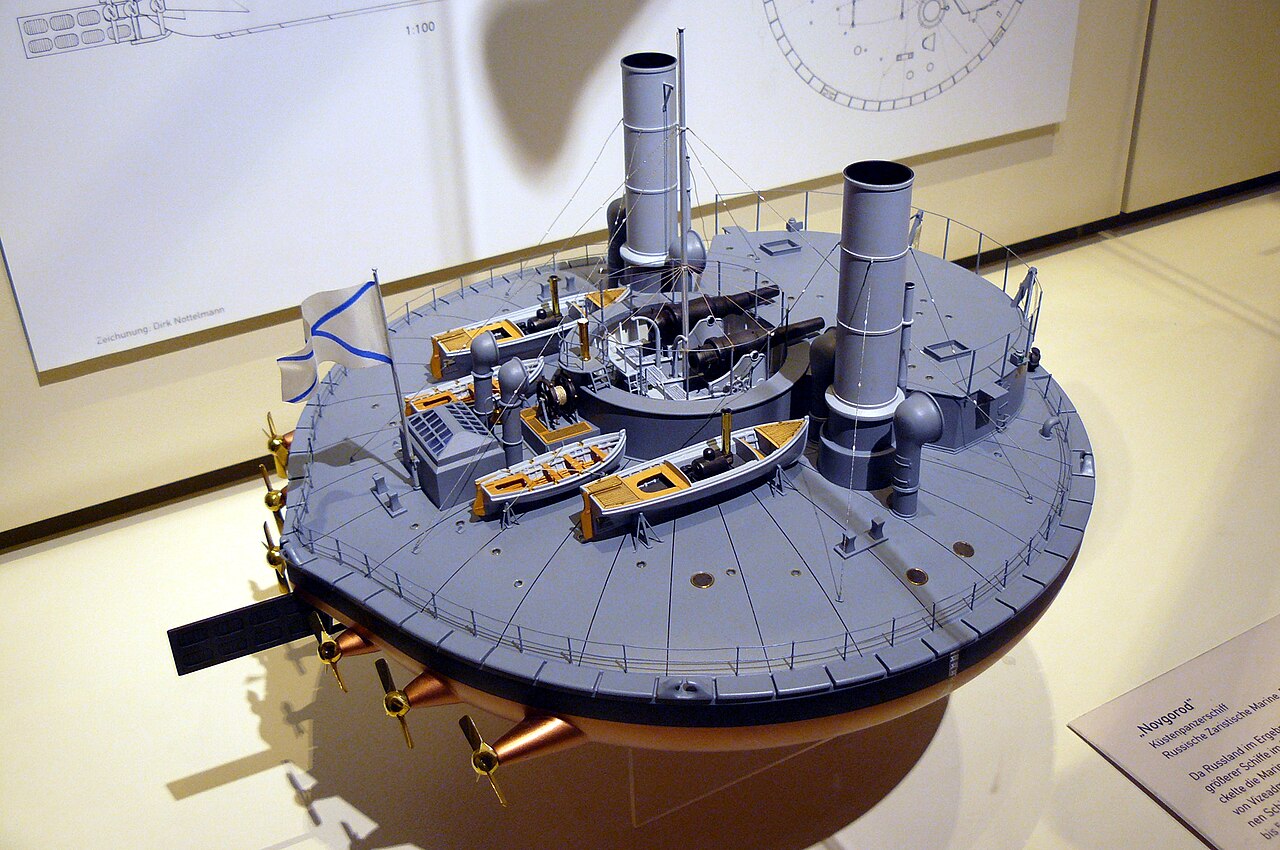
A model of Novgorod
In service, neither ship was a roaring success, even by the extremely low standards of the Russian Navy of the era. They were very slow, and could be brought to a standstill by heavy weather. Worse, the extremely blunt hulls meant that the rudder was largely ineffective, with a full circle under rudder alone taking as much as 45 minutes to complete. But they did have six shafts, and when using the engines, they proved very maneuverable, able to spin in place quite easily. This led to tales that they were completely uncontrollable, which have colored popular perception of the two ships to this day. They served without distinction in the Russo-Turkish War of 1877-78, and remained on the books until 1903, when both ships were in extremely poor condition and listed for disposal.
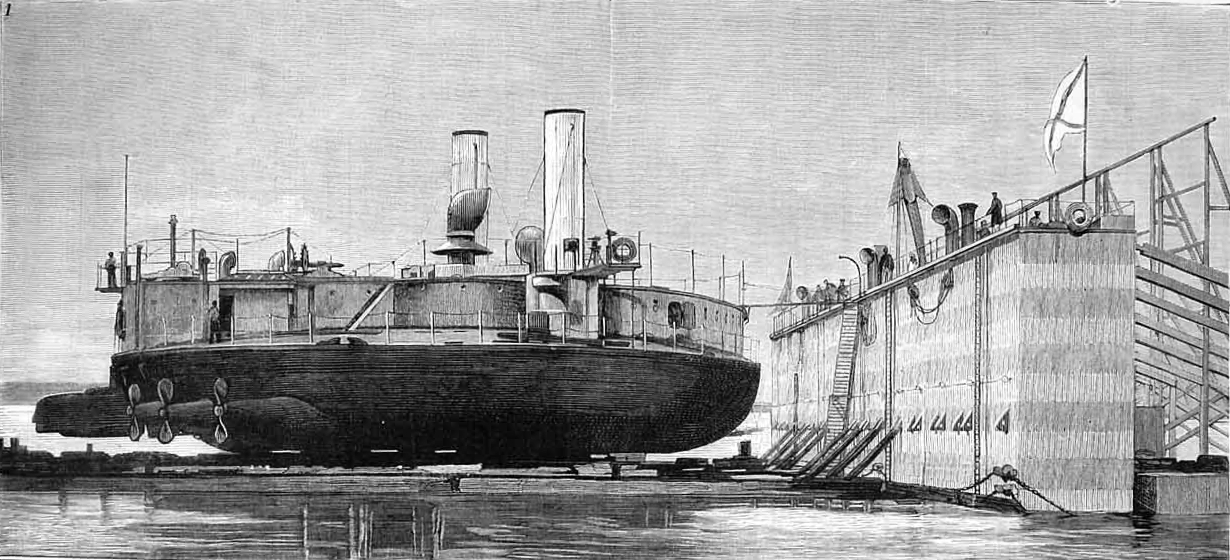
Vitse-admiral Popov
But the two ironclads were not the end of Popov's dreams of circular ships. He wanted a full-sized circular ironclad of 6,700 tons, which he hoped would be capable of 14 kts, but when the Russians asked William Froude to conduct tank testing of the hull form, he found that it would require five times the horsepower of a conventional ship to reach that speed. But by lengthening the circular hull somewhat, Froude discovered that the power requirements could be brought down significantly, while maintaining the steadiness that characterized the circular ships. Popov immediately seized on this design for future ironclads, although it was decided that they should get some experience with this new hull form at sea before committing to a fleet. Fortunately for him, the Imperial Yacht Livadiia had recently been wrecked, and he was allowed to build a new ship of the same name with an elliptical hull. She would be big enough (4,400 tons) to prove the concept, but wouldn't endanger anything vital if it didn't work.
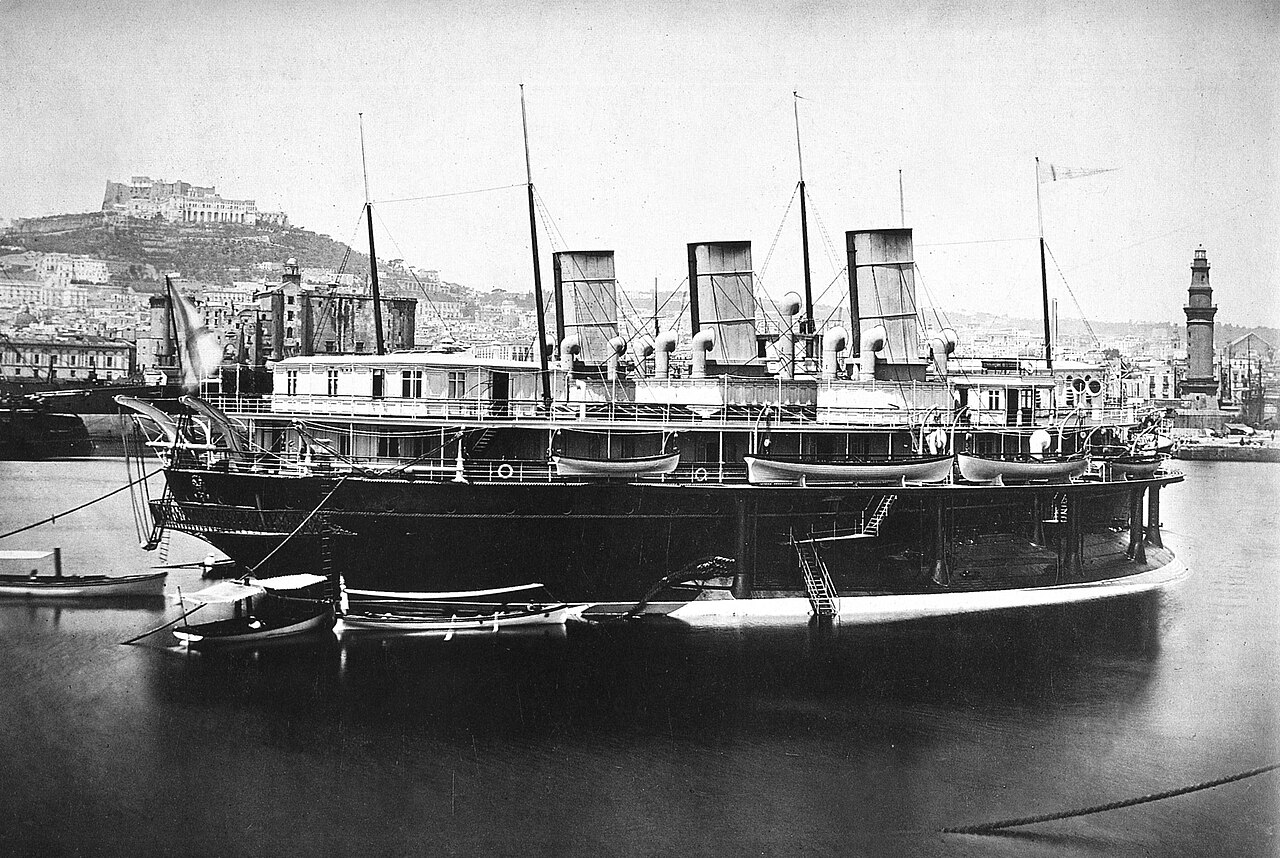
Livadiia
Because of the limits on Russian facilities in the Black Sea, Livadiia would be built in Britain. With a beam of 153' and a length of 260', she was certainly shaped like nothing else, but despite the new hull shape, she managed to make at least half a knot over her 14-kt design speed,2 and the power per ton required to drive her at 13 kts was very similar to that required by HMS Penelope, of the same length but only a third the beam. Maneuverability was also good, but the drawbacks of the hull form were discovered during her delivery voyage to the Black Sea. While crossing the Bay of Biscay in October 1880, she was caught in a fairly serious storm, with waves estimated at 20-25'. Throughout, she was exceedingly steady, but her flat bottom and 7' draft meant that she suffered from serious slamming, with the waves under the bow hitting with such force that those aboard found it difficult to believe she hadn't run into a solid object.

The storm did fairly extensive damage, and Livadiia was forced to make for Spain, where attempts at repair were stymied by the fact that no drydock available was wide enough to accommodate the ship.3 After seven months, she was able to resume her journey, but she arrived to a very different Russia than she had been expecting. In March 1881, while Livadiia was in Spain, Tsar Alexander II was assassinated, and his successor Alexander III was skeptical of Popov and viewed Livadiia as a waste of money. She was quickly stripped out and left to rot, bringing to an end Popov's dream of a fleet of battleships with his unique hull form.
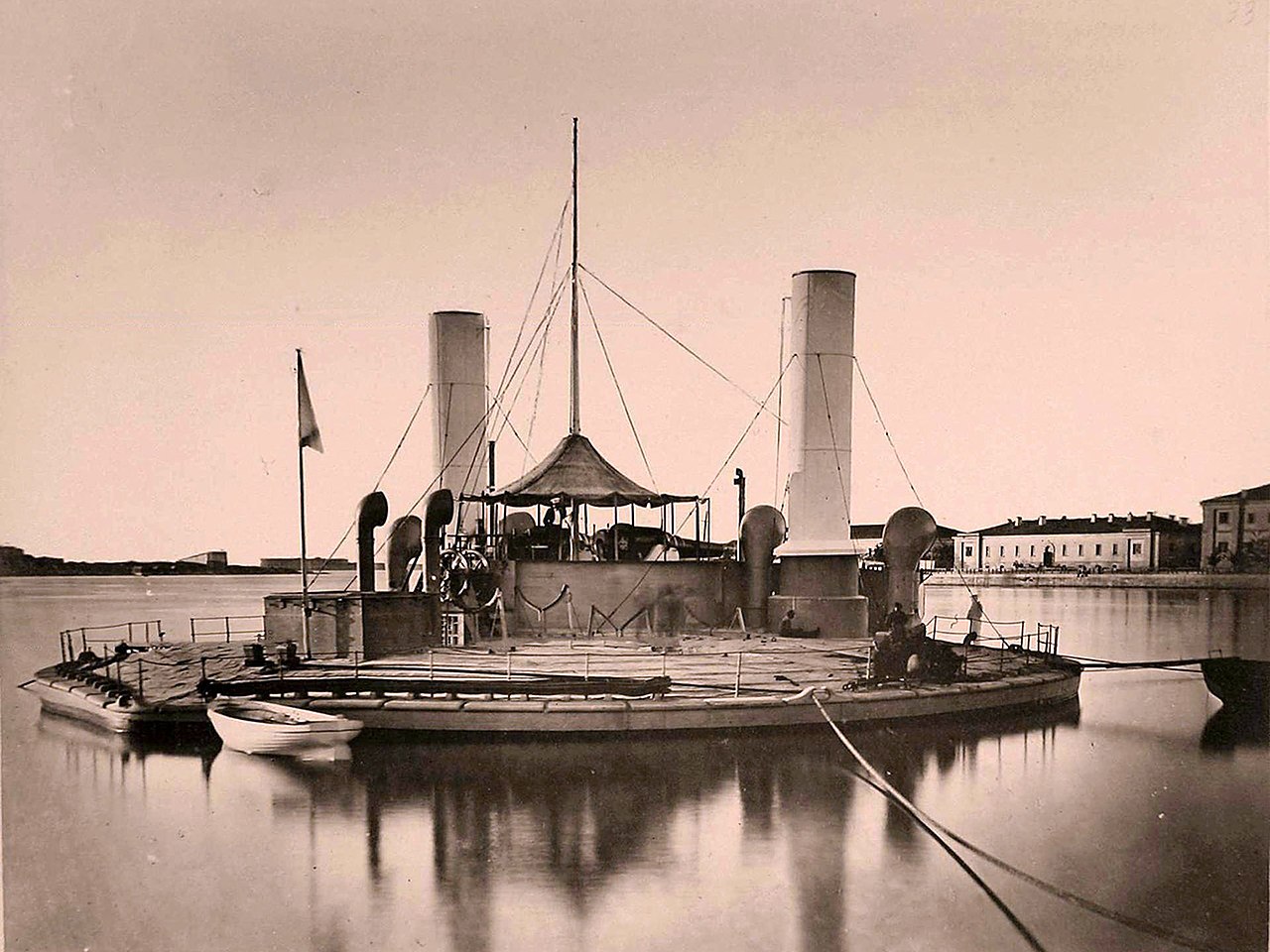
Novgorod shortly after entering service
But if Livadiia was a success, then that raises the question of why her elliptical hull remains entirely unique in the history of shipbuilding. Surely someone else would have needed the unusual set of characteristics she possessed, and her design was reasonably well-known at the time. I suspect that the answer lies less in the efficiency of the elliptical hull than in the inefficiency of so much else in 1880. Froude had built his first towing tank only a decade before, and Penelope, which Livadiia was compared to, was commissioned even before that. William Hovgaard credits the vessel's propulsive efficiency to favorable placement of the propellers, something that was going from a random accident to the result of careful study during this era. And I also suspect that the efficiency of the elliptical hull falls off at higher speeds, which were rapidly becoming necessary during the 1880s. As such, even while the idea of a short, fat ship reappears every few decades, modern proposals invariably have a more conventional hull form.
1 Amusingly, there was no specification in the treaty of how tonnage was to be measured. ⇑
2 Wikipedia credits her with 15.7 kts, although the source in question is in Russian, which opens up all sorts of room for weirdness, so I'm following William Hovgaard's account in Modern History of Warships. ⇑
3 For comparison, a 153' beam at the waterline makes Livadiia wider than the Nimitz and the same as Oasis of the Seas, one of the world's largest cruise ships. ⇑
Comments
"how to get the most out of this tonnage"
That never ends well!
One suspects that the problem of support facilities was also lurking in the background - if you need to build a while new dry dock for your extra-wide ship it’s not so cost effective as it might appear.
Admiral Popov would have understood Senator Tillman.