
In early April, 1982, Argentina invaded the Falkland Islands, a few desolate rocks in the South Atlantic. The British mobilized their fleet, sending it south by way of Ascension Island. On the 25th, a force retook South Georgia, a even smaller and more desolate island that Argentina had also captured, while the main task force closed in on the Falklands. May 1st saw the British launch their attack, first via bombers from Ascension and then from the carriers.1
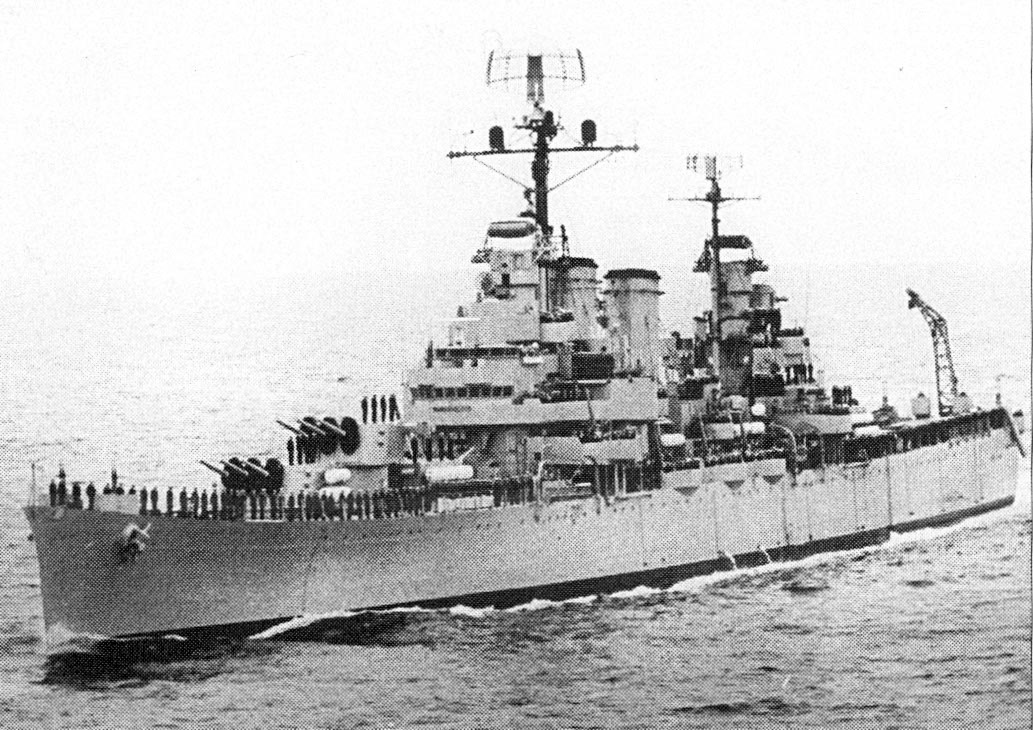
General Belgrano
May 1st had passed with little interference from the Argentinian Navy, but on the 2nd, Admiral Juan Lombardo, in charge of the naval defense of the islands, sent his forces into action. He had divided his available assets into four task groups, and sent three to the north of the islands, and one to the south. The most obviously dangerous group, TG 79.1, was composed of the carrier Veinticinco de Mayo, which had begun her career as the British Venerable, and two Type 42 destroyers, sisters of the ships that formed the core of the British fleet's air defense capability. This group was accompanied in the north by TG 79.2, two ex-US destroyers armed with Exocet anti-ship missiles.2 The last northern force was composed of three French-built Drummond class corvettes, also armed with Exocets. The southern force was built around the light cruiser General Belgrano, formerly USS Phoenix. She was escorted by another pair of Exocet-armed American destroyers. While it's easy to dismiss her 6" guns as obsolete in the age of supersonic fighters and guided missiles, the Belgrano was a serious concern for Admiral Woodward. His force was not set up to deal with a serious surface threat. The largest guns available were 4.5" weapons that were seriously outclassed by the Belgrano's guns, and their Exocets were not designed to kill armored ships. If the cruiser had managed to close within gun range of the carriers, probably at night or in bad weather, the results would likely have been disastrous.
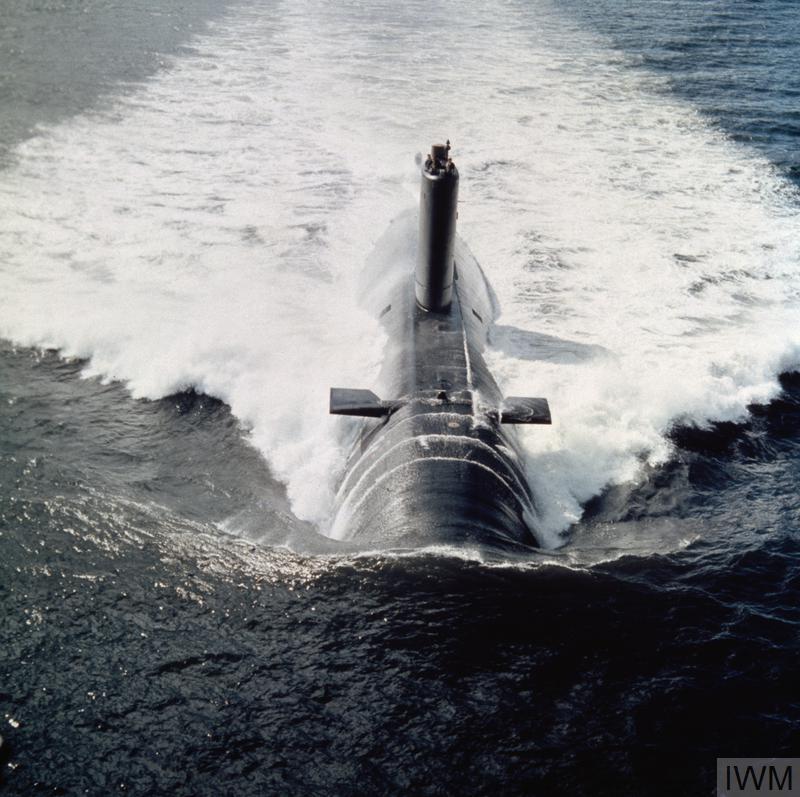
HMS Conqueror
The main British counter to the Argentine navy was their nuclear submarines, several of which were already in the vicinity of the islands. The northern groups had evaded the hunters, but Belgrano was not so lucky, and HMS Conqueror had picked up the group on May 1st. This allowed Admiral Woodward to focus his defenses against the strikes expected from Veinticinco de Mayo as part of the "massive attack" Lombardo had ordered on the 2nd.3
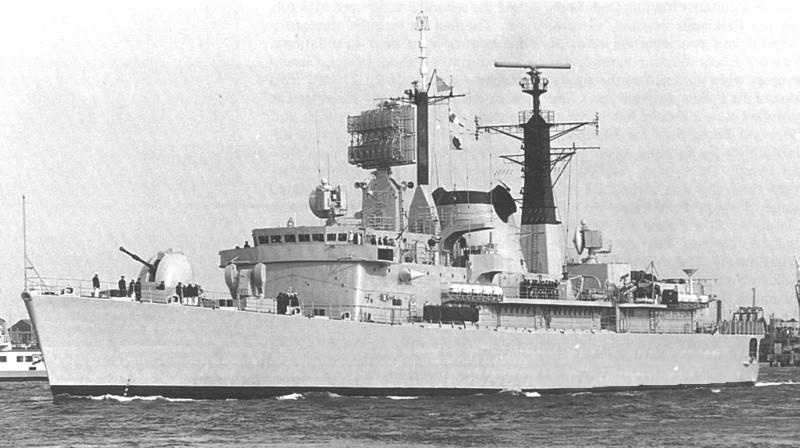
Santsima Trinidad, one of the Argentine Type 42s
The action on the 2nd began early when the British sent a pair of Harriers to investigate radar contacts to the north. 150 miles from the fleet, one of them popped up to make a radar sweep of the surface, and had the rude surprise of seeing a task group less than 10 miles away. The pilot's radar warning receiver alerted him to the presence of a Type 909 radar, the system associated with the Sea Dart on the Type 42 destroyer. The Harrier dove for the deck, and made good its escape. Admiral Woodward now knew where the enemy fleet was located, and deployed his trio of Type 42s about 30 miles towards the threat, while screening the carriers with his remaining escorts. CAP would be overhead from before first light, and he hoped that the Sea Harriers would be able to spot the low-flying A-4Qs, along with any land-based aircraft sent to aid the attack.
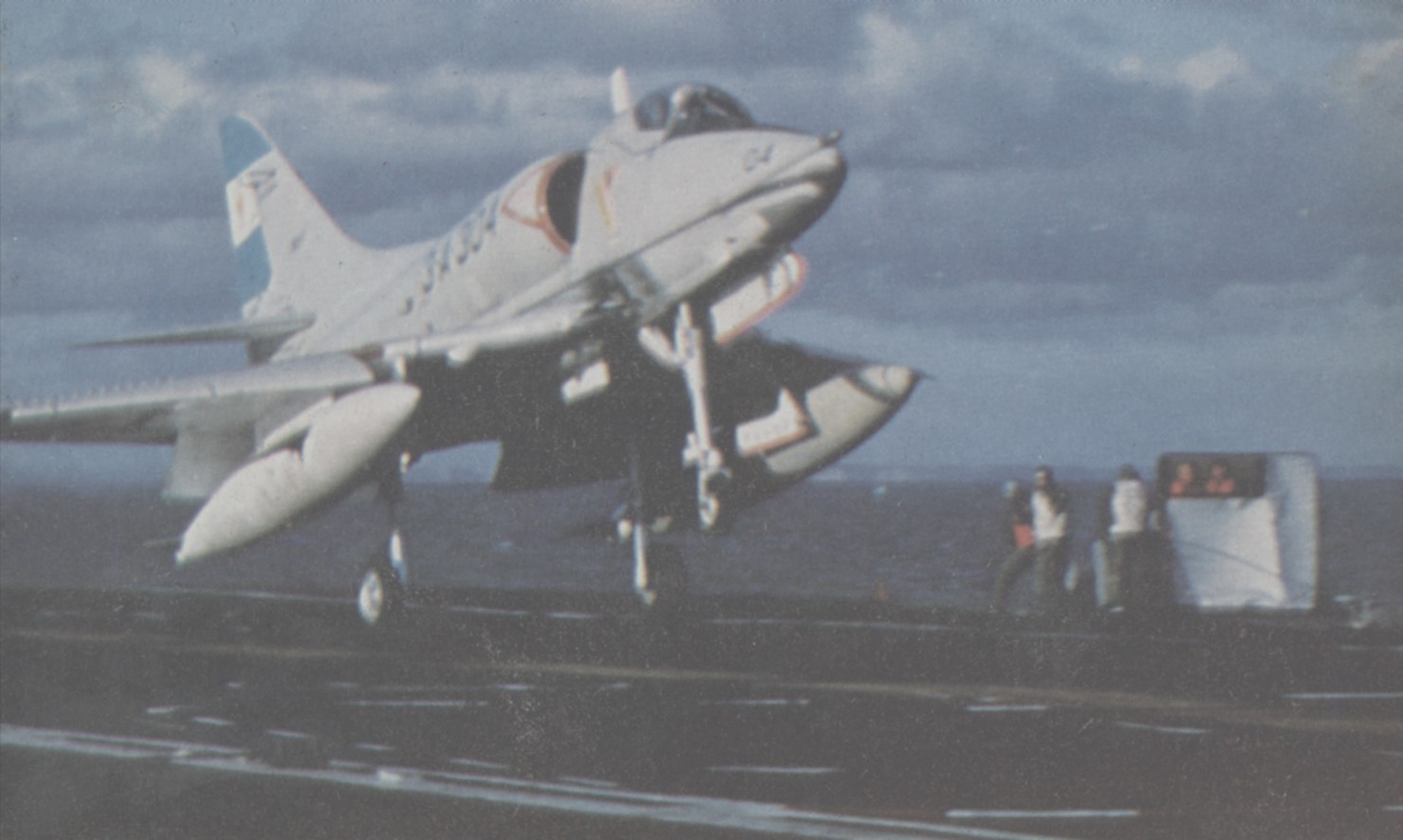
An A-4Q operating off Veinticinco de Mayo
The attack never came. The normal howling winds of the southern oceans dwindled to nearly nothing. The Argentine carrier's own speed and catapults could produce an airspeed of about 100 kts, but a fully-loaded Skyhawk needed another 25 kts of wind to get airborne. As it was, the choice was between sufficient fuel to reach the British and bombs to kill them, and the commander of the Veinticinco de Mayo decided to simply wait. The Argentine Navy, in a bout of inter-service rivalry, had decided not to inform the Air Force of its plans, and it only launched 19 sorties, as opposed to 56 on the 1st. The Navy's own land-based aviation units did attempt to get into the fight, launching a pair of Exocet-armed Super Etendards. As their unrefueled range was insufficient to reach further than Stanley, a C-130 tanker was detailed to support them, but problems with its systems resulted in the mission being scrubbed.
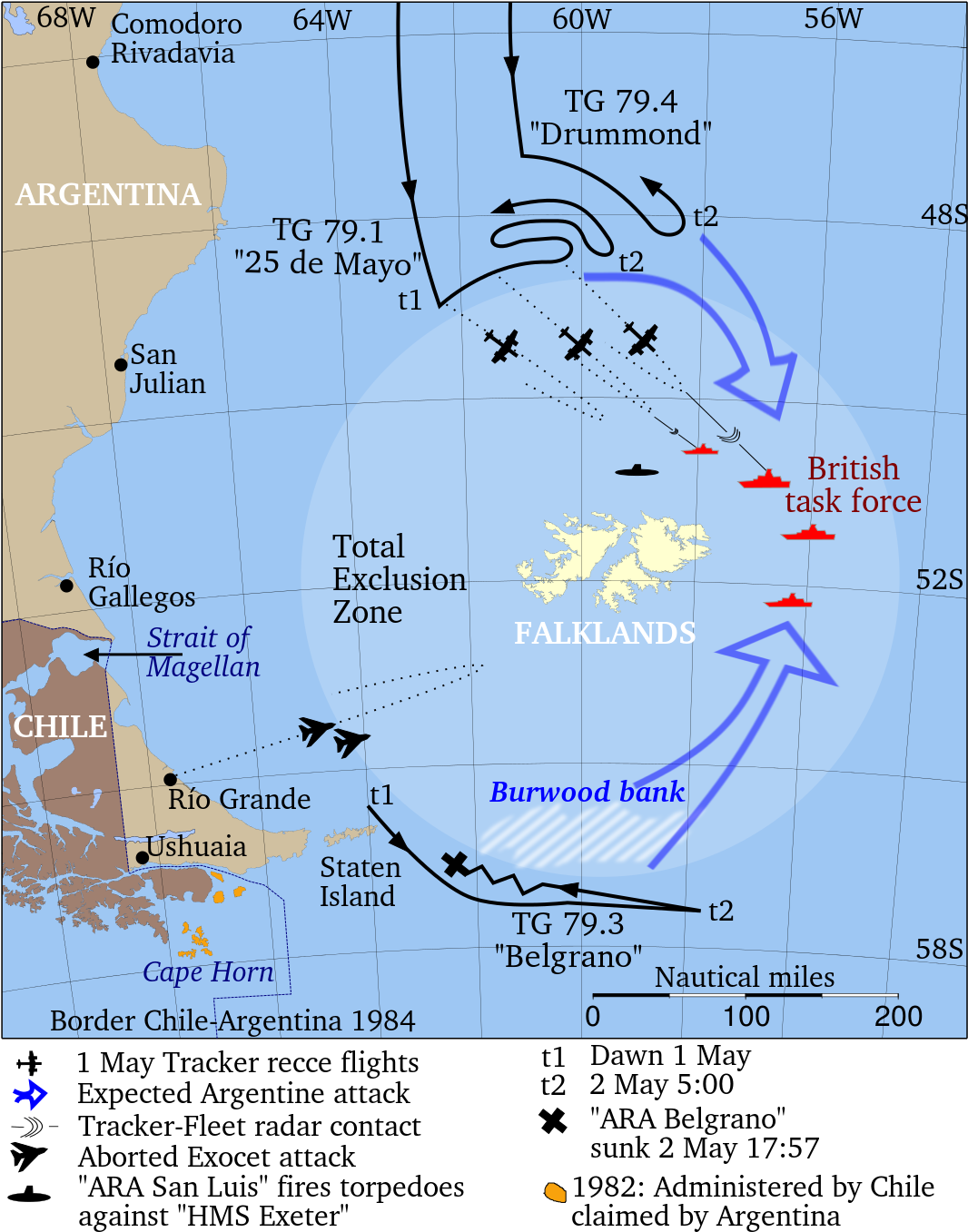
But it was events in the south that would guarantee British control of the sea. The Belgrano had been making her way slowly west during the 2nd, but she and her escorting destroyers would have 15 hours to make a high-speed approach to the Task Force, about 300 nm away. Worse, this course would take her across an underwater formation known as the Burdwood Bank. South of the Bank, the water was approximately 10,000 ft deep, but the Bank was quite shallow, as little as 150 ft in places, and poorly-mapped. If Conqueror was to try to follow the Belgrano across the Bank, there was a very real risk she would collide with an underwater mountain.4 Even if she hadn't actually hit anything, she was fitted with a clip-on towed-array sonar,5 and it would have been destroyed by the passage through the shallows, making it impossible to track ships at long range.
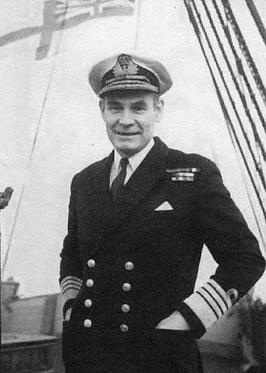
Terence Lewin
This situation prompted Admiral Woodward to force the government's hand, sending orders for Conqueror to sink the Belgrano while outside the 200-mile Total Exclusion Zone the British had declared around the Falklands6 despite lacking the authority to do so. The order was intercepted before it went to Conqueror, but it got the attention of those in the UK, and the Chief of the Defense Staff, Admiral of the Fleet Terence Lewin, took the request to the War Cabinet. On the basis of his testimony that the Argentines were planning a pincer attack, and that the present course and speed were essentially irrelevant, the Cabinet authorized Conqueror to attack.
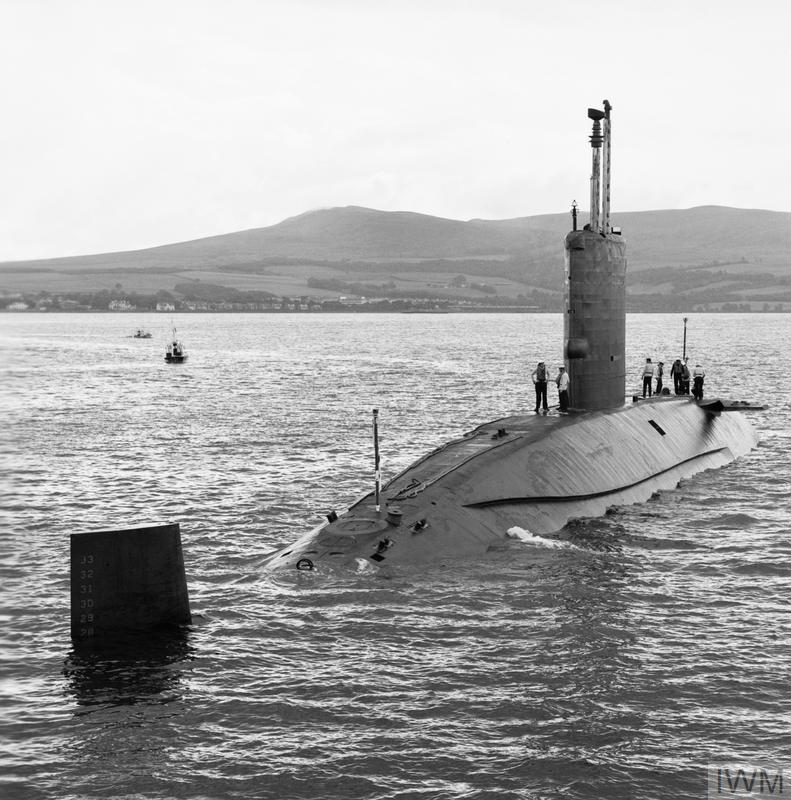
Conqueror
This order was given at 1330 GMT,7 but communications difficulties caused by damage to her masts from heavy seas meant that Conqueror did not get confirmation until four hours later. Reaching attack position on the Argentine ships, which were not even zig-zagging,8 took another hour and a half, thanks to the ground lost while piecing together the signal. Finally, at 1857 GMT, Conqueror fired a trio of WWII-era Mk VIII torpedoes9 from 1,400 yds in a spread aimed to put one of them into the Belgrano.
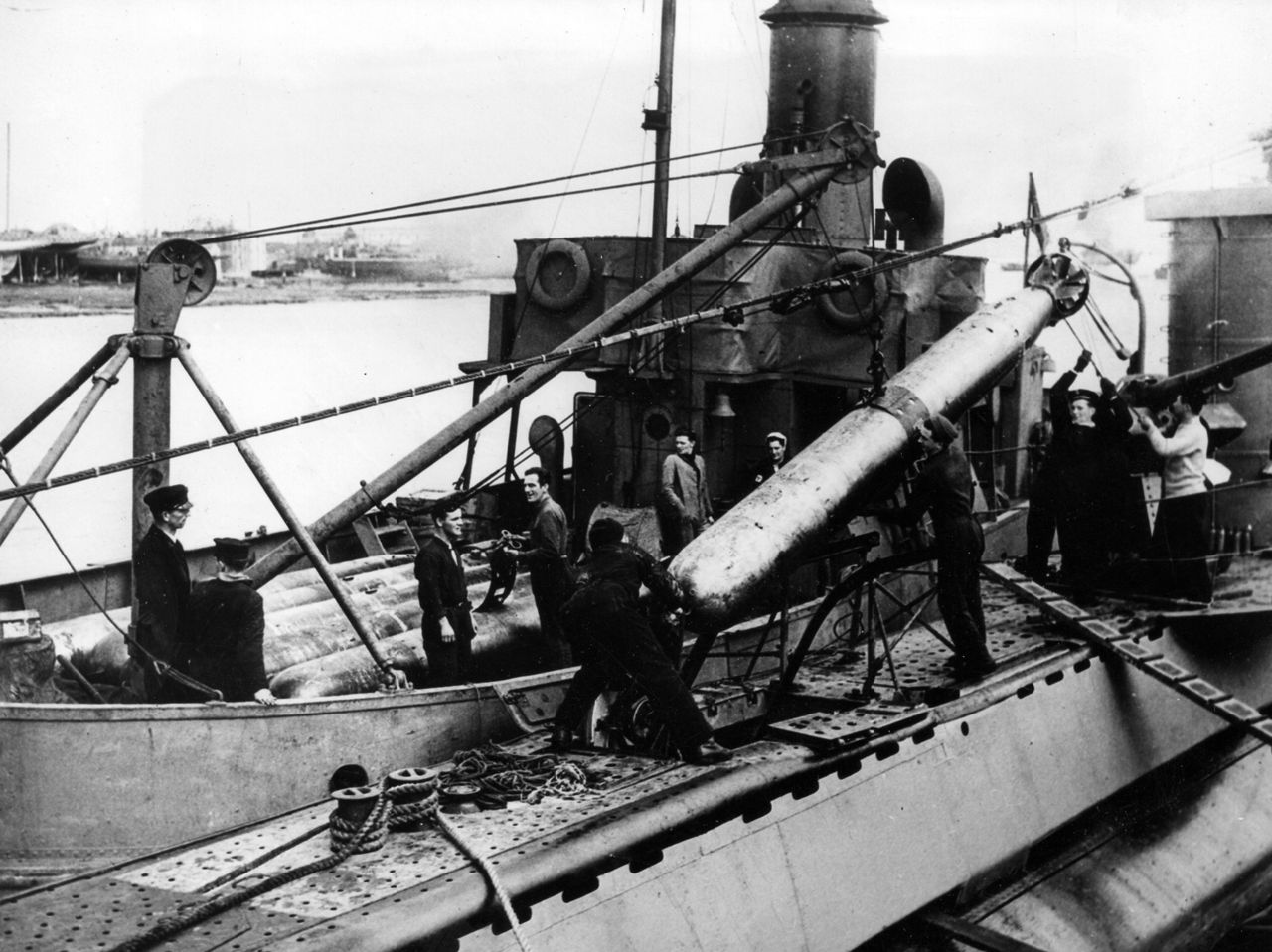
Mk VIII torpedoes being loaded aboard a submarine
The Belgrano was not expecting the attack. She was making only 10 kts, watertight doors had been left open and many of her men were enjoying an afternoon break in the mess deck. Two of Conqueror's torpedoes hit on the port side, one near the bow forward of the 6" turret, the other detonating alongside the engine rooms. The first hit smashed up the bow, but the bulkheads held, and the ship could easily have returned to port. The hit aft was much more serious. It managed to flood the engine room and sent a fireball racing through the mess deck, killing approximately 275 men.10 Power failed throughout the ship, and the officers quickly determined that she was doomed and ordered her abandoned.
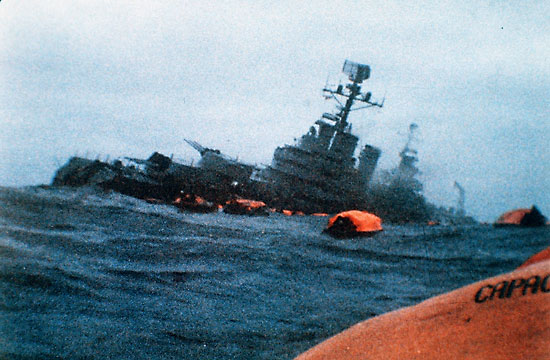
Belgrano about to sink
The crew deployed the self-inflating life rafts and evacuated in good order. Unfortunately for them, the loss of power had been too sudden to let them get a message off, and the destroyers, several miles away, had not seen her other distress signals. The destroyers were also distracted by an impact that one of them, Hipolito Bouchard, felt at about the time Belgrano was hit. The crew believed it to be a dud torpedo, and later examination in drydock revealed a mark consistent with this theory. If so, Conqueror nearly bagged her, too, although the torpedo was apparently moving too slowly (presumably at the end of its run) to set off the warhead. In any case, they immediately began hunting the submarine, and only noticed the lack of contact with the cruiser two hours later. The delay meant that the crew were not rescued until the next day, having spent the night in the brutal conditions of the Southern Ocean. A few rafts were lost, but in the end 772 of the 1,095 men aboard were rescued.
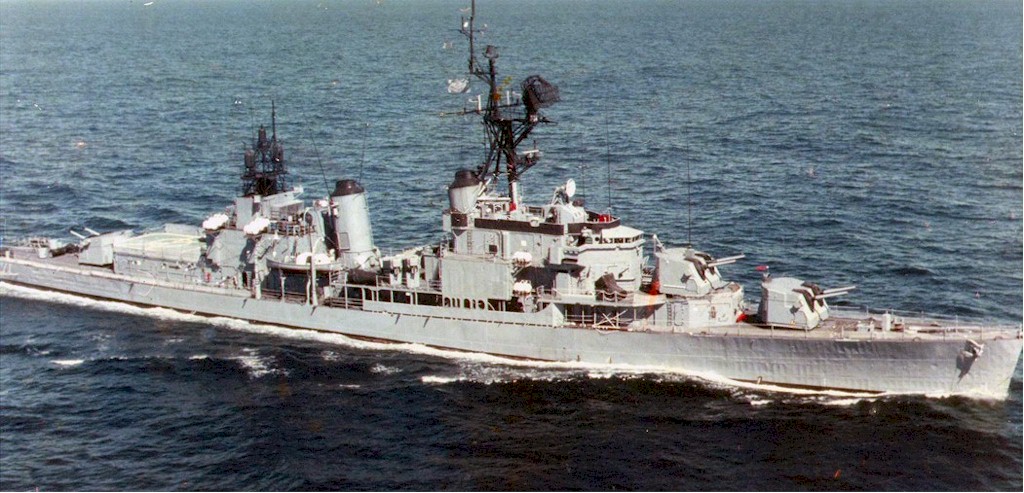
Hipolito Bouchard
Conqueror's three torpedoes, the only ones ever fired in anger by a nuclear submarine, immediately changed the war at sea. Admiral Woodward's southern flank was no longer in serious peril, as the destroyers, even if they had still been willing to risk an attack, were within the capability of his force to handle. More than that, the attack prompted Lombardo to withdraw the rest of his fleet into shallow water where the British submarines couldn't follow, securing control of the waters around the Falklands for the British. The 3rd was a fairly quiet day off the Falklands, at least as far as the war went. The storm that had battered the survivors of the Belgrano reached the British task force, and they sat the day out.
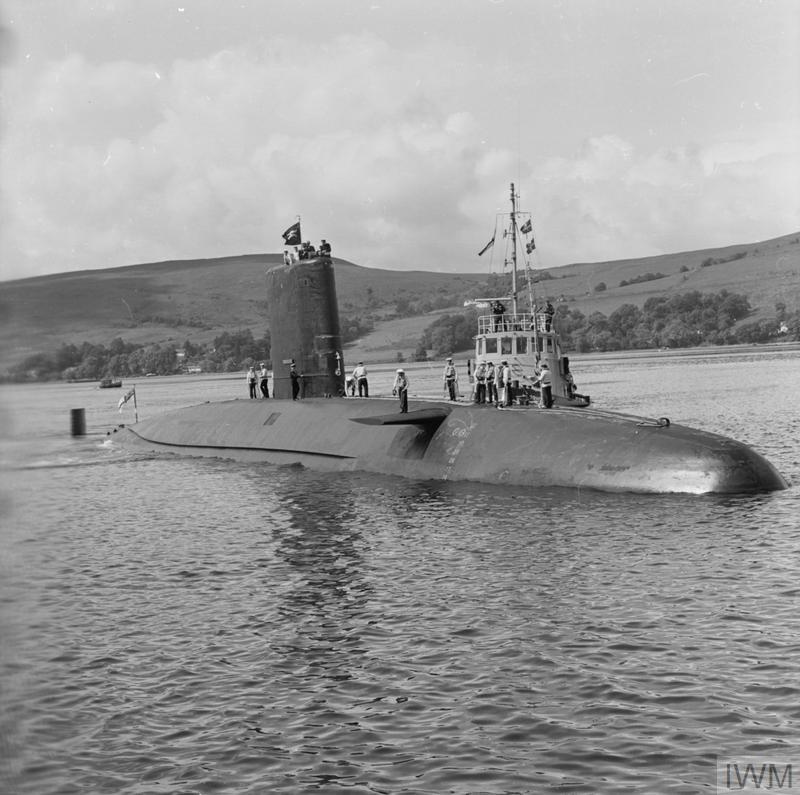
Conqueror returning to port after the war
The sinking provoked a controversy that continues to this day, due to the Belgrano's course away from the battle and position outside the exclusion zone. Argentine nationalists and anti-Thatcher elements in Britain have both demonstrated their ignorance of military affairs by claiming that this somehow rendered the sinking illegitimate. This was very much not the case, and in postwar interviews, the officers of the Belgrano agreed that they had been a valid target. The situation was made worse by a peace proposal from the President of Peru, which was issued 14 hours before the sinking, but did not reach London until afterwards. Argentina used the Belgrano as a pretext to reject the proposal, although it's unlikely that they would have accepted it anyway, as they continued to reject British peace offers for the rest of the month.
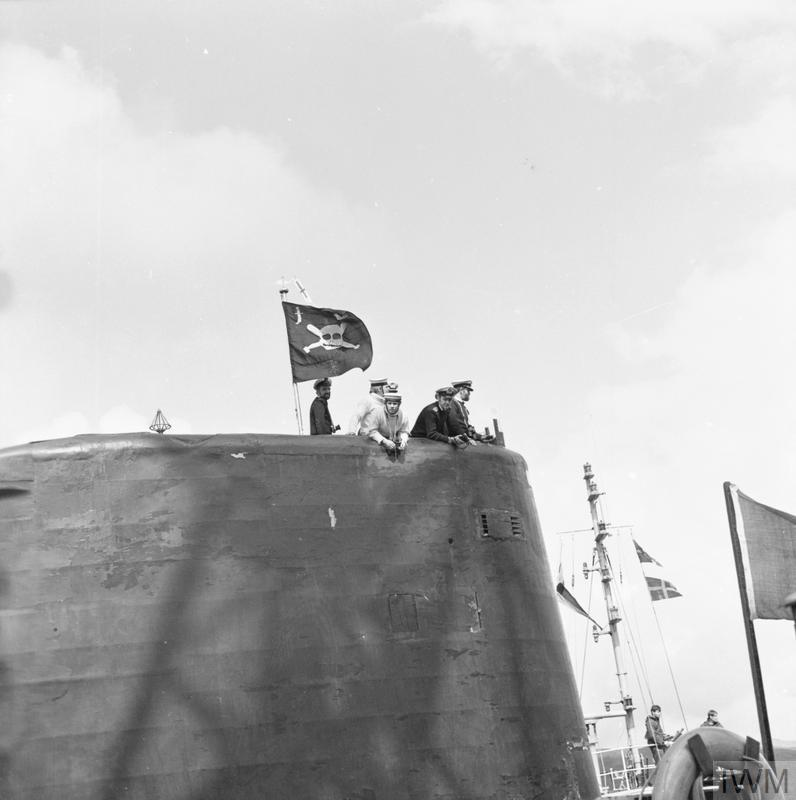
Conqueror flies a Jolly Roger flag, representing her sinking of the Belgrano
General Belgrano remains both the only vessel sunk by a nuclear submarine in time of war and the last vessel to serve with the USN in WWII sunk by enemy action. Her loss was a critical turning point in the war, securing British sea superiority. The first two days of May saw the British Carrier Task Force come close to achieving its main goal of securing air and sea superiority in preparation for the upcoming landings, for little more than the cost of ammunition expended. Over the next few days, they would learn that Argentina would not fall that easily, as British fortunes took a turn for the worse.
1 I've written a glossary to make it easier to keep track of terms in this series, and the full series is linked here. ⇑
2 This is rather confused. Some accounts say that the ships from TG 79.2 were actually detached to accompany the Belgrano, but I'm following The Royal Navy in the Falklands War, which definitely says that there were two other destroyers in the north. ⇑
3 The British, always experts at exploiting enemy communications, had intercepted this signal, and used similar signals intelligence methods to get a reasonable location on the Argentine fleet. Unfortunately, neither of the two SSNs to the north of the islands was close enough to intervene. ⇑
4 Traditional nautical charts are concerned primarily with making sure that the locations of topography that can threaten surface ships are correct, and there have been many cases where underwater obstacles have been found to be miles from their charted location, occasionally by a submarine running into them. The most prominent recent example is USS Connecticut, which ran into a seamount in the South China Sea in 2021. USS San Francisco was almost lost after a similar incident in 2005. ⇑
5 For various reasons, the array was attached at the start of the patrol, and left there for the entire time, being retrieved by a boat as she returned to base. As it was, Conqueror's array was damaged by grounding during the war. ⇑
6 It should be noted that the British had previously told the Argentinian government via diplomatic note that any vessel or aircraft that posed a threat to the British fleet, regardless of location relative to the exclusion zone, would be attacked, giving flat lie to many of the claims about Thatcher's decision. ⇑
7 The British forces used GMT throughout the campaign, although it was three hours ahead of local time. ⇑
8 Zig-zagging is a common precaution against submarine attack. The theory is that frequent course changes disrupt the ability of a submarine to reach attack position and get a firing solution. In practice, it's moderately effective against slow submarines, but not that useful against fast ones unless the target ship is also moving very fast. ⇑
9 Conqueror also carried the more modern Tigerfish torpedo, but it was not seen as sufficiently reliable, so the straight-running Mk VIIIs were used instead. ⇑
10 Many of the details of the sinking don't align with what I know of battle damage on other ships, but the reporting is fairly consistent. The basic Brooklyn design survived worse during WWII, but the Argentine navy was not up to WWII USN standards, and that shows very quickly in damage control. ⇑
Comments
The Falklands histories I've read have always approached things from the British point-of-view. As a result, I've never seen an interrogation of the Argentine decision to withdraw their navy to port. It strikes me that at this point the war is basically over - yes, there are some twists and turns still to come, and maybe if the FAA had got incredibly lucky they might have hit an aircraft carrier with an Exocet, but basically the Argentinians are now sitting passively just waiting to be conquered. So what were they thinking?
The little discussion I have read puts it down to rivalry in the junta, which I find hard to believe as a stand-alone cause, rather than as part of a bigger explanation. Were they thinking they could put to sea again later? Did they imagine that Britain would just give up? Did they not understand that they would all be thrown out if they lost the war? Did they fail to comprehend how bad their strategic position was? Or did they understand all that, but think that naval engagement would be futile?
There is an alternate universe where Lombardo, enraged by the loss of the Belgrano, sails on and confronts the Task Force in what is presumably the largest naval battle since WW2. What do you think happens? Are they massacred by British subs before they can even engage the fleet? Does the Exocet wreak havoc? To my mind, this is the most fascinating unanswered question of the war.
This is a hard one to figure out. I think the biggest factor was probably the institutional drive to preserve the ships. Even Lombardo, whose neck was on the line as part of the Junta, was still deep down a Navy man first, and a member of the Junta second. If the Navy is destroyed in the war, he's lost his power base, and gets thrown out of the Junta anyway.
At the same time, I'm not as sure as you are that the war was lost. Amphibious landings are tricky things, and they probably thought they had a good chance of being able to throw the troops back into the sea. The British have to win both sea/air superiority and on land. The Argentines can win either and still emerge victorious.
Figuring out what happens with the Lombardo's Revenge scenario is going to take much more information on what the submarines were doing than is available in public sources.
But they didn't contest the amphibious landings. In fact, it was so uncontested that some of the British landed, got bored, decided that it was easier to sail than march, and did a new amphibious landing closer to Stanley to save effort. And it's hard to see how they could have contested them, because the Falklands are big compared to the number of Argentine troops, and the Task Force gets to choose where to land. They can't have imagined that the British would try to land in Stanley right against their dug-in positions.
Or did they? Because it's weird that they lost without ever fighting a proper battle - was that what they were hoping for?
The amphibious landings were uncontested because the British landed at the opposite end of the island from Stanley. That was unexpected by everybody. I haven't looked into the amphibious landings yet, but IIRC there was serious talk of landing much nearer Stanley, and that was what Argentina expected.
Bluff Cove was a logistical landing, not a combat one. They had confirmed it was clear of troops, and it thus made sense to not have to ship supplies halfway across the island.
As for battles, do Goose Green and Mount Tumbledown not count? The reason the forces in Stanley surrendered was because the British had the hills around them, and it was clear that further defense was untenable.
If they were expecting a landing next to Stanley, that's foolish, but the ordinary kind of understandable foolishness that happens in strategy. So I guess that makes sense.
By battles I didn't necessarily mean land battles. Goose Green is famous but that was a tiny portion of the Argentine forces, and it was initiated by 2 Para, not the defenders. It would have been pretty shocking if the Argentinians had surrendered there without a fight when they had almost a 2-1 advantage. I just meant the more general phenomenon where the navy stays in port so as not to risk their ships, the air force don't go to the Harriers altitude so as not to risk the planes, the army stays dug into Stanley until they get surrounded - it feels like they should have just surrendered if they weren't going to engage the Task Force. And maybe that's the answer - it's certainly the case that the junta was shocked when we sent a Task Force, so maybe they had inwardly accepted defeat at that point and were just playing out time.
But if they were playing to win then I remain convinced that they were in big trouble at this point. The army did as well as could be expected in the circumstances and the air force considerably better.
I suspect the Junta started drinking their own Cool-Aid, and couldn't back down when it was obvious the British were going to fight. (Which is really what they should have done, and I'll agree that the war was essentially decided by May 3rd.) There's also the issue of morale. Well-led men with good morale will stay in combat even when the odds are bad. When the officers are bad and the men don't really want to be there, then your force crumbles quickly. Particularly if you try to get clever and attack.
As for the navy in particular, I suspect they were too invested in the carrier to hazard her. This is a navy that to this day conducts occasional CATOBAR training when there's a USN carrier passing by. Even though they haven't had a carrier in 28 years. Think about what it was like when they did have one. They'd never recover the institutional prestige of losing her.
Part of the reason Sandy was so worried about the enemy carrier was that the British force lacked any AEW capability, greatly increasing their susceptibility to a raid.
Interesting thing about that map (which I used in my ASW engagements since 1946 brief, incidentally), didn't San Luis actually attack HMS Yarmouth and HMS Brilliant, not HMS Exeter? Lucky for them her torpedo FCS was miswired. I can't imagine how frustrating that must have been for the sub's CO and crew. Would have been interesting if that mistake hadn't been made...
Supposedly, Belgrano was equipped with mock-up Exocet launchers constructed of wood. The British of course didn't know they were fakes and this raised their estimation of the threat she represented. I think she'd have been sunk anyway, but still not exactly helpful.
Fun fact about Belgrano (Ex USS Phoenix): she got in some hits on Fuso-class BB Yamashiro at the battle of Surigao Strait.
As I found it, the escorting destroyers (both FRAM II Allen M. Sumner-class) had basically had no ASW capability. An officer who served aboard one of them noted that they were still technically equipped with VDS, they weren't using because it was "very old and not much good." The Argentinians seemed to conceive of them as primarily ASuW (they had Exocet fitted, IIRC) and presence platforms. Belgrano herself had no sonar, but did have a hanger for a couple of Alouette IIIs, though they had little or no ASW utility. She'd had torpedo bulges fitted postwar, but it doesn't seem to have helped much.
It's also worth mentioning how spurious contacts had the British running around like crazy prosecuting phantom Argentine submarines. Surface ASW is hard.
Re the ASW hunt on the 1st. I looked into this, and honestly couldn't figure out what was going on. Every source said something different, so I just punted and said "ASW engagement, details unclear". But I do think it was Brilliant and Yarmouth.
(Speaking of that presentation, are you ever going to write it up so we can see it?)
I did know about the spurious contacts, and how much time they spent prosecuting the local marine life. I even wove that into the Staple Head story, just for fun.
Yes, I feel rather guilty about that. I moved to a job at a different company which, while a major step up, is also keeping me absurdly busy. It's definitely still in my queue but it's probably going to be another month or so before I can put electronic pen to paper and get it into a nice blog-post format.
Congratulations on the move! I look forward to seeing it when you have some time to write it up.
The Belgrano was not a serious threat to the British Task force. There was no way it was going to get to the carriers. This was 1982, not 1942 when Spruance with primitive CXAM radar had to worry about stumbling into the Japanese at night. Even without AEW, modern shipboard radar and Sea Kings flying with first generation night vision goggles would have prevented any attempt to sneak up on the carriers, night or bad weather notwithstanding. Spruance completely negated the night engagement threat by sailing east for just a few hours on the night of the 4-5 June; had the British thought Belgrano was north of the Falklands Woodward could have just sailed out to sea a bit and had plenty of standoff to search for it come daylight.
Nor would the Belgrano's armor make it immune to Exocets. The 20(?) or so Exocets with the British Task Force could have been expected to around 12 hits, given Argentine experience. An Exocet warhead is 364 lbs, compared to a 1000lbs bomb with 445. Even if none of them penetrated the belt, I do not see the Belgrano taking the equivalent of a ten Mk83s (or 22 Mk82s) and staying in the fight. Even if it never sank because it wasn't holed at the waterline, it would have been trashed. The idea that all of them would have bounced off the belt isn't reasonable, although sea skimmers are nominally designed to hit the waterline, as far as I can tell all hits at the Falklands (as well as the USS Stark a few years later) would have been above the belt. I can see scenarios where a single Exocet takes the Belgrano out of the fight, even if at no risk of sinking (a rear hit damages steering and it can no longer give chase, a hit at the unarmored bow lets in enough water to do the same, a hit higher up scrambles the fire control and the ship can't fight, a hit and/or subsequent fire gets to Sea Cat or 5" ready ammunition and the secondaries ruin the upperworks, etc.) With three or four hits I think its almost a given.
The proper employment of the Belgrano would have hiding inshore among the coves and islands of the Falklands, as the British did at South Georgia with Endurance. Although it would never have reached Invincible/Hermes, the Belgrano sailing up Falkland Sound the night of 21 May could have ended the British landing before it began. Exocets might been unusable in clutter close to shore, there was actual chance to sneak up or surprise the British, and there wasn't even if a need to engage, just revealing itself and causing a hasty British retreat would have been a major operational victory. If the Belgrano managed to get one or two of the priceless LPDs, it could have ended the war (not even necessary to sink them, causing one or both to run aground or take enough damage it needed to head back for repair virtually ends invasion prospects, a fire that makes embarked troops abandon ship or destroys all equipment is similar).
Knowing this, a Belgrano hiding inshore would have become a classic fleet in being, with the British unlikely to attempt to land until they knew the threat was removed. The cards are all on the Argentine side in this case. The way to get to Belgrano in shallow water would have been with Sea Harriers, but I believe all British air losses came from ground fire. Keeping an inshore Belgrano covered by AAA and SAMs would have created the possibility of attriting Harriers in greater numbers than actually happened, as the British would have been forced to attack into air defenses instead of avoiding them.
But the greatest effect of this deployment could have just been buying time. The weather turned in the South Atlantic almost literally the day after the Argentine surrender. A few extra weeks of waiting to find the Belgrano (if it was playing hide and seek), or sink it (losing Harriers to air defenses in the process), or having to reset an aborted landing if it popped up unexpectedly, and the British invasion could have been pushed out months until the Southern winter ended, with both diplomatic and logistical implications not favorable to the UK.
All of this could have been greatly magnified if the Argentines had managed to the Belgrano's sister ship, the Nueve de Julio, to the Falklands as well. It was useless as a combat ship, but using it for a shell game with the Belgrano would have greatly hindered British efforts. Is that cruiser tied to a tug the hulk, or the Belgrano pretending to be the hulk? Is the ship anchored off of Stanley an immobile floating battery, or a functional warship able to set sail at a moment's notice? Once again, just a few extra weeks to figure out which ship is which, or to sink both to be sure, or waiting for replacement Harriers because so many were lost attacking two defended targets, could have delayed a landing past the middle of June, at which point weather might have meant waiting to August/September.
You're not wrong that hiding the Belgrano inshore would have presented a much more serious tactical problem for the British, and to the extent that is true, I agree that the Argentinians handled her wrong. (Although there is the problem that the British could move the landing site to avoid her, and the Argentinians didn't expect a landing in Falkland Sound anyway.)
I don't think it's necessarily true that she wasn't a threat when Conqueror sunk her, though. Yeah, most likely Woodward can pick her up in time to avoid ending up in gun range (although remember that there are Exocets on her escorts, too) but it seems worth closing off even a 5% chance he can't. And even if he can, well, he now has this cruiser to deal with.
And I'm really not so sure that the Exocets were going to do a good job killing the cruiser, either. You posit mission kills from hits for or aft, but the early Exocets were extremely dumb, and would probably have gone for center of the radar reflection. (Note how close together the hits on the Stark were.) That probably puts most of the hits in the superstructure around the base of the funnels, which is not an area that contains much in the way of critical systems that aren't armored. Yeah, maybe the British get lucky and cut the wiring from the directors to the plotting room. Totally could happen. But again, how much are you willing to bet on that, and that the local FC in the turrets isn't adequate against targets which are going to be extremely vulnerable to even a single 6" shell. It's not Woodward's job to give the enemy a sporting chance, so he removed the threat entirely and early, and rightly so.
(I'd suggest gaming this out in CMO, but from past experience, CMO doesn't really handle armored warships all that well.)
Onux:
An enemy warship is a threat and a legitimate target.
A huge mistake I made in my wording. When I said the Belgrano was not a threat, I did not mean that it was not a legitimate target or that the Brits should not have sunk it. It was a completely legitimate target and Woodward was completely right to send the order to sink it, and the War Cabinet completely right to approve it.
When I say not a threat, I mean it was a weapon system that could not effectively engage the British task force at sea given the tactical and operational considerations. An attack helicopter barely flying at its max altitude of 15,000 feet is not a threat to a combat jet flying at 35,000 feet, so it is useless to send an attack helicopter flying around like that hoping it will win a dogfight. That same helicopter is deadly to a combat jet parked next to a runway, which is how you use use that system.
Same analogy here, the "pincer movement" was an illusion, the British were going to detect the Belgrano well before it came within gun range of any ship, let alone the carriers, and had more than enough firepower to take it out of action, even if they could not quickly sink it. A Belgrano in shore, however, puts an absolute hard stop at any attempt at landing until it is destroyed, and it located where it is least vulnerable to attack (water too shallow for subs, can be covered by ground based air defenses).
I admit my "single hit" mission kill is more of a formal hypothesis, not a likely outcome. You make an excellent point about the targeting of early Exocets and that hit would likely be base of the superstructure. But the British would never fire a single missile hoping for the best. They would have fired a salvo, and I don't see how 1,000-1,500 lbs of HE detonating at the superstructure from multiple hits does not have an effect. Even if it is just a few hours to put out fires and restore tripped breakers, and the core combat functionality of shooting and moving is unaffected, during that time the task force has opened up another 100-150nm, and once dawn arrives so do the Harriers to finish the game. Also if Belgrano is charging the task force then it is likely the missiles come head on, in which case the largest target is the front of the superstructure, and the effects on C3 to a couple of hits there (bridge, main director) could easily make the ship a mission kill.
The British can't just move the landing site if the Belgrano were in close. Traditional (non LCAC or helicopter) amphibious operations have tight requirements for beach and tide conditions, you can't just land anywhere you want. Something like only 15% of shoreline worldwide is suitable, and I wouldn't be surprised if it is less than that in the Falklands, given its rocky nature and South Atlantic seas. (On the other hand, the assault right onto sea walls at Inchon suggests requirements are not always so tight, and the British certainly displayed a great deal of audacity throughout the campaign). Operationally landing on E. Falklands is a non-starter (you can take it but no way to get to Stanley) and landing on Lafonia creates problems on land (the Argentinians can rush all their best units to Goose Green and bottle up 3 Cdo Brigade - with the Belgrano providing fire support).
But there are also time/space considerations. Even if the Belgrano were anchored off Stanley when the landing started, it is only 300km from Stanley to the entrance to San Carlos water going south around Lafonia. That's only ~5 hrs at max speed, the Belgrano could have been arriving by daylight (if the worst observation post in the world did it's job!). Going north it is even closer/shorter. In the correct employment, the Argentinians are moving Belgrano around, shifting every night, hanging camouflage nets, having its radio operators broadcast from a fishing boat sailing off of E. Falkland, etc. The risk that it happens to be hiding off Pebble Island the night of 21 May and can pop out and demolish the landing force as it tries to enter Falkland Sound is too great even if only 1%. Hence no landing attempt until an inshore Belgrano is decisively dealt with.
I do not think this is a good analogy. It is not physically impossible that the Belgrano could get the Task Force under its guns. It might be unlikely, but it was possible if things went wrong, and a prudent commander minimizes those odds.
That said, I did get an interesting insight into this when I checked Woodward's memoir, which I didn't have when I wrote this. His primary concern was apparently the Exocets on the destroyers, not Belgrano's guns themselves, and if the alternative to Conqueror is sinking the destroyers is an Exocet duel, that's a very bad plan.
They would definitely have some effect, but you can't just add up HE like that. Belgrano was armored, and I don't think that the fragments from an Exocet's warhead would be enough to meaningfully damage the deck. So if all of the hits are in the same area, the damage isn't really cumulative, because at some point, you're just bouncing the rubble left by the previous hit. And what that means depends heavily on what that rubble used to be. (There is at least one thing in the probable hit area that could cause a mission kill, but that would depend on several different things I'm not sure of, so I wouldn't want to count on it.)
If the ability to move is unaffected, how is the Task Force opening up more range? Also, consider that when new, Belgrano was 4 kts faster than Hermes, although goodness knows what the actual speeds were in 1982.
They're pretty flat, and a landing very near Stanley was discussed. But you make good points about the potential mobility of Belgrano. I don't disagree that she would have been better employed inshore, although that clearly didn't happen.
It is a bit of a bad analogy. I was using it to clarify my position on “not-a-threat-does-not-mean-don’t-sink-it.” Sinking the Belgrano probably won the war for the British, as with the Argentinians unwilling to contest the sea, the outcome was not in doubt. It was thus an outstanding move, even if against a rather dumb deployment (just as you should always shoot down that dumb helicopter trying to be a fighter).
To say that the missiles will hit center of return and not spread themselves stem to stern does not mean they will all pile into the same spot. The missiles that hit the Stark were in line, but separated a few dozen feet vertically. Both missiles hit the Atlantic Conveyor in the port quarter, but one didn’t fly in the hole of the other. Three to four missiles impacting the superstructure (or in the hull above the belt and armored deck) should find plenty of things to destroy that will affect operations. Electrical distribution (cables or panels), uptakes and down takes (plus blast blowing out boilers), ready ammo for secondary weapons, just starting fires amongst sailors bedding and clothing. Multiple hits of a few hundred pounds is probably worse than a single hit of 1500 in this regard. Is any of this fatal, absolutely not. But could it make a mission kill of the Belgrano, absolutely, at least for a time.
Plus in this specific case, the missiles are approaching from a frontal aspect. If the picture of the Belgrano at the top of the OP was the view of the missile, then center of return should be approximately below the director/mast, just aft of the bridge. I can think of a lot of things in that area that could affect ship operations if multiple large warheads scrambled it up.
“If the ability to move is unaffected, how is the Task Force opening up more range?”
Because I assume after any major caliber hit, let alone multiple, that there would have to be some period of slowing/stopping to assess and deal with damage. Even if it’s just relighting boilers or resetting breakers or whatnot. A fire (even if completely topside and not affecting engineering spaces) virtually guarantees this, as you are not going to fan the flames with 30kt induced draft while turning your hose streams into wind blown spray. Assuming each ship’s nominal speed (and you make an excellent point to question what they could actually make based on current maintenance and sea state) then Belgrano stopping for just an hour gives the carriers 28kts lead, which with a 4 kt advantage will take Belgrano 7 hrs to make up once going again. Night lasted about 14 hrs in the Falklands at this time, so it wouldn’t take much to keep Belgrano out of range until the Harriers could take off.
“They’re pretty flat,” The issue isn’t total elevation, the issue is slope of the beach and nearshore sea bottom. Coral atolls are even flatter, but the surrounding reef meant that tracked landing craft were needed to assault places like Tarawa, as regular LCVP/Higgins Boat craft couldn’t reach the sand. But unlike the Argentinians, the British didn’t have Amtracs, and while flat, the Falklands also have a rocky coast.
The issue isn’t could the British land somewhere other than San Carlos (absolute mobility) the issue is the relative mobility between their landing force and the Belgrano. Amphibious operations take a lot of planning and have a lot of considerations around tides. While sailing to San Carlos the British could not just switch the landings to Bluff Cove on a whim. It would take a few days (at least) to identify new beaches, assign which unit lands over each and in what order, determine the landing craft assignments to make that happen, develop a naval gunfire and air defense plan, etc. Belgrano by contrast could sail around the whole Falklands in a day. Hence the threat.
While the carriers can maneuver all they want to avoid contact and still perform their mission, the landing force must either stay the course to the planned landing (and be unable to avoid Belgrano and its guns) or cancel the landings completely to get away. In the worst case scenario the Belgrano surprises the amphibs in the narrow channel by White Rock Bay, and the landing ships literally cannot turn and flee without possibly running aground (or colliding with each other in confusion). The British lose ships either to 6” gunfire or the rocks, with no way out. The risk of this would have been a credible threat.
"although remember that there are Exocets on her escorts, too"
Yes, and that is the key point. The Argentinian Navy had one job on the night of May 1st - get their seven Exocet armed warships within range of the British Task Force, after having expended whatever assets were necessary (patrol aircraft, etc.) to locate it the day before. The 28 missiles they were carrying should have resulted in about 24 launches and 16 hits to about 12 ships, with eight of them sinking, extrapolating the results of the 7 Exocets used in combat. If they had managed to attack with their five air launched versions as well there would be about another three hits and another ship sunk. At the time the British Task Force only consisted of 11 ships.
We should not take from this that the Argentinians would have hit and wiped out every ship in the Task Force. Real life is messy, and never more so than in combat. Large attacks like this do not scale - not knowing the exact, exact location of the British means that some of the Argentinian ships could have firing at empty sea while others right at the carriers. Technically the launch rate for the surface version was 50% which if applied to all surface launches means 14 missiles causing 9 hits and six ships sunk. Some ships might have taken 2-4 hits, far overkill, while sparing others any hits. Nevertheless, there is a strong possibility of the Argentines inflicting a huge defeat on the British, especially given the confusion and performance with the Sheffield on the first encounter with anti-ship missiles.
Because, of course, the Argentines did not need to hit and sink every ship. Sinking one of the carriers, hitting both and causing them to have to retire for repairs, hitting both and causing fires that destroyed most of the Harriers even if the ships are structurally sound - any of these would have forced the Task Force to withdraw, at a minimum to reconstitute or perhaps completely. As I noted before, a delay of even weeks in the landings could have prevented them for months as winter set in.
Note that if you want to live out the fantasy of an all-gun warship running down and sinking carriers, then hiding amongst the Falklands and waiting for a mass Exocet attack is the way to do it. The Belgrano was sunk about 330 mi from where the Task Force was - among the Falklands it would have been 100-150 mi away. I’ve noted how the likelihood of getting within visual range to engage the carriers was nil - but after a major strike, with ships sunk or damaged, CICs evacuated due to fire, people in shock from injuries, undamaged ships alongside others evacuating survivors, etc. the chaos would have created gaps in the escort screen and the possibility to get amongst remaining ships of the Task Force and go to work with guns at close range.
Conventional wisdom says this would have won the war for Argentina, but not necessarily. It would have been a massive blow and precluded any possibility of continuing the invasion at the time. Thatcher, however, was made of stern stuff, and if she could have avoided her government falling (a big if, and maybe not a reasonable one) it was not necessarily the end. Illustrious was already being completed and would arrive in the S. Atlantic in August. If either Invincible or Hermes survived and could be repaired, we could have seen the British invasion play out in September/October instead of May/June - with the Argentinians no longer having a mass of Exocets since they couldn’t replace those they fired. The Argentinians could have done a lot during the extra four months of preparation once they knew the British would actually fight (a jet capable runway on the Falklands springs to mind) but there were also logistics problems for them keeping forces supplied and combat capable through the S. Atlantic winter.
Either way, the Falklands War was going to be determined by who controlled the sea and air, and a mass ASM attack was Argentina’s best (perhaps only) shot to do so.
I agree that the destroyers' Exocets were the main threat, but that immediately raises the questions of (a) why the British fired at Belgrano and not them, (b) why the Argentinians didn't continue the attack without her and (c) why Belgrano was ever in this attack force to begin with (even if they didn't have anything else useful for her to do, simply staying home would reduce the potential loss of life: Belgrano's sinking was roughly half of the whole war's Argentine death toll).
The Wiki version is that (a) the the Argentinians had successfully deceived the British (with fake launchers) into believing that Belgrano also had Exocets, and (b) the planned attack involved both groups, and had already been cancelled for the day because (as noted here) there wasn't enough wind for Vienticinco de Mayo to launch fully-loaded planes, and the British carriers had found the northern group and moved out of range. However, that still leaves them not trying again later because Belgrano's sinking made them decide it was too risky to be worth it, and if losing your decoy costs you more than losing an effective and makes you cancel the operation, it's not actually better than not sending a decoy (c). (They do mention that the plan included using Belgrano's guns to finish off crippled ships, but that doesn't seem important enough to care about having 15 6" rather than 12 5".)
At a guess, they were hoping that they'd only have to face the carrier group and not any SSNs, and that in that context, a large armored ship with Sea Cat SAMs (which aren't good but might at least scare the enemy into keeping their distance) would be a tough enough target to draw a non-trivial fraction of British resources into attacking it and not their other ships. However, this is very much a guess.
The explanation is actually quite prosaic. Conqueror's CO writes, as cited by Winton, that he was going to attack the whole task group. The Belgrano was the closest warship to him, as he had successfully deceived the task group who were arrayed facing an expected threat north, whereas he was south of the task group. Indeed the Exocet-armed destroyers were considered the main threat.