
In November 1956, there was fighting over the Suez Canal, the vital artery for Europe's oil supplies. Long owned by Britain and France, Egyptian dictator Gamal Abdel Nasser had nationalized it, and British Prime Minister Anthony Eden had decided that he and his French allies would not stand for this humiliation. The initial plan was to use an Israeli attack on Egypt as a pretext for intervention, with the two nations then acting to "secure the Canal" in the face of this threat. Nassar was unwilling to play along, and starting on October 31st, they began a sustained air campaign that wiped out the Egyptian air force and cleared the way for a ground invasion. Worried by mounting diplomatic pressure, the first wave were landed from the air on November 5th, securing vital areas on the outskirts of the city.
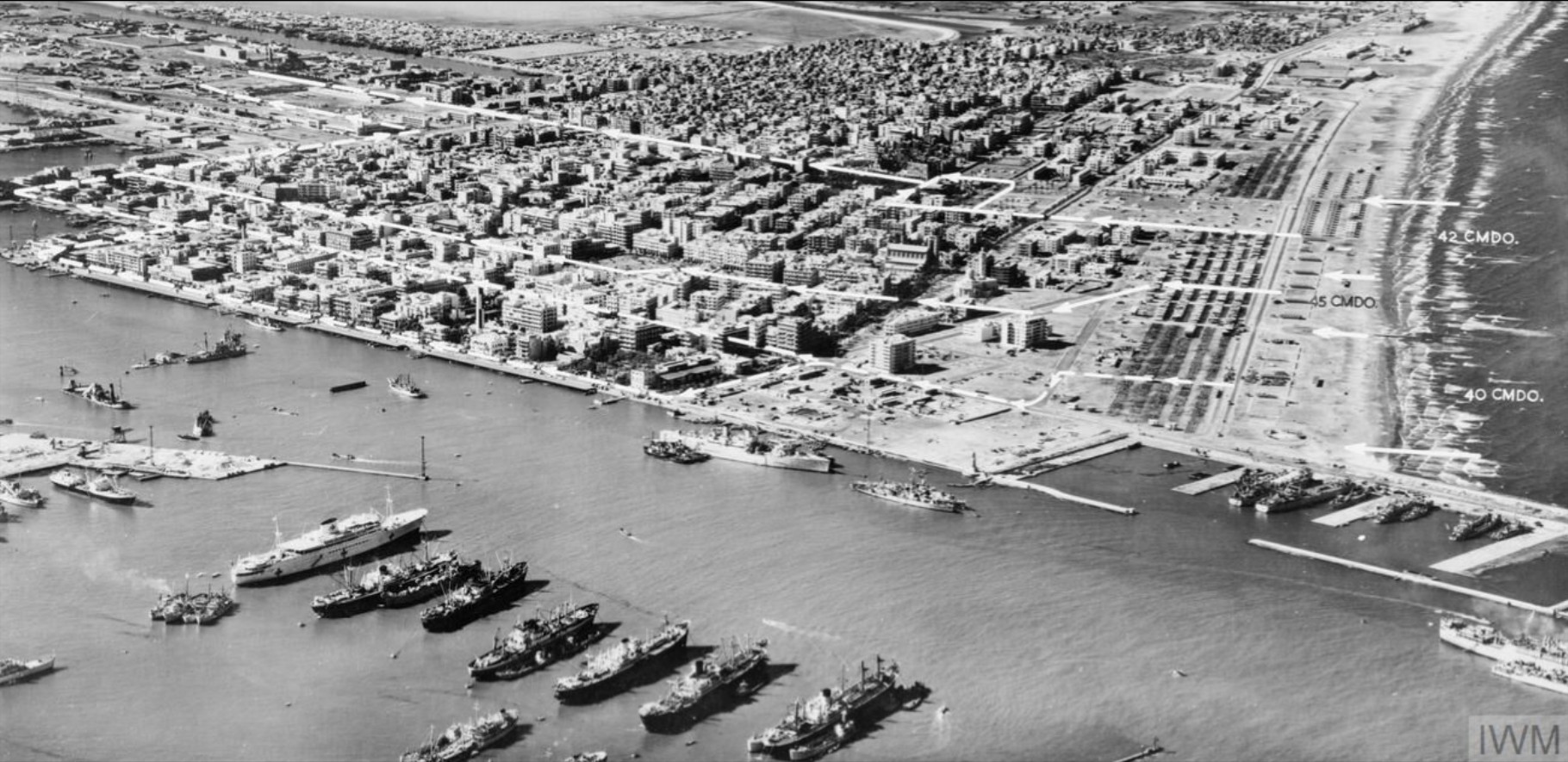
The landing beaches in Port Said
Finally, on November 6th, the Anglo-French force was ready to go ashore in strength. Pre-landing bombardment began shortly before 6, although it was restricted to a thousand rounds from the 4.5" guns of the destroyers for fear of collateral damage. Half an hour into the bombardment, the LSTs disgorged their cargo of LVTs loaded with the Marines of 40 and 42 Command for the 30-minute run to the beach. The bombardment continued as the amtracks swam in, pausing occasionally to clear the way for airstrikes, before lifting just before they crawled up onto the beach. It had done its work, and resistance on the beaches was minimal, with the main dangers being sniper fire and exploding weapons caches. Follow-on waves quickly followed in LCAs, which beached offshore. Fortunately, the troops already ashore had drawn the attention of what Egyptian defenders there were, so the process of wading to the beach was pretty straightforward.
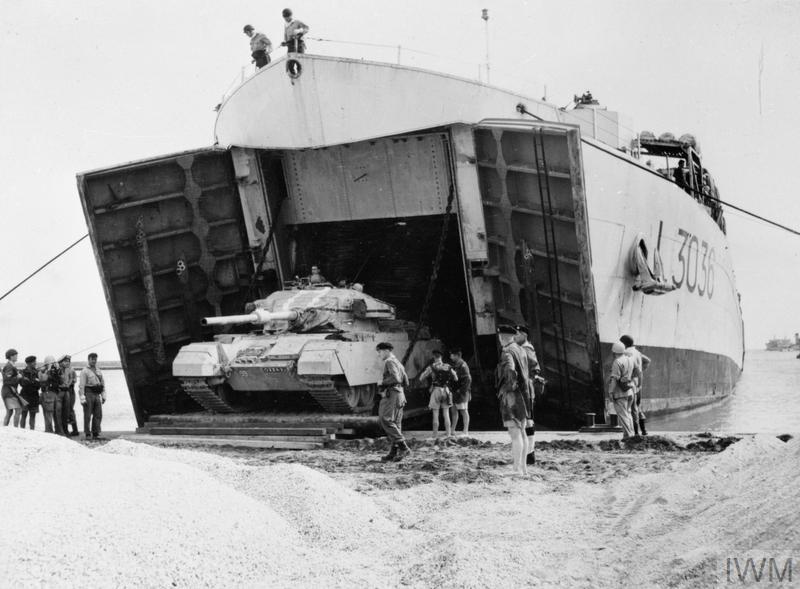
A Centurion unloads on the beach in Port Said
Once ashore, the men of 40 and 42 Commando began pushing south into Port Said, aided by a small number of Centurion tanks that had been landed with the second wave. 40 Commando was tasked with securing the area around the harbor to allow follow-on forces to land, while 42 Commando was to push south and link up with the French Paras at Raswa. The push down the city's main roads went fairly smoothly, although a couple of the Centurions got bogged down on a golf course and troops moving up and down the road faced sporadic sniper fire. Clearing the harbor proved to be more difficult. The Egyptians turned a number of large, stoutly-built structures into strongpoints, holding them fiercely even in the face of fire from the Centurions. On a few occasions, rockets and cannons from the fighters overhead were necessary to overcome resistance, and at one point, a destroyer offshore intervened against a Soviet-built SU-100 tank destroyer. Despite the resistance, casualties among the attacking force were fairly light, but reinforcements were slow to arrive. The inner harbor, where the second wave had been scheduled to unload, had been deliberately blocked by sinking ships there, forcing troops and equipment to come ashore further north on improvised piers.
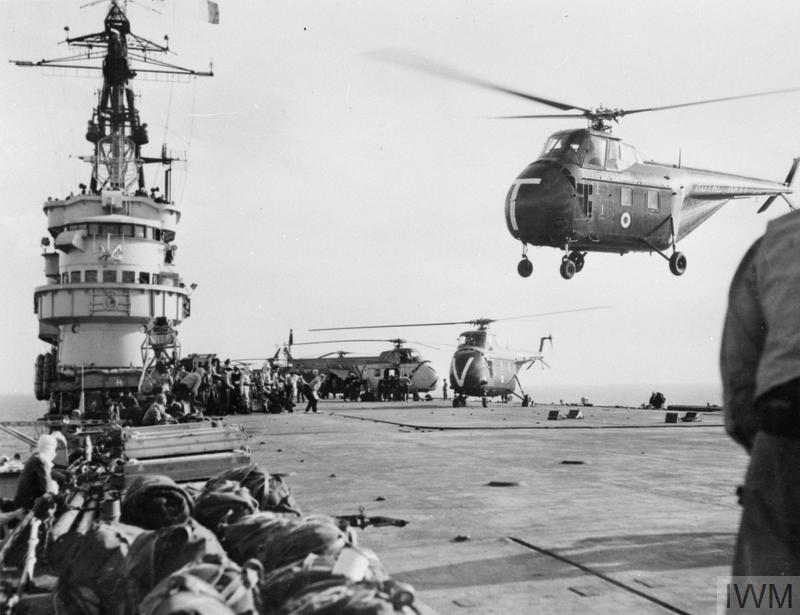
A Whirlwind takes off from Theseus
But not all of the follow-on troops and equipment would come ashore there. The battle for Port Said would mark the debut of a new kind of military operation: vertical envelopment, the practice of landing military units in a battle zone via helicopter. Now, helicopters weren't entirely new, with the US having deployed a few in WWII and more in Korea, but they were primitive and couldn't carry very much, limiting their use primarily to casualty evacuation and moving VIPs around. But the technology was improving, and both the US and Britain had been experimenting with the possibilities for moving entire units this way. The US had just converted the escort carrier Thetis Bay as a troop/helicopter carrier, but the British didn't have an equivalent ready to hand. Instead, they would improvise, using the light carriers Ocean and Theseus, serving as training ships when the crisis broke out. Their aviation facilities were hastily reactivated and an air group was scraped together from Navy Whirlwinds and Army and Air Force Sycamores, which promptly set to work figuring out the best way to transport a 450-man Commando1 from the ships to a landing zone 15 miles away.
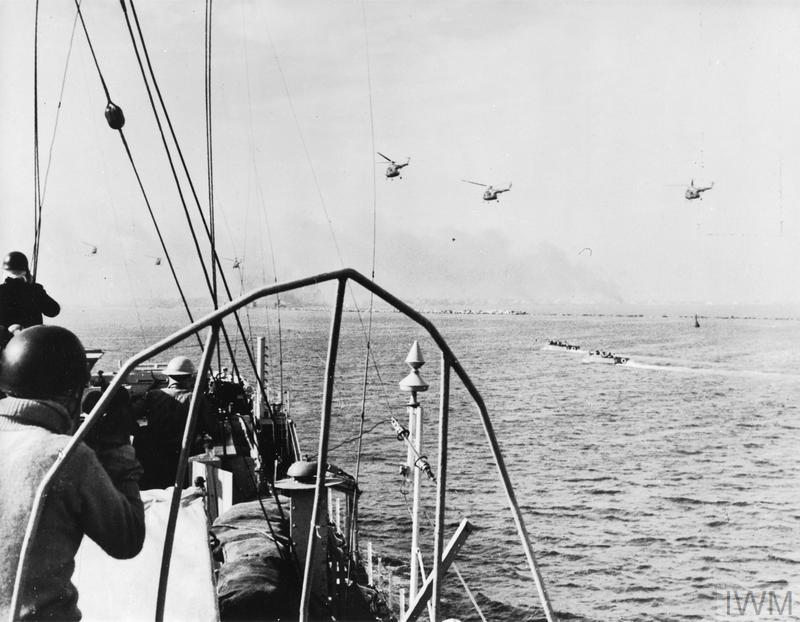
Helicopters carrying 45 Commando fly over the invasion force
They had sailed from Malta with the rest of the invasion force, with 45 Commando embarked, but due to concerns about the risks of the operation, the decision was made to hold 45 Commando in reserve. There was serious concern from the men aboard Ocean and Theseus that they would not get into action, but not quite 3 hours after the first landing, orders came down for the unit to land, half a dozen helicopters at a time, in the town's stadium. The first helicopter in was a Whirlwind carrying the unit's CO and the team responsible for controlling the LZ, and it landed successfully, but under such heavy fire that the pilot, hit in the thumb by a bullet, returned almost immediately to pluck them out. The LZ was quickly changed to one on the waterfront near the statue of de Lesseps, and 45 Commando joined in the effort to secure the area by pushing west to link up with 3 Para. Unfortunately for them, tragedy struck when an attempt to direct a group of Wyverns against Egyptian positions resulted in them strafing 45 Commando's headquarters, causing 16 casualties, including the unit's CO.
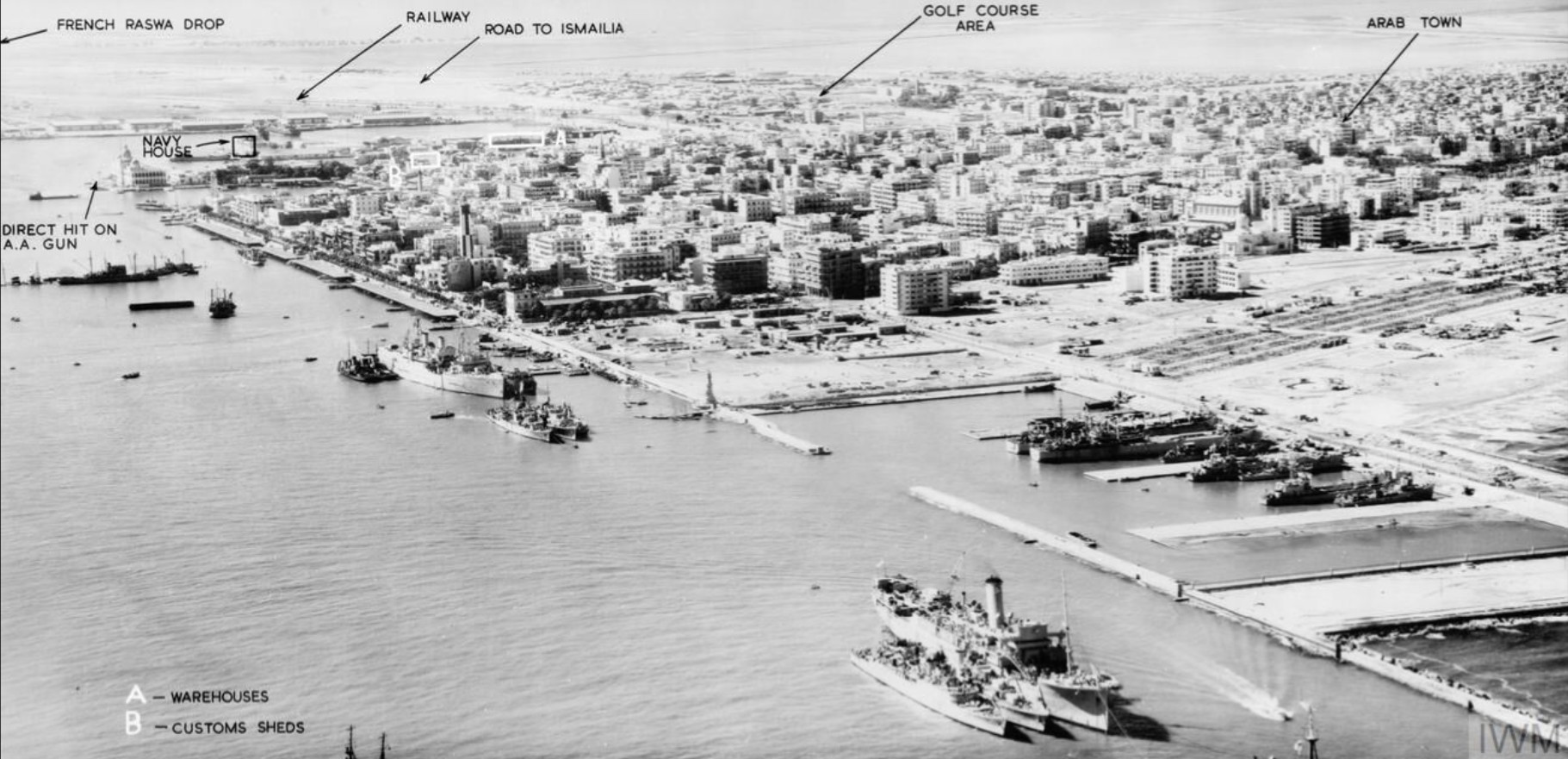
An aerial view of Port Said, looking south
By this point, rumors were circulating that the Egyptians were interested in surrendering, and General Hugh Stockwell, commander of the landing force, went ashore in full uniform along with his French counterpart, Andre Beaufre, to try to persuade the Egyptians to give up. It turned out that the rumors were wrong, but Stockwell was in no hurry to return to his command ship, and spent the rest of the day wandering around Port Said, out of contact with his superiors.
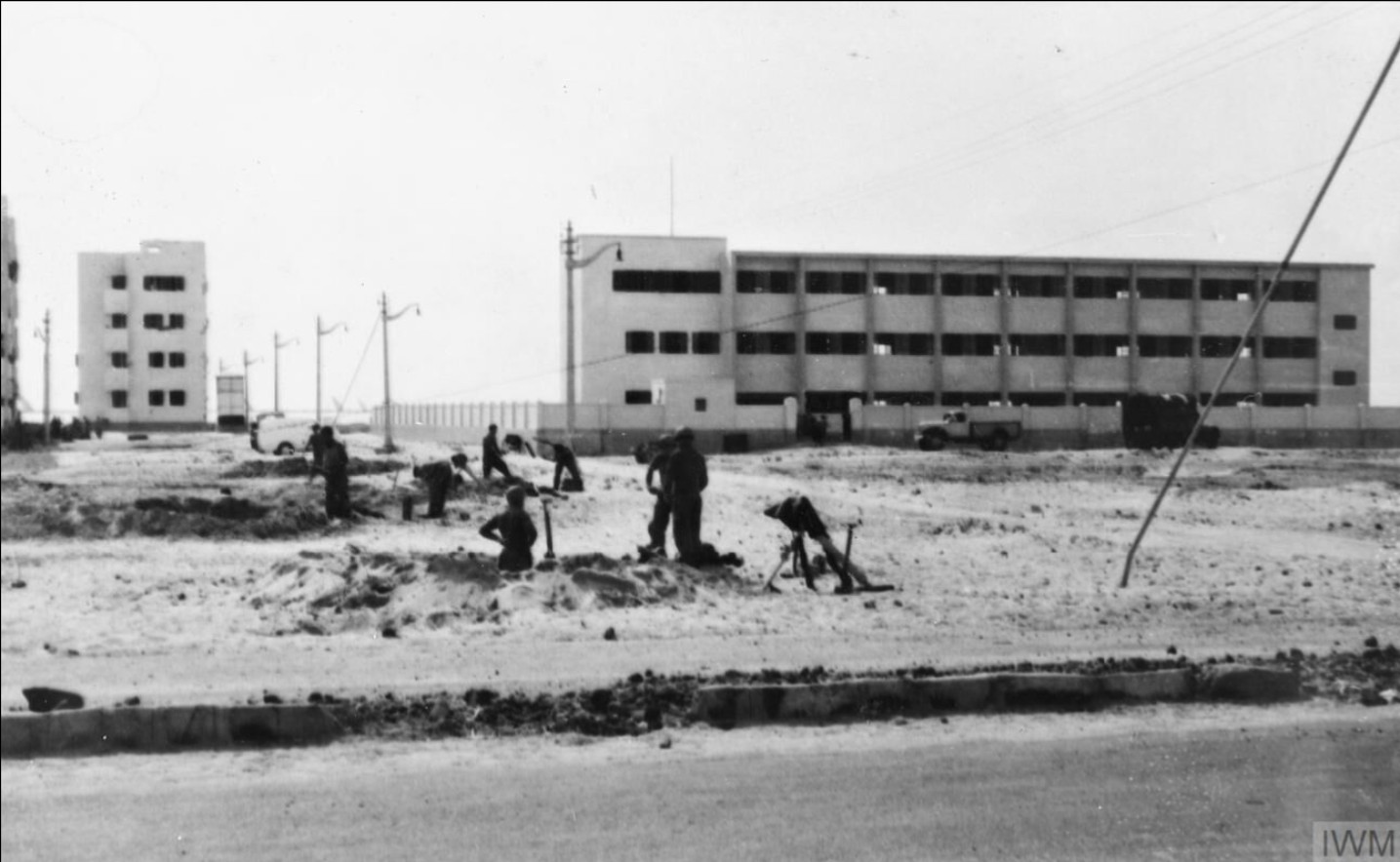
British troops advance in Port Said
This proved to be a critical mistake, because despite the Anglo-French victory on the battlefield, the political tide had turned decisively against them. Harold Macmillian, Eden's Chancellor of the Exchequer2 and previously a loyal supporter of his policy in Suez, reported during a cabinet meeting that British gold reserves were rapidly dwindling as investors sought to move assets out of a country that was increasingly seen as an international pariah. Despite British economic decline over the previous 40 years, the pound remained a major international reserve currency and a pillar of British economic and political power, and the depletion of the Bank of England's gold reserves could bring all of that crashing down. Normally, the British would have been able to count on American help, but Eisenhower, whose second term was being voted on that very day, refused to do so, as he believed it would be disastrous for America's position in the battle for the goodwill of the third world.3 The Soviets were making threatening noises, and Dag Hammarskjold, the Secretary-General of the United Nations, announced that both Israel and Egypt had agreed to an immediate cease-fire, and that a UN force would be assembled to secure the Canal.
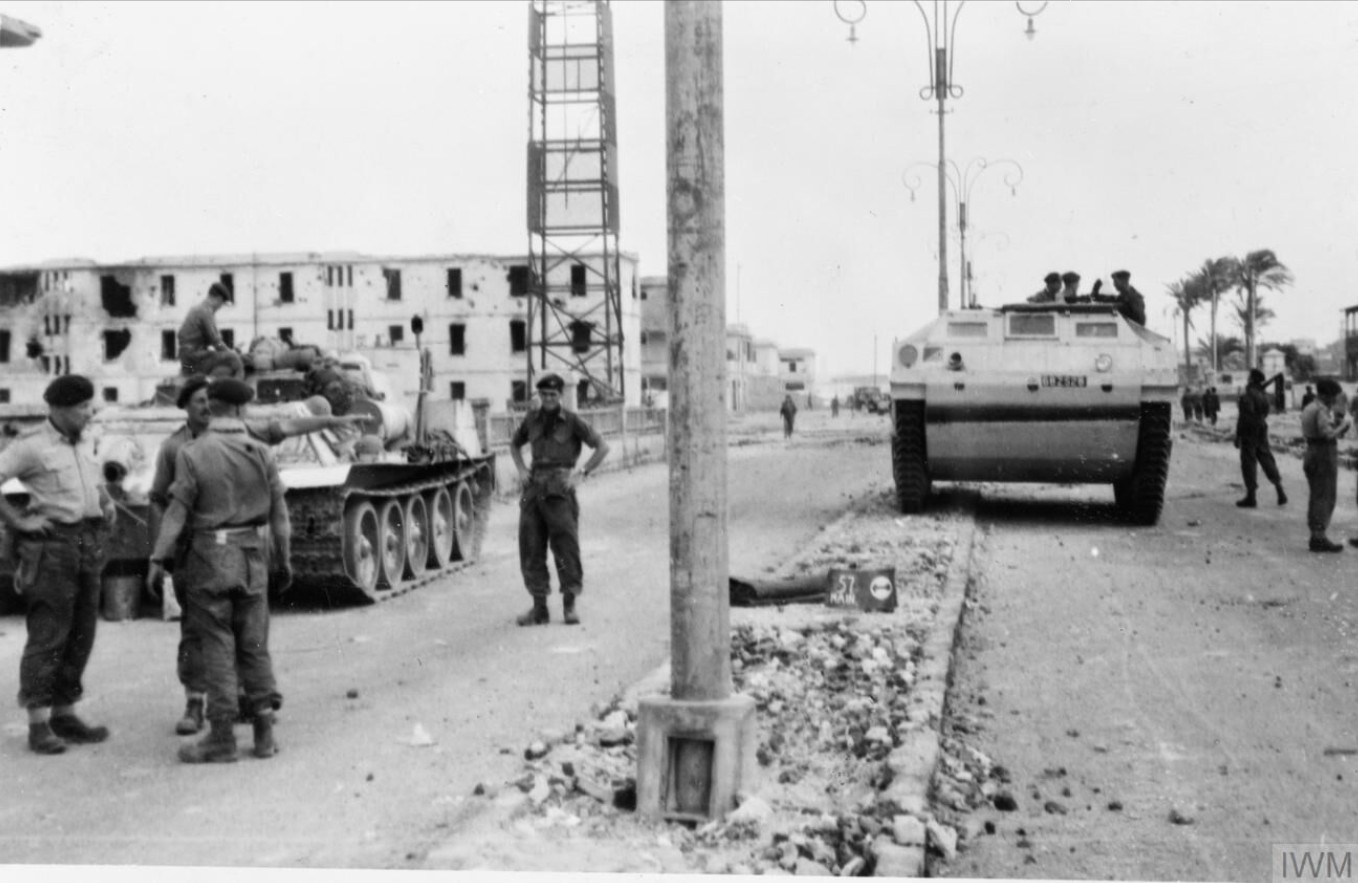
British troops after the cease-fire
The combined forces of his Cabinet colleagues, the US, the Soviets and the UN were too much for Eden, and he buckled around mid-day, agreeing to the cease-fire. Getting the French to sign on took a bit longer, and by the time Eden made the public announcement in the afternoon, the time of the cease-fire was set at midnight in London, or 2 AM in Egypt. But faulty communications and absent commanders meant that very little of this was apparent in Port Said. Instead, units had only begun to move south before digging in for the evening, the furthest forward being a unit of the Royal Tank Regiment 10 miles south of Port Said, and plans were drawn up for a significant push to seize El Quantra, the next major settlement along the Canal, on the 7th, and maybe push on to Ismailia, the halfway point of the Canal.
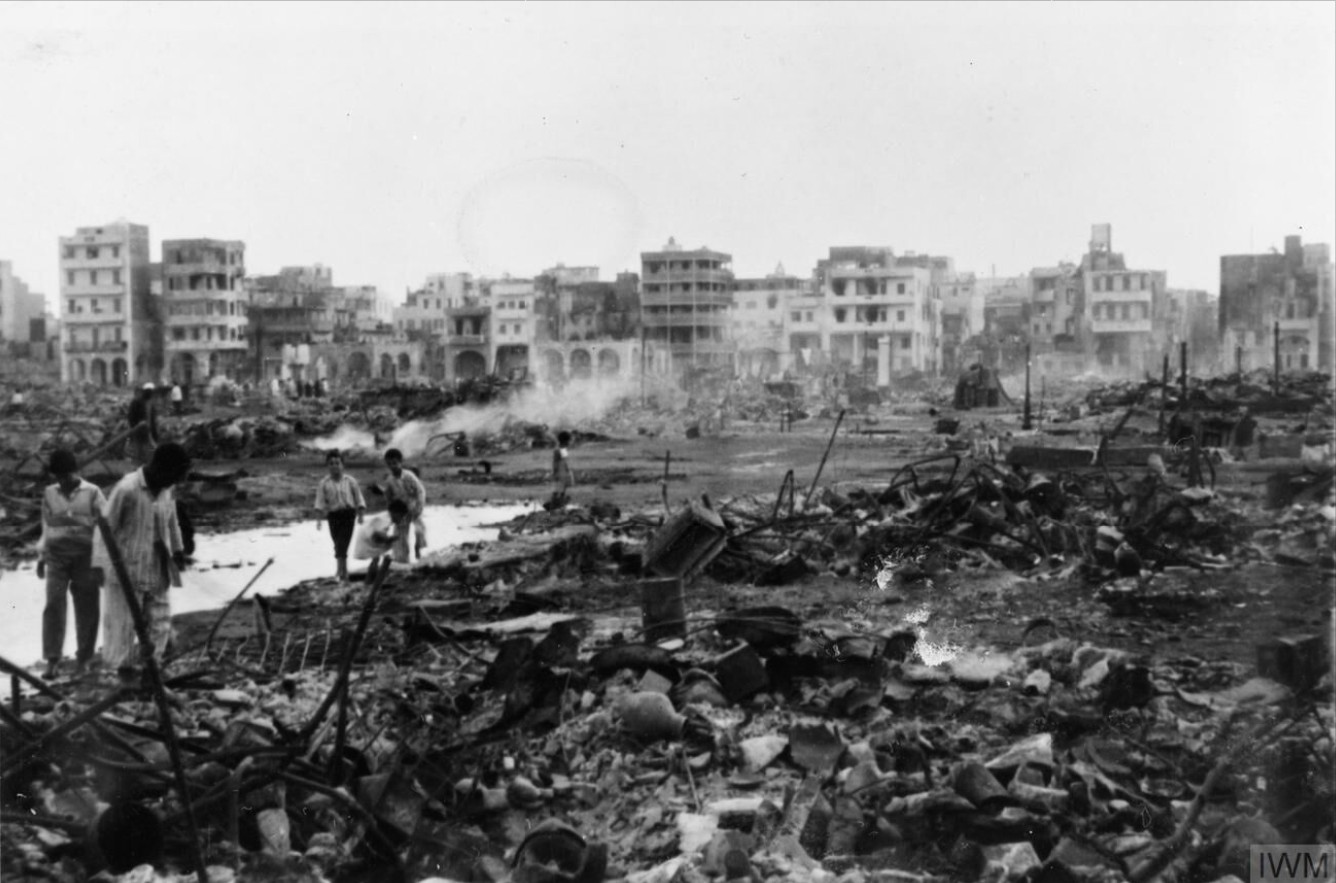
The results of the Anglo-French assault on Port Said
But with the impending cease-fire, orders went out to secure as much territory as possible, hopefully including Quantra. Communications in the area were still bad, and it was after midnight by the time word reached the tankers, who then waited for the infantry of 2 Para to arrive before pushing south down the narrow causeway that ran alongside the canal. There was only 45 minutes left when they finally set out, and they had 20 miles or so to go. But breakdowns slowed the convoy, and when 2 AM arrived, they were still on the causeway, an obviously unacceptable place to dig in. Swearing the journalists accompanying them to secrecy, the force pushed on another 20 minutes, finally arriving at Al Cap, four miles north of Quantra. There, they could dig in in reasonable security, taunted by the lights of their objective to the south. The war was over, although the Canal itself was still blocked and diplomatic repercussions would echo for years. We'll pick up the story there next time.
1 The term for a Royal Marine battalion, more or less. ⇑
2 Broadly equivalent to the American Secretary of the Treasury. ⇑
3 Secretary of State John Foster Dulles, who had worked so hard to keep the war from happening at all, was sick, but later said that if he had been well, he would have tried to buy the British and French enough time to secure the entire canal, reasoning that once they had started the invasion, the damage was already done, and cutting things short just hurt what were, in the end, US allies. ⇑
Recent Comments