
In 1956, war broke out in the Middle East. Britain and France had long owned the Suez Canal, and relied on it for much of their oil, but Egyptian dictator Gamal Abdel Nasser had nationalized it. After diplomatic efforts proved fruitless, the two nations, humiliated and concerned about their energy supply, came up with a plan to recapture it in cooperation with Israel, who hoped to preempt an Egyptian attack. An Israeli invasion of the Sinai would give the two great powers the chance to issue an ultimatum demanding both sides withdraw, and when Nasser refused, they would have their opening to invade.

Initially, things went according to plan. The Israeli invasion kicked off on October 29th, and the other two powers quickly directed both sides to withdraw. Nasser was predictably unwilling to suffer the humiliation of bowing to his former colonial overlord, and two days later, the British and French began a sustained air campaign from carriers and nearby land bases, swiftly wiping out the Egyptian air force and clearing the way for a ground invasion.
But despite the success of the air campaign, the Anglo-French commanders faced a serious problem. The need to hide the plan from the rest of the world had meant that the amphibious force hadn't set sail until October 31st, and the slow speed of the LSTs carrying the armor meant they couldn't begin landing operations until November 6th. Initially, this hadn't been seen as a major problem, because the landings had been planned for about 10 days after the air campaign began. But the pretext for the intervention was growing more transparent by the hour, and international opposition was building from both of the superpowers. It was unclear how long London and Paris could stall a ceasefire, and having one declared before there were boots on the ground would be diplomatically disastrous. As such, almost from the outbreak of hostilities, the French airborne commanders in particular began proposing immediate drops of troops into the area around Port Said.1 The British, with memories of Arnhem still fresh, were far more reluctant to commit unsupported airborne units days ahead of the arrival of relief, and also pointed out that the airfields on Cyprus were mostly full of fighters and bombers currently busy shooting at Egypt, so the size of any drop would be fairly limited. Eventually, the obvious compromise, the deployment of airborne units on the 5th to secure critical areas around Port Said, followed by the amphibious landing the next day, was adopted.
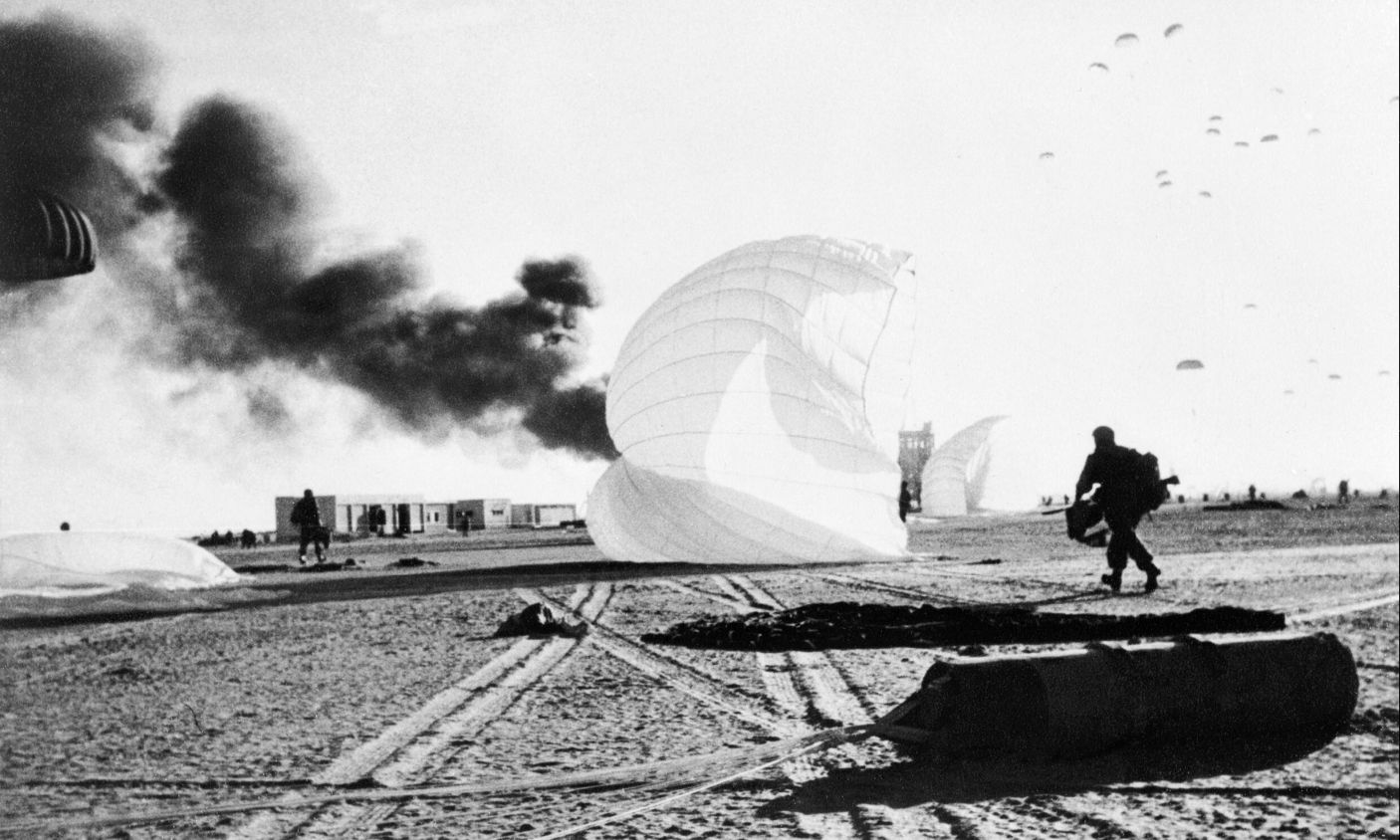
3 Para landing at Gamil
At dawn on the 5th, British and French fighters appeared over Port Said as usual, but this time, they were accompanied by transports. The British transports, Hastings and Valettas carrying 3 Para, were headed for Gamil airfield, four miles west of Port Said. Air strikes had been unable to completely suppress resistance on the airfield, but Egyptian attempts to shoot at the descending paratroopers were surprisingly ineffective, and the "Red Devils" soon retrieved their weapons and swiftly set about securing the airfield. Despite the lack of heavy weapons imposed by the rather antiquated side-loading transports,2 they were in control of the airfield within 30 minutes and had suffered no more than a dozen casualties, which were swiftly evacuated by helicopter to the ships offshore.
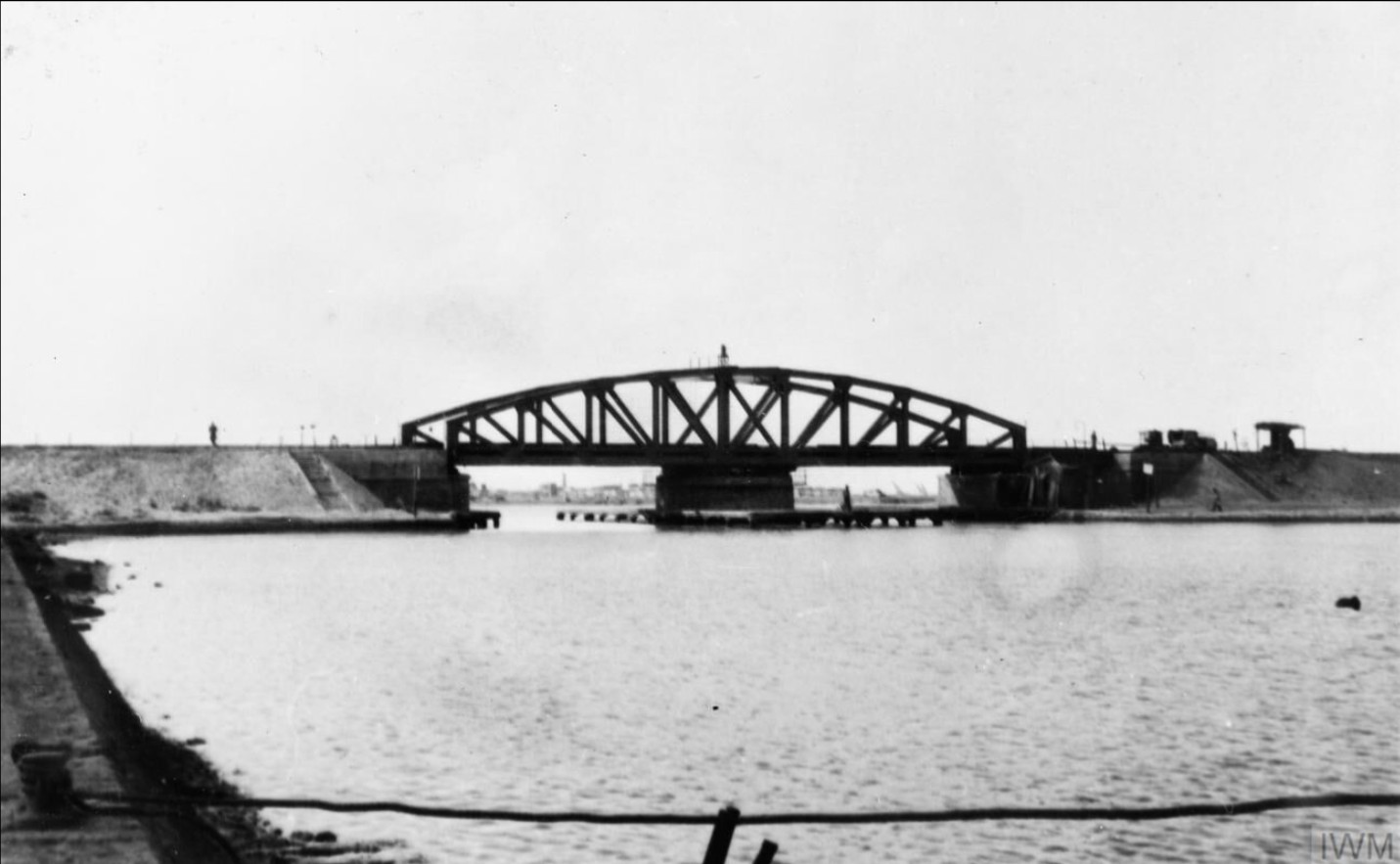
The bridge at Raswa, captured by the French paratroopers
The French paratroopers dropped at Raswa to the south of the town, planning to capture a bridge across a secondary canal that would speed the advance south, as well as the water treatment plant for Port Said, without which the town would swiftly become uninhabitable. The available drop zone was ludicrously small, only 200 by 500 yards, and to make sure they hit it, the drop was made from well under the minimum altitude regulations demanded. Despite this, the assault was entirely successful with minimal casualties, carrying both the bridge and the waterworks within a few hours.
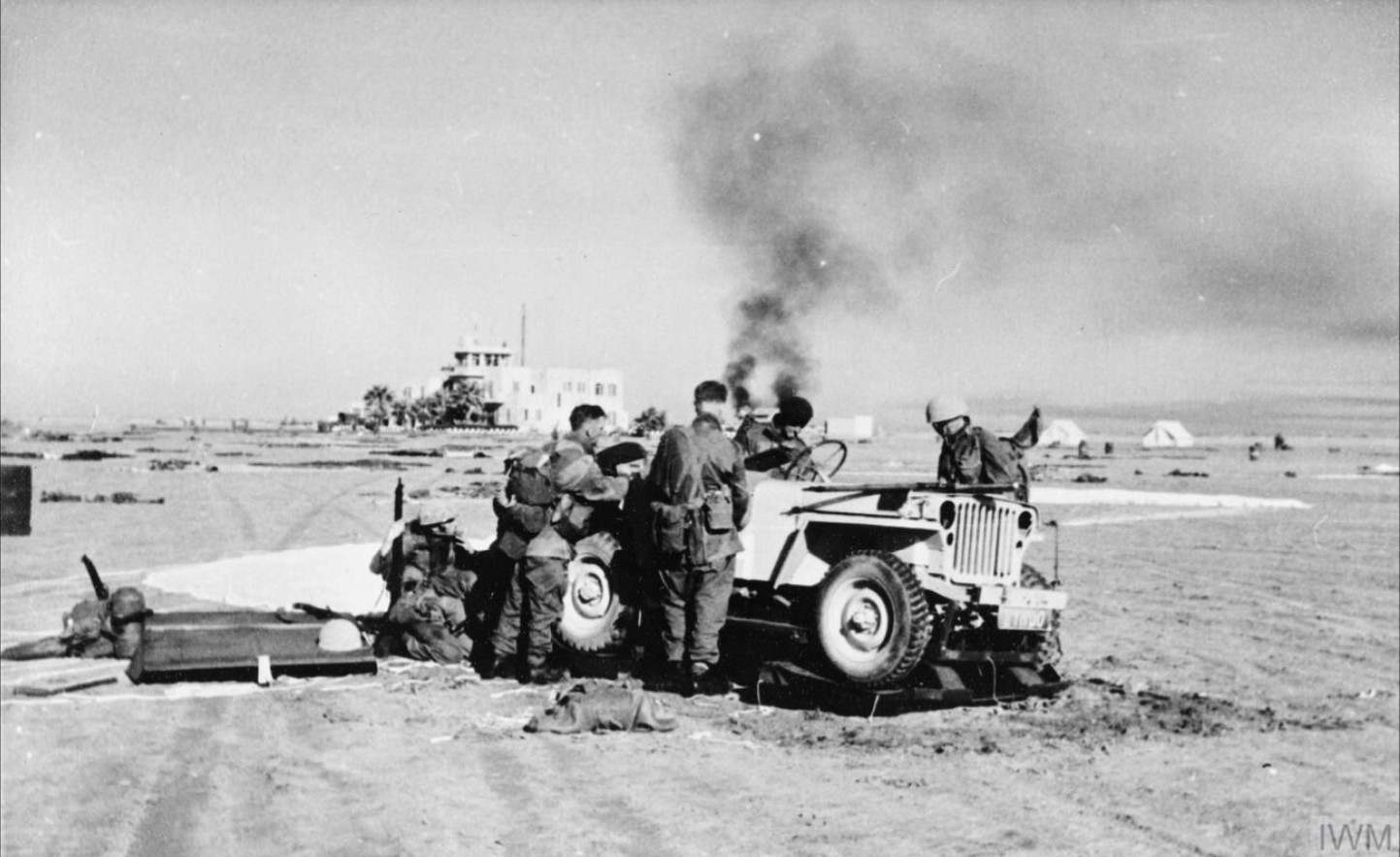
Members of 3 Para ready a jeep at Gamil
At Gamil, the British Paras began to push east towards Port Said itself, but even with aid from the "cab rank" of fighters overhead, Egyptian delaying tactics meant it was slow going, with little hope of a dramatic breakthrough. An extra company was dropped in the afternoon, but the decision was made to call things to a halt. Communication problems and limited equipment had plagued the force all day, and the advance company was low on ammunition and still well outside Port Said. There had been some hope of securing the areas where the landing was to take place, but that was clearly not going to happen, and the risk of Paras ending up in one of the zones slated for the supporting bombardment from the fleet offshore was judged too great, particularly with the comms problems.
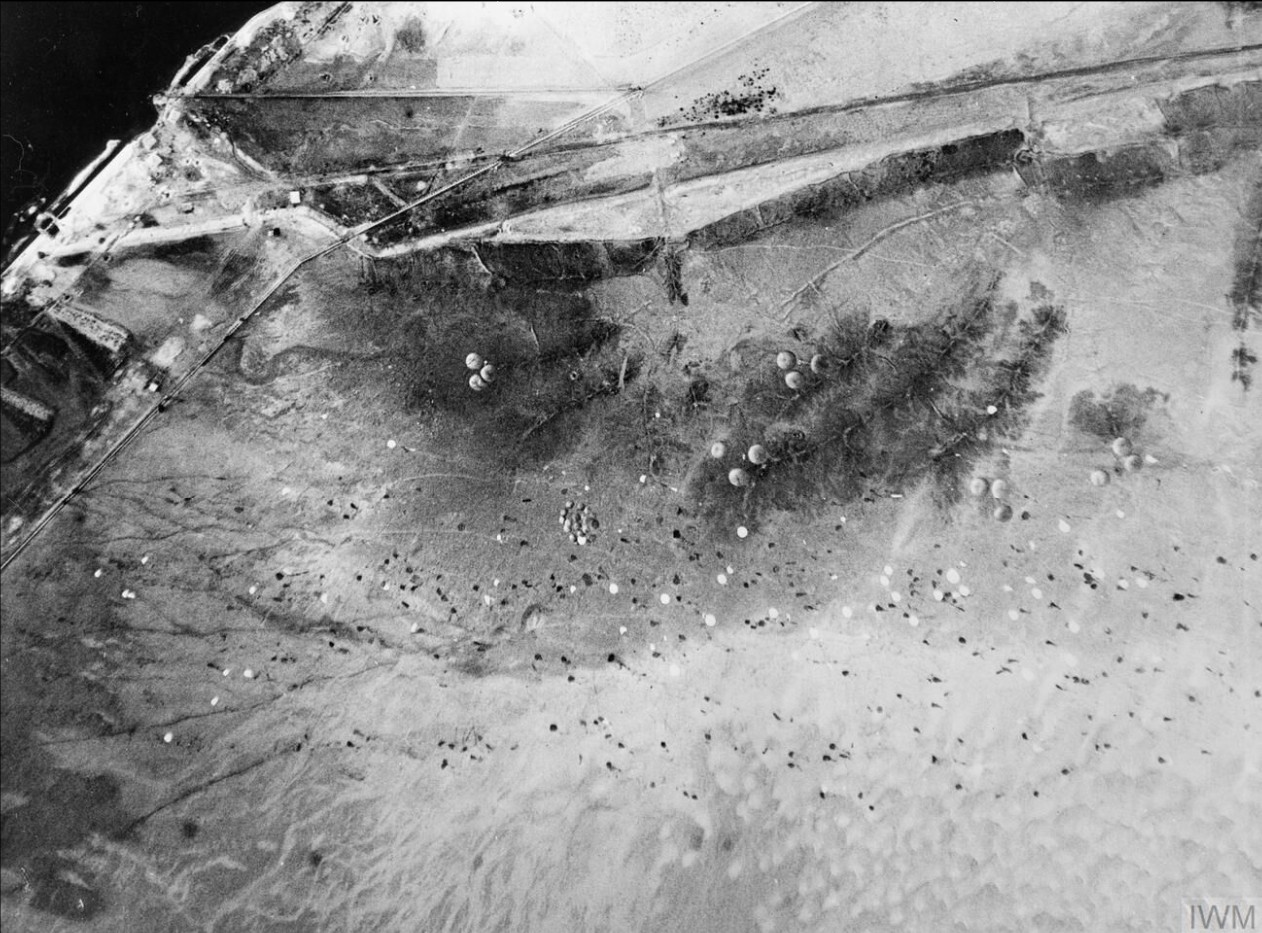
French paratroopers drop on Port Fuad
The French, more confident in their forces, also made a second drop that afternoon, but instead of landing on the same drop zone as the initial wave, a second battalion was dispatched to Port Fuad, on the east side of the Canal. The French troops managed to clear the town by morning,3 although this information didn't reach the offshore ships until a few minutes before an airstrike was scheduled to go in, validating British concerns about friendly fire. Control of the waterworks gave the invaders a great deal of leverage, but it wasn't enough to convince the Egyptian garrison to surrender. On the bright side, a reconnaissance south from Raswa determined that the road to Ismailia was open and unmined, at least for the 10 km or so that the team was willing to go for fear of being mistaken for Egyptian by marauding aircraft.
But by the evening, both groups of paratroopers were in secure positions, and the way was open for the main force to land the next morning. While most of them would come ashore as they had for the last 15 years, one contingent would introduce to the world a new method of amphibious operations - vertical envelopment. We'll pick up the story there next time.
1 Some plans were even crazier. One involved loading a thousand paratroopers aboard Jean Bart and sailing her into the harbor, much like the Germans did in Norway. This was shut down by a mention of the word "mines". ⇑
2 Modern military transports have ramps in the back that make it easy to drop large cargo like jeeps and artillery pieces. The British were using older versions that only had side doors, which are less effective at this. ⇑
3 I was able to find surprisingly little about the amount of fighting, because Suez remains shockingly poorly documented as a military campaign relative to the reams available on the diplomatic side. ⇑
Comments
I don't think it's really fair to call side loading aircraft can really be called antiquated for 1956.
The only rear loading aircraft i can find that had existed for a while by 1956 is the C-97, which in order to do para drops needed to have the rear doors removed because they were clamshell doors and the ramp had to be manually set up
While other aircraft with rear doors existed in 1956 they were all extremely new to actual service. The Blackburn Beverley, C-133, C-130 and C-123 had only entered service that year, and in the C-130s case December that year so not in time for the Suez crisis.
There being a few other rear ramp loading aircraft floating around as prototypes but given they weren't actually in service.
The French were using Nord Noratlases, which had rear doors, to say nothing of the C-82 and C-119, both of which were in wide service. I stand by my statement.
I suppose i just missed those then. I didn't know about the french on and i kinda just assumed the C-119 and C-82 didn't have them because the XC-120 didn't.
Uuuuh...
The C-82, C-119 and Noratlas all had clamshell doors in the rear, not a ramp, so they could not drop large stuff unless the clamshell door were removed.
The first plane I can find with a rear ramp is the C-123, but there could be others.
So? The rear doors were removable, and in a lot of cases removed. C-119s were famously used to drop bridge sections in 1950.