
The practice of operating aircraft at sea evolved rapidly from the earliest days of naval aviation through the introduction of the true aircraft carrier immediately after WWI, and was refined as more navies got into the game in the 20s. These in turn formed the basis of carrier operations through 1945, although some changes were necessary, largely to deal with the increasing weight of aircraft through the 1930s.
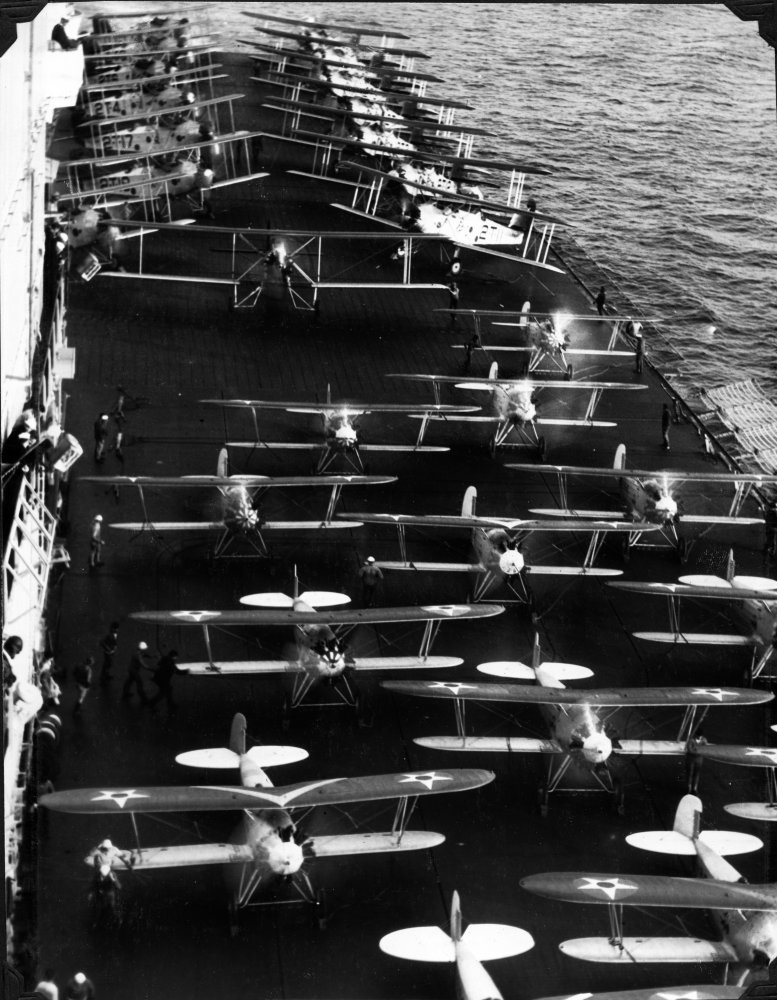
T4Ms (back) and F3Bs on a carrier deck, c.1930
The typical carrier aircraft of 1930 was a biplane, relatively light and with a lots of wing area to generate lift. For instance, an American air wing might be composed of Boeing F2Bs (gross weight 2,805 lb, wing loading 11.5 lbs/ft2), Vought O2Us (gross weight 3,635 lb, wing loading 11.4 lbs/ft2) and Martin T4Ms (gross weight 8,071 lbs, wing loading 12.3 lbs/ft2). But by 1941, the same carrier would be carrying an all-monoplane wing of Grumman F4Fs (gross weight 7,423 lb, wing loading 28.6 lbs/ft2), Douglas SBDs (gross weight 10,855 lb, wing loading 33.4 lbs/ft2) and TBDs (gross weight 10,194 lb, wing loading 24.2 lb/ft2). To an extremely rough approximation, takeoff and landing speeds scale with the square root of wing loading, so the 1941 air group would need to be going 40-70% faster than their predecessors of a decade earlier to take off or land. In practice, this requirement was mitigated somewhat by the switch from biplanes to monoplanes, which are more aerodynamically efficient, and the adoption of high-lift devices like flaps and slats that allowed the aircraft to stall at lower speeds.1 Despite this, they still would require stronger arresting gear and more room for takeoff, limiting the number of airplanes that could operate from a given ship.
Another major development during the 30s was the catapult. Initially, catapults were developed to allow aircraft to operate from battleships and cruisers, and the Americans installed a pair aboard Langley when she was first converted.2 They soon discovered that these weren't all that useful, as they were slow and offered little advantage over a normal rolling takeoff, and they were removed within a few years. But in the late 20s, as they designed their first purpose-built carrier, the Americans realized that the deck might not always be available given the new method of carrier operations they were developing. If there were always planes parked on deck, then flying off, say, a few recon planes or a handful of fighters for combat air patrol would involve moving all of the planes on deck aft to allow them to take off, then forward again for recovery. This effort would probably needed to be repeated multiple times a day, so the alternative of fitting a catapult to the hangar deck was proposed. This also had the advantage that it could get a plane airborne without requiring the carrier to turn into the wind and lose position relative to the rest of the fleet. And if the aft portion of the deck was taken up by a strike being spotted (or if it had been damaged by enemy bombs) the planes could be recovered using the secondary arrestor wires on the forward portion of the flight deck, with the carrier steaming backwards.
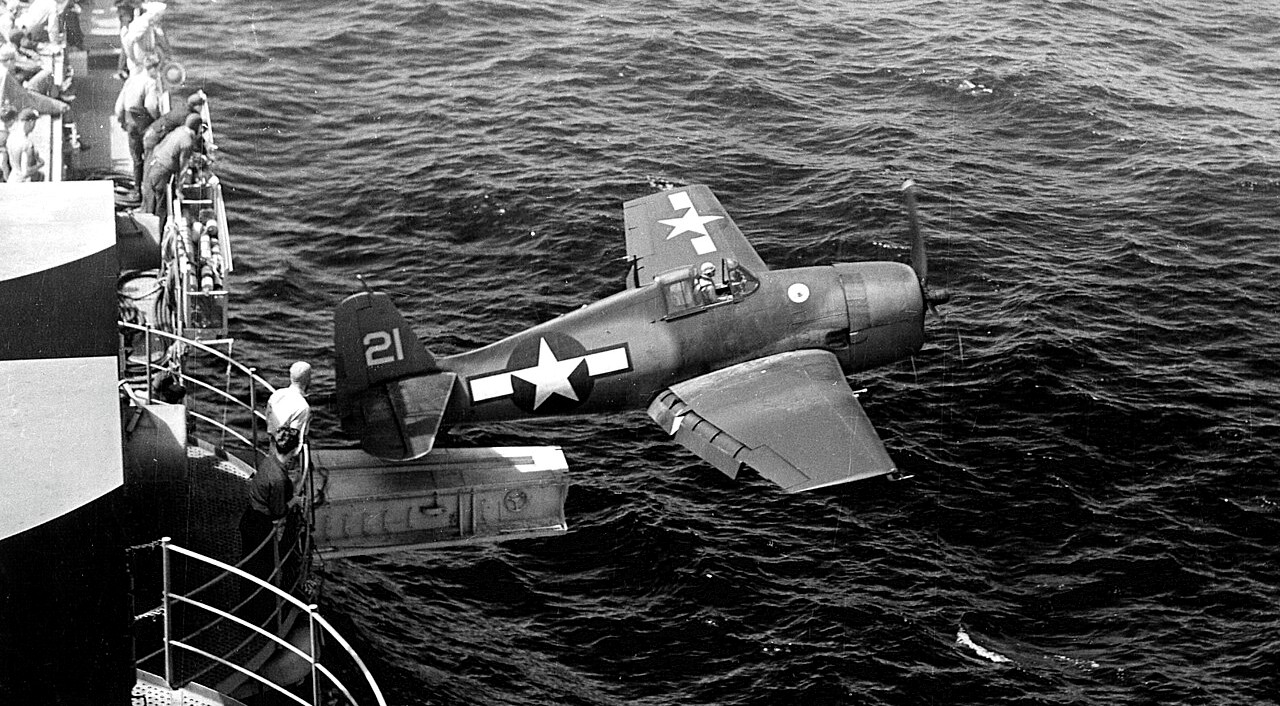
An F6F Hellcat is catapulted from the hangar on Hornet (CV-12)
In practice, the hangar catapult was basically never used operationally, but it had a profound effect on American carrier design. Shooting a plane out of the hangar obviously required a giant hole in the side of the hangar, which wasn't really compatible with using the flight deck as the strength deck. Instead, the hangar would be a superstructure on top of the hull, with a light flight deck that was easy to repair and open sides, although with more protection from weather than had been provided aboard Langley. This configuration, first adopted for Ranger in 1929 although fiscal constraints meant that she was never actually fitted with the hangar catapult, also allowed aircraft engines to be warmed up3 in the hangar, although this advantage was not appreciated until significantly later. The later Yorktowns and the first few Essexs were fitted with hangar catapults, as well as a pair of similar catapults on the flight deck for cases where heavy aircraft needed to be launched in low wind or when the deck was mostly full. These did see some use in the early days of the war, while the hangar catapults were removed in the middle of the war.
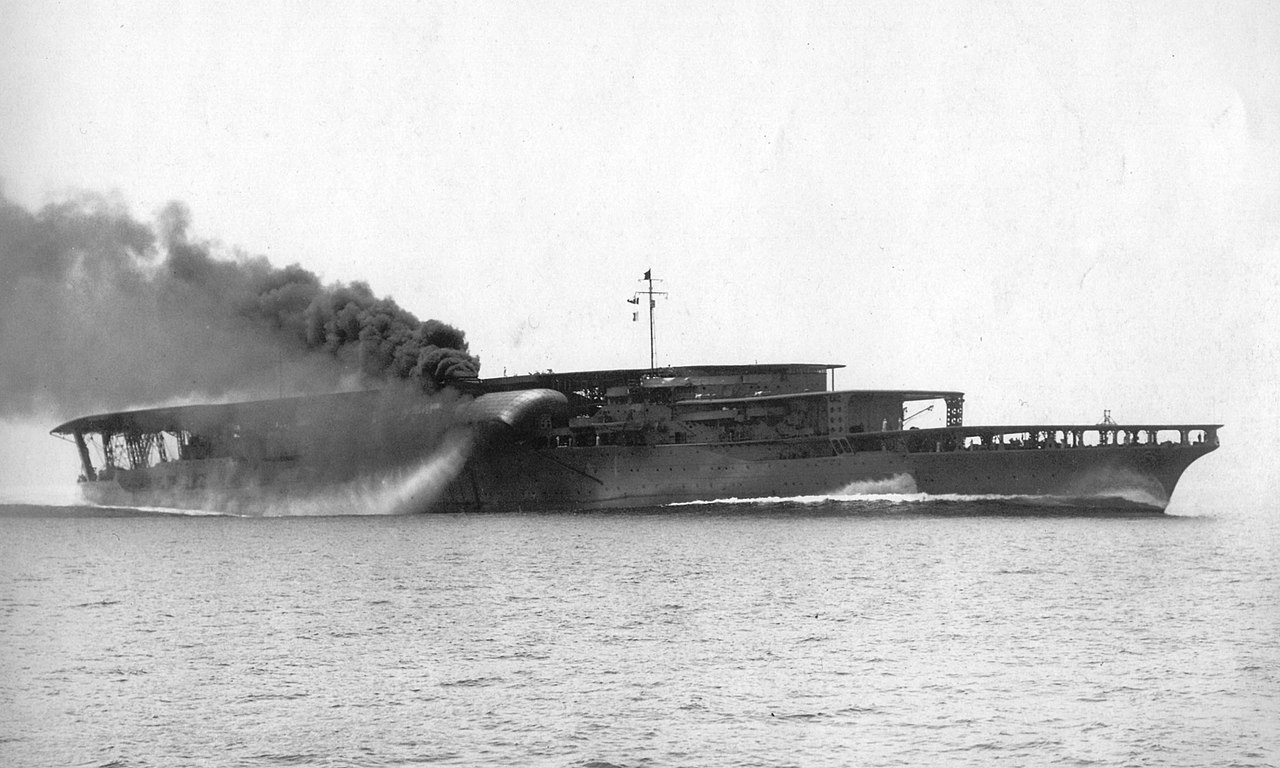
Akagi with three flight decks
The British and the Japanese, the other carrier-operating nations in the interwar years,4 were not blind to the potential need to launch planes while the main deck was blocked, but chose a rather different solution. Both built their early carriers with separate flying-off decks at the bow, with doors from the hangar leading directly onto them, the Japanese going so far as to build one deck for each hangar on Akagi and Kaga. The problem was that while these worked OK at first, they were pretty short, and thus unable to cope with faster, heavier airplanes. Add in problems caused by wind when the door at the front of the hangar was opened, and they were more or less abandoned by the outbreak of war, although the British battlecruiser conversions were never refitted with a full flight deck.
The British were also interested in catapults, although more for operations from other ships than for carriers. Through the start of the war, all British carrier aircraft had to be designed for catapult/float operations from cruisers, which imposed serious performance limitations, badly handicapping the RN in the early years of the war. Even when catapults did go aboard their carriers, they were somewhat different than the American version. American catapults were basically a rope pulled on by the hydraulic cylinder, with a small "bridle" connecting it to the plane. The British had a much more substantial cradle, modeled on those used on battleship catapults, that held the plane's tail off the deck in something closer to flying position. This turned out to be a mistake, as getting the plane onto the cradle was kind of a pain and the weight of the cradle itself was a substantial hindrance to catapult performance, both in acceleration and in having to stop it at the end of the stroke. As a result, by the end of the war, the British had switched to the American-style system for all future aircraft.
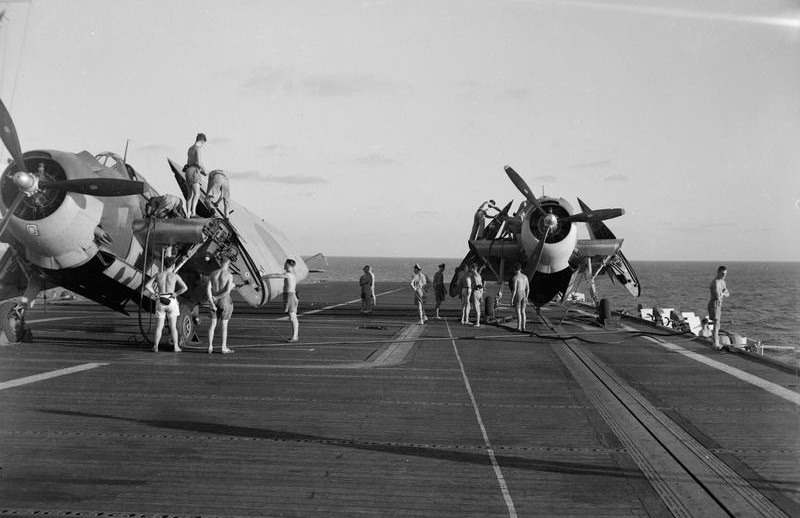
An Avenger sits on the catapult aboard escort carrier HMS Shah
But the British didn't use their catapults much in the early years of the war either, and it only came into its own with the arrival of the escort carrier. These were both slower (18 kts vs 30 kts) and shorter (~500' flight deck vs ~800') than a big carrier, a combination which made it impossible to operate heavy aircraft like the TBM Avenger (gross weight 15,900 lb, wing loading 32.4 lbs/ft2) using rolling takeoffs. But these were badly needed for the anti-submarine campaign, so catapulting became a way of life on the CVEs. By the end of the war, similar factors meant that as many as 40% of fleet carrier launches were also made using the catapults. The H4 hydraulic catapults fitted to the Essex class were capable of launching a 16,000 lb aircraft at 85 mph, and had pumps to do so once a minute, giving a theoretical launch interval of 30 seconds, not too far off the 20 possible with a rolling takeoff. Often, a strike would begin with planes being catapulted off until enough of the deck was clear for those later in the cycle to get airborne under their own power. Catapults were also useful for launching scouts and CAP in crosswinds, allowing the carrier to avoid turning into the wind for launch, and for sending up airplanes at night, as they prevented the plane from swerving over the side in the dark.
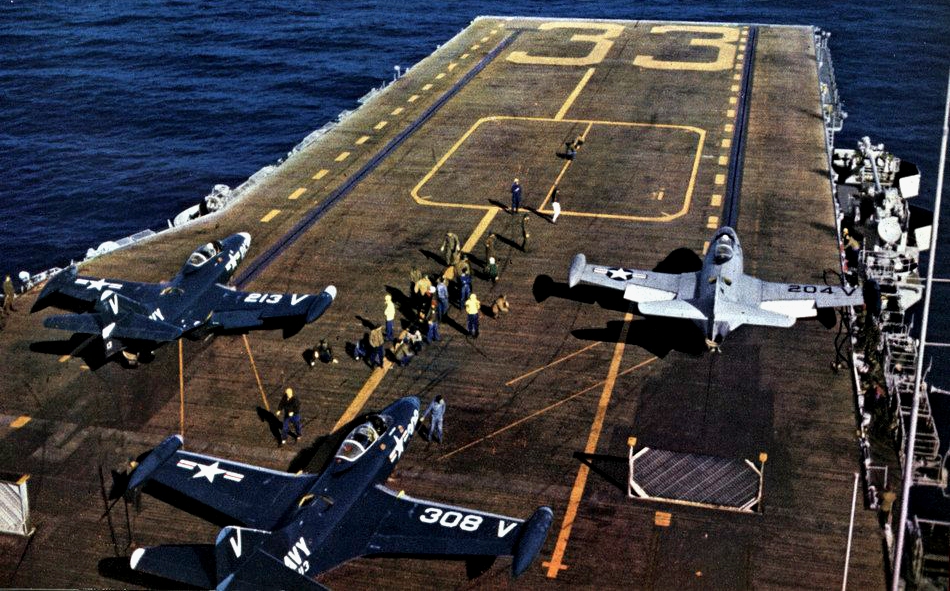
F9F-5 Panthers on the catapults of Kearsarge
Postwar, catapults went from useful to vital as jets arrived. A jet engine produces roughly constant thrust at all speeds, while a piston engine produces constant power, which means less thrust at high speeds and more thrust at low speeds. Add in the fact that jets tended to be bigger and have higher wing loadings (the F9F-5 Panther, a staple of the early USN jet force, weighed 18,700 lb and had a wing loading of 74.9 lbs/ft2) and rolling takeoffs were entirely impractical. Now, everything would have to be catapulted, and even then, it was clear that hydraulic catapults were quickly approaching their limits. Nor was that the only change that jets would require, a subject we will look at next time.
1 More powerful engines also helped with takeoff. The F2B had 6.6 lb/hp and the T4M 15.4 lb/hp, while the numbers for the F4F and TBD were 6.2 and 11.3 respectively. ⇑
2 It's worth a brief footnote on catapult power sources. The battleship/cruiser catapults were generally powered either by compressed air or by powder, because they needed to be small and light. A few carrier catapults used these mechanisms, but the vast majority before 1950 used a hydraulic ram running through a series of pullies to pull a cable that would be attached to the airplane being launched. These were safer and easier to use, but also big enough that they weren't really feasible for mountings on turrets or quarterdecks. ⇑
3 To avoid lubrication problems at full power, airplane engines needed to be run for five minutes or so before takeoff to heat up the oil. This was obviously impossible in a closed hangar like the British used. ⇑
Recent Comments