
Reader Ryan recently was in Hawaii, and kindly agreed to share his review of the various facilities there, ranging from the battleship Missouri to the air museum on Ford Island and various facilities ashore.
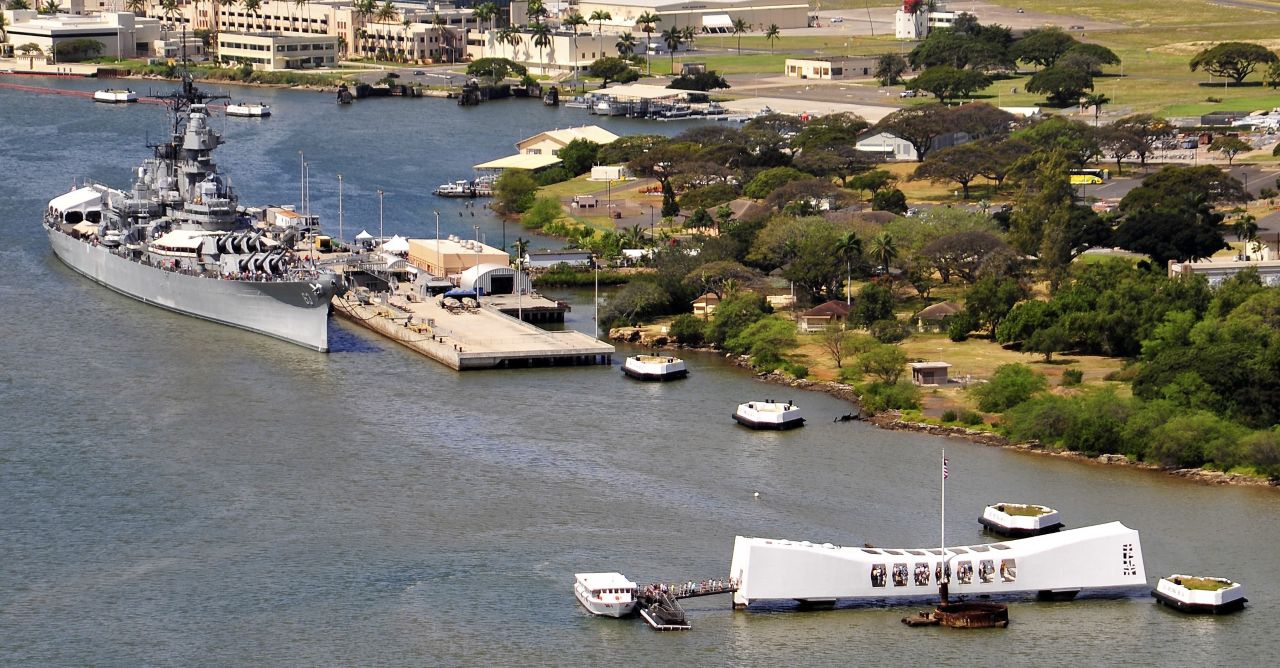
December 7th, 1941 – A day that shall live in infamy August 15th, 1945 – We hereby proclaim the unconditional surrender to the Allied Powers of the Japanese Imperial General Headquarters and of all Japanese armed forces and all armed forces under Japanese control wherever situated.
The Pearl Harbor family of historical sites frames itself as telling the story of the beginning of America’s Pacific War with the site itself and the conclusion of the war at the surrender signing on the decks of the USS Missouri. Ultimately the story this complex is trying to tell is that of the US Navy in the Pacific War – the ideal flow in my mind is start with the tale of loss at the Arizona memorial, then to the guerrilla campaign waged by USN submarines across the Pacific, the rebuilding of US airpower at the air museum, and then culminating in the story of seapower and victory told aboard the Missouri (alas the tour bus runs visitors center→Missouri→Air Museum, so for most folks the air museum gets the short shift, though it works too). I would strongly recommend the overall package to anyone visiting Oahu, on the strength of the historical value of the site itself, the sombre experience of the Arizona Memorial, high end regional quality air & submarine museums, and one of 4 museum Iowa class battleships. In the general area but not for a same day visit, there are a plethora of coastal defense sites (the pillboxes made convenient hiking trail markers after the war) around the island, as well as some supplementary, local scale museums, memorials, cemeteries, and historical sites scattered around Oahu (the army has a free one right on the beach at Waikiki).
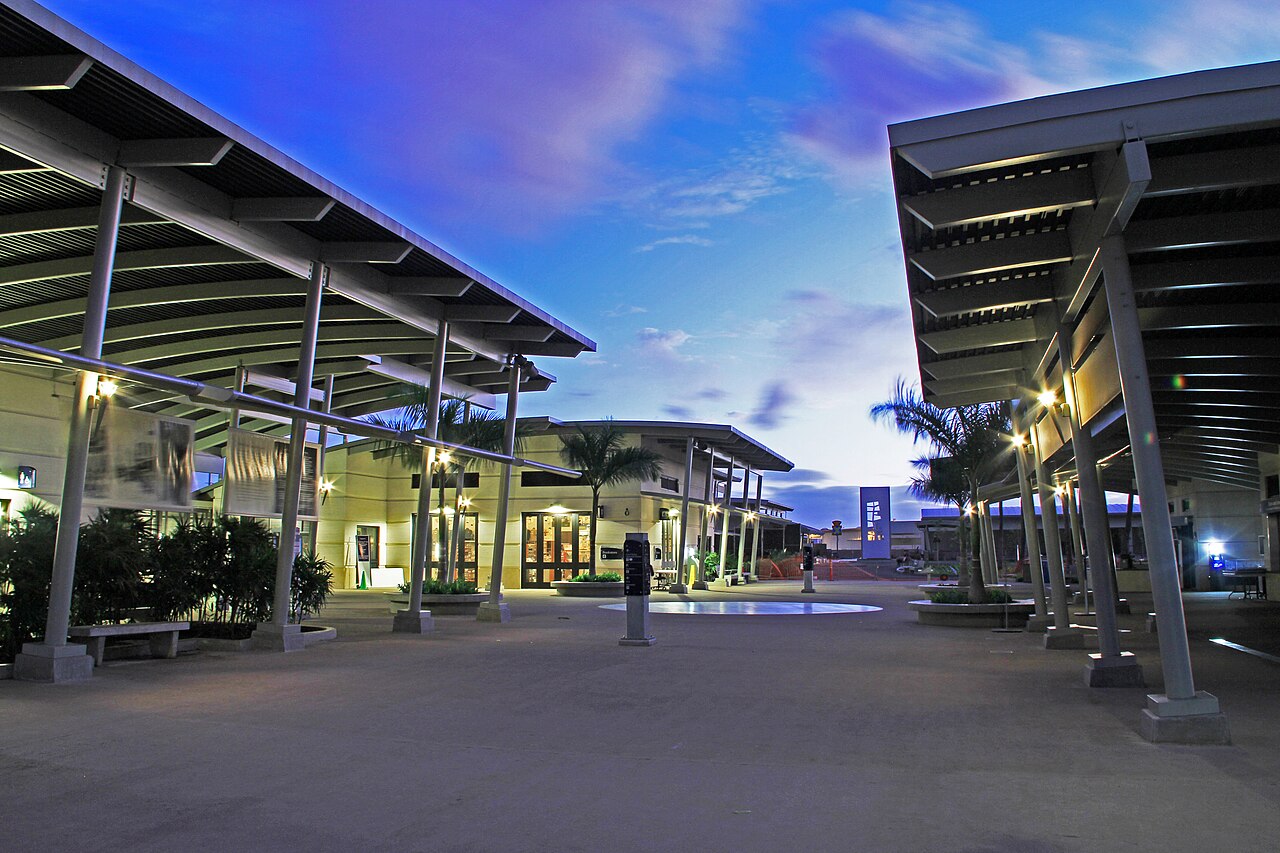
The Pearl Harbor Visitor Center
The main visitor’s center is located in Pearl City, tucked away after the end of the modern military shipyard there (keep an eye out, this remains a major US fleet base and you’ll likely see a fair amount of active duty ships as well). This is your centerpoint logistically speaking – right now that primarily means either driving (lot is reasonably sized, but can get overflowed in peak tourist season), rideshare (typically <$40 within the city of Honolulu), tour bus (many package options from the popular Waikiki Beach area and some of the nearby resorts), & city bus. There is a light rail station within walking distance, but the light rail system primarily services the residential areas of Pearl City/some parts of Honolulu, so this isn’t yet a great tourist option – check back in 2030 or so.
The visitors center hosts the terminus for the ferry to the USS Arizona memorial, the Pacific Fleet Submarine Museum, the Eternal Patrol memorial garden, a VR multimedia experience (my group skipped for time) and the main gift shop. It also serves as the bus terminal to Ford Island, where the Battleship Missouri & Aviation Museum are located. I believe you technically can drive to the island yourself, but you will be required to comply with normal rules for entering a US military facility (primarily providing identification to the visitor control station) and parking on base at the Missouri is very limited, though there seemed to be lots of space at the air museum. That said, almost everyone should use the free shuttle bus from the visitors center if you plan on attending more than one of the various attractions (which does not require any ID). Of note, they follow sporting event style restrictions on bags – if you want to bring one in, make sure it is of a clear plastic material. There are food options available at all of the sites, though they tend to start shutting down around 3 pm-ish (they seem to operate on island time rather than posted time unlike everything else).
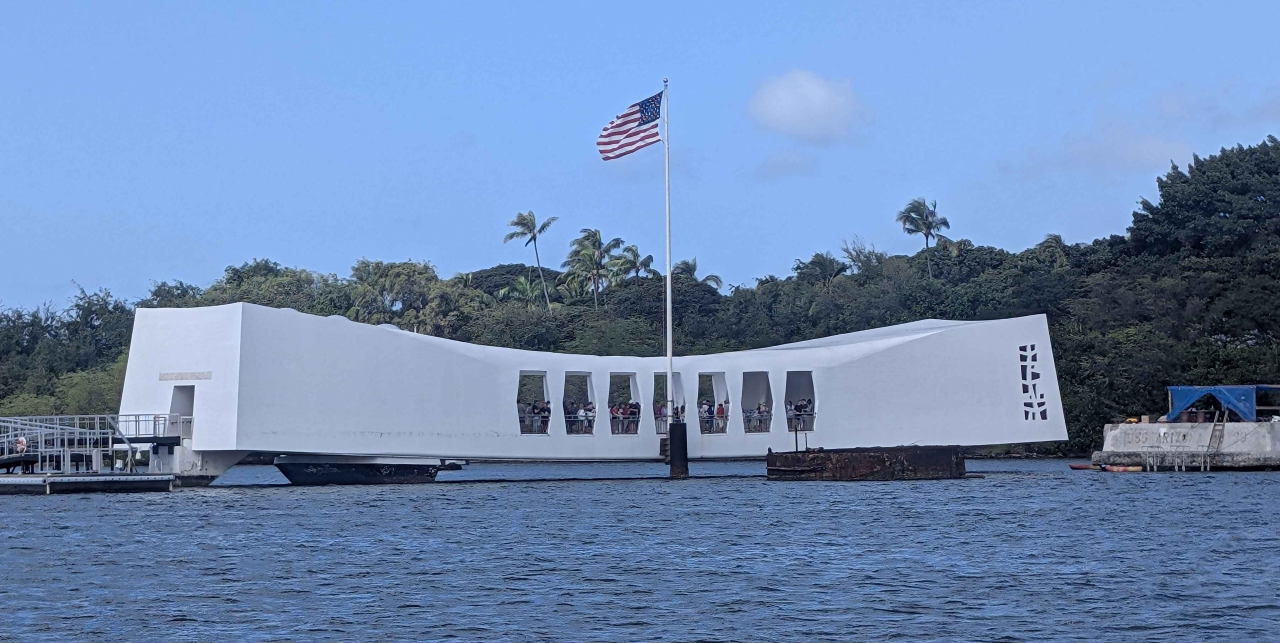
The Arizona Memorial
As a large complex spread across 3 main locations, a visit can get logistically challenging, and there is enough going on that it will be difficult for the average reader of this blog to satisfactorily explore each part in a single day – if you’re going to try you really do want to get an early start (hours are 7 am – 5 pm). I would estimate that the Arizona Memorial takes 1-1.5 hours, the submarine museum 1.5-2.5 hours, VR experience an hour, the grounds of the visitors center another half hour, transit around the sites 30-45 minutes, the Missouri 2-4 hours, and the Air museum 1-2 hours (so 7 hours minimum for everything, though more likely closer to 10 or 12 hours). All tickets (except the Arizona) to attractions are valid for 2 days (management understands how big the site is).
The USS Arizona Memorial site is a platform built over the sunken wreck of the USS Arizona, one of the battleships sunk in the Pearl Harbor attacks. It is the resting place of 1,102 of the 1,177 sailors and Marines, and fundamentally exists as a memorial to their grave. The memorial hall itself is spartan, with only a few plaques explaining the sinking and dominated by the memorial wall, that bears the name of those who died. Some pieces of the ship remain visible, notably barbette #3 and one of the masts, and depending on water clarity that day more can be viewed underwater. The memorial is surrounded by the ongoing restoration project for the historic quays that were used to host battleship row
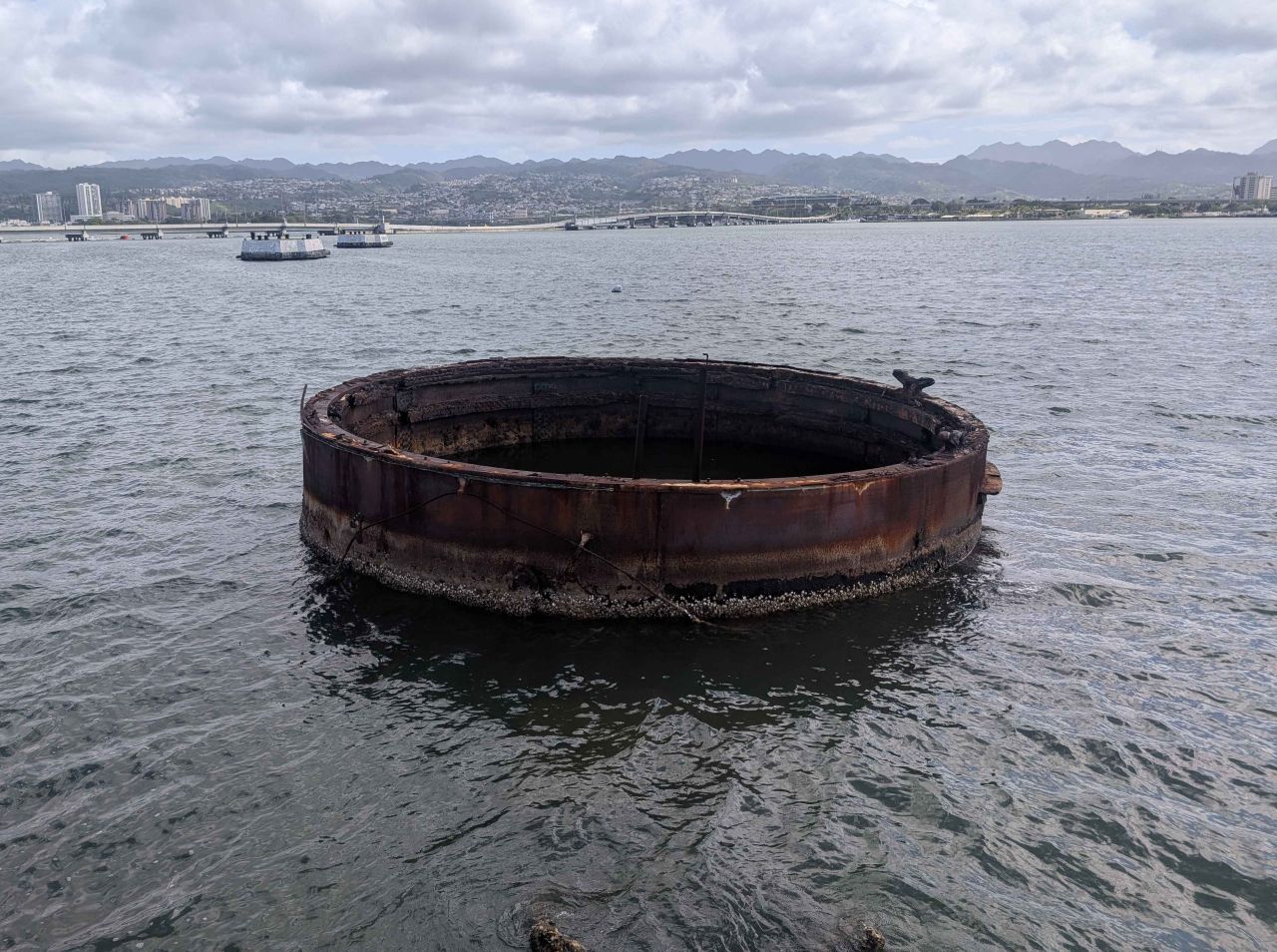
Barbette 3 of Arizona
Visiting the Arizona is the most complicated portion of the entire experience, and one that I don’t recommend to anyone who I wouldn’t take on a tour of Arlington National Cemetery or Flanders Field Cemetery. At the visitors center, there is a free 30 minute film on the Pearl Harbor attacks that is worth watching and takes place in the same building the ferry departs from (apparently they originally were bundled together, but the logistics got sufficiently complicated they decided to run the two separately). Access to the memorial is run separately by the US Park Service, and requires you to have a reserved timeslot (cost of $1) to get on the ferry. Timeslots are opened up in 2 chunks, 1 month and 1 day before the date in question – and like all park service reservations these are incredibly difficult to actually secure without a healthy dose of luck. Fortunately, there is also a standby line, which when you arrive at the visitors center find this first thing (on your left as you enter) and put down your name/phone number – I visited in the off season and was able to catch the 2nd ferry after arriving (they depart every 15 minutes).
The visitors center itself has a smattering of artifacts, memorials, and history scattered about what is a very nice waterside park area. Most notable is the garden memorial to the 52 USN submarines on eternal patrol due to wartime service, with a plaque of short history dedicated to each. If you didn’t buy package tickets online, you can purchase them here, or at each individual site.
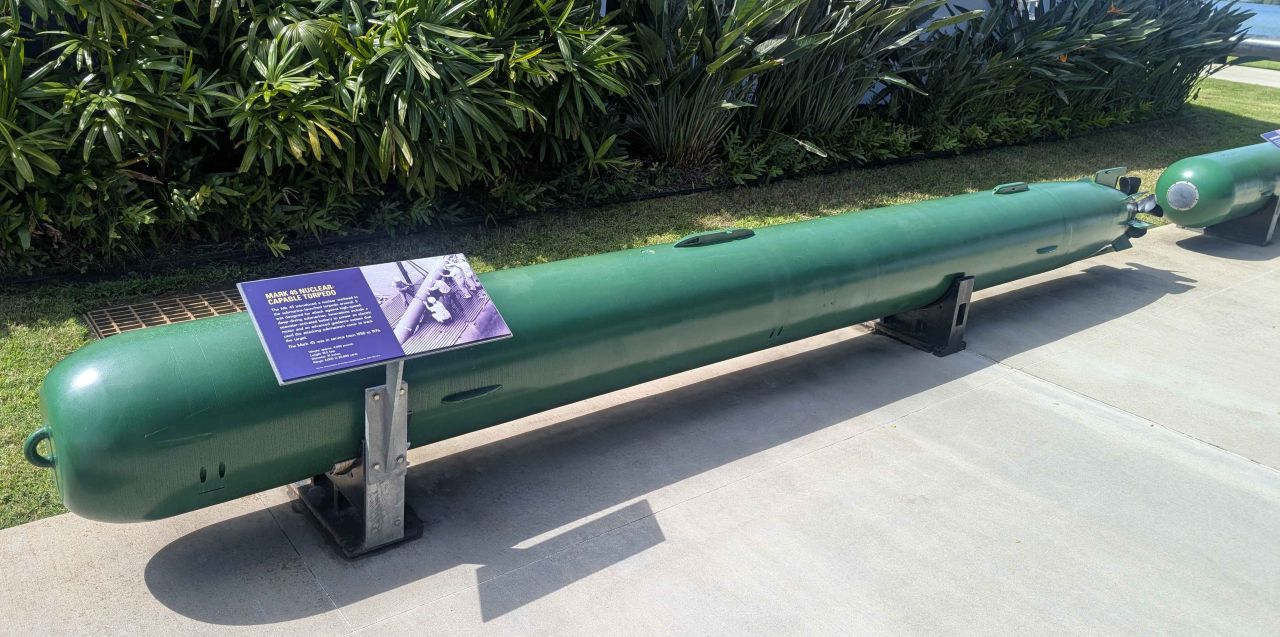
The far end of the visitors center is dominated by the the Pacific Fleet museum, which has 4 main focuses. There are two indoor halls, one dedicated to the role of submarines in the Pacific War, and another dedicated to the evolution of their role during the cold war. Outside is the large artifact garden and the USS Bowfin, which is a fairly typical example of a WW2 fleet boat (great for those new to naval museums, but it does not offer anything particularly unique relative to the dozen other fleet boat museums around the country and is a good candidate to skip for time in favor of the more unique offerings).
The halls are well done but in my opinion suffer from a lack of artifacts and an over-reliance on text and life of a submariner stories (I’m spoiled though because I live near the Naval Undersea Museum in Keyport, Wa and that is hard to top as a submarine museum).1 The artifact garden has a great collection of torpedoes and submarine rescue gear as well as a MAC (Multiple All Up Round Canister) prototype from the end of the cold war dropped with absolutely no context, from the navy converting four Ohio class ballistic missile submarines to fit 3 Tomahawks into a single Trident missile tube.
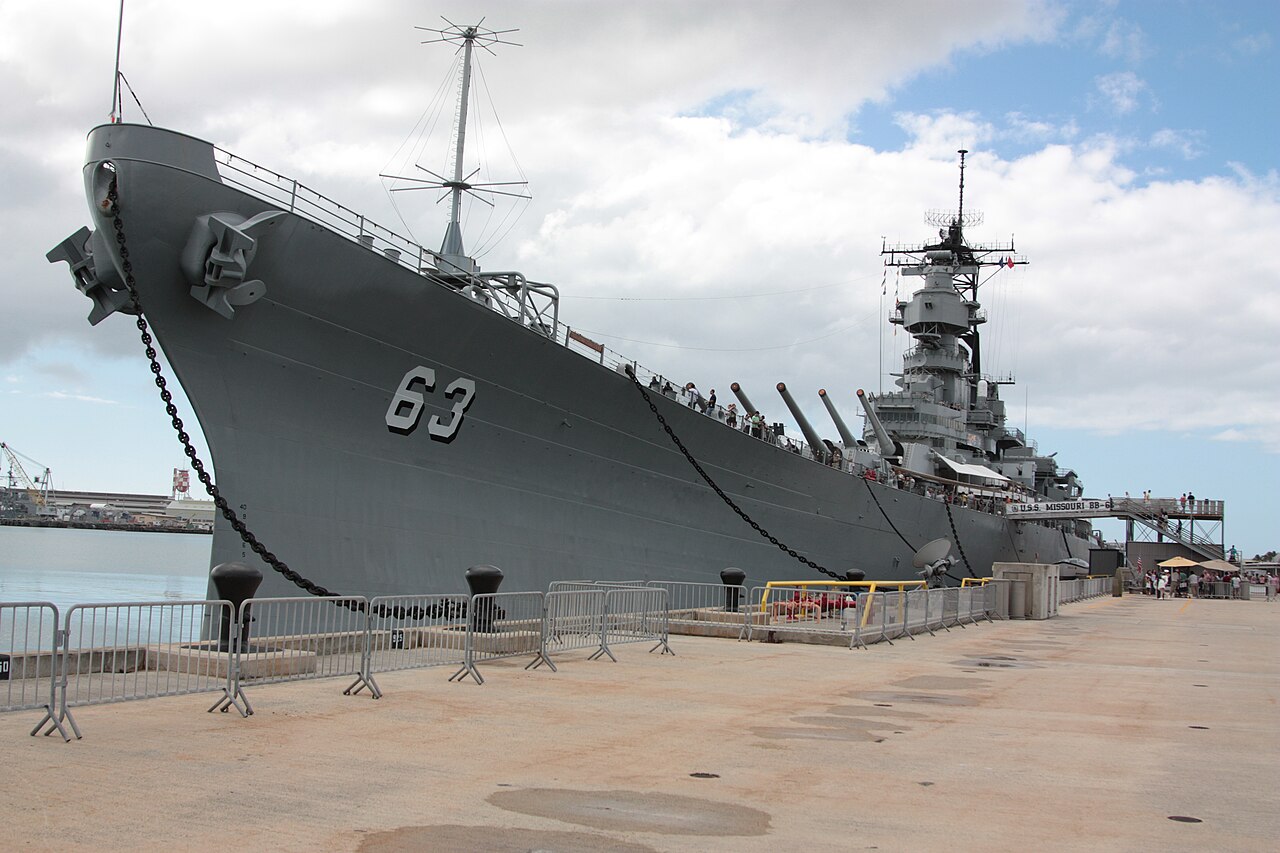
The USS Missouri (despite Bean’s best efforts, the most famous of the Iowa class battleships)2 was only commissioned in June of 1944 (the last US battleship completed), and like most of the Iowa class saw only limited combat duty, primarily shore bombardment in WW2. She was decommissioned in 1955 after being the first battleship to participate in the Korean War, and then was reactivated in 1984 as part of the 600 ship navy until her final decommissioning and conversion to a museum ship in 1995. The ship has the 1 & 2 decks fairly open (access to crew quarters and mess decks) and the flying bridge as part of normal access. They regularly run guided tours, or you can self guide yourself through reasonably well. She has two notable features that distinguish her from her 3 sister ships – the first is the highlight of the signing of the documents of surrender by the empire of Japan and the allied powers that brought a formal end to the Pacific War. The second is tucked away ignominiously in the depth of 2 deck, and is a plaque memorializing the incident in which the Missouri set a record (since broken) for the largest ship ever grounded in the Chesapeake Bay, and her captain whose name graces this blog’s annual (anti-) award for excellence in naval performance, the William D Brown Memorial Award. I ran out of time to do either the bridge tour or engine room add ons, which each have a couple of time slots every day – it feels like the Missouri has a fair bit higher visitor count than any of the other battleships and it does show a bit in how they arrange visitor handling (though I don’t have data to back that up).3
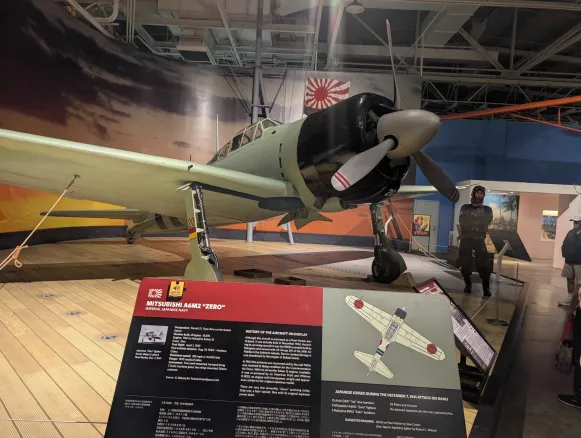
A Zero with a costumed docent
The final stop on the tour is the Pearl Harbor Aviation Museum, the main hall is dedicated to naval aircraft that fought the Pacific War (although with the exception of a Zero in good shape, the Japanese examples are all in fragments that were once aircraft form). There is the requisite Doolittle raid display, though it is overshadowed by the Midway exhibit next to it. The only real complaint I have is that the historical narrative kinda peters out right after Midway and devolves into a small collection of late war artifacts (also Guadalcanal is almost completely neglected). Tucked away behind the main building in a way that is difficult to realize it is there and poorly signed to is the aircraft park and hangar 47, which contains a wide array of WW2-modern aircraft, from the nice pristine models to a B-17 they pulled out of a swamp and most of the fuselage of a D3A “Val” dive bomber. Also detached from the main building is the former control tower for Luke Field, which hosts a small display on historical aircraft firefighting on the first floor, and then has a rooftop observation deck with a very cool set of signage that lines up specific views from the tower with various events from December 7th as well as a short video on the attack.
Comments
I've been bummed out for decades that the Missouri ended up in Hawaii. As a kid I visited her several times in Bremerton, WA when she was mothballed there -- though there was (as far as I remember) only a small exhibit off the Surrender Deck with information about her role in the ending of the war. This was before her reactivation, and it sounds like a good deal more work has gone into making her a real museum ship, and not just a member of the mothball fleet. I'm still jealous.
they don't have the nagato. 1 star.
Thank you for the review.
I had to respond as my son is stationed at Pearl, and I've gotten to visit the sites several times. Because he is local, we were not tied to the "tour" time schedules. I overall agree on your impressions, especially that its a great place to visit.
I think I enjoyed the Pacific Fleet museum more than you did. Some of that is I like narrative and text. And maybe I'm not spoiled by the Naval Undersea Museum.
For the Missouri, sorry you did not get to go on one of the guided tours. While you can certainly self-tour which I've done, the guided tours added a huge amount of detail for me. Example on the engineering tour our guide spent time to explain the workings for the great boilers and working in the engineering spaces. Different tour covered the bridge areas as well as the mechanical computers controlling the 16" firing.
You briefly mention it, but I enjoyed U.S. Army Museum of Hawaiʻi/Fort DeRussy on Waikiki. I thought it has some great displays and artifacts stretching from Kingdom of Hawai'i to more modern times. And as you note: free!