
Probably the most obscure corner of carrier aviation is COD, Carrier Onboard Delivery. This is exactly what it sounds like, the practice of delivering high-priority cargo, mail and personnel from bases ashore to aircraft carriers. The role originated in the immediate postwar years, and was first carried out by TBM Avengers modified to carry six passengers or cargo in the former bomb bay. But it was soon clear that the limited cargo weight and volume would be a problem for air-delivery of important cargoes like jet engines and nuclear weapons.1
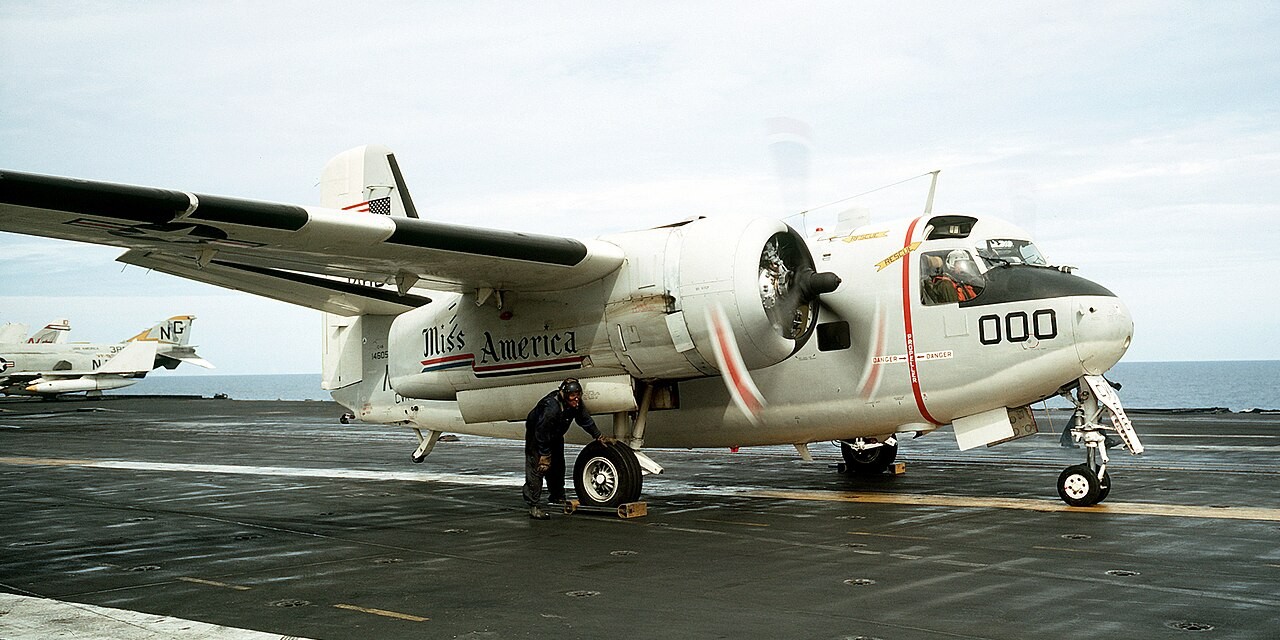
A C-1 Trader
The Navy ultimately chose to procure the C-1 Trader, a variant of their existing S-2 Tracker ASW aircraft with an enlarged fuselage. Entering service in 1956, the Trader would go on to serve for three decades in the USN, ultimately becoming the last operational piston-engined aircraft to fly from American carriers. But it was slow and limited in range, and, more importantly, it was soon unable to carry the largest jet engines in use by the fleet. The Navy again turned to Grumman to adapt an existing design with a new fuselage, turning the E-2 Hawkeye into the C-2 Greyhound. Ultimately, it would serve for almost 60 years until the growth of jet engines, in particular the F135 for the F-35C, caused the Navy to procure a new COD airplane capable of carrying it. The winner in this case was the CMV-22,2 based on the V-22 Osprey beloved of the Marines and loathed by budget analysts.
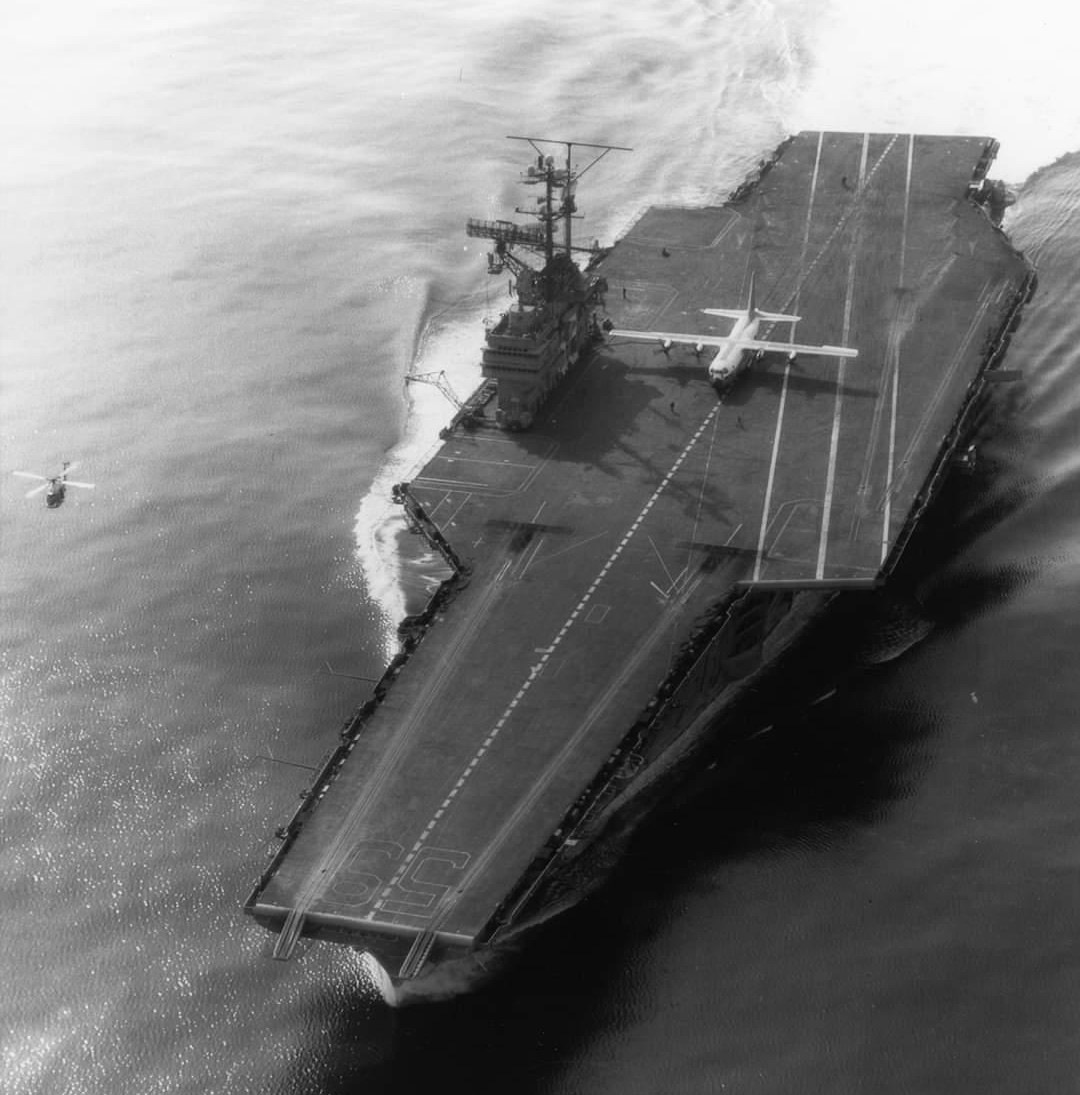
The Hercules aboard Forrestal
But while only three aircraft have actually served in the COD role since the mid-50s, there have been numerous other proposals, often for larger and longer-ranged aircraft. In 1963, looking for an emergency option that could better the C-1 Trader's range, the Navy carried out tests aboard Forrestal using a barely-modified KC-130F Hercules borrowed from the Marines. A pair of experienced carrier aviators were checked out on the Hercules and sent to conduct the tests about 500 miles out in the Atlantic. They were able to successfully conduct 29 touch-and-go landings, 21 full stop landings and 21 takeoffs, all without the assistance of the carrier's catapults and arresting gear. Famously, one test saw the Hercules stop opposite the ship's island with "Look Ma, No Hook" painted on the side, and it set a record for the heaviest aircraft operated from a carrier that stands to this day. But there were also problems. The biggest is that while it was technically possible, getting the necessary stopping distances required reversing their engines 3-4' off the deck, a maneuver that is generally frowned upon. The second was that the C-130 is a very big airplane by carrier standards, and landed straight down the deck instead of using the angle, which required the deck to be almost entirely clear of other aircraft. Since the days of Langley, the USN has kept a lot of planes on deck, so even landing a C-130 for five minutes would be extremely disruptive to normal operations, and it was way too large to park out of the way if something went wrong or they needed to wait. As a result of all this, despite the success of the tests, the procedure has never been repeated.
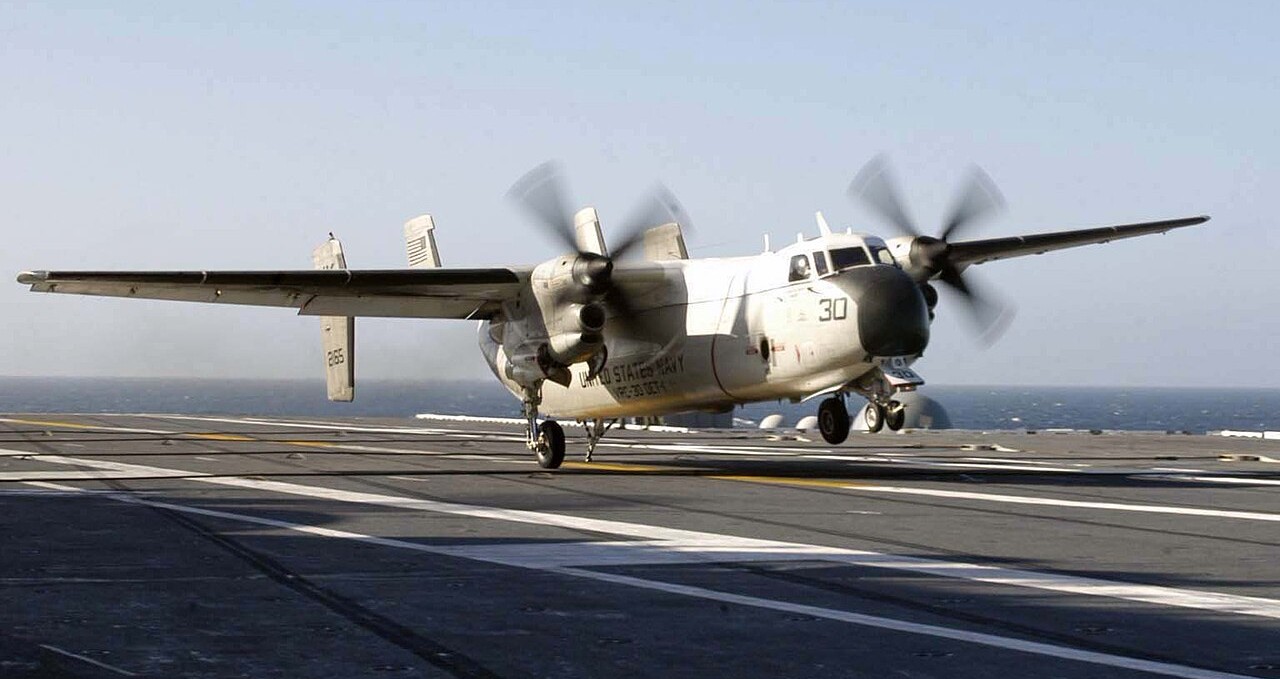
A C-2 lands aboard Lincoln
The Navy was still interested in the idea of a COD plane with more range and capacity than the C-2, and conducted a number of studies over the years. Because it was likely to be a small fleet, and the available funds were limited, very few of these were designed from scratch. Some were intended, like the C-2, to share commonality with other carrier aircraft,3 while others were based on whatever sub-C-130 transport was on the drawing board at the time. But the most interesting were a few proposals to use airliners as the basis for COD planes.
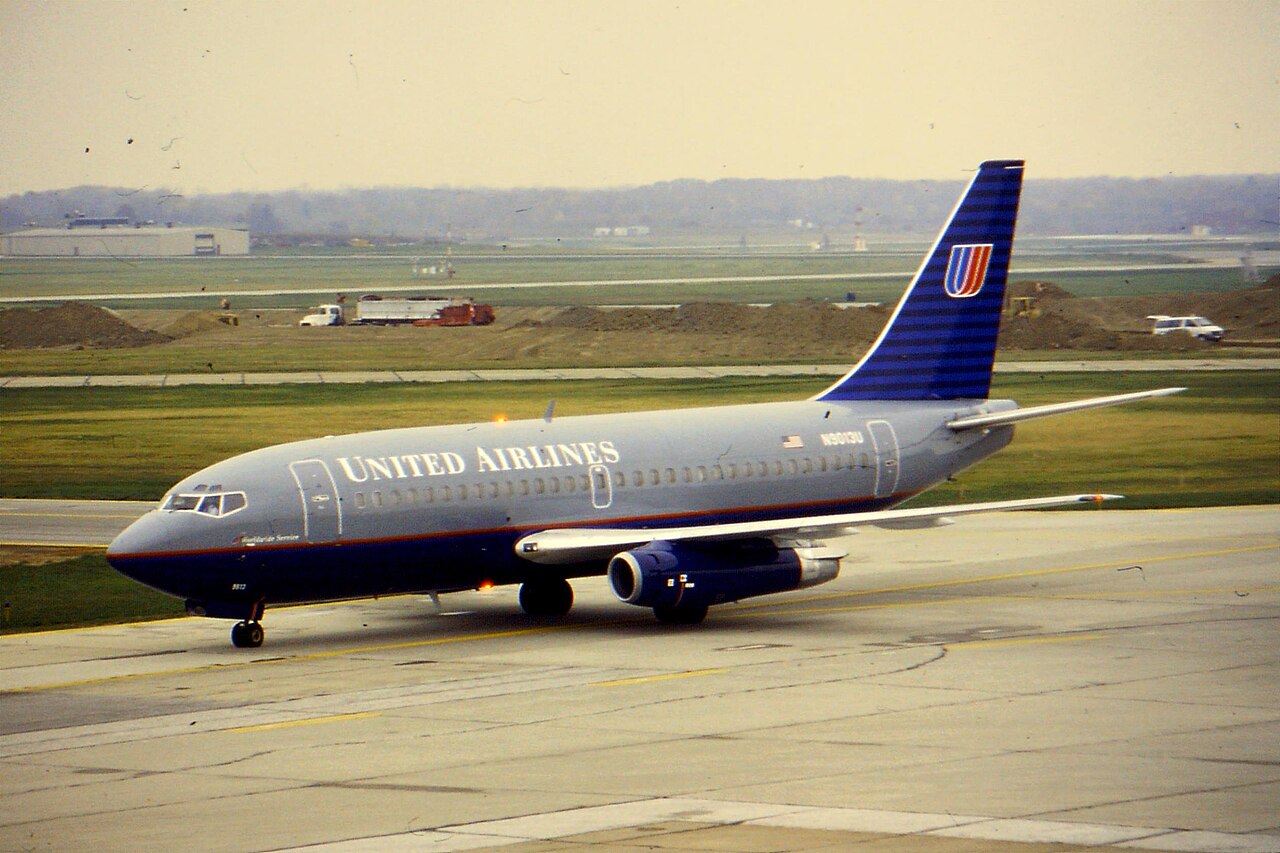
A 737-200 in gray with "United" on the side, so it's basically a USN jet
When I first heard this, I assumed it was a joke, or possibly the result of a gross violation of General Order 99. And while much of me still has a hard time believing it's real, and the former airline structures guy is still running around in terror,4 the math is just plausible enough to warrant investigation. The first round of proposals came in the early 70s, with a DC-9-105 and a 737 variant of some sort6 put forward as candidates. I'm going to focus on the DC-9, as I have a spec sheet for the military version of the DC-9-30 and I don't have anything equivalent for the 737-200Adv.7 Both would have been big for carrier operations, but they were significantly smaller than the later members of their family, and just might have squeezed aboard.
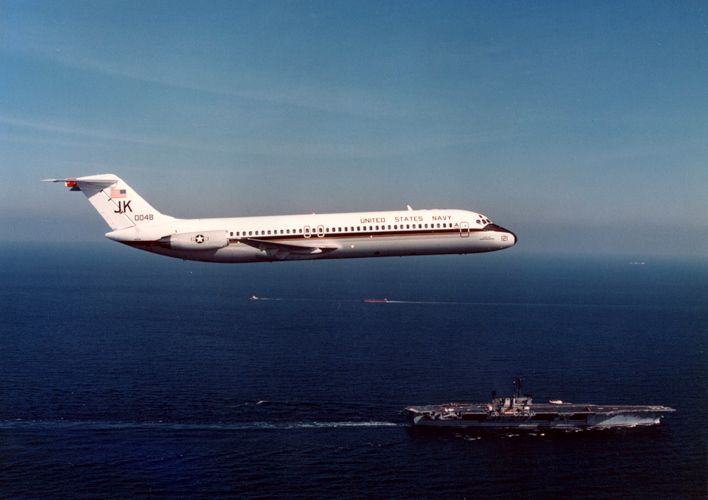
A C-9 flies past a carrier, though not to land on it
Now, to be clear, neither would have fit aboard very well, but the biggest problem the C-130 had was its 132' wingspan, while the DC-9-10's was 89' and the 737Adv was about 93'. While this was still significantly wider than anything regularly flown from a carrier (at this point, that was probably the A-3 Skywarrior at 72.5') the extra 40' and the fact that they were planning to use arresting gear and catapults meant that they could slot (probably fairly awkwardly) into the existing flight deck ops instead of having to kick everyone off. Obviously, sticking around might be a problem but COD birds were generally expected to fly aboard, unload, get refueled and then leave again. Of course, other modifications would be required, and McDonnell Douglas planned to fit not only a tailhook, but also a new nosewheel that incorporated catapult fittings and could be extended to give a higher angle of attack for takeoff, an in-flight refueling probe, and strengthened structure to take the loads of carrier operations. Folding wings were even proposed, though don't seem to have been accepted as part of the initial study.
But all of this assumes that it's physically possible to land and take off in the appropriate distances. Sure, you can do it with a C-130, a plane deliberately designed for short-field operations, provided you have enough wind over deck, but these are airliners designed to operate from relatively big runways. They may not chew up tarmac like the first generation of jets, but would they really be small and slow enough to be compatible with the equipment on a carrier?
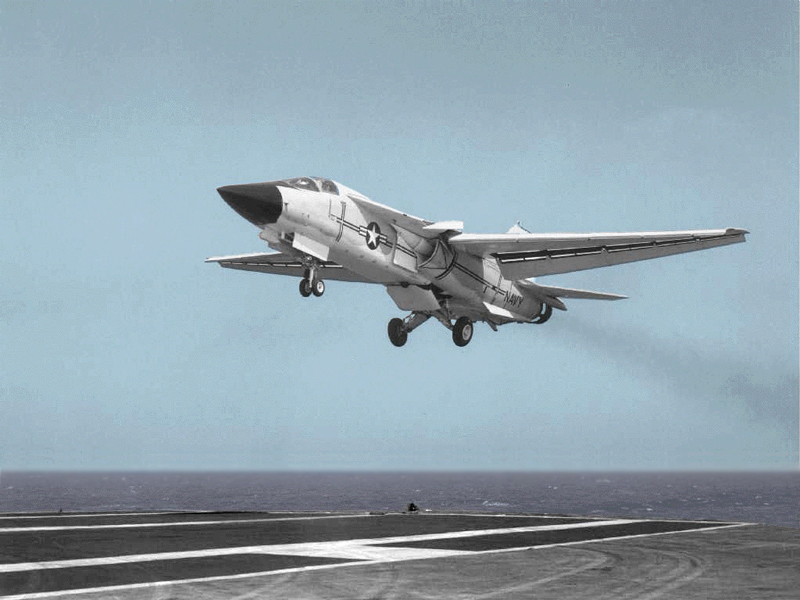
An F-111B lands on Coral Sea
Let's start by looking at the problem of landing. Per the SAC, for the design mission (10,000 lb of cargo), the C-9B should be landing at around 73,000 lb, with a power-off stall speed of 85 kts. If we assume 40 knots wind-over-deck, then it's going into the arresting gear at something like 45 kts, but it's also going to be landing at a similar weight to the weight the A-3 Skywarrior, the heaviest plane to regularly operate from a carrier, took off. But weight is only half the story. Speed is the other half, and it's here that I found something surprising. Looking through possible comparison aircraft, I found the F-111B, the result of an extremely dumb attempt to turn an Air Force light bomber into a Navy missile-slinger. It was cancelled before entering service, but it was definitely carrier-capable and even flew a few carrier tests. And at the maximum listed landing weight of 57,000 lb, it was stalling at about 100 kts, for a speed relative to the deck of 60 kts. If we assume that the arresting gear is basically limited by the kinetic energy of the landing aircraft8 then the total kinetic energy of the F-111B is 102.69 while the C-9B comes in at only 74.1, a value lower enough that I'm actually reasonably confident that this could have worked, structural issues aside.
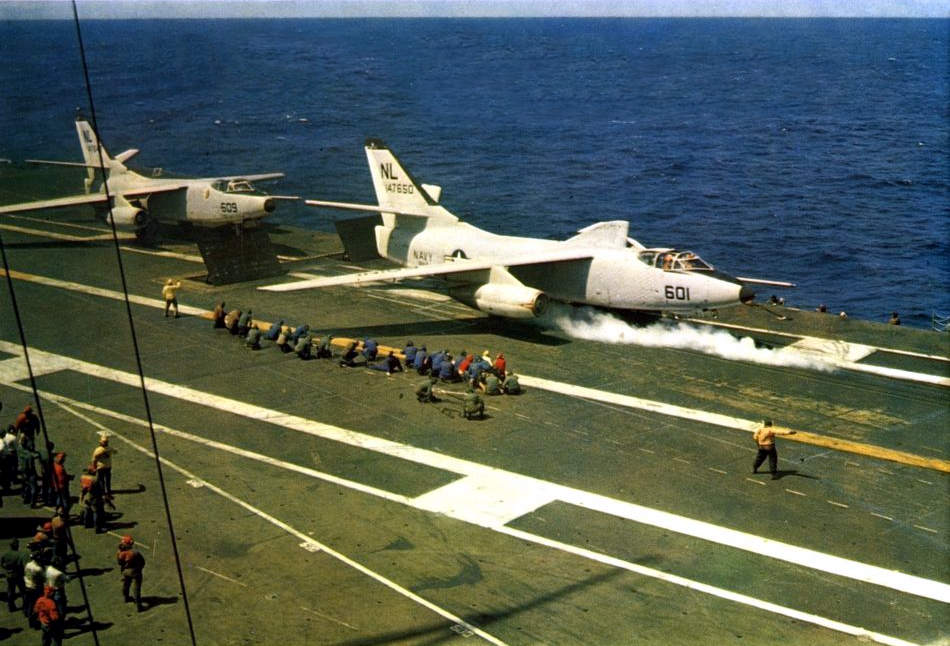
A Skywarrior prepares to launch, also from Coral Sea
But what about launch? Here, we're going to use the A-3B, the heaviest plane regularly to take off from a carrier,10 as our exemplar. It took off at 73,000 lb and a power-off stall speed of 124 kts. The C-9B's numbers are a takeoff at 99,700 lb and a power-off stall speed of 100 kts. If we again assume 40 kt wind over deck, we see the A-3 needing to get 257.5 from a combination of its engines and the catapult, while the C-9B needs only 179.5. Weirdly, it looks like the C-9 actually has a slightly higher thrust-to-weight ratio than the A-3, so again, we pass a plausibility check for this scheme.11
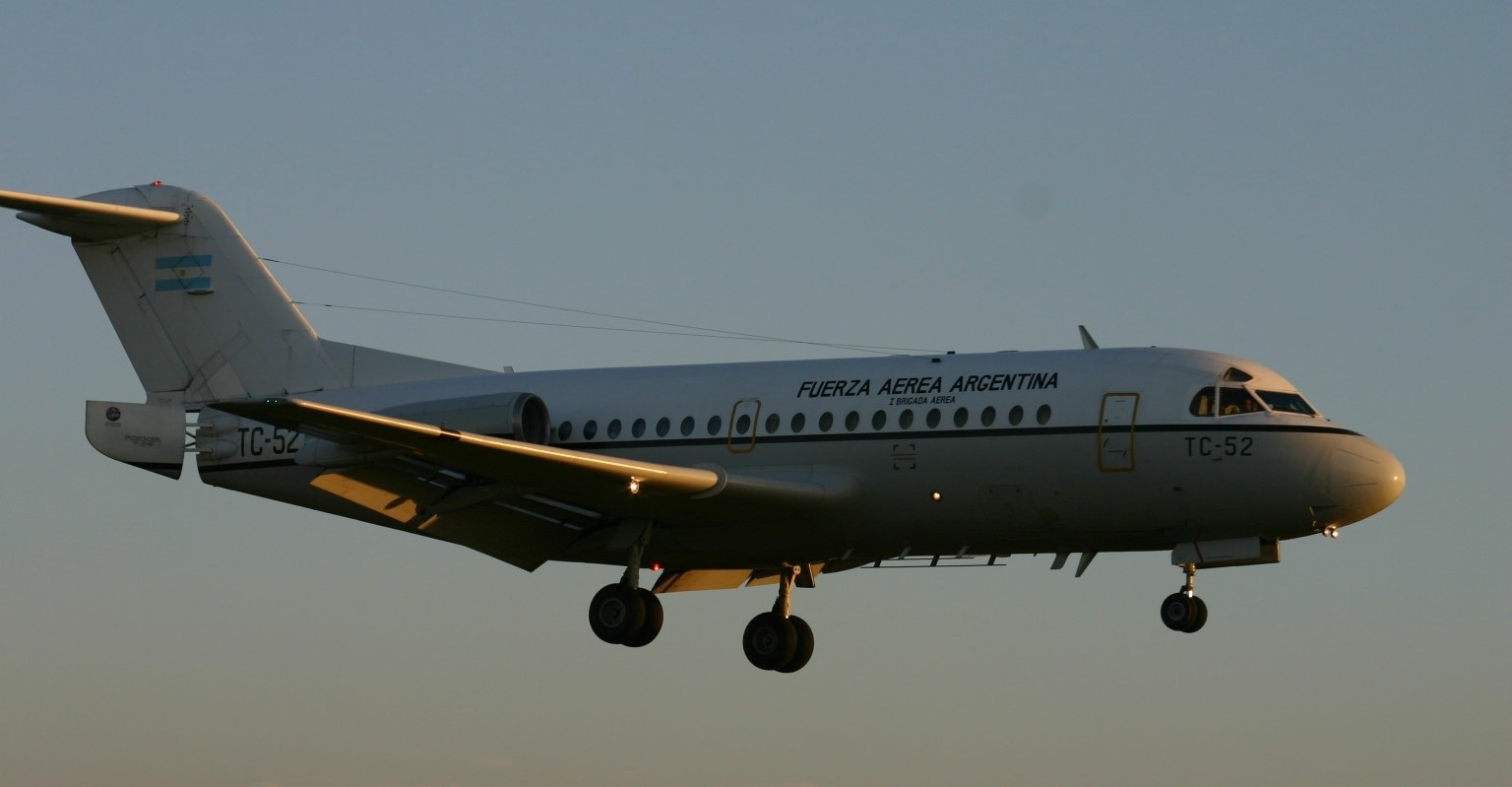
An F-28 from a carrier navy on final approach, sadly sans tailhook
Despite the fairly impressive performance (10,000 lb of cargo for 2,200 nm) the plans for the C-9 COD went nowhere. But it was far from the only airliner proposed for conversion, either in the early 70s or later. I've already mentioned the Boeing alternative, but at the same time, Hawker-Siddley proposed a version of their HS 748 turboprop airliner, with folding wings and the usual structural modifications, but it seems to have gone even less far than the jet alternatives. Later, in the 80s, when the Navy was looking at a new COD plane to replace the C-2, they seriously investigated the Fokker F28, a somewhat smaller airliner than the DC-9 and 737, but ultimately decided to build more C-2s instead. And it looks like we'll probably never see such proposals again. Modern airliners are less rugged, because structural weight costs money to haul around, and there's just not much demand for a long-range high-capacity COD, particularly now that the CMV-22 has aerial refueling capability. But it's an interesting rabbit hole of history to go down.
1 To be clear, these were nuclear weapons for other planes, and the COD bird didn't have a secondary nuclear strike role. ⇑
2 Yes, it would normally be the CV-22, but the Navy thinks its people are deeply stupid and would confuse the resulting aircraft with either the USS Independence or the program to develop a long-term replacement for the Ford class. And no, I don't know what was wrong with UV-22 either. ⇑
3 There were several proposals to use the S-3 Viking ASW plane as the basis of a new COD bird, with differing levels of redesign. Ultimately, all of them failed, and half a dozen S-3s were stripped out and redesignated as US-3, used to carry a few people and small cargoes like avionics and mail to carriers operating far from land bases. ⇑
4 While he's here, he would also like to note that he is extremely baffled by the recent media coverage of the 737MAX airworthiness directive. That kind of thing is basically Tuesday in the airline structures world, and after looking into it a bit, this is almost the definition of a routine issue. Boeing released the inspection in late 2024, and the planned AD was made public in November 2025. For that matter, the first MAX isn't going to need to do these inspections for probably another 3-5 years. ⇑
5 Technically, it was based on the DC-9-10 with DC-9-20 slats and a C-9B cargo door. ⇑
6 My one source on this (American Secret Projects Vol 3) is really light on details, but the timing suggests it would have been a 737-200 Advanced. The only detail I do have is that a Boeing test pilot in a company plane managed to stop a 737 in 559' on a simulated carrier deck, without the benefit of arresting gear. There was also a Boeing proposal to use a 727 as a COD bird, which makes even less sense, as it's a larger, heavier airplane and it doesn't seem like the Navy needed more cargo space. ⇑
7 The DC-9-30 had a 14' fuselage stretch to counter the threat of the 737, and a bigger wing. For some reason, possibly deck space, they didn't use the bigger wing on the COD version, but I think this is a reasonable bound on performance and I don't have decent data on the original DC-9-10. ⇑
8 To put this a slightly different way, we assume that the arresting gear is exerting a constant force across the length of the landing zone. Obviously, this is likely to annoy any arresting gear engineers reading this. If you are one of these people, get in touch and we can come up with a better model. ⇑
9 The unit is 1e6 lb*kts2, which is not a unit you should use on your physics homework. But I'm using the same unit throughout, and the important thing here is the relative values. ⇑
10 The A-3 was designed for long range and built with early, thirsty jet engines, so maximum landing weight was only 49,000 lb, hence the use of the F-111B for the landing analysis. ⇑
11 Apparently, it would even have been possible to launch the jet with one engine out, although I can't imagine this happening regularly for safety reasons. ⇑
Comments
The range and speed advantages would have been undeniable, but would airliner COD conversions really have been that useful? There is a reason that every tactical airlifter (including larger helicopters) has a rear ramp for loading and offloading. You mentioned delivery of aircraft engines, but an F-4 Phantom engine is ~17 feet long while the cargo door on the C-9 is only 11 feet long and ~7 feet off of the ground - how would they have gotten the engines out of/down from the airliner efficiently?
I was always surprised after the S-3 was introduced there was never an AEW and COD variant developed using the same engines and wing like how the the E-1 and C-1 were developed from the S-1 Tracker (Tracker of subs for ASW, Tracer of radar contacts for AEW, Trader of cargo for COD - that family had by far the best naming convention of any US aircraft, a scheme worthy of the British). The S-3 had a 100+ kt speeds advantage and some 1000 mi ferry range advantage over the E-2/C-2, not at all insignificant.
With the V-22 and variants here now I would probably base any future AEW and ASW platforms on it. The ability to VTOL and use surface combatants, amphibs, etc. for capabilities previously only available to CVNs is probably worth the lower performance of propellers vs jets.
The COD Osprey should be the CV-22C, because the USMC variant should have been the CV-22B, to get away from this "everything has an 'M' designation because modern technology allows aircraft to do more than one super-specialized thing" nonsense. MH-60R should have been SH-60R, and MH-60S the CH-60S, etc. (or at least flipped the series designator so the -60'S' type had the anti-Sub role, and the -60'R' handling resupply and rescue.)
I would think it would be worthwhile for the US to keeo a minimal capability to operate a C-130 on a carrier in cold storage, if only a cadre of 2-3 crews that are both carrier qual'd and C-130 type qualified who practice on one of those flight deck's painted on a runway once in a while. Might be totally unnecessary 99.999% of the time, but if there was ever a critical situation where you had to get something really large to or from a carrier RIGHT NOW it could pay big dividends. Or depending how geopolitics change if you needed to get an MC-130J somewhere far away for something you couldn't get landing rights for. Although the USAF CV-22B might now have made that range issue obsolete (while amplifying the problem that the USMC basic cargo model has the 'M' spec ops designator while the USAF spec ops model has the 'C' basic cargo designator).
I saw somewhere that the pilot who landed the C-130 on the Forrestal said that it wasn't being done to study generic COD use, but as part of the program that developed a carrier capable version of the U-2 spy plane. Whether this was done to provide cover for an empty carrier conducting flight ops, to test if an aircraft with a 100+ foot wingspan and a long landing roll could make it on deck without risking a top secret and state of the art spy plane, or because of some unique delivery requirements (a specialized form of COD) was not clear. However, the U-2 did make some arrested landings and unassisted takeoffs from USN carriers, an amazing corner of naval aviation history.
It probably helps databases and other such systems a lot to have unique identifiers for their inventories, the navy probably works with a lot of legacy systems so it would be even more helpful than normal. Of course I don't know for sure and I could be completely wrong on this.
@Onux I don't think there are any situations in which an urgent transport is absolutely necessary and in which you can also safely fly such a plane to a carrier and then clear its entire deck, at least if there are any, they probably don't come often enough to develop a solution for them.
@Onux
You take it out at an angle. Or, well, I don't know how wide the airstair is.
Re the S-3, they tried, and even issued Lockheed a contract at one point, but it didn't get funded. Some of the problem was that the S-3 was a little bit small for the role.
I don't disagree with you on the designation (obviously) although I think there's a plausible reason for M for the H-60S, because it genuinely is doing a lot of things. For the R model, it's just obviously stupid. (Note that this really doesn't explain the V-22, though, because the Air Force has the C model, and really, really shouldn't.)
Re the C-130, I initially thought they did it for non-COD reasons, but then went looking and every source I found said it was for a COD test, so I went with that. I don't think it's a capability that makes sense to maintain. It was done by fighter test pilots specially checked out on the C-130, and required clearing the deck in a way that I'm not sure is even possible on an operational carrier. To keep that in your pocket, you'd presumably need regular qualifications, which means pulling a carrier out of service to do it, initially in an era you had a dedicated training carrier (which probably couldn't support the job because the Essexes aren't that big).
@Anon
The problem there is that Independence was (a) a ship, which should make it unique enough (b) designated as CVL-22, rather than CV-22, and (c) blown up in 1946. I guess it's possible they ran into the same sort of problem that resulted in Windowns 9 being skipped, but I reserve the right to make fun of them for it.
Did the C-1 require a separate fuel supply of AvGas when it was operated alongside jets at the end of its career, or did they find some way to avoid that? It seems like it would really have complicated fleet logistics, though perhaps they prioritized using it on shorter range missions (e.g., off Vietnam) where the fuel could primarily be held onshore, or on ships with other radial engine aircraft, like the Skyraider.
I believe it did, and IIRC, this was a serious issue towards the end of its service life. I think I've heard stories about them basically landing with tanks half-full and flying back without taking on fuel on the carrier, but I don't have sources to hand for that.
Onux:
Take the afterburner off.
The smallest airline airports aren't much bigger than a carrier (the shortest I know of is 382m, though this 400m one is even more carrier-like in that it has sea cliffs at both ends), but the small planes they use wouldn't have the cargo capacity for this.
Larger STOL airliners like the HS 748 and DHC Dash 7/8 are no longer produced, to some concern in places like Norway with many airports sized for them (~800m).
A quick google search says that the airstair of the DC-9 is ~28 inches wide while the diameter of a J79 is 38 inches. The airstair door might be wider, but a J79 weighs ~3,800 lbs, so even if it could make it through the opening, how are you getting it down? You're not carrying or rolling it down the stairs.
Same issue for taking the engine out of the cargo door at an angle. I'm aware this is possible, but anyone who has moved furniture through a door or around a corner at an angle knows how much longer it takes versus coming straight through. And again, this is with a two ton object ~10 feet off the ground, so you need some kind of specialized lift/crane, and are going even slower with a crane as you worry about the weight swinging around. A pallet lift like the PFT-10 makes it easier, but now you're stuck with this specialized piece of equipment taking up precious space on your flight deck or in your hanger 99% of the time.
Taking off the afterburner is an option, but now you have sort of defeated the rapid resupply purpose of COD as the engine shop now has to reassemble and test the engine before installing it. With a rear ramp aircraft you can just roll the engine off on an engine dolly using ordinary tow carts you have on deck anyway. Same for all sorts of other cargo: the C-2 fits three 463L pallets and they roll right off; while a DC-9 cargo door can 463Ls, how do you get them up and down?
Again, I question the utility of the designs for the COD mission even if aerodynamically they can get on and off the deck. There is a reason all tactical transports post the Berlin airlift have been designed with a rear cargo ramp.
Regarding the S-3 being too small, difference between gross and max weight is ~14,000 lbs versus ~11,000 lbs for the C-2. Although of course I am assuming using the same engines/wings/avionics while pairing them with a new fuselage (rear ramp!) and tail for the COD and AEW roles, so the larger fuselage might cut into empty/gross weight, but there are a couple of tons to play with. The S-2 engines at 200 mph would be producing about the same horsepower (4,950) as the most recent E-2D engines (5,100) so I don't see a big picture problem with size/weight.
@Onux
It seems worth noting that the Navy appears to have agreed with you in practice - all of the designs that have actually been deployed have had a rear ramp. The "Airliner COD" seems like it was mostly a desktop engineering exercise.
However, I am somewhat surprised that "fit the F-35 engine in a C-2" was not a design constraint, as that is (to my understanding) the major driver behind the CMV-22.
Somewhat unrelated question - could you turn a V-22 into an AEW aircraft with modern phased array radars pulled from the E-7 or Global Eye? (I.e., is the replacement for the E-2D an E-2J or an EMV-22 or a drone? And if it is an EMV-22, does that open possibilities for the UK?
redRover:
If you want the F-35 to be single engine (probably necessary for the F-35B and hence commonality) then there's no way you're fitting it in a C-2.
@RedRover/@Anon
As best I can tell the cargo bay of the C-2 is between 324 inches (3 x 463L pallets) and 360 inches (30 feet) long. I'm not sure why it is supposed to be unable to carry an F-35 engine, as the F135 engine is ~220 inches long. I couldn't find anything specific why other than generic references to "it doesn't fit in its shipping configuration". As far as I am aware the C-2 carried F-14 engines (apparently with the nozzle off?) and that is as big or bigger than the F135 so again I'm not sure what the issue is, especially since the CMV-22 cabin is listed as smaller than the C-2 (68" wide and 288" long). Note that cabin dimensions of cargo aircraft can be massaged in all kinds of ways (usable floor length with or without ramp, length of the usable volume over some height, absolute length - i.e. cockpit door to farthest edge of the ramp at the ceiling - regardless of if you can fit anything there) so take all of my figures with a grain of salt as I don't have any engineering drawings.
@RedRover
You could not do an AEW V-22 using the E-7 or Global Eye radar setup as the top of the V-22 needs to be clear for the wing to rotate over it for hanger storage. As to a side mounted phased array like the Israeli Phalcon, I don't know, the V-22 has the disadvantage of the wings, engine nacelles and propellers hanging out right in front of where the phased array would be.
@redRover
The E-2 line is still, somehow, going, so there's really no reason to look for a replacement.
@Onux
The airstair line was a joke. I suspect that the actual answer was just a bit of mildly specialized cargo moving, because you can just angle it across the bay, then pull it out along the line of the engine center. Annoying, and worse than a cargo ramp, but not the end of the world.
Re the F135, my understanding is that it's a width issue. I've been inside both a C-2 and a V-22 (although it's been a very long time) and I believe the C-2 is noticeably narrower.
@bean There is no need to replace the E-2 right now given that the E-2D variant is a new build airframe and the APY-9 a completely new design radar. However, there would be enormous value in having a STOVL AEW platform. The LHA Lightening Carriers discussed elsewhere are in dire need of an AEW platform, as are the carriers of many allies, not just the UK. The Falklands War showed how vital AEW is - a slight change of luck and the lack of it could have cost Britain the war.
Plus there is the fact that being able to fly AEW from other than carriers or big deck amphibs (LSD/LPD, unimproved bases ashore, etc.) provides enormous flexibility. Ever since the Dowding system winning the air war has been about C2, and to some extent carrier battles will still be who hits first wins. A more distributed and survivable AEW network (plus not able to decouple carrier movement from the AEW plan) could be a big advantage.
For the F135 it can’t be a width issue. The C-2 cabin is wider than the V-22 cabin (90 vs 68 inches as best I can gather from the web; see above my previous disclaimers about floor width vs usable cargo width vs wall to wall width vs …)
I get how one could angle a long object like an engine out of a C-9 cargo door, but I feel it is much more than “ bit of mildly specialized cargo moving”. The maneuver you are talking about happens around 10+ feet above the flight deck (7’ to cabin of the plane, engine is 3-4’ diameter, plus some distance for the cradle). There are no flight deck lifts that go that high (where as an ordinary hydraulic lift cradle for engine installation/removal reaches the C-2/V-22 ramp easily) so it’s not mildly specialized it’s a unique piece of equipment the size of a small truck hogging deck and hanger space that isn’t to spare.
You could do it with a crane, it Tilly is the only crane I’m aware of on the flight deck, and it is way oversized for the job and itself takes up a huge amount of space. Now you not only have to find a place to park the aircraft with the 90’ wide wings you need space to park the 35’ long 66 ton crane next to it as it lifts out the 18-20’ long engine. And there is the risk from having a two ton object swinging around 10-12’ off the deck right next to the C-9 fuselage on a ship that may be rolling and pitching (yes, Tilly lifts whole planes weighing ten times that during its day job, but those only go a foot or two up). Plus as I mentioned about furniture, moving the engine to the door, angling it, pushing it a bit out, attaching to the crane, pushing a bit more, moving the crane to keep up, pushing a bit more … this is a process that is taking time, and you already identified how with a plane that size the priority is supposed to be land-unload-leave quickly.
And remember engines are worst case but this is an issue for everything the COD brings except for people, who can use the rear air stair. Bags of mail/care packages, 5 gallon cans of critical lubricant, bench mounted aviation test equipment - you name it, it all has to somehow safely get down 7’ to a flight deck moving at sea. I don’t see it working well in practice.
The solution to this could be to stick the crane inside the aircraft like a flying Hiab.
another weird-but-real thing: spare engines as external air cargo. Airlines actually did this (on revenue flights, even). I'm not aware of any military doing so (but haven't looked much), despite their greater experience with external carriage in general. Possibly because a long thin (for high-speed performance) fighter engine is easier to carry internally than a short fat airliner engine, but still heavy enough that the external option would require more than a normal bomb rack??
I know I've seen that sort of external engine carry on a B-36, and I wouldn't be surprised if other airplanes from the 40s and 50s also had that capability. At the same time, engines are big and delicate, and trying to hang one under the wing of a fighter seems dubious. I do think one of the S-3 proposals had external baggage pods, although I can't recall if that was going to include the engines.