Here are two more sea stories from Iowa tour lead Jim Pobog's time on the oiler Mispillion. Thanks again to Jim for giving me permission to post them here.
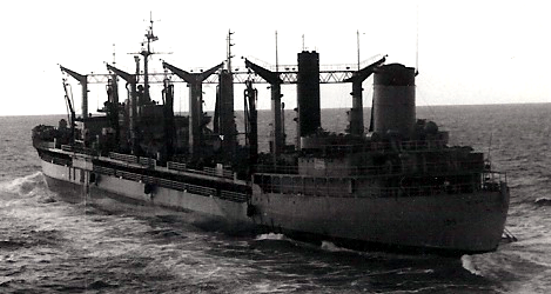
Mispillion in the Western Pacific

Here are two more sea stories from Iowa tour lead Jim Pobog's time on the oiler Mispillion. Thanks again to Jim for giving me permission to post them here.
The British battleships that served during WWII were less homogeneous than those of the US. While the USN had emphasized standardization during the pre-treaty era, the RN had not, and was left with a bizarre mix of ships, made more confusing by refits. 10 battleships1 and 3 battlecruisers2 dating back to WWI made up the bulk of the fleet at the start of the war, accompanied by the two units of the Nelson class built in the 20s under the Washington Naval Treaty. During the war, the 5 units of the King George V class joined the fleet. They were fast battleships of the same type as those built worldwide after 1937.3
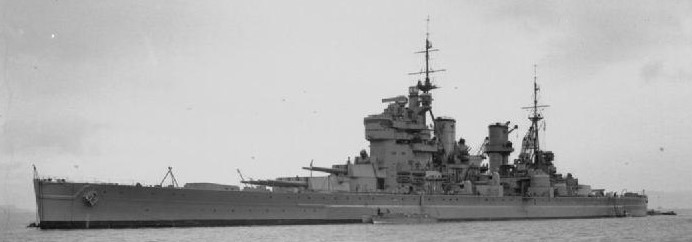
The British battleships fulfilled largely the same roles as their American counterparts, although with less emphasis on carrier screening and more on surface superiority. There were several reasons for this. First, the carrier was less important in the narrow seas around Europe, and the threat of surface forces significantly greater. Second, the British entered the war two years before the US, and that time interval was critical to the development of airplanes that were serious threats to battleships at sea. Third, the lack of an equivalent to Pearl Harbor meant that the British never were forced to radically change their doctrine away from the battleship. All that said, by the end of the war, when the British were operating with the US Pacific Fleet, their ships, battleship and carrier alike, were used very much like their American counterparts.
Last time, we discussed detecting submarines, but that was only the start of a process. Once a submarine had been detected, it still needed to be destroyed. At the start of the war, the only weapon was the venerable depth charge, essentially an explosive thrown over the side and fuzed to go off at a specific depth. However, as the war went on, the traditional depth charge, unchanged over the previous 20 years, became increasingly inadequate, and new and improved weapons were developed.
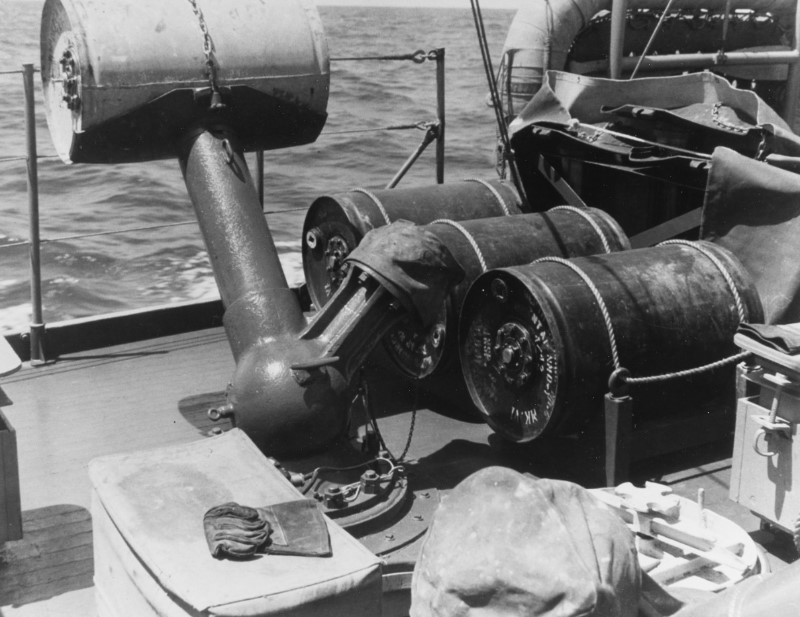
One of the biggest problems, even during WWI, with the traditional depth charge rack was that it only produced a narrow pattern. Submarines could estimate when a ship would lose contact, and then maneuver violently, hoping to dodge the pattern. During WWI, the USN developed the Y-gun, a device mounted on the centerline which threw two depth charges between 50 and 80 yards on either side of the ship. The biggest problem was that it consumed valuable centerline space, which was also in demand for guns and torpedo tubes. To solve this problem, the USN introduced the K-gun, which was essentially half a Y-gun, mounted on the railings. These were mounted in great numbers on destroyers and destroyer escorts during WWII.
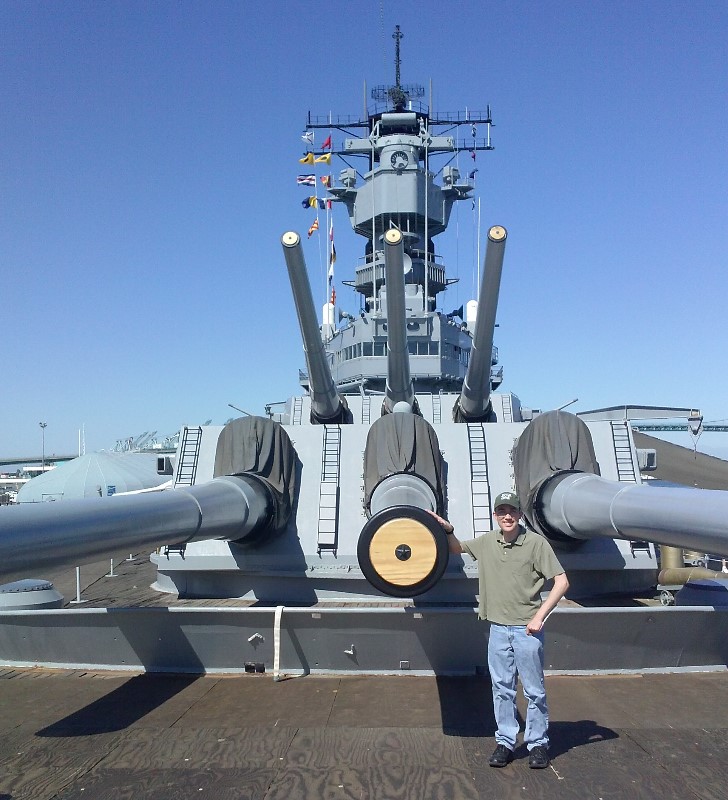
I've decided to add reviews of the military museums I've visited over the years to the blog, as I believe the information will be of interest to readers. We'll start with the Iowa. I promise that the information here is totally unbiased.4
Iowa is the greatest ship ever built, preserved in San Pedro since 2012. She served in WWII, Korea, and in the 1980s. Her fantastic crew has worked very hard to make the visitor experience as good as possible.6 Visitors will be able to see the 16" guns, officer's quarters, the conning tower and bridge, 5" mounts, CIWS, Tomahawk and Harpoon launchers, directors, and crew quarters, including berthing and messes. There's a museum at the end of the tour, along with the gift shop, where guests are encouraged to spend more money to support the Iowa.7 On deck, there's a Korean War HUP Retriever helicopter, as well as a motion simulator on the pier. My first visit took me about 90 minutes, and 2-2.5 hours is a pretty good estimate for a normal group. If you feel the need to get every single piece of information that's offered, it will take somewhat longer.8 There's a free audio tour app, which can be found by searching "Battleship Iowa" at the App or Play stores. It also works away from the ship, and includes some videos of spaces that are not on the normal tour route. Read more...
The biggest problem with killing submarines has always been finding them. During WWI, no good method was found for a ship to detect submarines while the searcher was moving at any speed, and at night even a surfaced submarine was nearly impossible to see. Fortunately, the interwar years brought devices that would solve both problems, and ultimately lead to the defeat of the U-boats. During WWII, more sensors joined the fight against the underwater menace.
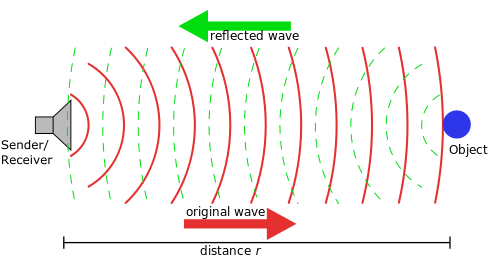
If sound was the only effective means of transmitting information through the water, and passive listening was insufficient, as it had proved during WWI, then the obvious answer was active sound detection, where a pulse is transmitted and the operator listened for echoes. This is best known today as active sonar.9 The idea actually predated the war, as the Fessenden Underwater Oscillator had been used to detect icebergs. The primitive amplifier technology of the time meant that it wasn't very effective against the weak echoes from submarines, and its relatively low frequency limited how well their direction could be pinned down. To make matters worse, the noise of a ship's motion through the water could easily drown out any echoes. Something better would be needed.
WWII saw the methods used in WWI for hunting submarines extended and expanded into a dizzying array of techniques and platforms that ultimately resulted in victory for the hunters in the Atlantic, and defeat in the Pacific. I'll start our look at WWII ASW with an overview of the forces employed, then look more closely at the sensors, weapons, and tactics used.
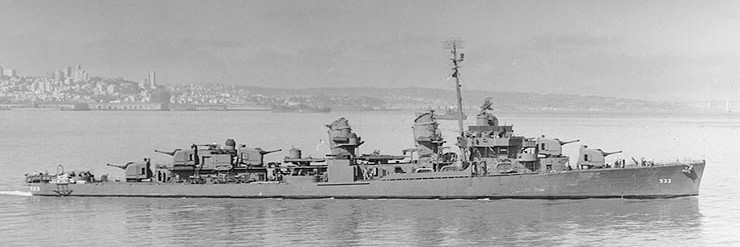
Much like WWI, surface ships formed the backbone of the war on the submarine. The best of these was the destroyer, also used as a torpedo platform and an escort for the fleet, both anti-air and anti-surface. Due to their versatility, destroyers were in high demand; they were never available in the numbers needed to screen the fleet and protect merchant shipping. Something cheaper and slower would be required to bear the burnt of the latter task, while the destroyers worked with other warships and acted as response units for the convoys.
Here's a partial list of useful and interesting places to go for more information on the stuff I talk about here, in no particular order.
A few other places of some relevance here:
The ships that immediately followed Dreadnought are often overlooked. None achieved any distinction in the war, and all fell to the axe of the Washington Treaty. However, the development of the battleship didn't suddenly stop after Dreadnought, and the 12"-gunned capital ships introduced a number of innovations, some very successful, others less so.10
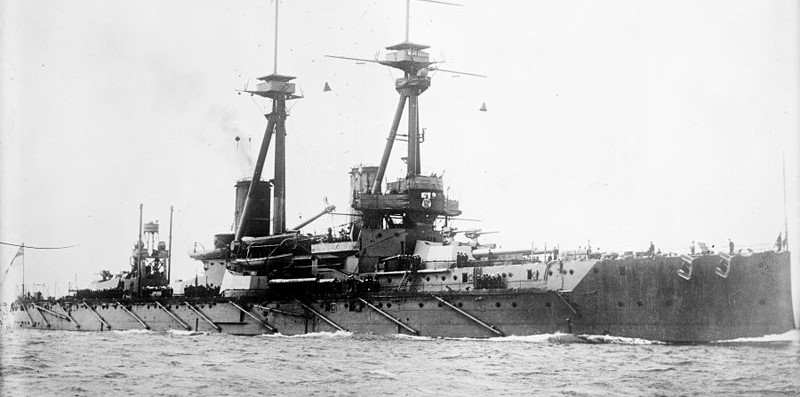
For the 1906-1907 program, the immediate successor to Dreadnought and the Invincibles, Fisher was not content to rest on his laurels. He sketched a "fusion" ship, intended to have battleship armor with battlecruiser speed. To keep dimensions reasonable, the design would have only four turrets, one on each end and two en echelon amidships, with the wing turrets being triples. The ship would have displaced 22,500 tons,11 and cost about a third more than her predecessor. This was a good design, although the triple wing turrets were rather odd, but the Liberal victory in the 1905 election moved social spending up the government's priority list, and the three ships bought were near-repeats of Dreadnought, the Bellerophon class.
This is a topic first discussed while Naval Gazing was at SSC, but I thought it worth revisiting here.
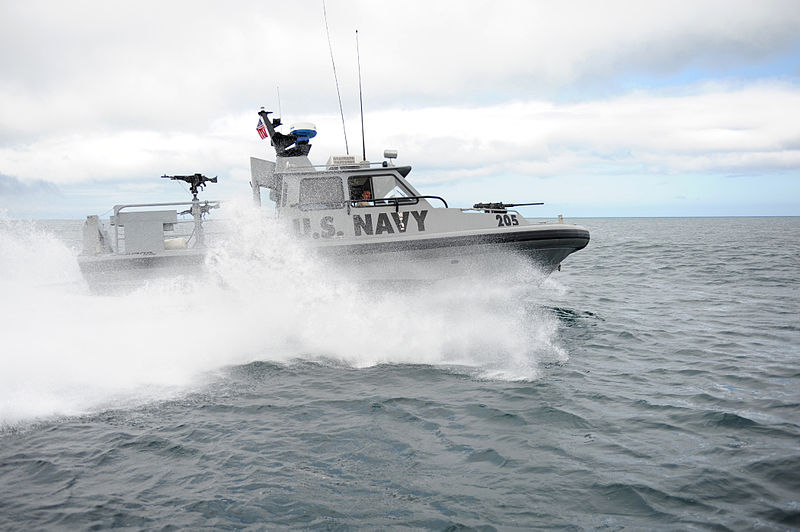
In the summer of 2017, the USN conducted exercises off the coast of San Clemente at the Southern California Offshore Range, under the code name Staple Head. The original purpose was rather mysterious, but eventually several analysts, including yours truly, worked out what was going on. The exercise was a test of USN 3MS,12 apparently in response to a recent increase in the perceived threat level from Russia and China.13 Previous exercises had mostly been focused on non-lethal countermeasures to the marine mammal threat, but Staple Head 2017 was a live-fire exercise.14
In honor of our recent discussion of the early battlecruisers, I'm reposting the story of possibly the most influential capital ship of the First World War. The battlecruiser Goeben and the light cruiser Breslau formed the German Mediterranean Division, stationed at Pola, the main Austrian naval base. They had been sent in 1912, to project German power into the region, with the wartime mission of disrupting the flow of troops from French North Africa (modern Algeria) to France. Two years later, they would play a major role in the opening days of the First World War.
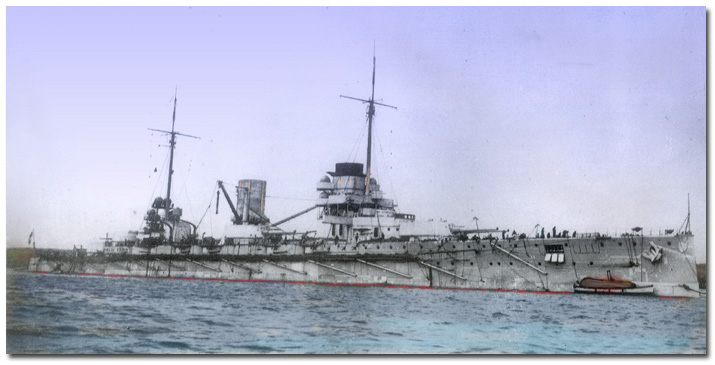
The British Mediterranean fleet, composed of the battlecruisers Inflexible, Indefatigable and Invincible, four armored and four light cruisers and a flotilla of destroyers, was ordered on July 30th 1914 to cover the French transports, and on August 2nd, to shadow Goeben while maintaining a watch on the Adriatic in case of a sortie by the Austrians. Admiral Souchon, in command of the German force, had already sortied, but was spotted in Taranto, Italy, by the British consul, who reported the findings to London. The Admiralty ordered Indomitable and Indefatigable sent to Gibraltar to guard against a sortie into the Atlantic, presumably an attempt to return to Germany. Souchon, however, was headed for Bone and Philippeville, embarkation ports for French troops in Algeria. On the evening of the 3rd, after having slipped through the Straits of Messina ahead of British searchers, he was informed that the Germans had signed an alliance with Turkey, and he was to head for Constantinople immediately. He ignored these orders, and bombarded the ports (doing very little damage) at dawn on August 4th before heading back to Italy to coal again. Shortly thereafter, Indomitable and Indefatigable sighted Goeben, but the British had not yet entered the war, and they did not engage. Admiral Milne, the British commander, reported the contact, but did not tell the Admiralty (headed by Winston Churchill) that the Germans were heading east, and Churchill continued to believe they would attempt to interfere with the French troop movements.
Recent Comments