March 07, 2018

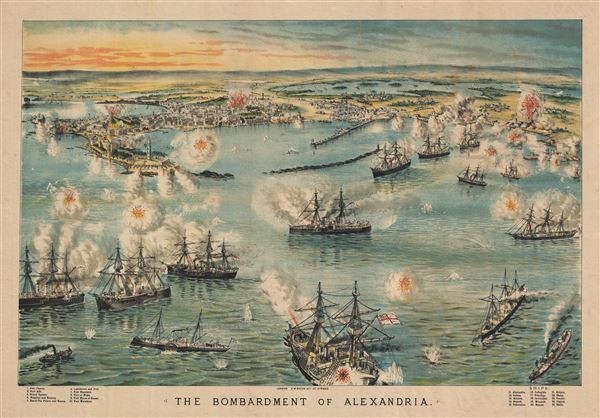
The Bombardment of Alexandria

We've talked about the early British ironclads at some length, and while these ships are fascinating, they were also never used in battle, with one exception. In 1881, the populace of Egypt revolted against the unofficial Anglo-French control of the country, threatening to depose the Khedive. The greater problem from the British perspective was that this also imperiled their control of the Suez Canal, the vital lifeline to British India. A squadron of ironclads was dispatched to Alexandria, and after riots in June of 1882, the Egyptians began to fortify the city, adding guns to the defensive works. The British repeatedly requested that the work be stopped, finally delivering an ultimatum that if the fortifications were not surrendered for disarmament, they would bombard the city on July 11th.

That morning, at 7 AM, the British moved in. The fleet consisted of the central-battery ships Alexandra, Invincible, Superb, Sultan and Penelope, the hybrid barbette/central battery ironclad Temeraire and the turret ships Monarch and Inflexible, the last of these under the command of Jackie Fisher. The total broadside of this force was 22,500 lbs from 44 heavy muzzle-loading guns. Supporting these ships was a torpedo boat, a dispatch boat, five smaller gun vessels, and a telegraph ship that had picked up the undersea cables to Malta and Cyprus, and was able to relay news of the action to London in near-real time.

Read more...

March 05, 2018

Russia's New Nuclear Weapons - A Skeptical Look

Putin’s announcement last week of several new and improved strategic systems has thrown the internet into a frenzy. They will supposedly render US ABM systems useless and, at least if you listen to some of the more hysterical pundits, completely change warfare as we know it.

Fortunately for the US, none of this is true. The systems announced are either fairly mundane or likely vaporware. Of course, recognizing this requires familiarity with military economics and nuclear history, so perhaps we shouldn’t be surprised that so many people are freaking out. In fact, it appears that Putin has simply taken a list of abandoned strategic weapons systems, repackaged them, and brought them out for political reasons.

We’ll start with the nuclear-powered cruise missile. This is not a new idea. The US investigated it extensively during the 50s, and ultimately decided against it. Nuclear reactors are heavy compared to conventional systems of similar power, and nearly impossible to test, given the risks of nuclear contamination if something goes wrong. Why Putin would buy a risky, expensive, and strategically dubious missile is not clear. Russia is traditionally very concerned with maintaining positive control over nuclear weapons, and having them flying around on an unmanned platform is not exactly likely to make anyone comfortable. Particularly given the communications problems involved in using a weapon like this effectively, I believe it to be a fake.

The nuclear-powered minisubmarine is much the same. Nobody wants to let nuclear weapons run around the oceans unattended, and communications have always been the Achilles heel of submarine operations. The characteristics described don’t go well together, as high speed means lots of noise and a relatively large size, while being undetectable also drives up size. The concept of using underwater vehicles to attack ports dates back to the initial plans for the first Soviet nuclear attack submarine, the November class.

The hypersonic glider is somewhat more plausible, although as is fairly common, the characteristics are rather overstated. Hypersonic aerodynamics are inherently inefficient, which means that range is somewhat limited and maneuver capability is nowhere near what proponents would have you believe. Too much maneuver means that you run out of energy and fall short of the target. The inconsistent information we’ve gotten on this one, such as very different speed values, make me classify it as probable vaporware.

The RS-28 ICBM is a fairly mundane development. They're building a new heavy ICBM because their previous one is made in Ukraine, but it’s not a game-changer. The ability to attack over the south pole is also not particularly novel, although the deployment of a missile with this capability does suggest a new Russian attitude towards arms control, which might profitably be answered with a similar attitude on the part of the US.

The Kinzhal hypersonic missile was quickly identified by the internet as an air-launched version of the existing Iskander ballistic missile. This is yet another system with roots in the Cold War, and it’s nowhere near as revolutionary as it’s made out to be. Iskander is an impressive weapon, but it’s not exempt from the laws of physics, and it’s well within the envelope of the SM-3 and SM-6 missiles. It’s also the subject of inconsistent performance claims, some of which are clearly stated to be terrifying when they actually aren’t. One mode is “a 90-degree dive at 7-800 m/s”. This sounds impressive, but it’s only about Mach 2.5. It could be useful if you’re attacking a missile site that doesn’t have another one covering it, but this is not the case at sea, and Mach 2.5 is well within the envelope of most SAMs.

The last system announced was a laser point-defense system for base protection. This is not a strategic system, and I’m not really qualified to evaluate how useful it is. Similar systems have been under development for years in the US, and have even been deployed for operational evaluation.

Putin blamed US missile defenses for the array of new weapons, but this is utter nonsense. The US has 44 ABMs with capability against ICBMs, mostly in Alaska. These are positioned to protect the US against missiles from North Korea, which also gives some protection against China. The Russians have enough missiles to comfortably overwhelm the existing GMD system, and most of them are on trajectories that are not within the system’s engagement zone anyway. It does bear pointing out, though, that he’d have no reason to do this if ABM systems are as ineffective as their detractors claim.

So what is he up to, then? Again, we must look back to the Cold War. During that conflict, the Russians twice managed to convince the US that they had a major edge in strategic weapons, first bombers and then missiles. In both cases, the US was comfortably ahead, but bad intelligence and Soviet deceptions lead to panic in the west. Later, Reagan used a similar strategy. Fake black programs were set up and details were “leaked” to the Russians, with massive funding flowing to programs in an attempt to duplicate American technology that never existed in the first place. The strain of these programs played a vital part in bringing about the collapse of the Soviet Union.

There’s also a domestic political angle. The Russian presidential election is on March 18th, and Putin is presumably trying to bring the opinion the country more in line with the election results.

The other big question missed by the media is how all of this is being funded. Russia’s GDP is smaller than that of South Korea in nominal terms, and just behind Germany in PPP terms. Even with the mess that most of the west has made of military equipment procurement, it’s hard to see them being able to fund a strategic buildup of this magnitude, particularly when combined with ongoing operations in Syria and Ukraine, and the modernization of their conventional forces that we see articles about every so often.

Ultimately, since the end of the Cold War, the Russians have established themselves as masters of military vaporware. Their systems arrive late or not at all, and it’s impossible to definitively say just how effective they are when they get there. Putin’s latest announcement of a bunch of repackaged Cold War-era concepts is entirely in line with traditional Russian strategy. Hopefully we’re smart enough to avoid playing into his hands this time.


2024 Update: Fortunately, we haven't gotten clear information on most of these systems, but my view on the Kinzal has been amply confirmed. In 2023, the Russians used a number against Ukraine, and Patriot has performed very well against them. Weirdly, they do seem to have actually gone in and built the nuclear-armed minisubmarine and claim to be working on the nuclear-powered cruise missile. That said, I remain skeptical of how far they will go with either system.

March 04, 2018

Propulsion Part 4

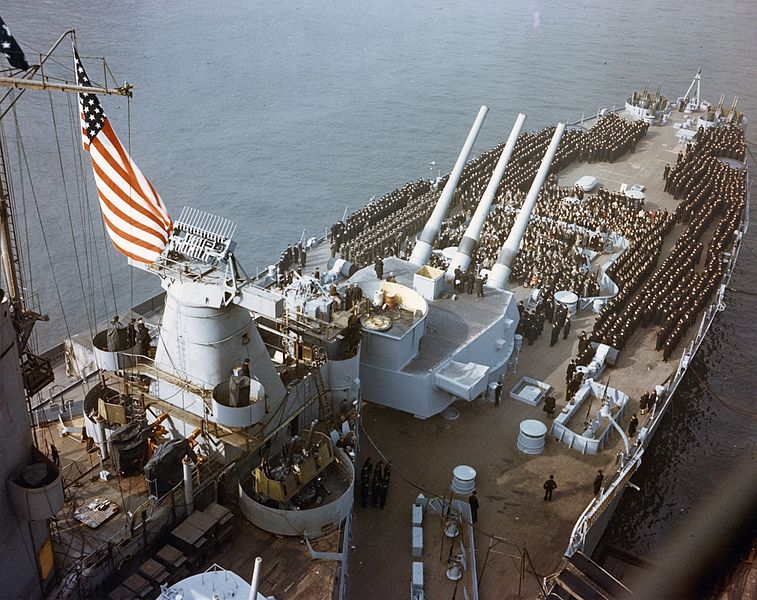
While we've examined the history of battleship propulsion, from the dawn of steam through turbines and oil and the introduction of gearing, it's now time to examine the pinnacle of the art, the plant built for the Iowa class. Going into (possibly excessive) depth on this system will make it a lot easier to understand the nuts and bolts of steam propulsion, as well as giving me a chance to showcase a part of Iowa very few visitors get to see.


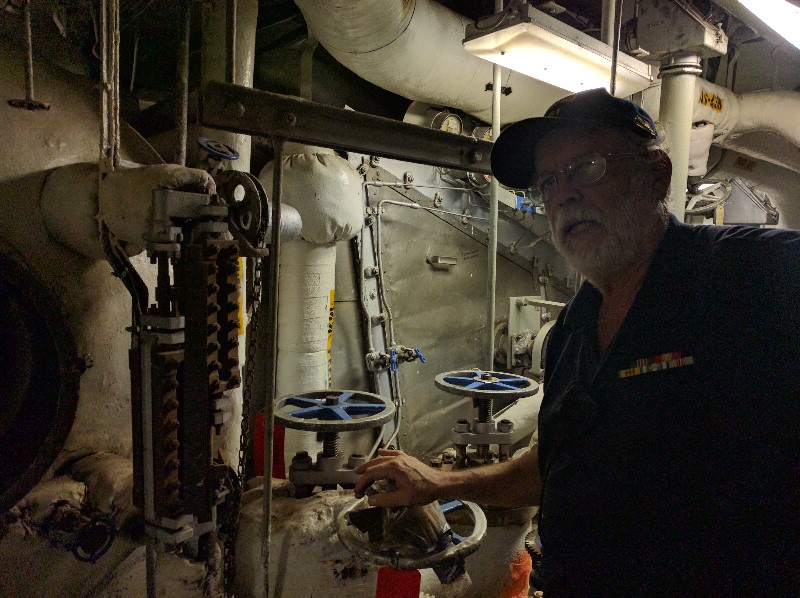
Jim Pobog explaining the boiler control system1

To propel the 53,900 tons of battleship at 32.5 kts required 212,000 HP, produced by 4,444 tons of machinery.2 Iowa's machinery is arranged in four boiler rooms and four engine rooms, alternating in the space between Turrets II and III. Each boiler room contains two Babcock & Wilcox M-type water-tube boilers producing steam at 600 psi and 850 F. It can be divided into waterside and fireside, and we'll look at waterside first. The feedwater enters the boiler and first passes through the economizer, which is a heat exchanger in the boiler exhaust, to get as much heat out of the exhaust gasses as possible. It then goes into the steam drum at the top of the boiler. From there, the downcomers route it into the water drums at the bottom, where it enters the steam tubes that take it back to the steam drum. It is in these tubes that most of the steam is generated. As it leaves the steam tubes, the mix of steam and water is at about 485°F, and moisture separators return any remaining liquid water to the steam drum. The steam goes into the superheater, where it is heated to the final temperature of 850°F and sent to the turbines. The water level in the plant is controlled manually. A boiler technician, universally known as a BT, was stationed near the steam drum. His job was to make sure that the water didn't get too high and flow over into the turbines, or too low, which would make the boiler melt.

Read more...

March 02, 2018

Sea Story: Late Night Forward Pumproom Test

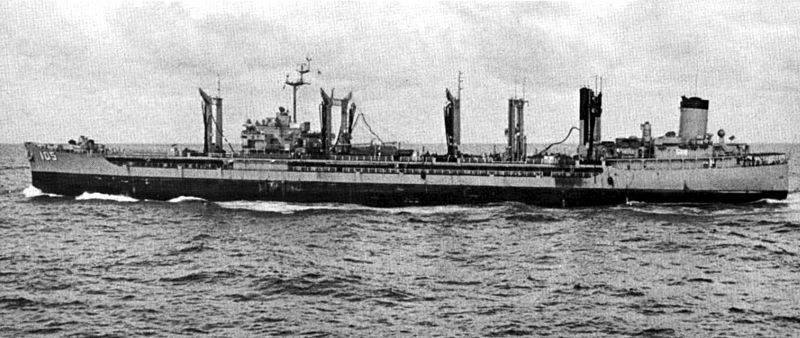
The following is from Jim Pobog, the tour department lead on the Iowa. He was a boiler technician on the oiler Mispillion off Vietnam, and has kindly given me permission to post some of his sea stories here. Here's one in honor of our recent discussions of engineering. Some of the terminology here is best understood after reading Propulsion Part 4.


USS Mispillion (AO-105) off Vietnam

One of the interesting effects of being at sea for long periods of time was that it was easy to lose track of what day it was. The repeated routine day after day led you to doing things on sort of an autopilot, never expecting variation.

At one of these times I was on watch in the fire room in the middle of the night. We were just station keeping, sailing in those big circles, back and forth up and down the coast of North Vietnam.

Quite suddenly the engine-order telegraph rang. The engine-order telegraph is the thing you see in movies, the large dial that indicates what speed the Officer of The Deck wants the ship to go. We were cruising along at Ahead 1/3, then… RIIIING!!!! RIIIIING!!!, and it shows All Back Emergency.

Now that is a thrill, having those bells come out of nowhere in the middle of the night.

Read more...

February 28, 2018

Propulsion Part 3

The main tasks of the naval engineer once oil and turbines had been adopted were making the existing plants more powerful and more efficient. The most obvious way to resolve the mismatch between the desire of turbines to turn quickly and the desire of the screws to turn slowly was to use gears.3 The problem is that transmitting tens of thousands of horsepower through gears is not easy.


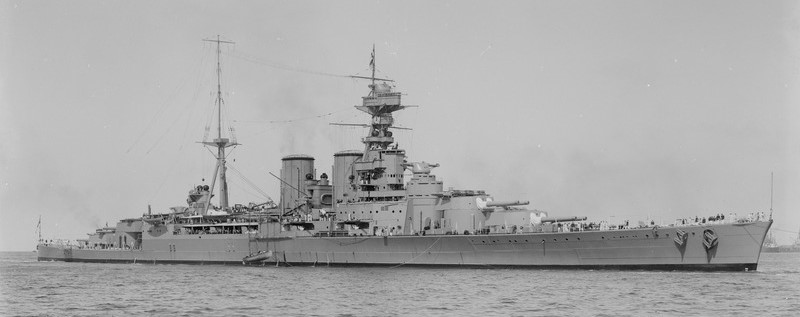
HMS Hood, the first battleship designed with geared turbines

The geared turbine first went to sea in large ships in 1916 with the three ships of the Courageous class, although they weren't technically battleships. This was necessary to allow them to make 32 kts, by far the fastest sort-of capital ships of the day. They also introduced new small-tube boilers, which were about 30% lighter for the power than the large-tube boilers in use previously. The first proper battleship followed a year later, when the USS North Dakota was refitted from direct-drive to geared turbines. But since there are very few details on that plant available,4 we'll look at the first battleship designed with a geared turbine plant, HMS Hood.5 She had separate high-pressure and low-pressure turbines on each shaft, along with astern blades in the low-pressure turbine casing. The outer shafts also had cruising turbines which could be clutched in at low speeds. At full power, the gearing reduced the 1500 rpm of the HP turbine and the 1100 rpm of the LP turbine down to 210 rpm at the shaft. Total designed power on each shaft was 36,000 hp, making Hood the most powerful ship afloat, although in practice turbines could be safely overloaded, and she made 32 kts using 151,600 shp on trials at a displacement of 42,200 tons. 24 small-tube Yarrow boilers produced steam at 235 psi, and 1,200 tons of oil could propel Hood 6,400 nm at 12 kts.

Read more...

February 25, 2018

Propulsion Part 2

From the dawn of marine steam propulsion, all ships had been powered by coal, and used their steam in piston engines with increasing numbers of cylinders. The beginning of the 20th century saw coal give way to oil, and the steam turbine replace the reciprocating engine.


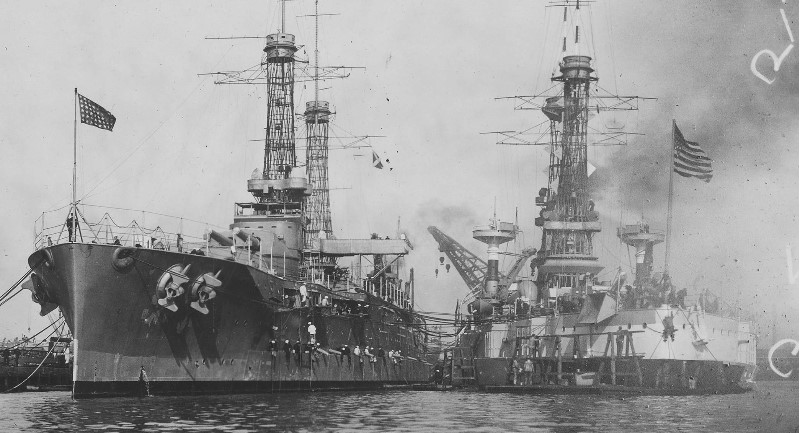
Nevada (left) and Florida, old and new propulsion

The first battleship to burn oil was the Russian Rotislav, for purely economic reasons. Oil was readily available from Baku in the Black Sea, while coal had to be imported, so half of her boilers burned coal, while the other half burned oil. This was not a success, and the Russians soon returned to the use of coal. In the early days, coal firing had been developed to a great degree of sophistication, while the heavy fuel oil used then was extremely difficult to burn efficiently. The British introduced oil on the King Edward VII class, spraying it into coal-fired boilers in an attempt to improve acceleration and reduce the load on the stokers at high speed. This mixed firing was common on battleships worldwide until coal was totally replaced by oil in the 1920s.

Read more...

February 23, 2018

Strike Warfare

I’m venturing outside of my usual remit today, and discussing an issue that’s about 90% air warfare, although it obviously applies to naval aviation, too.


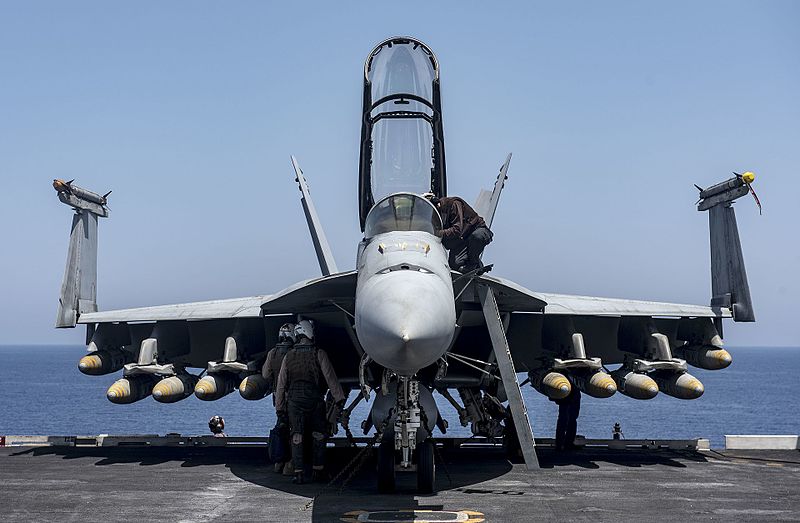
F/A-18F Super Hornet loaded for a strike mission

We can broadly divide combat aircraft operation into two categories, which I’ll call strike and responsive. Obviously, there’s a continuum between the two extremes, but this dichotomy will help make clear something not commonly understood outside of the military world.

Strike operations are missions launched against (usually) fixed targets, probably at the direction of high-level commanders. Let’s work an example:

Read more...

February 22, 2018

Happy 75th, Iowa!

75 years ago today, the USS Iowa was commissioned for the first time at the New York Navy Yard.

The original bell is also scheduled to arrive today from Des Moines, where it's been on display for the past 25 years. I wish I could be there for the celebration on Saturday.

February 21, 2018

Propulsion Part 1

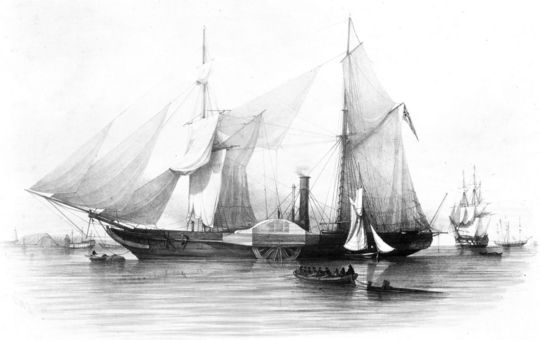
Steam first went to sea in the early years of the 19th century. At first, it was used by navies primarily to tow ships in and out of harbor, being immune to wind and resistant to tides, both serious problems for sailing ships. Later, steamships were used extensively for minor roles, such as dispatch boats. In the 1830s, the first steam warships were built, such as HMS Gorgon. However, the use of paddle wheels meant that they could only mount a limited broadside armament, so only small ships received them. Larger ships retained sail exclusively until the advent of the screw propeller. Besides clean broadsides, screws also allowed the engines to be entirely below the waterline, where they were protected from enemy fire.


HMS Gorgon

The British and French began modifying existing warships, both frigates and line-of-battle ships, in the mid-1840s. The resulting "blockships" were intended to use their steam only sparingly, as the inefficient steam engines gave them only limited endurance. As the engines improved, so did the importance of steam in ship design, and by the time HMS Warrior was designed, her steam plant was as important as her sails. But before we examine them it more detail, we need to look at the basics of a steam plant.

Read more...

February 18, 2018

One Year

One year ago today, I wrote the first post in what is now Naval Gazing. IrishDude asked in one of the OTs about people's hobbies, and I responded by talking about my work as a tour guide on the Iowa. The discussion continued, and thanks to David Friedman's questions about the classic Iowa vs Yamato duel, I ended up writing out a text version of my fire control spiel. That got enough of a reaction that I kept writing, and have continued to do so since.

So I guess I have to say thanks. Thanks to IrishDude for asking the initial question, and to David Friedman for the follow-up. Thanks to everyone else for encouraging me to keep writing, particularly in the times when I wasn't getting a lot of comments and have felt like giving up. (I've mostly learned that I usually don't get a lot of comments when I've done a good job of explaining my point and so nobody has questions, but there are still days when I do wonder where everybody is.) And thanks to those who provided technical comments and pushed me to raise my game. Thanks to Scott Alexander for putting up with me filling his Open Threads with battleships. Thanks to Said Achmiz for hosting me, and dndnrsn for proofreading my columns here.

And thank you for reading. It's been an interesting year, and I'm certainly in a very different place than I was when this started. Naval Gazing has largely filled the hole left by the Iowa when I moved to Oklahoma, and I hope that I've made your lives more interesting over the past year, too. I plan to continue to do so for the next one.