
On October 14th, 1944, the three carrier groups of TF 38 were conducting strikes on Formosa. The operation had been planned to provide distant cover for the approaching landings at Leyte, and had been scheduled to wrap up the previous day. However, heavy cruiser Canberra had been torpedoed during the last set of strikes, and it was decided to tow her home instead of scuttling her, which required an extension. Three groups would again spend the morning pounding the airfields of Formosa, while the fourth was dispatched against Japanese air bases in northern Luzon. The strikes themselves encountered little opposition, but also failed to shut down the air bases, and all of the US carriers groups were trailed by snoopers throughout the day. TG 38.2 and TG 38.3 began to withdraw in the afternoon, leaving behind TG 38.1, the Task Group Canberra had originally been assigned to, to cover the withdrawal of the crippled cruiser.
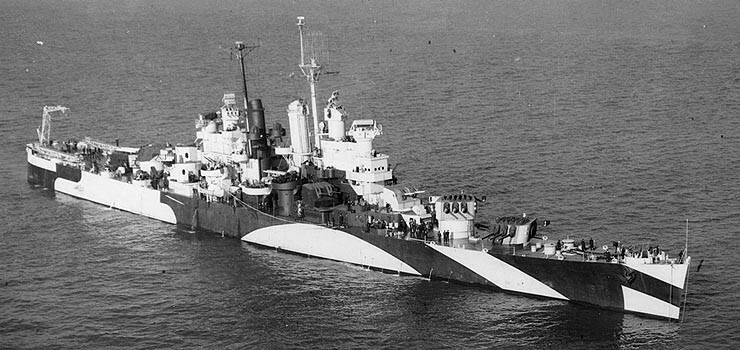
Houston underway earlier in 1944
As such, it was TG 38.1 that caught the bulk of the Japanese dusk attack, again in the form of torpedo bombers. 11 to 16 Frans appeared, and while most were shot down or driven off by AA fire, a few got through to drop their torpedoes. This time, their target was light cruiser Houston, transferred from TG 38.2 the previous day to take over Canberra's station. She found herself facing three torpedoes in the water, two to port and one to starboard. Only the one from starboard got through, but it hit in the worst possible spot. The ship had been turning to evade, rolling heavily to port, so the torpedo detonated against the ship's bottom, halfway between the centerline and the bilge keel, and directly under the turbines for shaft 1 in the forward engine room. The space flooded almost instantly, and the explosion damaged the bulkheads forward and aft, flooding both boiler rooms over the next few minutes.
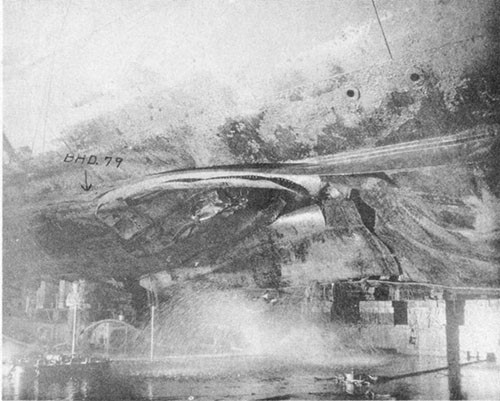
The damage from the torpedo
Even if that had been the extent of the damage, it would have been catastrophic. The ship's boilers provided steam not only for propulsion but also for the turbogenerators that powered the ship, so Houston fell dark and silent, except for the noises of water rushing in and the ship's damaged hull creaking and groaning as it worked in the waves. But the destruction of the turbines had other consequences. One was that, with the reduction gear blown to bits, shaft 1 was dragged aft about 5' by the propeller, damaging the stuffing glands where the shaft passed through the aft engine room, which soon had to be evacuated.1 And the low-pressure turbine itself was thrown upward with enough force to drive the 2" plates of the armored deck about 6" upward under the ship's machine shop, which also opened the way for a jet of high-temperature steam to kill everyone inside. A bigger long-term problem was that the explosion had warped doors and started seams, making it difficult to control flooding on the 3rd deck above the machinery. And the shock violently shook the ship, toppling the air-search radar, although it caused remarkably few injuries to ankles or legs, as sailors belowdecks had been trained to sit or lie down whenever possible.
But in the first few minutes, the biggest threat was to the cruiser's stability. She was running fairly light on fuel, leaving her somewhat top-heavy even before thousands of tons of floodwater began to slosh back and forth across the engineering spaces. This free-surface effect had the cruiser rolling up to 37°, perilously close to the 41° that her crew thought would be enough to turn her over and far enough that the edge of the main deck occasionally dipped below the sea, before the spaces filled and the roll stabilized at 20° or so. But 5,000 tons of water posed still more problems. With the extra weight concentrated amidships and the ship held up by buoyancy in the bow and stern, the hull girder began to sag and buckle. Ominous creaks rang through the hull, rivets sprang out of their holes and the bow and stern began to move a bit relative to each other. The ship's Captain, worried that his ship was about to break up and receiving reports of progressive flooding on 3rd deck, gave the order to abandon ship about two hours after the torpedo hit.
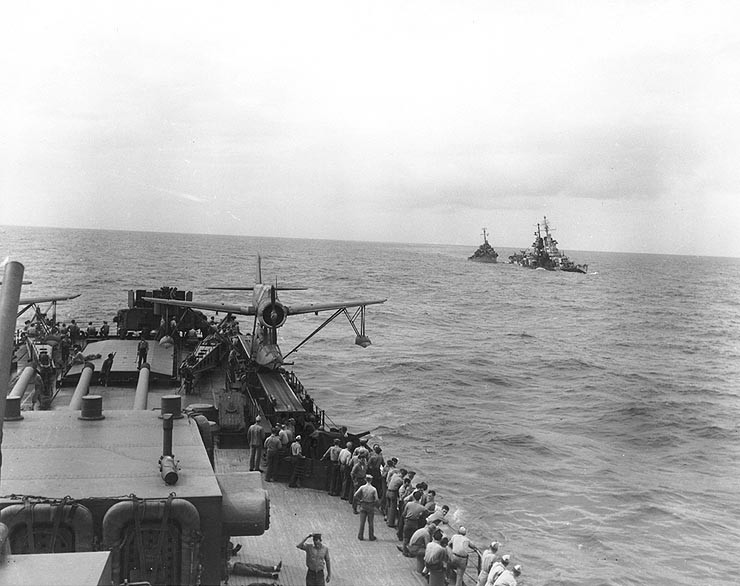
A destroyer stands by Houston, ready to take men off, as seen from Boston
Even this was complicated by Houston's situation. The ship was rolling too much in the heavy swell for destroyers to safely come alongside, and many men went into the water, relying on lifejackets and rafts for flotation. The lucky ones were quickly found and rescued, with destroyer Boyd recovering 380 men from Houston, outnumbering her own crew. The unlucky ones remained adrift throughout the night, as Japanese planes prowling overhead pounced on ships which switched on their searchlights, and the really unlucky ones were never seen again.
But many of Houston's crew were unwilling to abandon their ship, which wasn't obviously going down, and the engineering team soon convinced the Captain to rescind the order and allow them to fight to save the ship. The first order of business was getting a tow from heavy cruiser Boston, standing by to assist, but even this was complicated. Most of the deckhands who would normally have done the job of rigging the tow were among the two thirds of the crew that had already gone over the side, and a scratch crew had to be formed to do the hazardous work of rigging the tow. One early complication was that Boston was riding much higher than Houston, so the normal practice of the towing ship approaching from windward would see her drift down onto the light cruiser. Instead, she had to make her approach from the downwind side, on a night so dark that the bridge had to be guided by messages relayed from the stern, while aboard Houston, the crew worked to pull the lines over by hand. Another complication came when they attempted to attach the towing rope to the ship's anchor chain. The shackle required was held by a bolt that required a small retaining pin, and in the chaos aboard Houston, the retaining pin couldn't be found. Eventually, the crew decided to substitute rope for the pin, hoping that it would hold. If it didn't, they'd have to haul the 270' of anchor chain they planned to let out as part of the towing process back aboard before a second tow could be rigged. Normally, this wouldn't be a big deal, but with all power out, the work would have to be done by hand.2
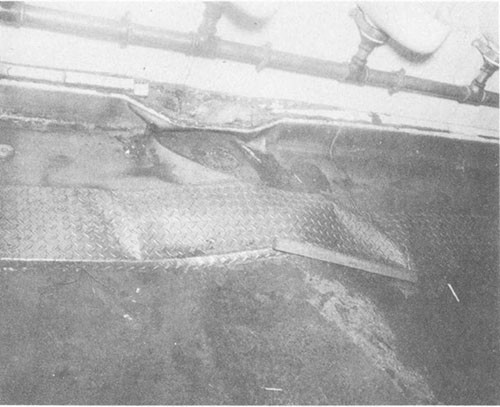
A buckled deck aboard Houston
Eventually, the work was done, and the crew began to pay out the anchor chain as Boston started to move off. One problem that was immediately apparent was that the towing cable wasn't long enough. Normal practice was to make sure the tow line was partially submerged, so that the water dampened shocks and reduced the chance of a sudden surge snapping the tow, which required getting another 270' of chain out. And while this was going on, the crews belowdecks set to work shoring bulkheads and plugging the numerous leaks that still threatened Houston's buoyancy. Cables leaked, hatches didn't seal properly, rivets had sprung and welds had cracked. But all were eventually fixed with whatever materials were to hand, and the process of pumping out these spaces, occasionally via bucket brigade, began. By daybreak, the list had been reduced to 12° and it was pretty obvious that Houston had some life left in her. But she was still days away from being safely out of range of Japanese air attack, and her path to getting there was far from smooth. We'll pick up the story there next time.
1 For the sake of fairness, it's worth noting that Canberra and Houston were the only two of 11 US cruisers torpedoed in the machinery spaces during the war to suffer these kind of problems from shaft damage. ⇑
2 Ultimately, the lashing didn't hold, but the chain kinked in such a way as to keep the bolt in. ⇑
Comments
The Battle to Save the Houston is a great book that I highly recommend if want to learn more about the crews efforts to save their ship.