On Friday, October 13th, 1944, TF 38 was conducting strikes off the coast of Formosa (now Taiwan). It was the second and final day of an operation to wipe out Japanese air strength on the island in preparation for the upcoming landings on Leyte, and they had been reasonably successful all day. But as evening fell, a group of Japanese Betty torpedo bombers attacked, coming in so low that radar failed to spot them. Four went for the carrier Franklin and while all of their torpedoes missed, one crashed onto her deck, bursting into flames before sliding over the side.1 Eight others bored in on heavy cruiser Canberra,2 and while six were shot down by the group's AA fire, one of the torpedoes struck home, detonating at the boundary between the two aft boiler rooms. A mast-high fireball was followed by the usual geyser of water, and violent vertical vibrations ran through the hull. Both boiler rooms flooded almost immediately, leaving no survivors, and fuel oil blown out of the air intakes from boiler 4 covered the deck nearby, but fortunately didn't ignite.
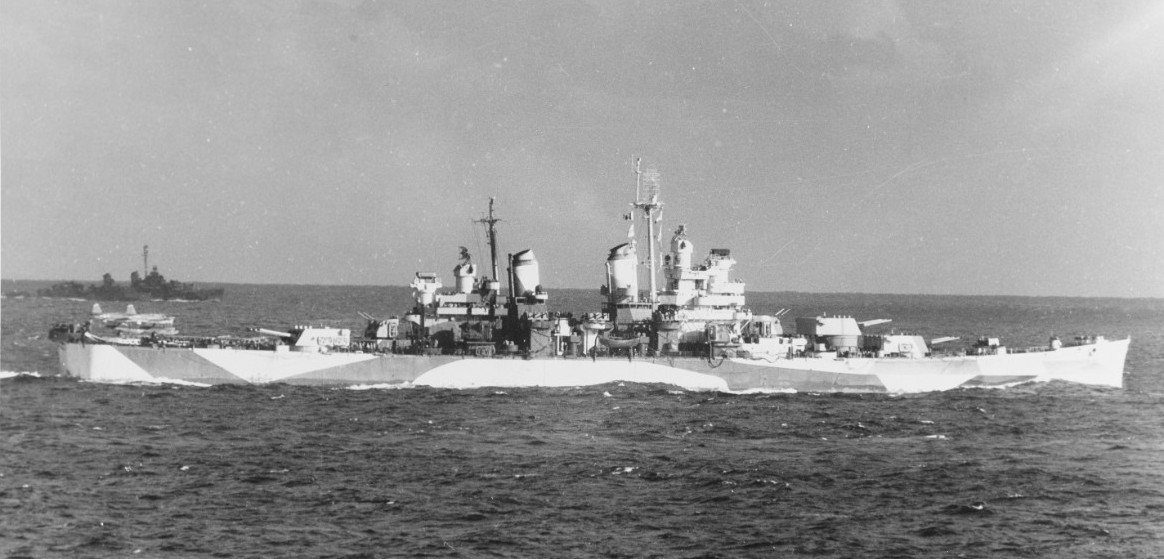
Canberra with 3rd Fleet a few days before being torpedoed
But the bigger problem was that the explosion was directly under one of the bearings for shaft 1, which was ripped from the reduction gearing forward and thrown upwards and inboard, tearing holes in the bulkheads of both the fore and aft engine rooms. Water began pouring into both, filling the aft engine room in 4 minutes and the forward one in 10. Although the boilers in the forward two rooms remained intact and continued to generate power, Canberra was dead in the water. Her rudder was also jammed over, the result of a last-minute attempt to dodge the torpedo, and while the emergency diesel generator would normally have provided power to the steering gear, breakers kept tripping. Eventually, the rudder was put amidships using the ship's roll, opening the hydraulic valves on the steering gear to allow it to swing amidships, then closing them to stop it swinging back. The electrical problems were not helped by numerous leaks in spaces fore and aft of the flooded machinery spaces, as the stuffing glands for electrical cables proved to be less watertight than expected. The leaks were all controlled fairly quickly, thanks to the cruiser's highly-trained damage control team, and only a few spaces saw more than a couple inches of water.
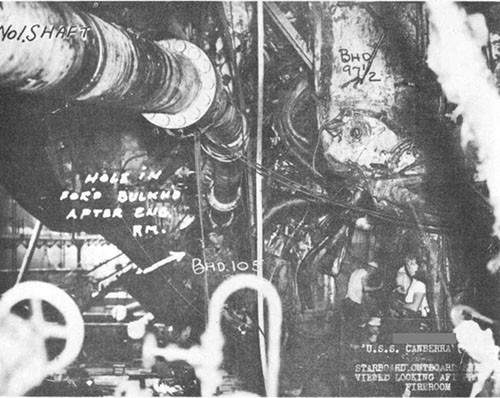
The bent shaft, looking aft
But although there was no particular danger of her sinking, Canberra was still stranded 90 miles off an enemy-held coast, and she was unlikely to move under her own power without a stint in drydock. Normal procedure would have been to simply take off the crew and scuttle the ship, but the strength of the American carrier force prompted Admiral Halsey to take a chance and order another day of air strikes on Formosa while Canberra was towed clear, allowing the ship to be repaired to fight another day. Fellow heavy cruiser Wichita was ordered to take the stricken ship under tow, and within 20 minutes, her crew had the necessary lines rigged out on deck. But the winds were high and a heavy swell was running, and while the initial messenger lines were passed successfully, at one point the two ships yawed apart so violently that a 4.5" manila line crushed three sailors,3 then knocked a fire hydrant loose, sending water spewing high into the air. The line then snapped, but Wichita’s quick-thinking crew passed another line and managed to get the towing wire across on their second attempt. Unfortunately, they hadn't sent their towing shackle, and Canberra’s was too big to fit into the eye on the rope. It took about two hours, but Canberra’s crew managed to attach the wire to the port anchor chain with a couple of spares and Wichita set off, slowly turning towards the southeast.
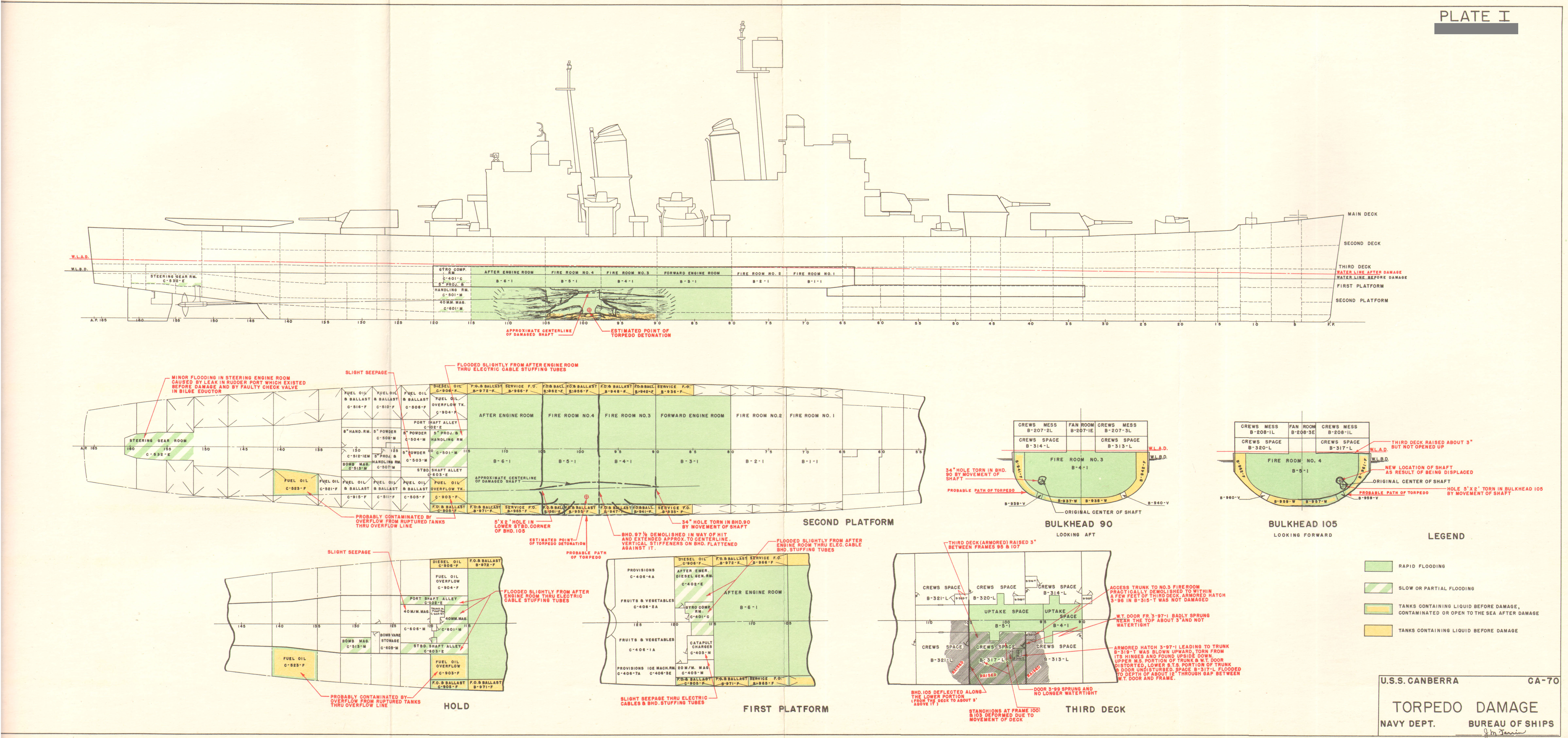
The diagram from the damage report. Click to enlarge.
The night was spent shoring up bulkheads, plugging leaks and dewatering spaces outside the machinery. Emergency power cables had already been strung before the attack, allowing quick restoration of power through most of the aft portion of the ship. Communication was harder to restore, as many of the relevant circuits had shorted out in the flooded spaces. And because all of the evaporators4 were inaccessible, extreme measures to conserve fresh water began immediately.
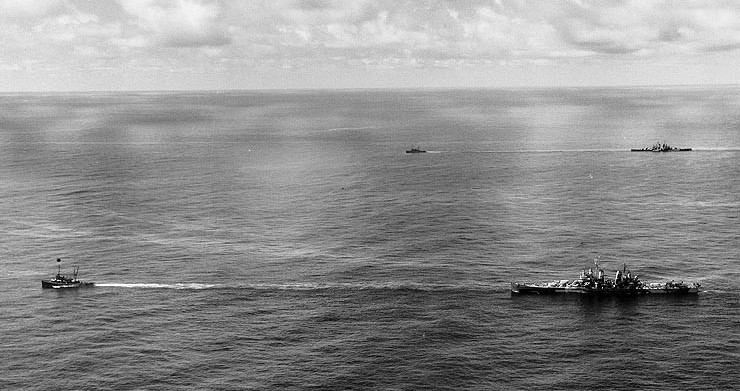
Canberra and Houston under tow
Things were made more complicated when light cruiser Houston, detailed to take over Canberra's spot, was torpedoed the next day,5 and again the decision was made to tow her clear. The two cruisers were assigned to what was known as "CripDiv (Cripple Division) 1" and provided with air cover from a pair of CVLs and some light cruisers and destroyers as escorts, while they were slowly towed out of the range of enemy aircraft. On the morning of the 15th, tugs Munsee and Pawnee arrived, with Munsee taking over the tow from Wichita. Aboard Canberra, the crew continued the slow work of dealing with the problems of a ship with the middle full of water, which occasionally meant things like manually rebuilding pipes to keep salt water out of the boilers.
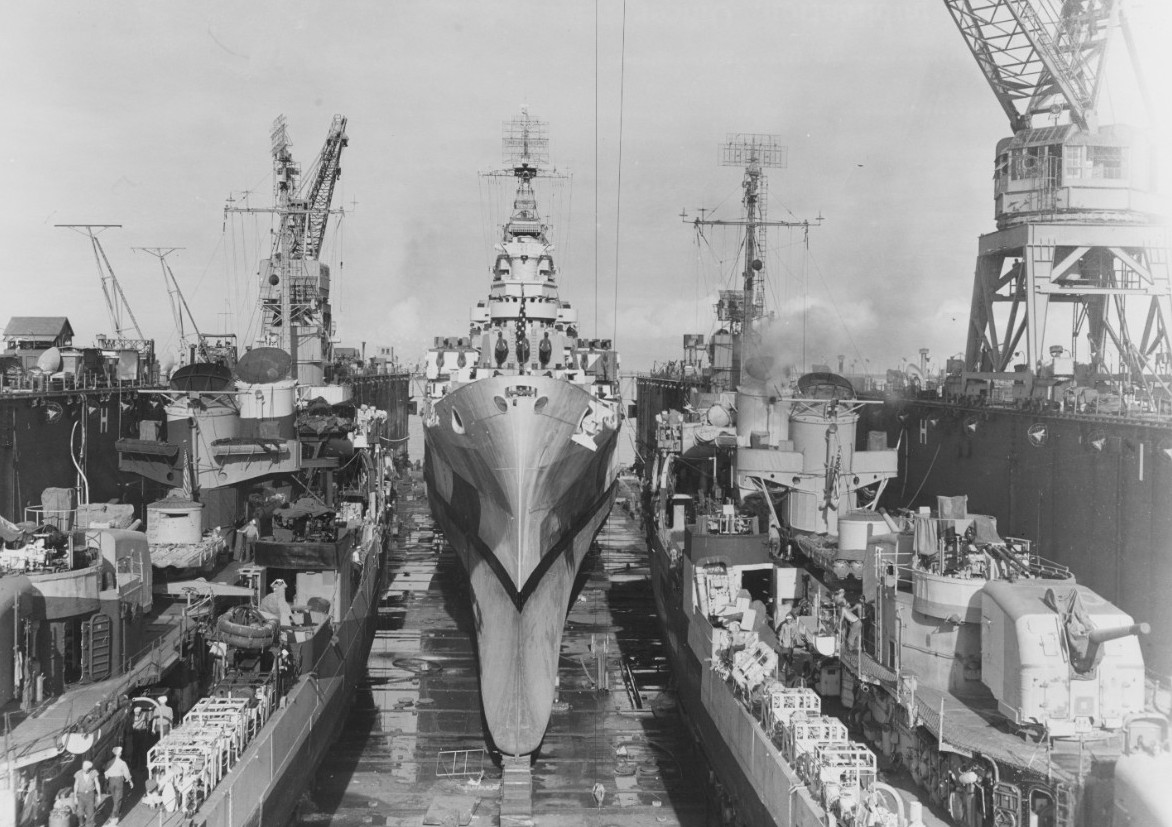
Canberra in drydock at Manaus, with destroyers Claxton and Killen
On the 20th, a week after she was torpedoed and halfway to the forward base at Ulithi, salvage ship Current came alongside, transferring extra pumps and divers who were able to go in and salvage several pump motors from the forward engine room, as well as doing preliminary work on a patch for the hole in that space. A first attempt while at sea failed, but the second, made the day after reaching Ulithi, succeeded, and then it was a simple matter of pumping out the space and shoring up the bulkhead, the main complication being that asbestos insulation in the water kept plugging up the pumps. The motors were used to put one of the evaporators back in operation, giving the ship fresh water for the week's tow to Manaus, where she was finally drydocked. The extent of the damage could finally be fully understood, the holes were patched, any salvageable equipment was preserved to make it easier to restore to operation, all three surviving shafts were put back in operation, and in January, she departed for Boston Navy Yard under her own power. Repairs would ultimately stretch past the end of the war, and Canberra would go on to serve as one of the first platforms for the Terrier missile.
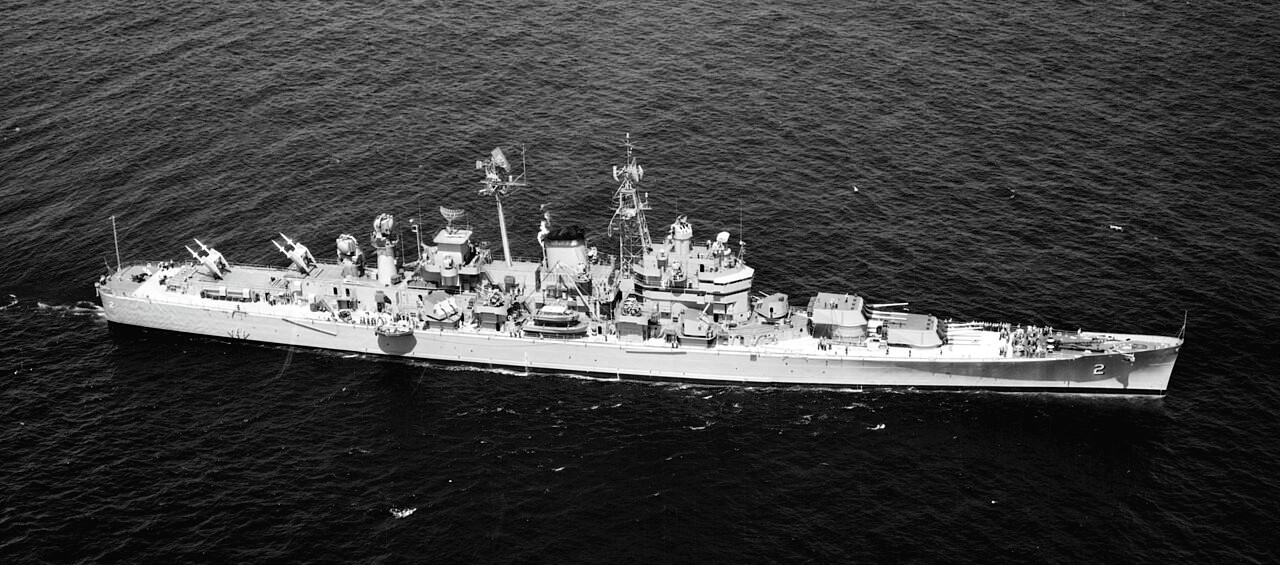
Canberra in the 50s, showing her missiles aft
But Canberra's was not the most dramatic survival story that played out in the eastern reaches of the Philippine Sea in October 1944. Houston was hit not once but twice, and lost not only her propulsion but also all boilers. We'll look at her story next time.
1 For those who might be confused, this is a separate incident from when Franklin was badly damaged in March 1945. ⇑
2 Canberra was unique among USN ships in being named after a foreign ship, in this case, HMAS Canberra, sunk at Savo Island. LCS-30 has since used the same name. ⇑
3 This is a remarkably good performance given the difficult conditions. While all suffered broken bones, none of the men died. ⇑
4 The things that turn salt water into fresh water. ⇑
5 We will come to her story soon enough. ⇑
Comments
...Which leads me to a question - how did CANBERRA end up being selected for CAG conversion when there were other BALTIMOREs that had not only never been touched, but were comparatively 'low-mileage'?
I'm not sure there were a ton of other options at that precise moment. The redesignation was in January of 52, at which point most of the Baltimores had been reactivated to fight in Korea. The only other ones in the picture (either not in service at that time, or reactivated in late 51/early 52) are Baltimore, Quincy, Bremerton, Chicago and Oregon City. Late-war US repair work on ships they cared about was usually very good, so she was almost certainly in better shape than the former pair, and I suspect the latter pair were in the best shape and being held for an ultimate conversion down the road, like they did with Franklin and Bunker Hill. (Or the rumors about Oregon City being defective are true, but I don't recall ever seeing any details on that beyond speculation driven by her short service life, and Friedman does mention she was considered for a missile conversion at one point after this.)
God, the job of that salvage crew must have been horrifying.
Related, there's a book called Mud, Muscles, and Miracles about the history of US Navy salvage efforts (I have a PDF copy, I'd be curious if bean has a physical one). It's highly regarded in the USN repair community, at least.
I do not have a physical copy, though I do have a pdf one. I should definitely look through it for ideas. Salvage is interesting to write about.
Edit: Huh. That book is claiming that the salvage tug's diving officer died in Canberra's engine room. The damage report doesn't say anything about that.
That would definitely have been a high-risk dive; the density of entanglement hazards in an unprepared engine room would be fearful even before battle damage comes into play, and access would be limited so you couldn't be confident your buddy would be able to clear you.
Comes with the job of being a salvage diver on a Navy tug, I guess, but yeesh.
I agree with BerndL. And think of the men in the flooded boiler rooms. I hope they died before they knew what was happening.
"Normal procedure would have been to simply take off the crew and scuttle the ship": Is this because, by the date of this battle, we were producing so many warships that we could afford to scuttle the ships that would be too much trouble to recover and repair? If so, it really makes you appreciate the phrase "the Arsenal of Democracy."
What is a messenger line, and how did they pass lines between ships in 1944? I know how Captains Hornblower and Aubrey accomplished it--a sailor in the bow with a strong arm.
Blackshoe: Thanks for mentioning Mud, Muscles, and Miracles. Excellent post, Bean!
@Steve
No, it's because trying to get a crippled warship out of harm's way is exceedingly dangerous. You're crawling along at 4 kts, unable to do much in the face of air attack, and hoping that the Japanese don't take out any other ships while you do so.
A messenger line is a light line that you use to haul across heavier lines. As for how it's passed, they sometimes used arm, and sometimes a line-throwing gun.
@Steve: for a reference, bolos and monkey's fists were still discussed in the manuals when I was in and the old salts still remembered them, but line-throwing rifles were standard. The rifle was the M-14 (which was still the standard rifle on USSS FIRST SHIP for deployment in 2006, although they were removed after that and replaced with the M16A...2?) with an adapter kit; brief search online seems to indicate that's still true although they might have started using M-16s for line-throwing. Interestingly, the USCG apparently uses M-16s and...M1903s(!).
I would love to have a copy of that PDF, if you feel like sharing?
@Tony
It's a Navy publication, and freely available on their website.
Thank you!