
Starting in the 1840s, the electric telegraph began to link together the world's cities. Initially, this was only over land or bridgeable rivers, but soon, efforts were made to pass cables underwater, at least over short distances. Intercontinental cables remained a dream until the arrival of Cyrus Field, an American who put together a company to bridge the North Atlantic. His first attempt, laid by American and British warships in 1857, failed when the cable snapped 300 miles out from Ireland, but he raised more money and tried again the next year. That cable was more successful, in that it did provide a telegraph link between the two countries, but it was so noisy that it would take hours to send a message. To make matters worse, construction and operational defects meant that it failed completely in only a month.
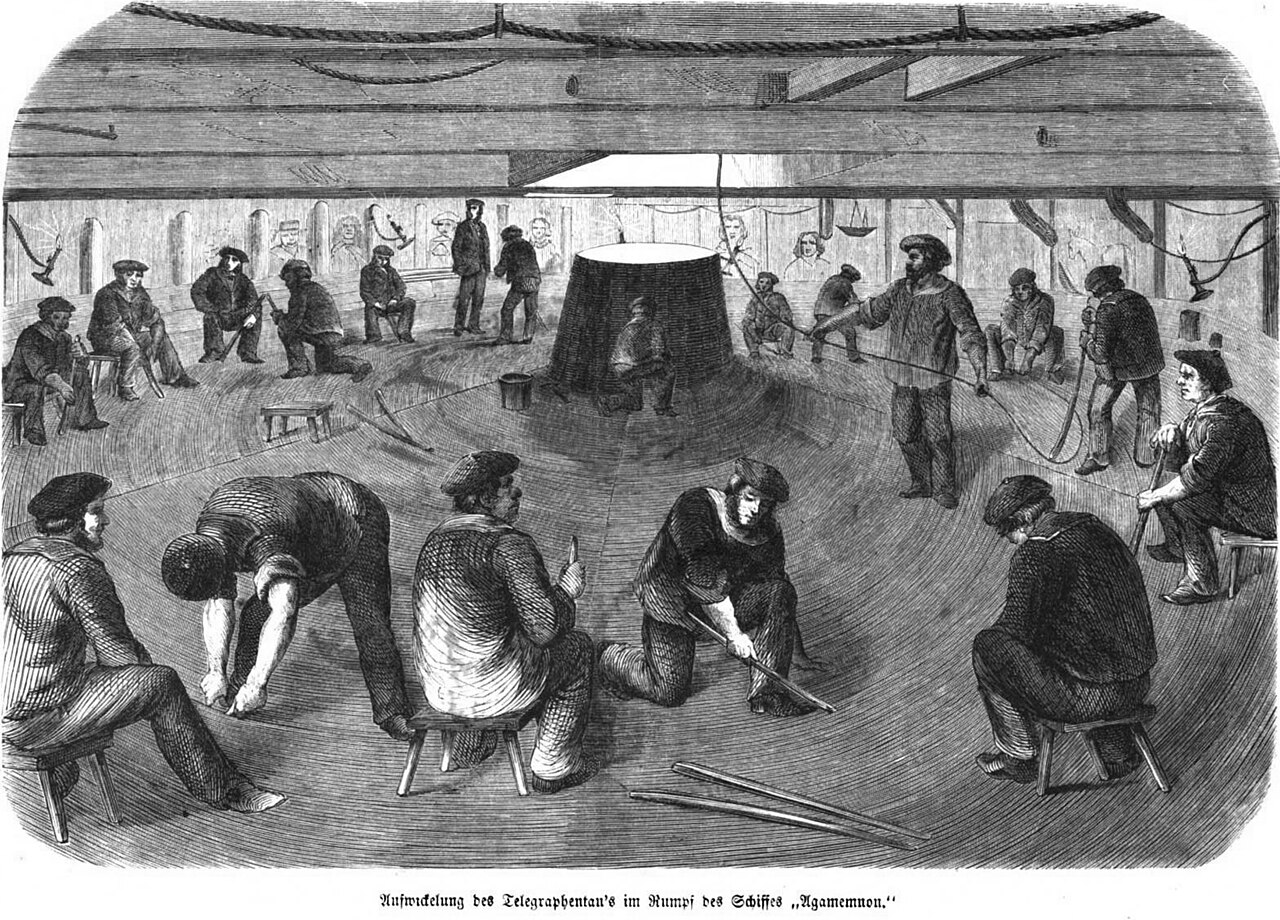
Inside a cable tank
The cable's failure provoked widespread skepticism, a matter made worse by the failure of an even more expensive cable through the Red Sea to India, and a commission of inquiry was set up to investigate the problems of submarine cables. The commission, a joint effort of the British government and the Atlantic Telegraph Company whose members included physicist Charles Wheatstone, published a 560 page report that confirmed that the problems with the cable were ones of design and operation, and that the concept itself was not inherently flawed. Unfortunately, it would take many years for Field to raise the money necessary to try again. Pretty much everyone in his own country was distracted for some reason, and the British ended up providing the lion's share of the money for the second attempt. This time, there was no rush to prepare the cable, and samples were made and thoroughly tested, with the final version being over twice as strong and three times as conductive as the first cable.
The second cable would have another major advantage over the first, in the form of an appropriate ship to lay it. Great Eastern had been the brainchild of renowned engineer Isambard Kingdom Brunel, who had decided that he would build a ship capable of going straight from Britain to Australia.1 Iron shipbuilding had made this possible, and the vessel that emerged was almost six times the tonnage2 of any other ship afloat, and would not be exceeded in size until the dawn of the 20th century. Brunel died in 1859, shortly after her maiden voyage, thus missing a very expensive lesson in why this sort of size jump is generally a bad idea. Great Eastern proved far too large to make money as a passenger liner, but she was perfect for laying cable. When she set sail in June 1865, all 7,000 tons of cable were aboard, saving the trouble of a splice in the mid-Atlantic.
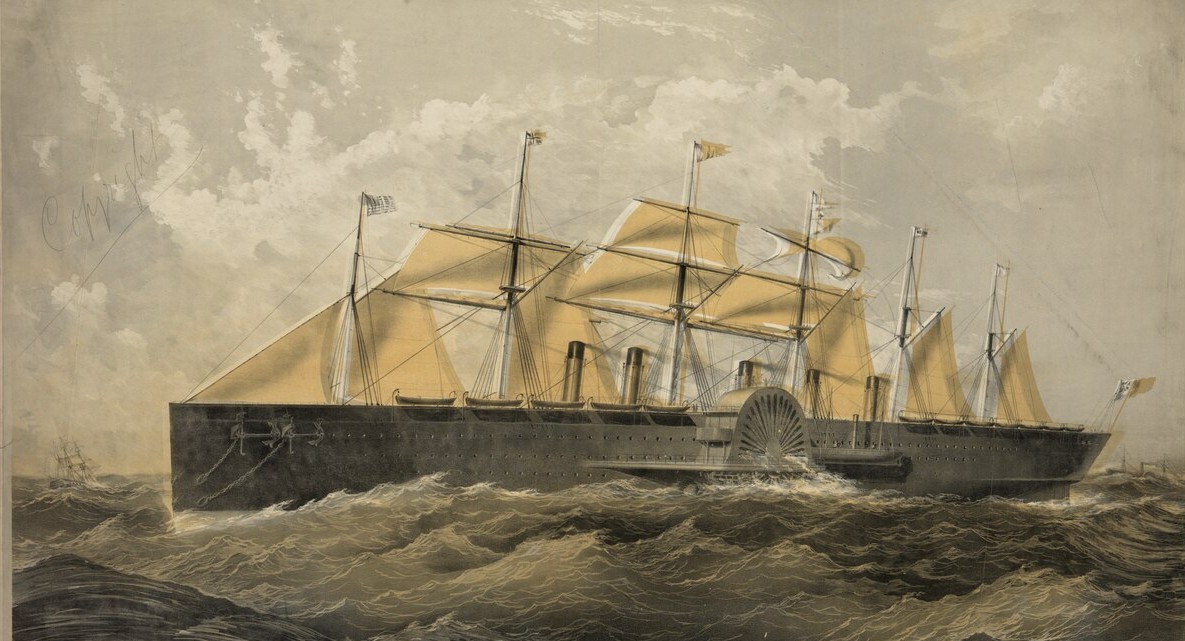
Great Eastern
Unfortunately, that didn't mean the crew wouldn't have to splice cable. Only a day out of Ireland, an electrical fault was detected, and the cable would need to be hauled back aboard until the problem could be found. This sounds easy, but the only machinery for taking the cable aboard was forward, which meant that the cable had to be cut and the end moved to the bow, a complicated and difficult process, before recovery could begin. Ten hours and ten miles of cable later, the problem was located. A piece of iron wire had been driven straight into the core, short-circuiting the whole thing and raising questions about sabotage. But a new section was spliced in, and the great ship headed west again, only to have the cable go entirely dead, only to mysteriously resume service shortly thereafter. Another fault was detected on the seventh day, and after the whole recovery process was repeated, the same type of short circuit was found. Measures were put in place to prevent sabotage, and the work continued on.
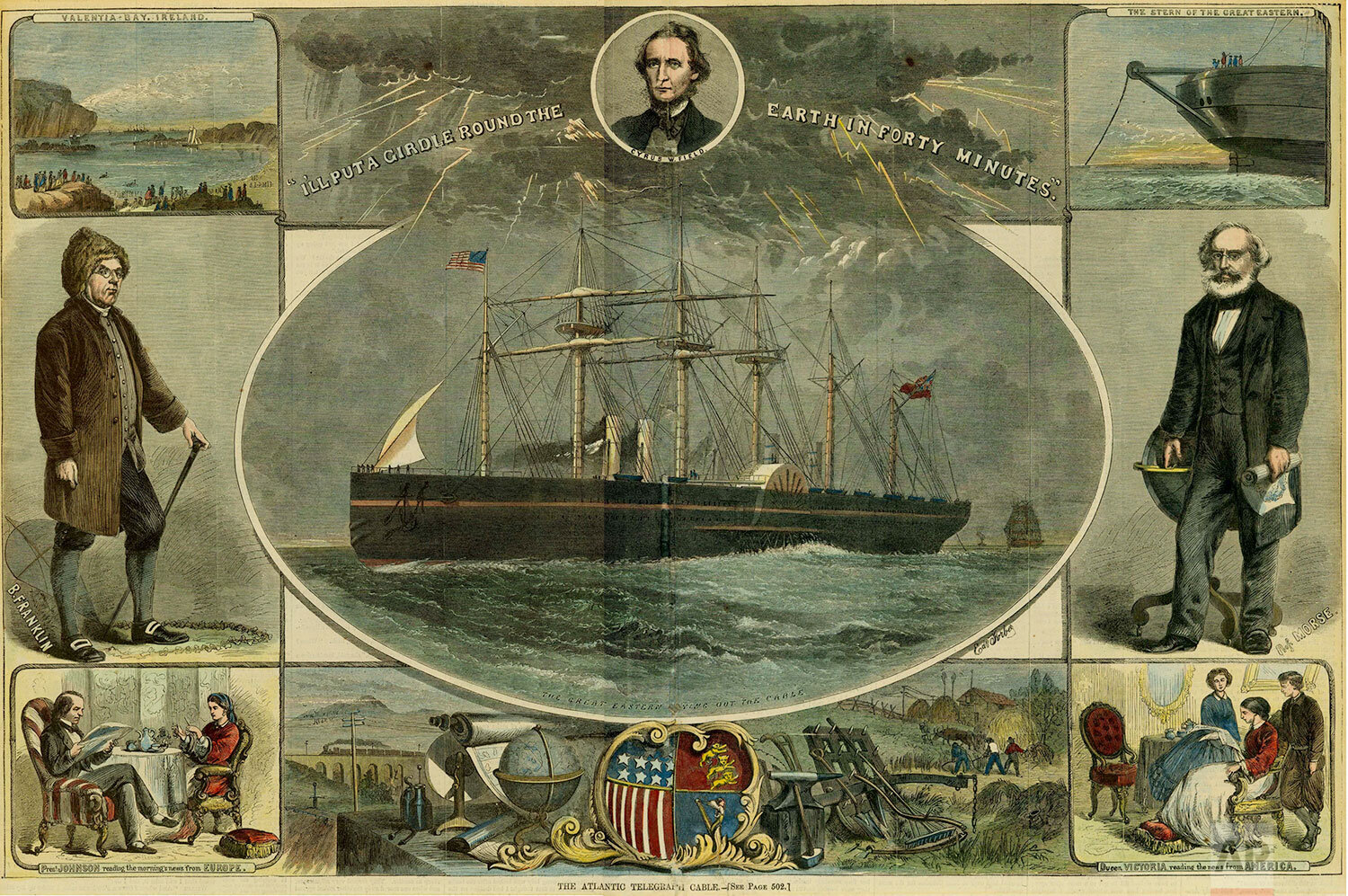
It was these measures which found the cause of the problem a few days later, when one of the watchers noticed a similar defect going through the rollers and into the sea. Unfortunately, it was too late to stop it, and the whole process of recovering the cable began for a third time. During the process, a worker noticed broken armoring wires on the tank underneath where the defect had rested, the brittle iron having snapped under the tremendous weight of the cable above. But in their haste, nobody remembered to tell Ireland what was going on, a decision that caused a great deal of consternation when the cable broke as it was being raised. By this point, Great Eastern was almost three-quarters of the way across the Atlantic, and the water below was at least 2,000 fathoms deep.3 Broken cable ends had been routinely retrieved in much shallower waters, but there were serious concerns about Great Eastern's ability to find the cable end over two miles below and bring it to the surface.
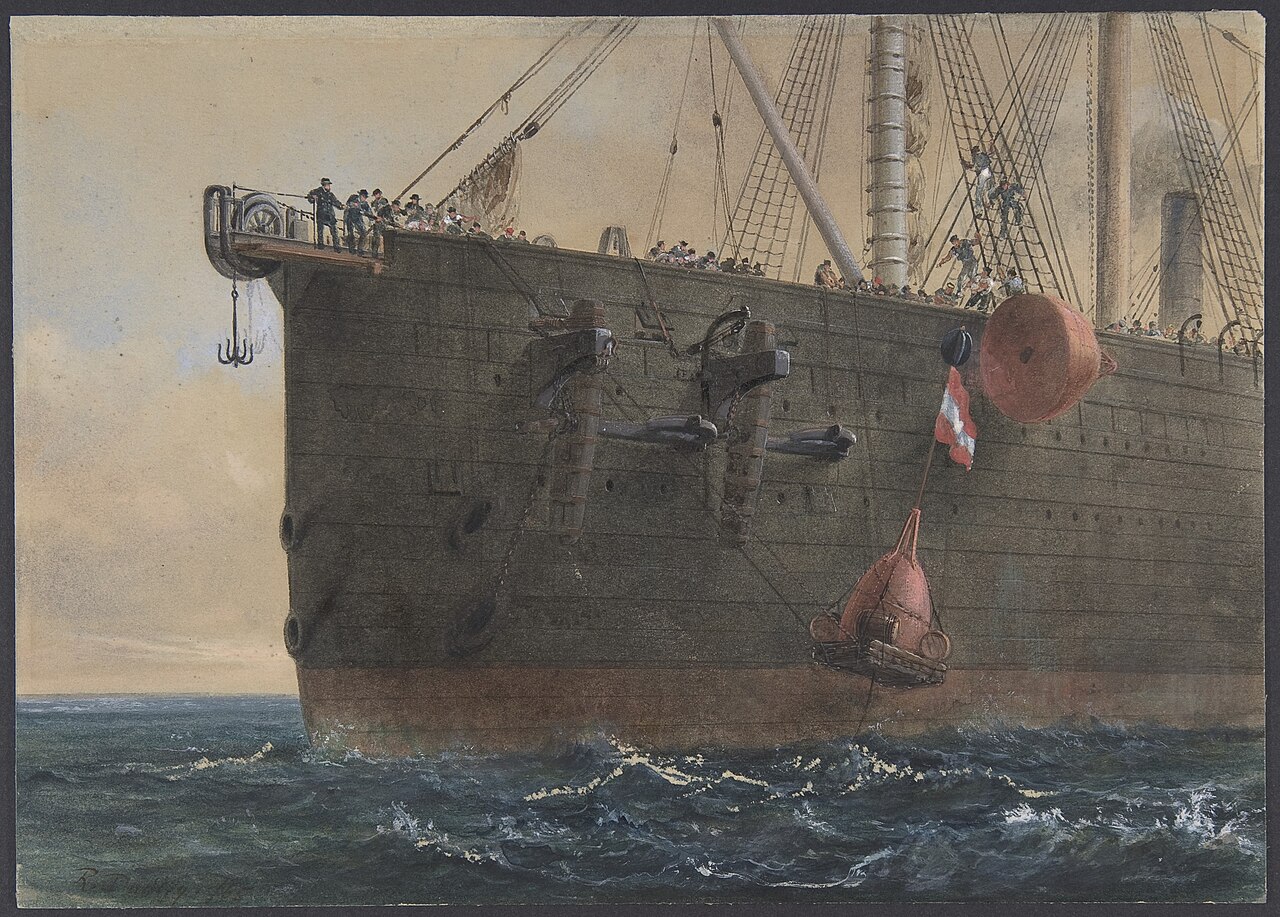
Great Eastern prepares to grapple for the cable
Because nobody had expected to try and grapple for a cable in the mid-Atlantic, there wasn't an appropriate rope onboard, and one had to be constructed from shorter sections of wire rope. The first two attempts successfully caught the cable, but the grapple rope broke as it was being hauled up, forcing a section of hemp line to be used as part of the third attempt. Unfortunately, it too parted while being hauled up, and after nine days the men aboard Great Eastern finally decided that there was no chance of recovering the cable on this trip.
But they had made it most of the way across the Atlantic, and grappled for a cable in previously-unknown depths. Field quickly set about raising money for a third attempt in 1866, which would not only lay an improved cable (with the fragile armoring wires replaced with something less likely to cause problems) but also grapple for the broken end of the 1865 cable and complete it as well. The winter was also spent making improvements to Great Eastern, everything from providing continual electrical testing to allowing the cable to be taken in over the stern to scraping the hull clean of fouling. The result was an almost anticlimactic voyage in July 1866, a two-week crossing from Ireland to Newfoundland where the biggest source of excitement was a brief tangle inside a cable tank that was swiftly sorted out. Her progress was carefully followed by the newspapers in Europe, but those in America could only watch and hope. Finally, on July 27th, the great ship appeared off Heart's Content, on the southeastern corner of the island, where deep water close to shore would keep the cable safe from the depredations of fishermen and anchors. The two continents were finally and permanently linked, although a break in the cable across the St. Lawrence meant it was two days before the news reached New York.
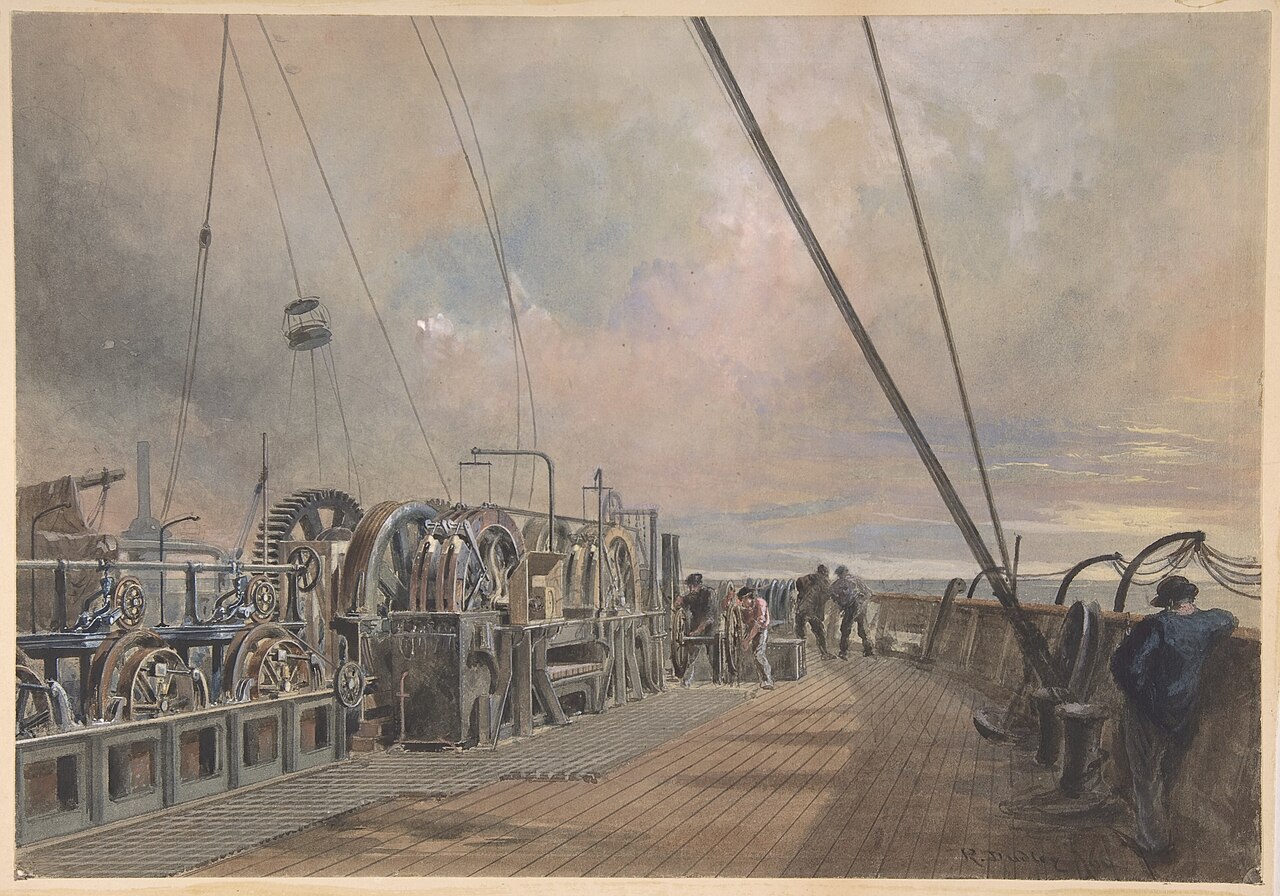
Paying-out machinery on the deck of Great Eastern
Field had triumphed, and his cable made £1000 on its first day in operation. But his work was not yet done, and after two weeks, Great Eastern again set sail for her battle with the deep. Supporting ships had located the previous year's cable and marked its line with buoys, although expectations of a quick recovery were dashed as the grapple repeatedly returned coated in the fine mud of the seabed. After a full week, the cable was finally hooked and dragged to the surface, but it had been fatally weakened by the repeated attempts to grapple it, and within five minutes it snapped and was lost to the deep again. More attempts were made, but each time the cable was lifted, it snapped once again. Finally, after about three weeks, the expedition moved a hundred miles eastward, where the water was slightly shallower and the cable hopefully undamaged, and tried a new strategy. The thirtieth grapple run snagged the cable, but it was hauled only halfway to the surface before the line was buoyed and Great Eastern moved off a few miles to repeat the process. Now that a great deal of strain had been relieved, the cable was easily hauled aboard, and rapidly taken down to the electrician for testing.
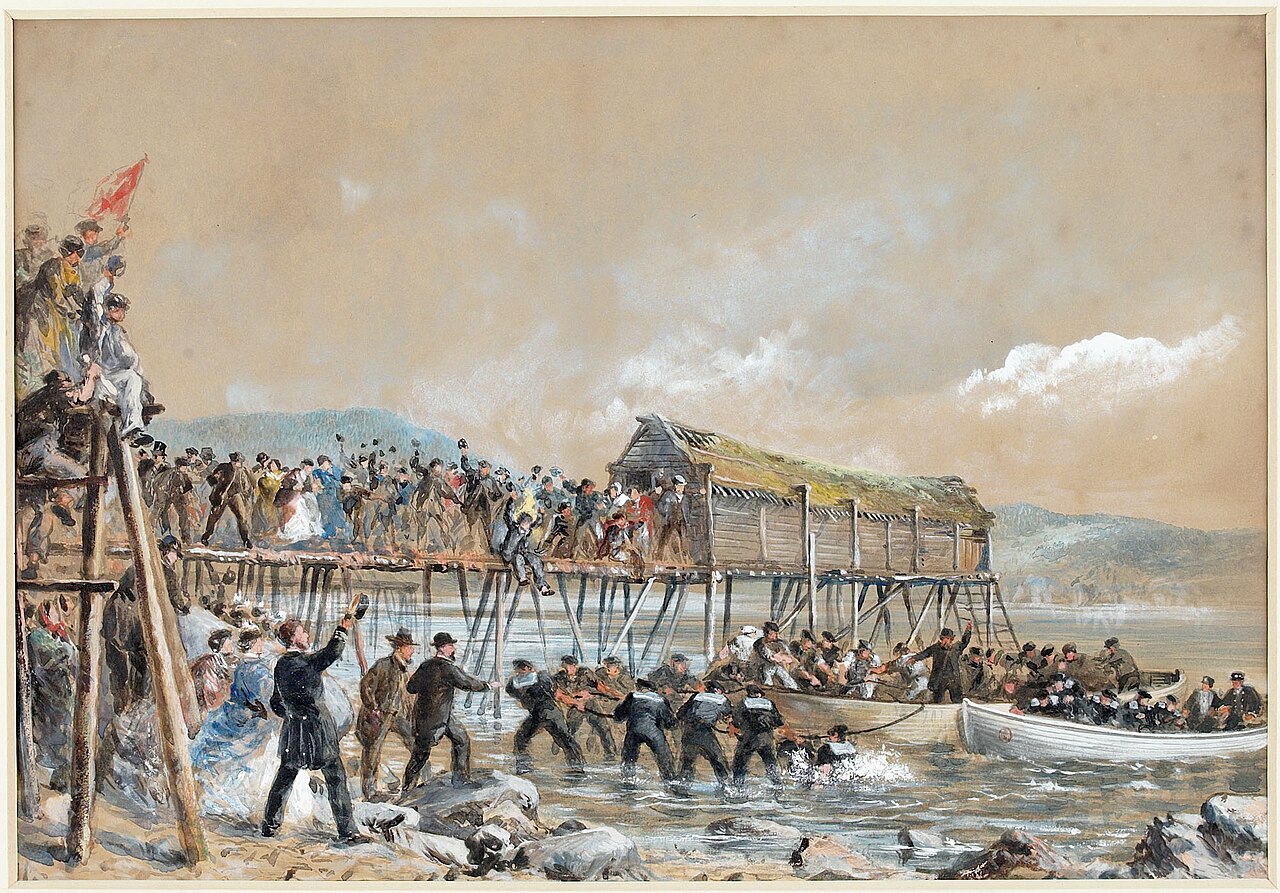
The cable comes ashore at Heart's Content, Newfoundland
Back in Ireland, a small team had spent the last year monitoring the broken cable to ensure that it didn't develop new problems, and occasionally receiving "messages" from the deep, the result of geomagnetic fluctuations picked up by a thousand-mile antenna. But on that day, the message was clear. The cable had been wrested from the Atlantic, and Great Eastern would finish the job she had started the previous year. This time, her progress was eagerly followed on both sides of the Atlantic, reports back to Ireland being passed over the completed cable to those waiting in Newfoundland. Despite weathering a storm on the way, Great Eastern arrived at Heart's Content on September 7th, giving Field not one but two channels for messages between Europe and the Americas.
1 It should be noted that this was in the early 1850s, before work on the Suez Canal had even begun. ⇑
2 Gross Register, because that's what I have. ⇑
3 The only set of sounding gear had been on one of the escorting warships, which had gotten separated early on in the journey. As such, nobody was sure exactly how deep the bottom was. ⇑
Comments
It is unclear which cable is being salvaged: the working one or one of the earlier defective ones