
I didn't comment on the latest conflict between the US and Iran last week for two reasons. First, it broke out on Saturday, and that didn't leave me a lot of time to write something up. Second, in that time, the fog of war was still pretty dense, and I didn't see anything I could say where I would add value above and beyond what you'd get following the news.
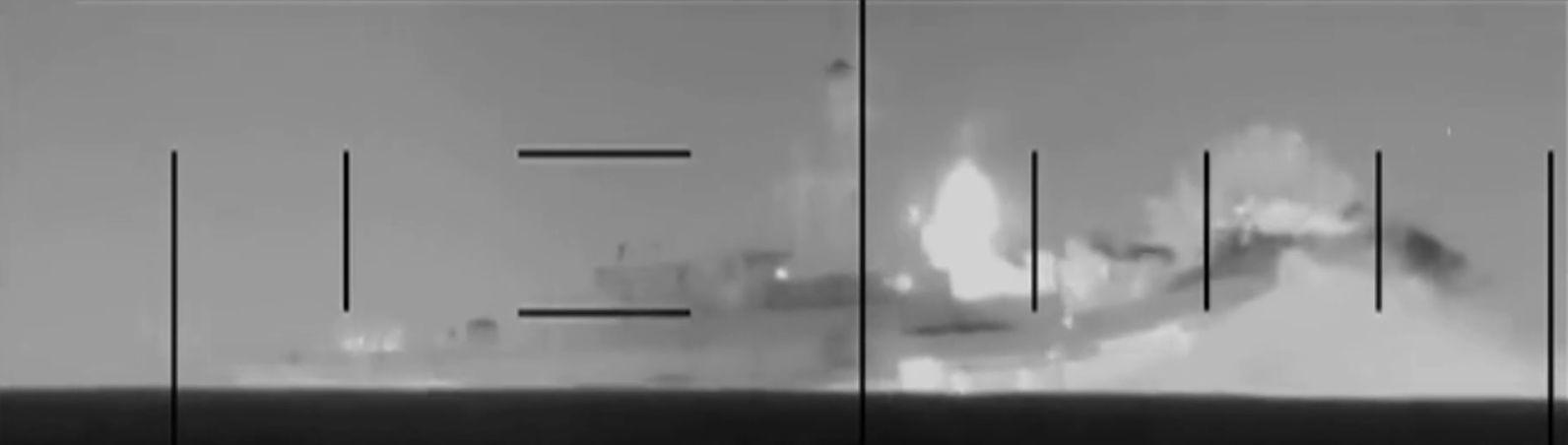
But that changed pretty dramatically on Wednesday, when the Pentagon announced that an Iranian frigate had been sunk by a US attack submarine, revealed on Friday to be USS Charlotte, one of old Los Angeles class boats.1 This is only the second time in the history of the nuclear submarine that torpedoes have been used in anger, and the first in over 40 years, since HMS Conqueror put General Belgrano on the bottom of the Atlantic. Even better, we have video of the torpedo hit, and I thought there was enough interesting stuff going on there that it was worth dedicating this week's post.
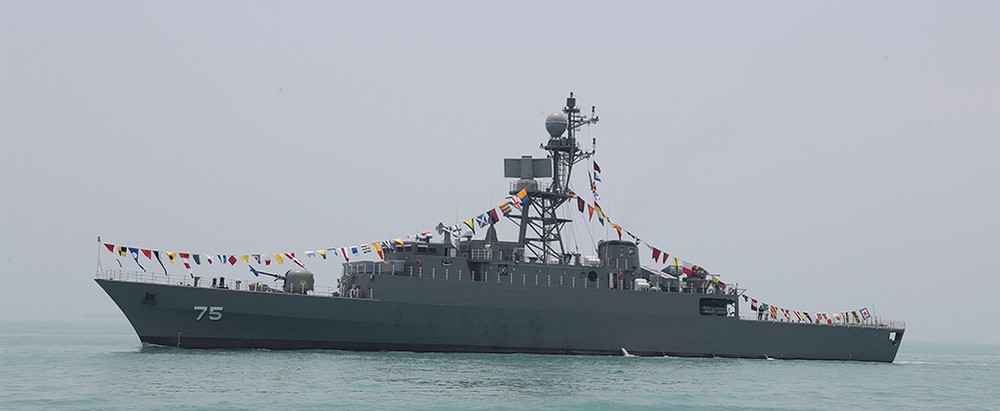
Dena commissioning
So, first, what do we know about the victim? Dena was a unit of the Moudge class light frigates, domestically produced in Iran. These are definitely on the small side for frigates, with an official displacement of only 1,500 tons, and other sources given even lower numbers. Armament is a 76 mm and 40 mm gun, some lighter weapons, plus four SAMs that are about the size of SM-2MR and that look to have performance somewhere between that missile and ESSM, depending on variant. I can't quite see the logic of fitting such a small number of SAMs instead of a larger number of smaller missiles, and I wonder if they might be intended to be used in surface-to-surface mode. Rounding things out are a quartet of C-802 anti-ship missiles and a deck for an ASW helicopter, although there's no hangar and none of the pictures show the ship with the helicopter aboard, which makes me suspect that it's primarily intended for rearming and refueling helicopters based ashore. I also question the official speed of 30 kts, which seems a bit high for 20,000 shp on the claimed displacement. CMO gives 28 kts, which is more plausible.
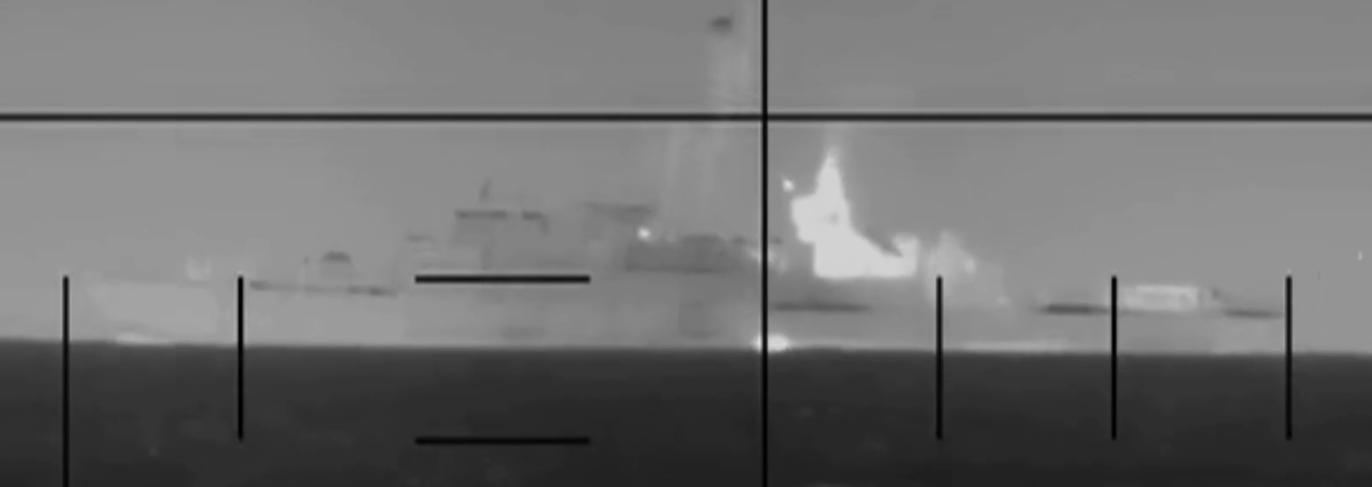
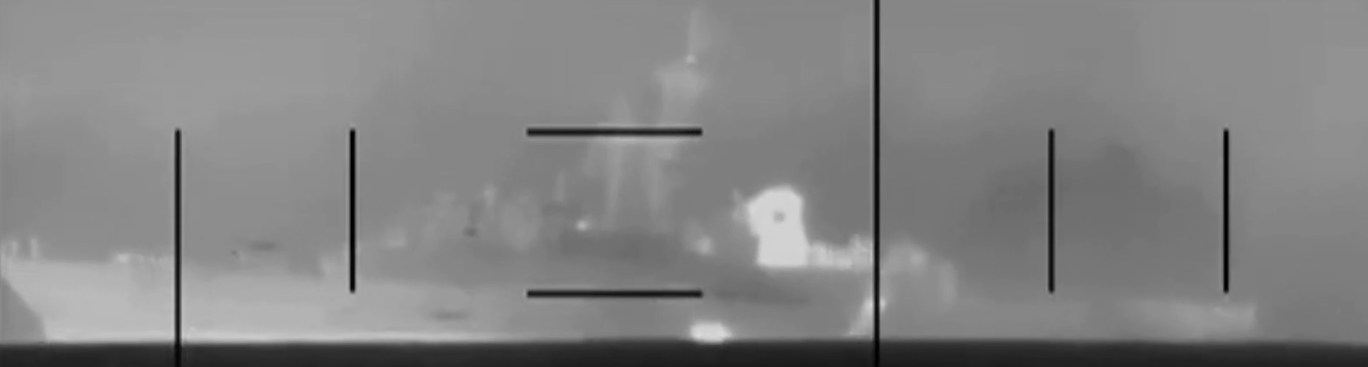
The view from Charlotte before the torpedo hit
But none of this mattered on Wednesday. Dena was returning from the Milan naval exercise and an international fleet review hosted by India. This was all near Visakhapatnam, halfway up the east coast of India, and as Dena was headed home, Charlotte found her, and fired the fatal shot somewhere between 19 and 50 nautical miles2 off of Galle, on the southwestern tip of Sri Lanka. Initially, General Caine, the chairman of the JCS, reported that a single Mk 48 was used, but the same report that named Charlotte also claimed that the first torpedo fired malfunctioned, and the second was successful. Reports are that Dena was able to get off a distress call before she sank, although I suspect this is more likely to have been a self-contained, automated system given the damage apparent in the video. Ultimately, the Sri Lankans were able to recover 32 survivors and 87 bodies. Reports vary on how many were aboard the ship, and thus how many remain unaccounted for, with the total aboard reported as being between 130 and 180 depending on the source. I suspect the numbers towards the higher end are correct due to the relatively high ratio of bodies to survivors. The lower numbers imply that two-thirds of the crew either were killed in a way that their bodies ended up floating separately from the ship (a likely fate for anyone in the structurally destroyed aft section, but unlikely further forward) or died after successfully escaping the ship (somewhat unlikely given the relatively prompt arrival of rescue forces, although we still don't have a detailed timeline for that).
Which brings us to the video, which I've embedded here. The first thing to note is that this is clearly a thermal image, with the bright spot amidships being the funnel and the exhaust gasses from the diesels. Second, this is clearly a classic underbottom explosion, with the astonishing violence that usually accompanies those. The Mk 48 torpedo is designed to kill far larger ships, so it's not surprising how much damage we see here. What is slightly surprising is how far aft the torpedo detonates. Based on the stadiometer markings, the torpedo went off only 40' or so from the stern, and I would expect based on the other example I've seen of a Mk 48 hitting a surface ship that it would be aiming more amidships. In any case, you can see the structure of the aft hull coming apart as the bubble jet forms, as in the top image, exhaust gasses being driven out of the funnel by the inrushing wave of water and the main radar falling off the mast. Moments later, the lifting of the aft hull drives the bow down, and then things go entirely gray as the spray from the hit blocks out most of the image. By the time things clear, towards the very end of the clip and about 14 seconds after the torpedo hits, she almost looks back to normal, although this is obviously not true. There's no exhaust gasses, although the funnel itself remains hot, and it looks like there might be a gap in the hull just aft showing warmer interior spaces (probably some part of engineering). Whatever was on the flight deck is totally gone, and it's obvious that she's going down by the stern very quickly thereafter. Reporting is that she sank only 2-3 minutes after the hit.
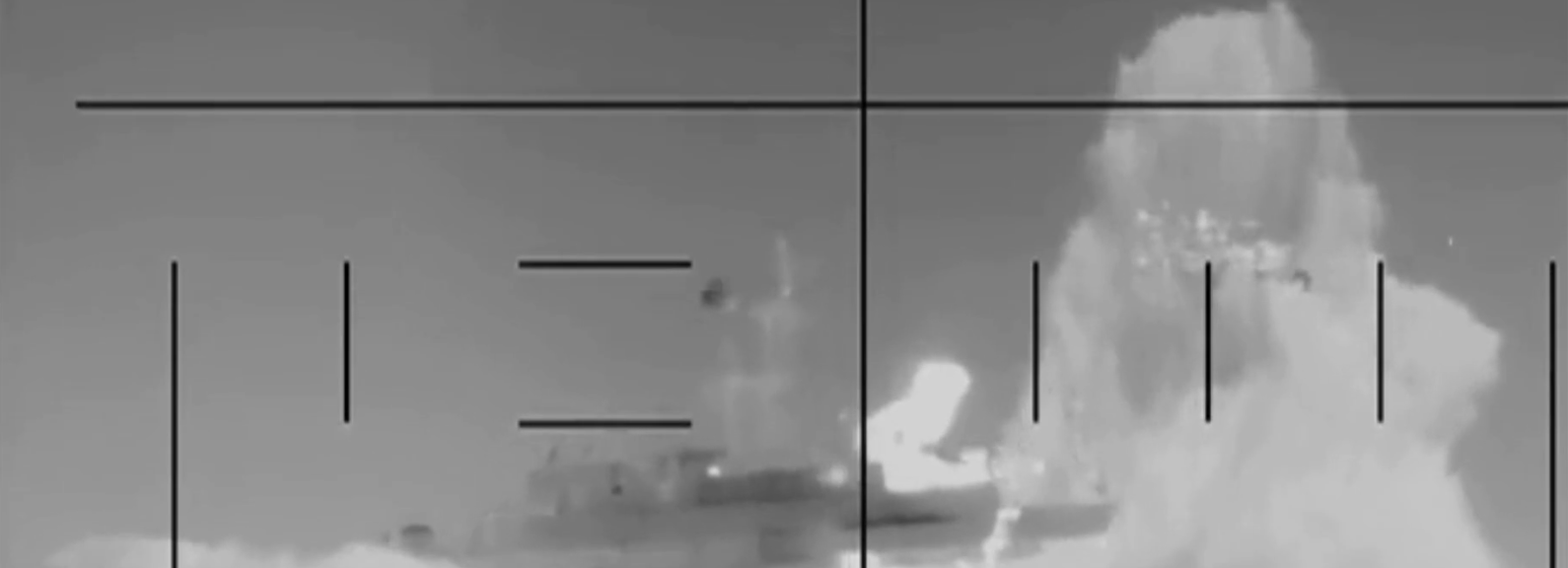
The bow is driven down, and the spray column obscures the stern
Dena was not the only ship the Iranians had in the area, and on Thursday, the replenishment ship Bushehr was interned by Sri Lanka, while LST Lavan was interned by the Indians.3 The fact that there isn't a declared war going on makes things a bit confusing, but in practice, this means that the ship (and probably the crew) are effectively under arrest, taken off the board until the end of hostilities, but still belong to Iran. It was not unusual during the world wars for ships that would clearly be unable to reach a friendly port to seek internment in a neutral power, as it saves lives (and ships) relative to making the enemy actually sink them. This would have been a good plan for Dena, and it's not clear if the Iranians decided against doing so, or were unable to get India or Sri Lanka to agree to it before Charlotte caught up to her.
I'm going to avoid getting too deep into the legal weeds on the actual sinking, largely because that ties deeply into the legal status of US actions against Iran, something well outside the scope of this blog. All I can say is that in practical terms, Dena was clearly a danger to any non-submerged American forces in the region, and removing that kind of threat is generally considered to be well within the rights of a belligerent.
The end of the video, with the ship looking almost intact
But there's a last naval aspect to the conflict that eclipses all of this, the Strait of Hormuz at the mouth of the Arabian Gulf. Something like 20% of the world's supply of oil and natural gas passes through Hormuz, and it's always been Iran's trump card if they think there's an existential threat to the regime. They finally declared it closed a few days ago, and daily transit volume has fallen from the typical rate of about 120 ships a day down to single digits. At the moment, this looks to be largely downstream of insurance shenanigans, and we don't seem to have seen attacks on the few ships which have transited. The problem is that while the Iranian Navy looks to have been comprehensively smashed, it doesn't take a navy to close a 20-mile wide strait. Iran has a lot of options for nastiness, ranging from Shaheds to C-802s to unmanned surface vessels (which have already been deployed against tankers inside the Gulf) to mines. Mines are a particular concern, given the generally low state of USN mine warfare capabilities and the difficulty of clearing them while under missile attack. The price of oil is headed upwards, and the Gulf States are likely to become pretty unhappy with the war if the closure persists. Definitely an area to keep an eye on.
3/9 Update: Two interesting aspects have come out in the day since I've published this. First, Iran apparently requested docking permission for all three ships from India when the shooting started on the 28th, and India agreed on the 1st, three days before the sinking. It's possible that there was ongoing diplomatic wrangling about the details of the deal (the Indians wanted full internment, the Iranians were hoping to keep the ships on the board) but in any case, Dena could have been safe well before she was sunk.
Second, the Iranians are claiming that Dena was unarmed, and that this was obvious because she was on her way back from an exercise with India, because you have to be unarmed to participate in those kind of things. Now, from a strict law of war perspective, this is meaningless. There's a deck gun visible in the video, and that's more than enough to make her a legitimate target. "I am out of ammo" is easy to say and hard to check, and the laws of war are pragmatic about such things. I also find it highly doubtful on a practical level. I've never heard of this rule, nor had a former naval officer I contacted, and there's no trace of it on the internet before the past week. I also really doubt that the USN would be willing to offload 80 missiles from the destroyer scheduled to participate, both from a logistics perspective and because they generally try not to sail defenseless warships around. The Indians themselves are not willing to back up the claim that Dena was entirely unarmed, either. Maybe she was carrying a lighter load than usual, but that's the sort of thing which is very difficult to confirm without putting people onboard, and when combined with Iran's behavior re internment, leaves this firmly in "good shoot" territory.
1 Two things worth noting here. First, the Australians have confirmed that three of their personnel were onboard, presumably as part of AUKUS. Second, I correctly predicted that the firing submarine was an LA or Seawolf from the released video, which seemed quite a bit shakier than I would expect from the photonics mast on a Virginia. ⇑
2 A lot of sources seem to have standardized on 19 nm, but this is a recent development, and I'm not sure that this is correct. The continental shelf is unusually narrow in this area, barely reaching out to the 12-mile limit. ⇑
3 Interestingly, while Dena was several years younger than the blog, both of these ships were originally built for the Shah's government. ⇑
Comments
"in practice, this means that the ship (and probably the crew) are effectively under arrest, taken off the board until the end of hostilities, but still belong to Iran. It was not unusual during the world wars for ships that would clearly be unable to reach a friendly port to seek internment in a neutral power, as it saves lives (and ships) relative to making the enemy actually sink them."
Considering the widely-noted link between poor countries, even democracies, and police corruption/brutality, I wonder if interned sailors in poor neutral powers during the World Wars were treated much better than the neutral power's own citizens under arrest. Presumably they had every incentive to obey the Geneva Conventions and all laws of war.
Legally, interned personnel must be treated at least as well as POWs would. In practice, they can be treated quite a bit better (for instance, Swedish treatment of allied internees in WWII), and I would expect that most neutrals would do their best to treat internees fairly well for diplomatic reasons. In this case, it's not clear exactly what their legal status is, and the US has been putting pressure on India and Sri Lanka not to repatriate them. Haven't heard what the outcome there is.
Can you clarify the phrase "relatively high ratio of bodies to survivors"? I'm not at all well-versed, but I'm surprised anyone survived given the violence of that explosion.
Basically, they found almost three times as many bodies as survivors. I find this weird because I would expect a fair number of people to be unable to get clear of the ship before she went down, and almost nobody to die between going in the water and getting rescued. (I assume the Iranians have some reasonable life-saving equipment and this is the Indian Ocean, so hypothermia probably isn't killing people very quickly.) Most injuries that would stop someone from getting to a lifeboat/raft/debris seem like they'd also stop you from getting off the ship in the first place, and then your body isn't recovered.
That said, I'm not surprised we saw survivors. Probably nobody from aft, but I'd expect a lot of people in the forward half to survive the initial blast.
Oh, boh, are we having another Torpedo Crisis?
Two Mk48s launched, and a dud...
Does anyone know what Sri-lankan ship and/or ships went out to pick up the surviving crew and bodies from the INS Dena?
Surprisingly no where seems to say which ship did it.
It'd be ironic if it was one of the ex-USCG ships Sri-Lanka has.
I did not run across that information while I was looking into this.
"plus four SAMs that are about the size of SM-2MR and that look to have performance somewhere between that missile and ESSM, depending on variant. I can’t quite see the logic of fitting such a small number of SAMs" maybe wanting something with a longer range than ESSM or it was intended as an offensive ground to air missile? Not sure how good domestic or Chinese/Russian equivalents to the SM-2MR & ESSM are.
Regarding the number of bodies, I'm not sure where I read it (Instapundit or maybe Rantburg), but there were rumors of a dispute between small number of the crew and their captain and the captain kicked them off the vessel using the lifeboat. That MIGHT tie in with the reports that the USN warned the Dena twice to stop and surrender.
The only place I've seen that was the Daily Fail, and I don't take places which can't use a picture of the right submarine class very seriously.
"Definitely an area to keep an eye on." A lot of understatement there!
What do you think is the biggest risk to reopening without Iran's cooperation?
Presumably a convoy and air cover can stop most if not all the slower drones.
I don't have a good feel if we could have enough persistent surveillance and presence to stop small boats laying mines.
Then anti-ship missiles, whether conventional or ballistic, seem not fun to counter is such a constrained space.
If Iran decides to lay mines, we're in big trouble. Even if we get a good idea of where they are (and persistent surveillance is basically the whole point of the MQ-4C) clearing them is still going to be extremely difficult, particularly if it has to be done under fire. But so far, they seem quite content not to do that, because they are still exporting oil in their own tanker fleet, and we don't seem to have taken action against it.
The problem with other threats is mostly magazine depth. We saw in the Red Sea that we can counter pretty much any missile/drone they can throw at us, but that it gets expensive in terms of munitions very fast. Also worth noting that we'd probably need to convoy all the way up to Kuwait, and with maybe 16 Burkes in the region, we don't really have the forces to do that.
More broadly, I just found out that the torpedoing may be causing problems for merchant shipping by widening the area declared as a war zone. The premiums aren't what they are for a Hormuz transit, but it's an extra cost.
Thank you for this analysis!
Was there any obligation of US ships to offer aid to the survivors of the Dena?
It is my understanding that the submarine was the only US ship in the area. Submarines have not been expected to stop and render aid to merchant ships torpedoed (even by idiots who have no idea how a submarine works) since the early days of WWII, as radio allowed the sinking merchant ship to broadcast their position and request help.
I am not aware of any requirement for a submarine to stop and offer aid to any naval ship at any time.
I may be wrong about either or both of these.
@Belushi TD, Captain Todaro would not approve your attitude.
"What is slightly surprising is how far aft the torpedo detonates. Based on the stadiometer markings, the torpedo went off only 40′ or so from the stern, and I would expect based on the other example I’ve seen of a Mk 48 hitting a surface ship that it would be aiming more amidships."
Is it possible the torpedo was set to acoustic homing, and detonated directly beneath the propellers?
The Moudge class does not seem to be particularly lucky, with three of the six sinking or capsizing in the past decade, all before the USN became involved.
Seconding Onux's comments; Mk 48s have active/passive terminal homing, and that hit implies the stern was making A LOT of noise. Not sure what the exact machinery layout of the MOUJ-class is (Wiki lists her plant as two diesel mains and four diesel gens, but I can't imagine they are all that far aft, which implies either a bad prop or maybe a thrust bearing was bad?
Re: casualty numbers. Interesting comparison can be had with the sinking of ROKS CHEONAN (which many sources are ignoring in the list of "Ships sunk by submarines after WW2"); in that case, 46/104 personnel on board died (although with a messy political twist here, since most of the killed were draftees because that's where their berthing is).
I guess if you're running in full passive you might aim aft, I just sort of assumed that the Mk 48 was smarter than that. Didn't make much difference here, but might somewhere else. That said, not sure it would take a particularly bad prop to make that the main source of noise if Iranian acoustic design isn't particularly advanced.
I was extremely careful with my caveats, and specified "nuclear". Although that is a case which might bear looking into.
And, per wiki, 40 of the bodies were found when the ship was salvaged. Now, she didn't break in half for 5 minutes after the hit, which implies that the level of violence was a lot lower, but it does add support for my guess that there were more than 130 onboard.
"I guess if you’re running in full passive you might aim aft,"
If you are running in full passive mode you don't aim at anything - the torpedo will home in on the largest source of noise, which is likely to be the propellers either because of general principles, or especially if they have any slight damage or wear that causes extra turbulence or cavitation.
"I just sort of assumed that the Mk 48 was smarter than that."
Most people believe that it is smarter than that, particularly when running under control of a guidance wire or when using active sonar, but just because it can be smarter doesn't mean that it was used that way, versus a simpler passive homing mode. C.f. HMS Conqueror using an old WWII ear Mk8 torpedo to sink the Belgrano instead of the newer Tigerfish, because the older torpedo was considered more reliable. Also, there are the reports that two torpedos were fired by Charlotte, which suggests that the first missed or did not detonate. That might have caused the Captain to choose a simpler passive attack for the second.
If the torpedo will miss ~75% of the target because the propellers are loud, then it will miss 125% of the target if the towed decoy is louder. I'd have expected the Mark 48 to be smarter than that. Either "yes, that's loud, but the thing next to it is a diesel", or switch to active during the final phase of the engagement.
https://www.abc.net.au/news/2026-03-11/middle-east-blog-march-11/106439598 We now have confirmed strikes against shipping in the Strait of Hormuz
Excuse me. I need to go do my penance for forgetting about Foxer. That said, I could sort of see it being the case that the hardest thing to create a convincing decoy of is the propeller. It’s a big structure moving through the same water the torpedo is in, which probably creates all sorts of exciting signals from, oh, blade doppler or whatever. Whereas any diesel is going to be putting its sound through the hull in a way that may make it easier to record and play back through the towed decoy.
Edit: This is plausibly related to the inability to build decoys for wake-homing torpedoes.
@megasilverfist
Definitely concerning, but I’m only going to be really bothered if something strikes a mine.
Seems like the smart way to deal with towed decoys would be to determine from the bearing rate which direction the target is crossing , then steering for the lead "sounds like part of a ship, even if it isn't the loudest part" noise source.
Or just let the operator set the details, if the command wire is still intact.
Assuming that you're only dealing with towed decoys, sure. But if I was a decoy designer with a nasty mind (which is a qualification for the job), I'd be wondering what I could do with a USV and some fairly basic software. Probably best to try and figure out which is the real one directly rather than rely on that kind of heuristic.
Does the Mk48 retain the basic “match gyros and proceed along the course until you hit something” capability, or has that been deprecated?
I believe it should still be able to do that, although I'm not sure why you would do that.
"I’d have expected the Mark 48 to be smarter than that. Either “yes, that’s loud, but the thing next to it is a diesel”,"
What you are saying implies a level of signal processing that is comparatively recent. We take for granted today that you can take a picture on your phone and it will automatically detect faces or QR codes, but supposedly only 50 Mk 48's are built (or rebuilt?) per year, which means that a large part of the stock probably dates from the 1990s or early 2000s. I know the Soviets developed a mine coded to respond to the signature of the LM2500 turbine that is ubiquitous on USN ships, but listening while stationary for the specific frequency/hum of a specific spinning engine passing overhead is probably a lot easier that trying to distinguish generic engine rumble from generic propeller noise while flying along at 50 knots. I have no doubt it could be done with modern sensors and processors (see above on dynamically detecting QR codes in an image) but would not assume that capability is in every warshot carried by subs. Same for detecting blade doppler versus broadcast propeller noise from a decoy. I might be pessimistic here, sometimes military technology is on the leading edge and has capability years before it comes to market. Other times military technology is made by the lowest bidder and designed by the people who were not recruited by a top Silicon Valley firm.
I believe the inability to make decoys for wake homing torpedoes is because they are sensing a property of the water behind the ship (a wake has slightly different density, refractivity, etc. compared to water around it) rather than sensing a signal from the ship itself. A wake 'decoy' would need to be an object of several thousand tons moving through the water to generate the same hydronic changes, i.e. another ship, which kind of defeats the purpose. Its the same reason pressure mines cannot be swept - you cannot generate a signal at a distance that will actuate the sensor like a magnetic field or sound, you need to actually create a pressure differential at the mine, which again means moving the amount of water around that a ship moves.
As an aside to tie together two disparate comment threads, I will note that resistance to wake homing torpedoes might be another advantage of SWATH hulls for combat ships, given that they are known to produce much lower wakes. Also since wake homing torpedos look for the edges of the wake and try to steer between them, there is the possibility with widely spaced hulls that such a torpedo might go right between them under the ship. This might also translate into some resistance to pressure mines, at least until your enemies reprogram their mines to look for SWATH pressure profiles - a cycle of arms and armor that never ends (assuming the pressure profile is different enough, I don't have a lot of knowledge about how pressure mines try to detect "ships" versus "waves" and "whales").
@bean
To test how well the crew remembers vector math!
More seriously it was a question raised by the point above about using an older torpedo to sink the Belgrano, and the apparent failure of the first torpedo from the Charlotte.
On the passive/active question - I suppose this depends on the parameters of the engagement (range, speed of target, speed of torpedo/available fuel remaining, bearing, etc.), but it seems like the obvious solution is go passive until you’re within a half mile (or whatever) of the target, then go active to confirm it’s not a decoy and optimize the targeting. If it’s a decoy then at least you’re giving the torpedo a chance to find the real target.
Also, tail chase is the hardest situation (because of the relative velocities) but I wonder if there is data on how often shots are taken from the various relative bearings during exercises. (I.e., in practice submarines fire at the bow x% of the time, and take broadside shots y%)
Sorry, one other question - decoys work by emitting a fake target noise, or creating enough general noise to mask the mother ship against passive sonar, but do they have active sonar jamming equipment that parallels some of the electronic warfare equipment seen in aircraft?
My sense is that the physics are different enough that it wouldn’t really work in practice, though in theory waves are waves.
@Onyx
It's probably not entirely accurate to say that that kind of signal processing was invented in the early cold war to analyze sonar signals, but it was definitely a major early user. This was being done by people who know about Foxer and the problems with not doing any sort of signal processing, and while the computers may be old, you can get a lot done with old computers if you care about efficiency more than the average writer of desktop software.
@redRover
If you follow the links through the Falklands series, they later tried to use the Tigerfish on another target (I think one of the LSLs) and got zero hits from IIRC at least three shots. I wouldn't actually read too much into the parallel here, because we have zero information on the cause of the first Mk 48 failure, and there are several categories for which "just set it to a constant bearing" is not a solution.
I am not aware of any such equipment, and suspect that it wouldn't work because the ocean likes to smear sound around too much for the sort of tricks you can get with radar.
Everyone has known since ‘The Hunt for Red October’ came out that subs have the signal processing ability to distinguish one ship type from another based on noise signature (the FBI actually launched an investigation to see if someone had leaked classified information to Tom Clancy, eventually determining he was just very good at putting it all together from open sources). That however is different from having the processing power on board a torpedo for it to pick a particular part of a ship to hit based on sound. As an anaolgy, synthetic aperture radar existed on planes in the 70s and 80s and could make detailed pictures of ships, but early generation anti-ship missiles couldn’t be programmed to hit the bridge instead of the hanger based on its radar return. Once again, an obvious or even easy capability to design and build today, but I wouldn’t assume state of the art in all weapons when they are often stockpiled for decades.
As for jamming, it is worth noting that radar jamming is always used against active radars (play space invaders on their screen) while towed decoys are generally aligned against passive sonar (mask the target or make a louder target). Although I am also not aware of any such system, it should be possible to design a sonar jammer against an active torpedo: false signals at the right frequency timed to arrive in such a way as to present a false range reading (or if from a towed decoy, a false bearing) and thus cause the torpedo to calculate an incorrect targeting solution.
I assume there is not much impetus for this because unlike radar, passive sonar actually works better than active. You can usually detect then noise a ship gives off itself at a greater distance than you can send noise and have it bounce back. As a result, every torpedo already has “home in jam” capability via its passive sonar homing, so interfering with its worse performing active homing while giving a great signal for its better performing passive homing isn’t giving you much of an advantage.
@Onyx Small programmable DSPs have been commercially available since about 1980. Based on the history of the F-14, I have to assume that similar technology was available to the navy military a few years earlier as well. The 1990s had well-established signal processing capabilities and algorithms in the public market. The MP3 format was released in 1991. Which suggests that there was enough processing power and the algorithms available to be largely-successful, even if we can do better now.
@bean: The Straits of Hormuz are narrow enough that, with luck, Iran could hit ships with conventional artillery. Even if it's only a 1% chance, that's not one that insurance companies are going to want to take.
@Garrett,
The MP3 format was released in 1991, but Shazam, the app that can listen to a snippet of music and then tell you what the song is, what not released until 2008, I believe, and it did (and still does) have trouble with classical music, if the microphone is obscured, and if there is background noise. Just because DSPs existed and could encode and play back a fixed signal in the 80s/90s doesn't mean the processing power was there to determine exactly what an unknown signal was, or distinguish an engine signal from a propeller signal (or even more difficult, say, a main engine from a ship service generator). An now remember that from the perspective of a torpedo you have to deal with sound attenuation in water, possible decoys (Nixie/Foxer), quieting (Prairie/Masker), and a much higher signal to noise ratio than radar does (whale calls and shrimp mating do not emit in the electromagnetic spectrum, but certainly do acoustically). Again, it seems pretty well known that subs had the capability to distinguish ships based on unique sound signatures (unless Clancy was way overselling things with "the computer program was developed from a geology system so it classify's the super secret sub as 'tectonic noise' plotline). That is still different (and less hard) that aiming at a specific point by differentiating two signatures from the same ship (versus looking at them in aggregate to say 'Ship A' not 'Ship B'). I'm still not going to bet that your average torpedo from a few decades ago (likely still stockpiled today) can be programmed to hit one part of a ship versus another based on passive signature. I could very well be wrong. The precursor work for the F-117 stealth aircraft was published in the 1950s, and the computer mouse along with a graphical user interface was demonstrated in 1968, a decade and a half before being available commercially. Maybe there is some crazy tech hiding out in the Mk48 all this time.
@baen, interesting to see you remarked on the death toll. it has been speculated that the unusually high number of casualties is because a crew assembly of some kind was taking place aft at the time of the torpedo hit, unfortunately right above where the torpedo struck. if one reviews the video, it can be plainly seen that some unfortunate fellow emerged from the superstructure and was walking aft seconds before the torpedo detonated, and there also seems to be a large blob on the flight deck, which might be people standing still. from your review of the video, what do you think?
That would be almost the only thing that would make sense, but I don't see it in the video. There's a couple people visible, and they're significantly brighter than the thing on the deck aft, which can be seen breaking apart as the jet climbs.
@Onux
Doing specific ship identification via LOFAR (which isn't that different from "is this a diesel or a prop") was available from store stations in the late 50s, and on ASW aircraft by the mid-60s. Now, there's 10 generations of Moore's Law between that and the earliest possible date the computers on the Mk 48 date to. That's plenty to take "computer we can fit on an airplane" and make it "computer we can fit into a torpedo".
Does anyone think the torpedo didn't have an explosive warhead? I think so, since it didn't fracture the ship.
@Marcelo, no.
A torpedo without a warhead is about the same dimensions and quite a bit heavier than a floating log. Without a warhead the impact damage will only depend on the combined speed of the torpedo and ship at impact. The damage will be the same if the ship is moving fast and the impact object is relatively stationary, or the object is moving fast and the ship is relatively stationary.
Ships the size of the Dena have run into floating logs, freshwater or at sea, and the worst that can happen is a hole in the hull. Ships in WW2 got hit by dud torpedoes and reported a "thunk" sound and later a dent in the hull - if they noticed at all. No massive spray of water, no violent pitching, no radars and guns being dislodged from the deck.
Under perfect exercise conditions with a stationary target a heavyweight torpedo can break a ship in half. (Also note that these spectacular photos/videos get more attention than "the ship just sank some minutes later".) Doesn't mean it always happens.