June 28, 2019

Musuem Review - Bavarian Military Museums

Proofreader and general friend of the blog dndnrsn was in Bavaria for a few months recently, and spent some time visiting museums. He's reviewed several that have military/history interest for us.1

Bavarian Army Museum/WWI Museum/Bavarian Police Museum

There are three linked museums built into historically significant old castle/fort buildings. Entrance is €1 to enter each on Sundays - otherwise it’s €3.50, or 7 to see all 3, with reduced entry for some. Therefore, best visited on a Sunday.


Look, the 2nd ed AD&D weapons section.2

When I went, the main exhibition of the Bavarian Army Museum was closed due to renovation work. There’s an exhibition of medieval weaponry and photography thereof, with German and English text. There was also an exhibit about the Austro-Prussian war. Some interesting stuff, and my German was enough to piece most of it together. Read more...

June 26, 2019

Information, Communication and Naval Warfare Part 3

While learning where the enemy is and what he's doing before he does the same to you has been a part of warfare since one tribe first went out to ambush another, it's only comparatively recently that efforts have been made to integrate and disseminate it on a large scale. Jackie Fisher first came up with the concept while in command of the Mediterranean Fleet, and the RN developed it into to a key weapon in WWI. Later, the British and Americans used similar techniques to plot incoming air raids, multiplying the effectiveness of their defenses. However, these systems were entirely manual, which meant that they could be overwhelmed by an opponent that launched large numbers of separate raids, or whose aircraft were fast enough to stay ahead of the plotters. To make matters worse, nuclear and standoff weapons meant that attackers had to be intercepted further out than ever before. During exercises in the early 50s, jet raids on US carrier groups had maybe a 1 in 3 chance of being successfully intercepted. Incremental improvements could help this some, but radical solutions would be needed to solve the problem properly.

Two solutions immediately presented themselves: decentralization and automation. Decentralization could take any number of forms. Broadcast control abandoned any attempt to have controllers vector fighters in and instead simply gave the position and course of incoming raids, letting fighters plot their own intercepts. In other cases, it involved assigning sectors and CAP3 sections to specific ships, with a central control ship to coordinate when raids crossed sector boundaries. Maybe one ship would be in charge of tracking friendlies, so that the CAP wasn't wasted chasing down the ASW patrol. However, decentralized control demanded good communications, which was a problem in an era limited to voice radio and teletype, and even decentralized control only helped to resolve the problems of moving information from one plot to another. Read more...

June 24, 2019

Rule the Waves 2 Game 1 - January 1902

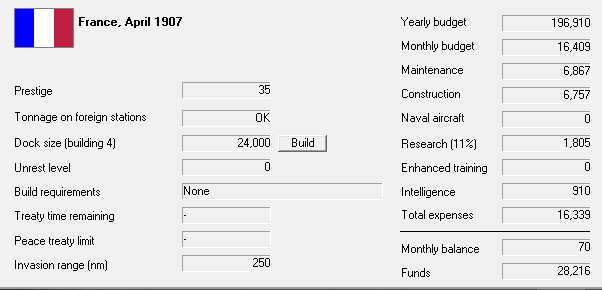
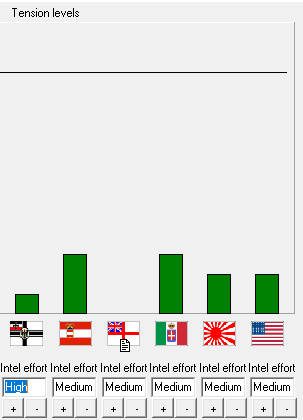
Gentlemen, our first two years at the Ministère de la Marine have gone almost exactly as we had wished. We remain on good terms with the Anglophone nations and Japan, while we stand on the brink of war with Italy. Four capital ships, two light cruisers, and a brace of destroyers all are under construction in our yards. This means that only limited funds are available for new construction right now, and we need to make good use of them to ready ourselves for war.


The world situation

Read more...

June 23, 2019

The Spanish-American War Part 5 - The Blockade of Santiago

In 1898, tensions between the US and Spain over the remains of Spain's Caribbean empire boiled over after the battleship Maine blew up in Havana Harbor. The US declared war and blockaded Cuba, while the Asiatic Fleet under George Dewey destroyed the Spanish fleet in the Philippines at Manila Bay. But the bigger prize was closer to home, as the Spanish dispatched a force under Admiral Cervera to break the Cuban blockade. The Americans attempted to intercept him, but he managed to reach the port of Santiago, on Cuba's south coast, unmolested. It took over a week for the Flying Squadron, under Commodore Winfield Schley, to establish that he was at Santiago and blockade the port.


Cruiser New Orleans bombards Santiago

On May 29th, a day after his forces finally settled in to blockade Santiago, Schley took most of his squadron inshore to reconnoiter the approaches to the port. His efforts were finally rewarded with a view of several of Cervera's cruisers, confirming that they had managed to trap the Spanish. One of the Spanish ships opened fire, but the range, 15,000 yards, was much too great for the fire-control technology of the day. Two days later, the Americans sent a group led by Massachusetts and Iowa in to bombard the cruiser Colon and the shore batteries from half the range of the previous engagement. Neither side made particularly good shooting, the only notable hit being an American shell that struck a Spanish shore battery's magazine and failed to explode. Read more...

June 21, 2019

The Scuttling of the High Seas Fleet

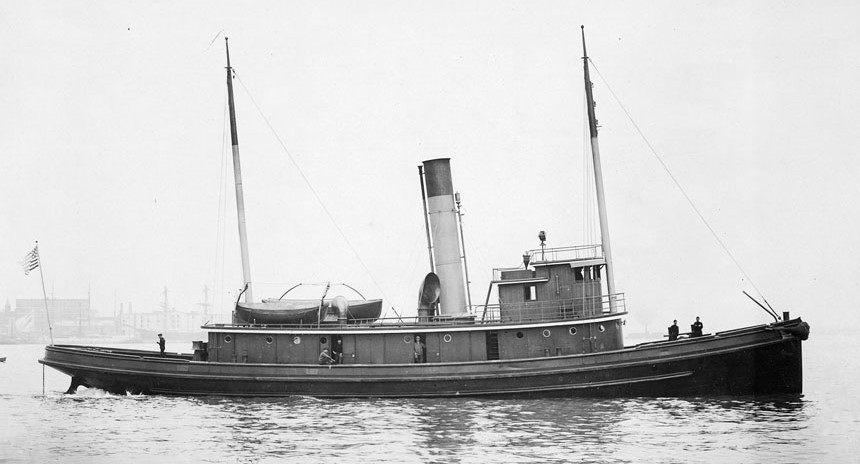
Even though the Armistice on November 11th, 1918 had signaled the end of the fighting, the Great War had left many loose ends for the diplomats to tie up. One of the biggest was the fleet of battleships and battlecruisers the now-deposed Kaiser had built. 10 days after the Armistice, they had sailed into Rosyth, and they were swiftly transferred to the Grand Fleet's former base at Scapa Flow in the Orkneys to the north of Scotland, to be held there by the British until their fate was decided at the negotiating table in Versailles.


Hindenberg interned in Scapa

It was not a pleasant experience for either the officers or the men aboard those ships. Discipline in the High Seas Fleet had frayed during the long years in port after Jutland, and collapsed completely when the fleet was ordered to sail to its doom in late October. The British, when they came aboard the interned ships, were astonished at the lack of respect for the officers, whose orders had to be countersigned by the crew's councils, and at the amount of dirt which had been allowed to build up. The lack of food and recreation did not help. Food came twice a month from Germany, and while the rations were more generous than during the Turnip Winter, it was monotonous and of low quality. The only luxury available in abundance was brandy, which was necessary to make life less boring. Read more...

June 19, 2019

Museum Review - Soya

When Lord Nelson visited Tokyo this past December, she went to see Soya, an arctic research vessel turned museum ship.4

Type: Arctic research vessel
Location: Osaka, Fune-no-kagakukan Station to be precise. It’s approximately a 30 minute ride from central Tokyo via public transit.
Rating: 3/5
Price: free

Soya offers only self-guided tours, perhaps due to the cramped quarters. The ship is interesting enough at first, but once you’ve seen half a dozen officer’s bedrooms, the novelty starts to wear off. The rooms are entirely glassed in, making photographs difficult, and on the rare occasion that the tour route reaches the deck, all the interesting bits are roped off. It certainly doesn’t help that all of the signage is in Japanese, with the exception of the title translations, which can be… rather unconventional.5 Read more...

June 17, 2019

Open Thread 28

It's time for our biweekly open thread. Talk about anything you want.

Also, note that play has begun on our RTW2 game, which is being continued in a separate thread. The report was posted in the OP last night.

The highlight of the OT is the splendid Okieboat website, dedicated to the guided missile cruiser Oklahoma City. There's a tremendous amount of information about everything from the very interesting Talos missile to life aboard. It's one of the very best descriptions of the complexity of a modern warship that I've ever seen.

Overhauled posts include the history of the New Jersey, my review of Alabama, Falklands Part 3 - Logistics at Ascension, the Battle of Pungdo, So You Want to Build a Modern Navy - Aviation Part 1 and Jackie Fisher.

June 16, 2019

Battleship Aviation Part 4

Even as the seaplanes that battleships had traditionally carried were being retired in the late 40s, the need for battleship-based aircraft hadn't gone away. If anything, it had grown as the battleships focused more on shore bombardment. While fire-control radar had largely removed the need for aerial spotters when shooting at ships,6 it couldn't easily distinguish a shore target from the surrounding terrain. For that, aerial spotters were still needed. To fill this niche, the US Navy7 turned to the helicopter, which had emerged in the closing days of WWII and would revolutionize naval aviation.


A Sikorsky R-4 operates off of a ship

Navies had long been interested in rotary-wing aircraft for the obvious reason that they could take off and land vertically, removing the need for flight decks, catapults, craning aircraft out of the water, and all of the other hassles that went with fixed-wing aviation. In 1931, the USN had evaluated the Pitcairn XOP-1 autogyro, a sort of airplane-helicopter hybrid that used an unpowered rotor to generate lift. The XOP-1 was operated from the carrier Langley, but ultimately rejected as having insufficient range and payload to be useful. Several more attempts were made over the next decade, but autogyros, which were unable to hover, were simply not satisfactory, and interest turned to craft with powered rotors. The British made the first serious attempt at building one of these in 1938, when they issued Specification S.38/22, for a naval ASW helicopter. The competition was won by the Cierva Autogiro Company with their C.41 Gyrodyne design. The gyrodyne used a powered rotor for takeoff, landing, and hover, but was propelled by a conventional engine in level flight. However, the project was cancelled in 1940 due to other pressures, and rotary-wing naval aviation properly began in 1942, when the Germans conducted trials of the Flettner Fl 282 on the light cruiser Koln. A year later, the Americans began trials with the Sikorsky R-4 under the aegis of the Coast Guard. The German efforts never bore fruit, and Allied helicopters saw only very limited operational service during WWII, focusing primarily on search and rescue, a role that they obviously excelled at. Read more...

June 14, 2019

Museum Review - Newark Air Museum

Reader Alexander was kind enough to provide this report on the Newark Air Museum in Nottinghamshire, which is about 2.5 hours north of London.8


An Avro Vulcan at Newark9
Type: Air Museum,
Location: Newark, Nottinghamshire, UK
Rating: 4.5/5, limited collection, but the cockpit tours make up for it.
Price: £9 ($11.50 US) for adults

Website Read more...

June 12, 2019

Soviet Battleships Part 1

After the overthrow of the Tsarist regime, the energy of the new Soviet military was primarily concentrated on the army, and with good reason. The USSR faced threats on every land border, while naval threats were fairly minimal. The Soviet Navy soldiered on with a few ships from the days of the Tsars, most prominently the remaining battleships of the Gangut class. But this would all change in the 1930s.


Oktyabrskaya Revolyutsiya, formerly Gangut, in 1934

Joseph Stalin began talking about a new navy as early as 1931, apparently seeing a great oceanic fleet as necessary to the power and prestige of the Soviet state, a deterrent against the enemies he was sure were plotting against him.10 However, nothing came of this discussion until 1935, when serious work on designs began, under the designation "large armored artillery ships". This was prompted by a worsening international situation, particularly the rise of Germany under Hitler. In fact, the first batch of design studies were for ships of 26,000 tons, the same size that had recently been announced for the Scharnhorst class. The plan actually approved in June 1936 showed 8 35,000 ton ships and no fewer than 16 26,000 ton vessels, a battleship construction program unmatched by even the major naval powers. Read more...