
This week has seen the announcement by the Trump Administration that they are going to be building "battleships", a subject that is well within my beat, so I figured I would take the time to start by saying that these are nothing of the sort. Defining the battleship is slightly tricky, but the best version I have is that it is a large, gun-armed armored warship. This proposal is certainly large, but it doesn't really classify as gun-armed, in that the guns are clearly secondary weapons, and there's been no discussion of armor at all. So whatever these are, they aren't battleships. Their closest cousin is the Soviet Kirov class, which likewise are somewhat hard to classify, but in the finest tradition of the USN, I'm going to go with "Large Missile Cruiser" for these. But the fact that they're being called by the wrong name, while personally extremely annoying, is just the tip of the iceberg.
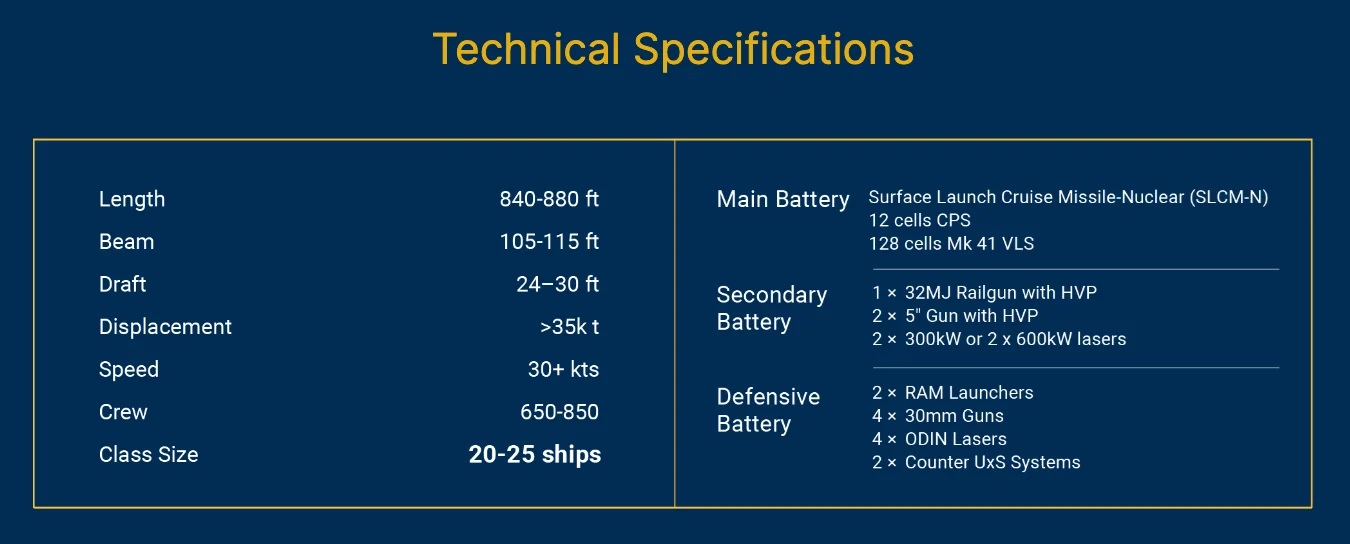
First, a look at the announced specs, as given above. The dimensions are somewhat large given the displacement, as they're a pretty close match for Iowa, which is 50%+ heavier at full load, although they're also not too far from the Alaskas, of roughly the same displacement. The length might make sense if they were going for nuclear power, because a very long hull would minimize power requirements, but it seems that it's IEP instead. But then we get to armament, and things get weird. It starts with the new ship-launched nuclear cruise missile that Trump has been pushing since his first term. This is basically a replacement for the nuclear Tomahawk, and whatever the logic for or against such a program might be, there's the problem that I'm pretty sure there's no need to have this new "battleship" to use the missile. Details on the missile are very sketchy, but given that the base program is targeted at submarines, it probably can just go in the VLS with everything else. If it can't that's a requirements problem, and we should change those instead of spending money on this thing. I'm sure the crews will love it, too, given the need to guard the VLS all the time to avoid letting anyone know if there are actually nukes aboard.
Second, there are cells for Conventional Prompt Strike, which is the current hypersonic weapon that they're pushing. It's not in service yet, and I'm skeptical how much real value it will deliver. I'm also not entirely sure how many missiles will actually be aboard. Zumwalt recently got four tubes in place of her forward gun, each of which carries three missiles, and I could see either four tubes/12 missiles or 12 tubes/36 missiles, with the latter maybe making more sense given the size of the ship. The graphic provided by the Navy (below) is curiously unhelpful about this, almost like it was put together by someone who doesn't understand any of this stuff.

Then there's 128 cells of VLS, which is obviously the main armament of any surface warship in this day and age. Now, this is almost exactly the same number of VLS cells carried by a Ticonderoga class cruiser on 10,000 tons,1 which raises a fair number of questions about the efficiency of the design relative to a slightly stretched Burke or any number of proposed designs that would be half the size of this thing.
The secondary armament is even worse. It starts with a railgun, which has become one of the perennial "next generation" weapons that never seems to get anywhere. I remember reading about how cool they were going to be almost 20 years ago, and over the last few years, the program seems to have been basically cancelled. The problem is that if you make an electrical explosion, it's sort of hard to stop it from eroding the rails, and nobody has been able to get a "barrel life" long enough to justify sticking it on a ship, even after investigating some rather amusing systems to change the rails in the field. The 5" guns are fine, although putting them both forward is a bit odd, and I'm a big fan of lasers. The tertiary armament is even weirder. RAM makes sense as a backup for something like this, but the number of 30 mm guns is a bit odd given that they're basically for shooting and drones and small boats, and you already have lasers for that. But better safe than sorry. Then there's ODIN, which is a laser-based dazzler system. And I'm sorry, but if you are going to put more lasers on, why not put on more full-size lasers? They can also dazzle things you don't want to shoot down. ODIN was developed for cases where you didn't have the power or (probably) integration to want a full-powered laser, but that isn't a problem here. And then you have nebulous "counter UxS systems", which certainly hit current buzzwords, but otherwise leave us with no idea what they do.

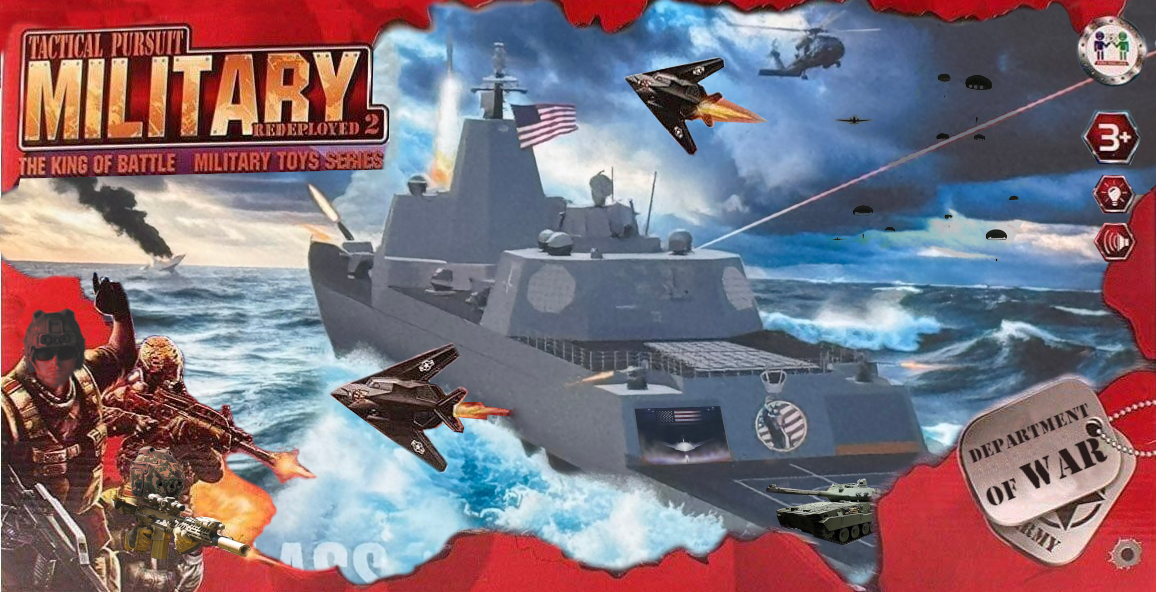
But look how pretty it is! That's what matters, right?
On the whole, it's pretty clearly a grab-bag of stuff that sounded cool, thrown together without any real attempt to explain how is this better spending an equivalent amount of money on Burkes or on the DDG(X) program, which was going to come in around 15,000 tons, and which this is allegedly supposed to replace. Apparently, a lot of this is driven because Trump thinks that modern ships are ugly, and should look good. And I'm not entirely in disagreement with him on that. I love a beautiful ship as much as anyone, but I also strive to keep my aesthetic judgements separate from my policy judgements. I also think that there's some value in having good-looking ships when you're doing port visits and the like, and have even toyed with a "cheap capital ship" to be able to gain some of the benefits I discussed for the Iowas in the 1980s. But that would not have been billed as the future of the Navy, more an interesting side project, and I'm far from sure it would actually be a good use of our limited defense budget.
We've seen a similarly casual approach to procurement policy with the replacement for Constellation. SecNav Phelan has announced that it will be a minimum-change version of the National Security Cutter design, with a flexible mission module slot added on and maybe RAM, in hopes of getting in the water more quickly. Now, they might actually be able to make "getting a ship launched by 2028" on this one, particularly if they're able to reuse components from the cutter Friedman (WMSL-760), which was cancelled back in July, with an unclear amount of work already done. But the result will be something more much like the "minimum viable warship"/Type 31 than a true multi-role frigate, and we should be careful not to confuse the two. In particular, even if the mission module slots get filled with VLS carrying, say, ESSM, the ship does not have the sort of radar necessary to be considered a serious air defense asset on the modern battlefield. I gamed this out in Command: Modern Operations, which doubles as a mid-grade military simulation tool. Both the new ship, apparently designated FF(X) and FFG-62 handled a salvo of 8 conventional C-802-type sea-skimming missiles without too much trouble. But then I upped the threat to NSM and things changed radically. FFG-62 picked them up at 18.5 nm, just inside the radar horizon, and began firing at about 15 nm, with none of the missiles getting closer than 9.3 nm. The NSC-based design, with its much worse radar, didn't pick them up until 3.7 nm, when it was too late to do anything other than a single RAM and a few ineffective shots from Phalanx and the 57 mm gun. NSC also has no onboard sonar system, although one based on the LCS version might be adaptable for use from the mission deck, at an obvious cost in air defense capability. But it's "An American Design from an American Shipyard", so we're going to build it anyway, instead of more Constellations.
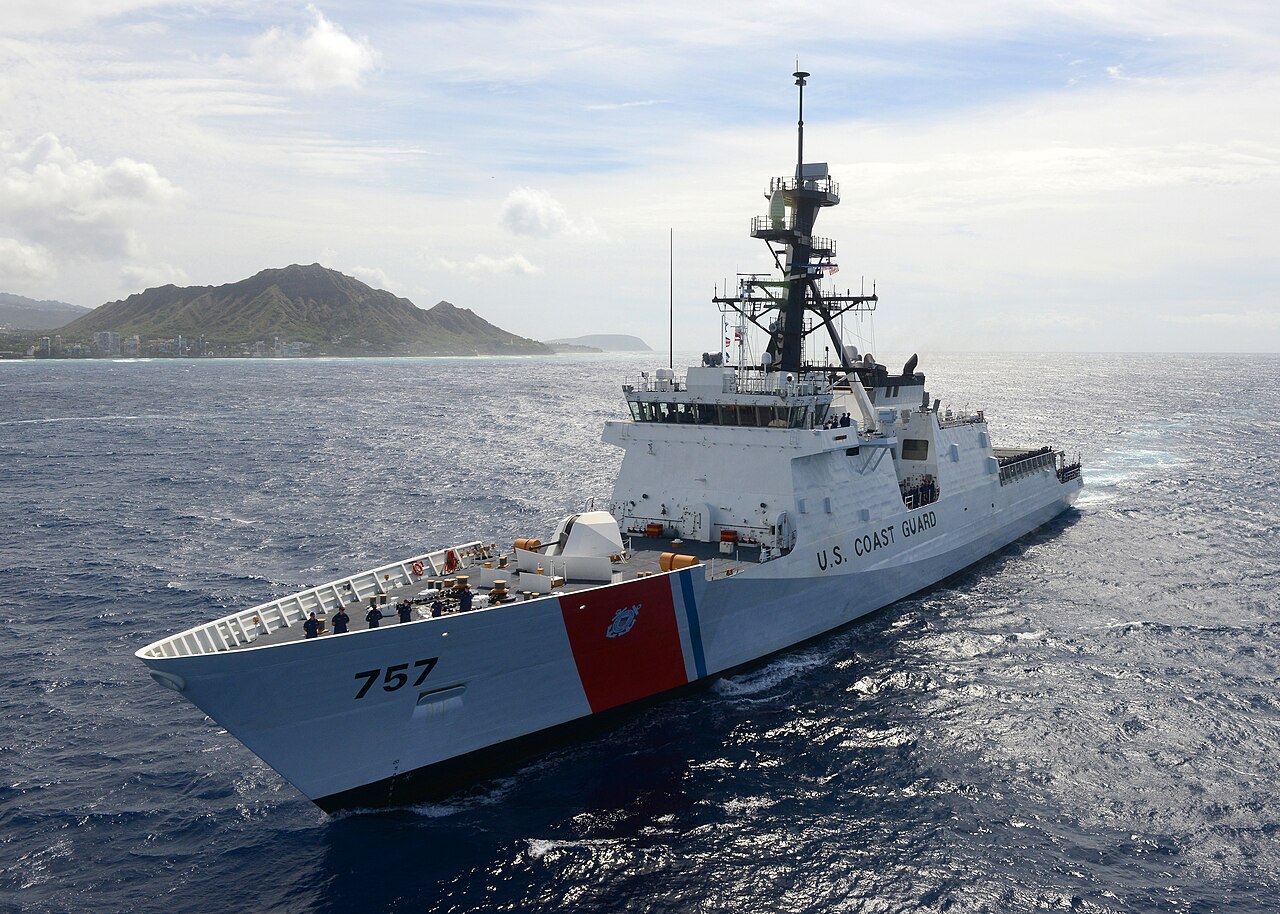
I am also bothered by the name. Not Defiant, which is a fine name for a warship, even if lacking in any particular heritage in the USN. But calling the ships the Trump class is... Look, I've been banging on about this for some time, and naming things after someone who is not only alive but in office is just gross. Also, a complete misunderstanding of how class names work in the American tradition. The British sometimes will pick a theme name, but we just take the first-ordered ship of the class,2 and use that. So even if this does end up getting into the water, it will probably be as the Defiant class. And I'm not hopeful for that happening. This is pretty clearly a very early design, intended to cater to someone whose understanding of naval matters comes entirely from vague memories of Victory at Sea3 and various yachts. It's going to take years to turn it into something we can build, and its fate past 2028 is going to depend on whoever ends up winning that election, a subject I'm not competent to speculate on.
The design is also pushing the limits of "steel is cheap and air is free", a doctrine I am usually a fierce partisan of. I think that view is pretty straightforwardly true when you're talking about putting 4,000 tons of combat systems in a 6,000 ton hull. But at some point, other factors start to take over. There's a least a little bit of wisdom in the Type 42 view that if you have extra space, people will try to install stuff in it. I was also worried about drydocking, but apparently, pretty much every drydock we have that supports DDGs also can handle LHDs, which are about the same size as this thing. More importantly, even if this ship was considerably more capable than DDG(X), which it mostly isn't, it can only be in one place at a time, and we have a lot of commitments. A ship in the wrong place isn't all that much better than no ship at all, so there are reasons to want numbers.
Shas'ui made an excellent summary of the program on the Naval Gazing Discord
Ultimately, this entire thing is silly. This is a ludicrously overgrown destroyer/cruiser (so far as those are separate things these days) without even a figleaf of justification for its size. And even if there was some justification for the size, it definitely isn't a battleship. Also, on a personal note, I would really appreciate it if the Administration stopped dropping significant naval news on the weeks of major holidays, because it adds something to my plate that I would rather not have to deal with.
1 Those carried 122, because they were built with the strikedown crane, which cost 3 cells in each of the forward and aft clusters. And yes, that was a fairly tight design, so you'd really want a bit more tonnage for that many cells. ⇑
2 There's actually a slight difference between the USN and RN here. The Americans take the first ship by hull number, while the British tend to pick the first-completed ship, so the Colorado class is known as the Maryland class in British sources because Maryland completed first. ⇑
3 To be clear, I am not slamming Victory at Sea, which is an excellent series that I highly recommend. But it is perhaps not the best way to understand modern naval policy. ⇑
Comments
I think far more interesting is if the USA will turn into full USSR mode. The US had Rumstead who was teaching the navy how stupid they are (and came with completely genius plans as Zumwalt and LCS), but when someone oposed him he ignored him, maybe called him "old bureocrat" on tv and delayed his promotion, but he never fired them. The current Hegsetg-Trump fires anyone who is not "Enthusiastic enought" on what they thought. I think the last CNO was fired because she tried to explained that the USN needs some ASW assets.
The problem is that the Navy can survive 4 years of Fox host with stupid ideas in the SecDef position, but can not survive 4 years of Fox host with stupid ideas in the SecDef position when they will not resist him.
You can end up with new administration coming in 2029 to find out that you have stoped DDX and Burkes for building capital ship that are useless and you will not build new air defence destroyer until 2035 years even if you buy foreign design. You do not have any ASW or light assets, because you buy basically LCS 2.0, Virginia fleet is decimated by Columbia class and new carriers are delayed because they instal steam catapults.
A lot of people were saying that Trump administration will be disaster for European security, but to be fair I would be probably far more terrified as Japanese, Korean or Taiwanese. And if I was citizen of Hawaii I would probably think about learning chinese, just in case.
Thanks for your thoughts on this. AFAICS you haven't written anything on railguns before, presumably because it's a bit like caseless ammo; in theory an idea with some advantages, but in reality you start running into serious issues real fast that the conventional approach doesn't have... eg conventional cartridge cases limit the rate at which the gun heats up during sustained firing.
Overall the whole proposal is nuts, and I assume it's basically just a way for defence contractors to get funding to continue work on the "advanced X" platform, although if it goes far enough sooner or later some hulls might be laid down and at that stage it truly would be time money thrown away for nothing. If the proposal states "> 35k t" then I guess the internal realistic estimates are even higher, 40-45k. Building a ship that's going to be 2x plus the size of a Burke for AFAICS little additional capability other than some extra defensive armament seems to me to be the definition of "nuts".
My hope is that ultimately Defiant will get pared down into something actually useful. I expect the railgun will get the axe as soon as anyone even half-serious gets a whack at it.
The size, though, still baffles me. I can only imagine that at least some of it is peacocking - "let's make this bigger than Kirov and then add some margin on top of that". And let's not forget that a Kirov just got reactivated, which might have been what planted this seed in the first place. If people were being half-sensible, I think 128 Mk 41, 12 LD-VLS, 4 Seahawks, a few guns and a good suite of point defenses could fit on 15-20k tons with room to grow.
I'm wondering... was the name "Defiant" inspired by Star Trek? A lot of us in the general public think of "Enterprise" as first being the Star Trek ship and only later remember that it was a navy ship first. My guess is that they wanted to name this the Enterprise, but couldn't because there's already a new Enterprise under construction, and thought of Defiant as being the logical follow-up. (it's also the most battleship-like of the main series Star Trek ships)
Another question- why do you call the railgun and lasers the secondary armament? It looks to me like it was designed first and foremost to use those new weapons, which is why it has to be so big. Not so much for the actual size of the weapons themselves, but for the power generation to use them. If they just wanted 128 VLS missiles and 12 CPS, they could fit those on a much smaller hull (or just build more Burkes and Zumwalts). It seems like they really want something that can do shore bombardment, which is a more "battleship" type role.
The multi-racial, multi-species utopian Star Trek? Hardly.
I believe it is based on that image of trump with his fist in the air. It occurs no less than twice in one of the images.
@AJ Gyles
I would say that electric consumption of modern energy weapons if often overstated. You need like 1MW to run 300kW laser, but let just say it is 2MW and that the railgun would need something simillar, so that it is 6MW. That is still fraction of power generated by Burke, the only reason why you can not put it on the Burke is that it is old construction so only small part of total power is turned into electricity, it does not have power stability features and the cooling systems is insufficient. If you make 7000 tons frigate and equip it with IEP propulsion it could have 1MW lasers in terms of power generation.
I'm not at all averse to calling the Trump-class a battleship, or a battlecruiser if someone prefers (and I sort of do). If we're going to keep the traditional ship designations - and we are because "Large Sea Control / Land Attack Platform" would be lame - we need to try and keep the spirit of the original meaning without being wedded to technical specifics re guns or armor. "BBG" and "BCG" are perfectly sensible designations for a ship in this class, and it's also sensible to want to distinguish behemoths like this from Burkes and Ticos.
I'm averse to building the damn fool things, because BBG and BCG are perfectly sensible names for something there's no sensible reason to build. About as ridiculous as building a "Torpedo Battleship" a century or so ago.
Once you're up to 100-150 VLS cells and all the support systems they need to be well-rounded warships, the sensible path forward is to ask "how many more of these can I build?", not "how can I make this bigger?". Bigger made sense with guns, because big-ship armor can stop medium-ship guns cold. Missiles don't work that way.
This is currently at no 1 on https://news.ycombinator.com . Prepare for traffic!
Seems to me like the only really novel bit here is the size - ignore that, and this is just another DDGX/Zumwalt/Kirov/etc. missile ship.
So to my mind, the question is why it's so big. And there's a few plausible reasons I can think of. (Note: "plausible" =/= "good".)
1) Ego/PR/etc.: If it's primarily this one, they're a terrible idea. It's possible to do that as a throw-in on an otherwise-good ship, but it should never be the main justification.
2) Nuclear power: Obviously, it's possible to do this on a smaller hull(USS Truxtun CGN-35 was under 9000 tons), but the reactor designs that powered the old CGNs are long obsolete, so there's something to be said for giving it the same A1B reactor that they use for the Ford class. One reactor instead of two, on a ship half the mass, seems like a very reasonable baseline. That gives you an absolutely massive electrical grid to play with. Given the desire for lasers/railguns/etc., which will need a lot of electricity, I think this could possibly make sense.
3) Armor: I can imagine a world where this makes sense in 2025, but I don't think we actually live in that world. The Iowas had enough armor to really make a difference, but that required a lot of facilities that don't exist any more, and it'd demand displacement figures far higher than what we're seeing for this ship. Just slapping on a few inches isn't likely to make anywhere near enough difference to justify these behemoths.
4) Some kind of space-intensive new technology: The only one in the public domain that even comes close is if this is some sort of tender ship for major sea drones, because docking a bunch of drones that might be 1-2kton each could demand large facilities. But there's nothing like that suggested in the specs we have so far, so I'm discounting it. (It'll be designed to control those drones, of course, but those C&C facilities don't demand a monster ship like this.) Other than that, we're into the realm of "maybe there's something secret that'd justify this?", but that's a silly realm to speculate on. I can't think of anything rumored, and you can always come up with some sci-fi nonsense to justify any bad procurement decision.
5) Industrial limitations, where it's hard to build more small ships, but easy to build a few big ones: Plausible in theory, but doesn't apply to the modern US.
So basically, if this is a nuclear-powered ship designed for aggressive use of the power from a big reactor, then it might be a decent decision. If not, then I'd be hard-pressed to see how the numbers pencil out to anything that actually makes sense here.
@StupidBro where are you finding estimates for the energy consumption of a laser weapon? I'm having a hard time finding anything on that, especially for something as experimental as a 600kW weapon. I would expect the efficiency to go down as the power output goes up.
For a railgun, the estimate to use it was a whopping 25MW of pure electrical power: https://web.archive.org/web/20140412124223/http://www.popsci.com/article/technology/navy-wants-fire-its-ridiculously-strong-railgun-ocean. And that's for a 32MJ gun shooting 10 rounds per minute. You'd need even more than that if you wanted to shoot more rapidly- like, say, if you wanted this gun to be your main defense against a missile swarm attack.
@John Schilling @Alsadius
To play a devils advocate I can see some reasons why it is good to have 35k tons battlecruiser.
Radars (especially X band) are far better on stable platforms, so if you want to put some miniturized SBX on it, it is not bad to have 35k tons displacement. Also VD sonars really likes stable platforms at high sea states. You can launch ASW helicopters basically anytime. You can have huge range, which means you can go without refueling to Taiwan even at 30 knots. And also damage resistence on 35k tons ship would be very good.
Are these things worthy it for your ship to be three times the size? Definitely not, it is pushed by Fox moderator, PE manager and realite magnate, not the Navy, but there are some advantages. It is the same stupidity as Zumwalt, but at 2000s the US had a time to do stupid things.
Alsadius - Current plans (such as they are) don't call for nuclear power, but rather CODAG-IEP. That seems like it might be somewhat volume-intensive, but it's surprisingly conservative. I kind of doubt that's driving the size, but then, I think IEP did drive some of Zumwalt's size, so... maybe?
@AJ Gyles
This was very rough estimates, because I do not know particulary lot about lasers and I am out of military industry (I have done radars, now I do finance). But I have find this source from DARPA funded think-tank:
https://csbaonline.org/about/news/are-missile-defense-lasers-on-the-verge-of-reality
but as general rule, if your emittor do not have at least 25% efficiency you usually end up in disaster cycle, when stable power -> more heat -> the materials get degradated -> less efficiency -> more heat. This is e.g. notorious problem with Ka band radars. And to be fair I think we are as close to 32Mj railgun as we are to 10MW laser. The current working prototype is like 5Mj.
The Japanese seem to have found a relative solution to the "barrel" life problem: https://asiatimes.com/2025/04/japans-railgun-ready-to-zap-chinese-hypersonic-missiles/
I also don't see these ships ever being laid down, too much money for the unit cost, too many Congress critters dislike Trump and factions in the Navy are going to stall and procrastinate.
Got this from a U.S. Naval Institute email:
"Where to build Defiant? HII Ingalls Shipbuilding, which builds bigger amphibious warships, could handle the size of the ship. Likewise, HII Newport News Shipbuilding could build the ships but their graving docks have been configured for carrier construction. Hanwha Ocean’s Philly Shipyard inherited graving docks from the Philadelphia Navy Yard big enough to build the Trump-class but is still tooling up for higher-end Navy work. General Dynamics Bath Iron Works built the Zumwalt-class but can they build a ship twice the size?"
I don't see anything there saying they've managed to lick the barrel erosion problem, other than they seem a little more sanguine about going live with it than the US ever did. (And Japan seems considerably less prone to peacocking than China, so mounting one even as a test article does smell somewhat promising.)
Why does the US seem so anti Drone tech?
Floating drone factories seems like the most obvious choice right now.
@senectus
Floating drone factories? What kind of drone? What would it be doing? What's the CONOPS here?
@StupidBro
How can the Navy push back if anyone who pushes back is replaced?
@Fionn
No, I haven't written on railguns before. I don't find them that interesting, and there wasn't much sign they'd turn out to be particularly useful.
I don't think so. Defense contractors generally do care at least a little about actually defending the country, and this is such an obvious white elephant that I'm pretty sure this is being pushed because we have a President who only knows about Victory at Sea and a SecNav who doesn't even own a rowboat.
@AJ Gyles
Because the official specs did. And because the railguns and lasers are definitely less useful (because of range limits if nothing else) than the missiles.
I don't know of any particular reason why that would be the case. The lasing mechanism itself is based on a commercial fiber laser, and you get power by chaining them together.
@senectus
We've had drones for a long time. They're called cruise missiles, and this carries a lot of them.
More broadly, define "drone", and how it's supposed to work. There are reasons why we don't expect drones to change naval warfare all that much, at least relative to what they've done on land.
@StupidBro Thanks for that link. It sounds pretty optimistic about the development of laser weapons, and that's from 2015. So if it's anywhere near correct about "And we’re probably about two to three years from being able to go to 300 [kw] if funding is supplied." Then there's a good chance these things are already near-ready. But it does sound like you're right that the lasers would not be a major use of power, leaving plenty for the radar and railgun systems. @bean Less useful as offensive weapons, sure. But as defensive systems they seem potentially very powerful. It seems to me like this is an attempt at entirely new kind of ship that blends the distinction between offense and defense. If (and I admit this is a big if) the lasers and railgun work perfectly, they could take out quite a large number of incoming missiles, which again gives this more of a "battleship" feel. Doubly so if we could build an entire fleet of these things to support each other.
We're pushing out lasers to a lot of ships now. If you follow the "I'm a big fan of lasers" link, it's to a short series I did on laser weapons a few years back. I've tried to keep it reasonably up to date. They're excellent against slow drones, starting to get there against missiles, but not world-changing in the latter role. I am basically completely discounting the railgun, because I've seen no evidence that the erosion issues are solved.
I think even without a working railgun, the combination of Standard, ESSM, RAM and lasers all directed by Aegis would make anything with that combo a tough nut to crack.
What I'm not convinced of, is that this 35k-ton behemoth would be any tougher a nut than a 15-20k CG(X)/DDG(X)-sort-of-thing. Well, outside of the larger hull making it more damage-tolerant.
bean:
Treat it as the lowest priority you can get away with then push back once Trump is out of office (and if anything goes wrong leak it).
If you're lucky it'll waste less than the Stalingrad class.
@Anonymous
This is possible at normal enviroment, the problem is that if you make atmosphere of fear people will usually not risk their whole life career and mortgage so the Navy gets the best ships possible. If you came to NAVSEA and you say that you will fire them unless they give you blueprints for battleship in a year, they will make them at a time.
Actually there is beautifull example of Moskva-class helicopter carriers. In 1960 Gorskhov wanted ASW helicopter carriers for fighting the US boomers in Arctic, to be designed in two years. In the west everyone thought that it is impossible for Soviets to design it that quickly. But they did, because otherwise they would be fired. When the ships went on their first voyage it was found out that seakeeping is so terrible, that they can not launch the helicopters basically all the time at the ocean. So the ships were completely useless and ended up in a Black sea fleet
@AJ Gyles
I would not be so optimistic with lasers on naval ships in 4 years, because you need to solve the problem with demand spikes when in a second your electricity consumption is 1MW up. This can be solved pretty easily on a new ship, but good luck with retrofiting Burkes with large Flywheel energy storages.
But maybe this was solved in some other way and I only do not know about the solution.
@ Jade
https://www.twz.com/sea/railgun-damage-to-japanese-target-ship-seen-for-the-first-time
Barrel life of 200 rounds (I saw 120 from an article earlier in the year) There are a number of articles that sate that the Japanese have managed to find a way around the low barrel life (30 rounds) of the American rail gun
A relevant link: https://rantburg.com/poparticle.php?D=12/29/2025&SO=&HC=2&ID=810360
Seems like Israel is ahead of the US when it comes to laser technology.
"The main downside of a laser system is that it does not function well in low visibility, including heavy cloud cover or other inclement weather. "
@Chantry
I believe the Japanese railgun has better barrel life due to reduced performance. As for Israeli lasers, Iron Beam is a 100 kW-class weapon, which is not exactly cutting edge. We've had those for a while.
@Chantry
You need to first understand how they have "solved" that problem. They make it not much powefull and then put 320 g dart into it and then launch it at 6M. It is railgun, it works, but it has shorter range than 76mm OTO Melara and anyway you can just put the same dart into sub-caliber projectile for 76mm OTO Melara and it would fly about the same speeed (gas expansion limit for propelants is about 2000m/s). The problematic part when the US stopped it is in front of them, they did not solve it.
@Alsadius, @ StupidBro
The Ticos should probably have been about 12,000 tons; a bit more rugged hull design and a bit more room for the crew to work, both important for a cruiser. Beyond that, what do we want in a new surface combatant that the Tico's didn't have? For me:
Good high-energy lasers in place of Phalanx, yes - but don't hold the design hostage to them, feel free to roll out with Phalanx but SWAP reserved for the laser.
A proper 155mm naval gun, compatible with the Army's shells. Again, don't hold the design hostage to this, roll it out with 5"/62 and SWAP reserved for the 6".
Integrated electric propulsion, absolutely. And if you're worried about demand spikes for the lasers or whatnot, And note that a megawatt of power for ten minutes is maybe a ton of lithium-ion batteries, that you can bury deep in the hull.
Maybe 32 more VLS cells, or some Dark Eagles to replace some of the Tomahawks currently filling space in the VLS. Anything much more than that, and I'll be asking for more hulls rather than bigger ones.
RAM for point defense against saturation attacks, in parallel with the lasers.
An active torpedo defense system, possibly replacing/overlapping the 324mm torpedo tubes.
Better anti-boat guns; 30mm is fine if the mount and fire control are good.
Hangar space for a modest number of drones in addition to the two MH-60s.
And of course the latest and shiniest version of all the electronics, but that shouldn't affect SWAP much.
Does all of this combined push us above 15-16,000 tons? I don't think so. If you can throw in a reactor that lets the ship cruise at 20 knots, I could see 20,000 tons.
Thanks for the answers.
It will interesting to see what the future brings and if we can manage to resolve the hardware issues of a railgun.
I had two predictions for 2025: 1. The next US aircraft carrier is going to be called USS Trump 2. The English language is going to be renamed "the American language"
Maybe I am wrong on number 2, but they gave me something better on number 1. BATTLESHIP TRUMP
I think this will be good learning experiance for the navy.
They already got their fingers burned on the "Little Crappy Ships".
Why not try "Big Fancy Gunships"?
Hopefully the BFG's soak up all the tendy crazy ideas for a generation.
Then a few years later we get the Goldilocks-class of boring useful ships.
@John Schilling
I completely agree with you that it is not effective to make 15k tons naval destroyer 35k tons and that BBG is stupid idea. What I said is that there are some practical advantages especially in sensor stability and range. And if they came with this idea in 2000s (instead of Zumwalt) it would be another stupid political pet project that the USN would cancel in 2020 after 6 hulls and they would get very good escort cruisers. It would be mybe smaller disaster than Zumwalt. But now, cancelling the DDG(X) and put the money into the BBG, is really a national security disaster.
Oddly enough I think they should've gone more over the top with it. Right now it's too stupid to be a sensible design but too sensible to survive on rule of cool alone.
Either ditch the rail guns and shrink the design to something reasonable or add 20" of armour and 18" guns plus maybe a few Tridents.
All military equipment should be designed either by a team of highly qualified engineers or by a hyperactive toddler with a box of crayons, having them work together will lead to compromises that leave no one happy.
I didn’t quite get where you were going with this. Isn’t the whole point of nuclear propulsion that it’s basically free/unlimited at the point of use? Like, they could just drive a super short/fat boat at 30kts all day if the sea state permits it, in a way that CODAG (or straight gas turbines) wouldn’t really support.
Or am I missing something?
Nuclear power isn't infinite power output, it's practically unlimited fuel. If you need a lot of juice to get a stubbier hull going the same speed, you have to make your reactor, turbines, etc beefier. You can avoid needing to make your engineering plant as beefy by lengthening the hull. (See: Iowa-class BBs. Their extra length made it easier to reach 30+ knots.)
Now, if your plant produces enough juice to drive your hull at 30 knots, you can do that all day with a nuke, yes. But you still need a beefier engine to drive a stubbier hull at the same speed.
Seeing as how these should instead be termed "cruisers", it sure seems like a missed opportunity to not classify these as "Big Beautiful Cruisers". A class of a couple dozen BBCs would be far more on-brand for anyone of the opinion that the U.S. Navy is somehow lacking in sea control.
@ike
If that was going to work, it would have worked with LCS.
@redRover
More or less what Jade said. Nuclear plants tend to be pretty heavy for a given power output, and increasing the length of the ship is a way to reduce the required power. But you can sustain that power for a long, long time.
@bean @StupidBro I think you're both underestimating the Japanese railgun. According to this: https://www.japantimes.co.jp/news/2025/09/11/japan/railgun-test-firing/
" "However, by using a new discharge method, materials and a smaller 40 mm caliber, ATLA has succeeded in reducing barrel wear while maintaining an initial velocity of around Mach 6.5, approximately 8,026 kilometers per hour, or 6.5 times the speed of sound, Murano said.
“As a result, even after 120 consecutive firings, no decline in muzzle velocity was observed," he said. " That is a significant improvement in durablity over the US railgun, and in speed over any sort of traditional gun system. Admittedly, it's still lower energy than the 32MJ that the US wanted, but it seems to be high enough energy to be useful. My guess is that a real system would be varied in power- high power for striking distant targets, lower power for missile defense and preserving barrel life.
At any rate, can we agree that this design will live or die based on the railgun tech? If they can make it work, that will be a huge breakthrough and allow it to do things that would be impossible for any other current ship. If not, it's just a huge waste of money and might end up as another Zumwalt-type boondoggle of a "warship" without a weapon.
@AJ Gyles
Yes, but again you are missing the point of how they have done it. Their current solution is to have really small power to the level of conventional gun with sub-caliber ammunition. If the US have downsized their project to the level of the Japanese they would probably also massively prolonged the barrel life.
And BBG is definitely not about the railgun. The 32Mj railgun is a secondary armament here. It has definitely some tactical use (if it works), but the missiles are the main weapon. Also you do not need this size of ship for a railgun, Zumwalt was designed with potentional capacity for two 64Mj railguns.
@Jade/Bean
Sure, but length helps with speed/energy efficiency/range for fossil fuels as well.
I think the missing point was that nuclear has limited peaking capacity, whereas a “sprint” turbine is relatively light, and can use the same fuel that the cruise engines do at lower speeds. Consequently, there is less penalty for fossil fuel power plants optimizing for cruise and using crude applications of power to hit their speed targets.
However, this seems like it’s more of a consideration for IEP or diesel plants, as geared turbines are notoriously inefficient at part throttle operation.
The reason length helps more for a nuclear design is because nuclear propulsion is heavy for its power output, so the smaller a nuke plant you can get away with, the better.
Also, the efficiency of geared turbines might not come up as much - no reason you couldn't have nuke-IEP or even CONAG-IEP.
Perun has looked at the Trump class through his defense procurement/economics lense. His view is that if the Trump class replace the DDG(X), which is what the announcement stated, it's going to be a disaster for USN shipbuilding over the next couple of decades. (Or, another disaster.)
https://www.youtube.com/watch?v=qvUbx9TvOwk
The cancellation of DDG(X) does not have to be such a disaster, because it still aimed to 2040s. There as not a single ASW CODLAG frigate project with AEGIS when the Constellation project started, on the other hand there will be plenty of large air defence IEP destroyers with AEGIS build in 2030s, so you can just modify Dutch, German, Korean etc.
The real disaster will be if they somehow force them to laid keel at 2028. The current multi-year contract for Burkes expires at the end of 2027 and it is build on the line where BBG should have been built.
Suppose someone is interested, Com. Tom Sharpe, one of the best British authors on this matter, wrote an excellent article on BBG(X), mostly similar to this, but with some extra interesting points.
Here is a Telegraph link: https://www.telegraph.co.uk/news/2025/12/27/trump-golden-fleet-super-battleships-us-navy-shipbuilding/
And if you do not have a Telegraph subscription, there is free version from the archive: https://archive.is/RCG6e
Sorry to necro. But unlike many here it seems, I think a BBG would be a good idea. You could stick a really powerful radar on it, and networked Aegis destroyers could take advantage of its capabilities. Good seakeeping, a vast missile capacity, room for a nuclear power plant, and margin for things we think up in the future are also pluses. Obviously this ship as proposed is not a good idea, but I would be more sanguine about it. There's no way Trump or Hegseth could design a warship by themselves or even control a team that was doing it on their behalf. Whoever designed this is obviously much smarter than them, or it would have armor and 20-inch guns to beat the Yamato. It's likely that this is an intentionally silly plan with things added to gain Trump's favor. Once his back is turned or he is out of office, things like the railgun and CPS get tossed and we'll find out why they wanted the space and power generation capability for it.
The problem is that the ship you're describing, while potentially useful, bears no resemblance to the announced ship. The radar is the same as on the Flight III Burkes and the missile capacity is easily achievable on a ship half or even a third the size. And there's no nuclear plant planned. So it's basically a ship that's twice the size that it needs to be, and I can't figure out why except so it can be called a "battleship", which it isn't.
As for necros, those are encouraged, even way further back than this.
Warship scaling laws are such that missile based surface combatants don't make much sense far beyond 10,000 tonnes, maybe active guidance can push it up by allowing more missiles per illuminator but you'll still find that there is not much economy from the bigger ship.
@5shi
I would disagree with you on two points: price and timing.
You are completely right about the advantage of a stable platform for radars (especially the X-band discrimination ones) and actually even the sonars. Now the price for BBG(X) is triple that of the new DDG(X). If you develop the smaller SBX, "fast SURTASS" and nuclear propulsion, you will be going fivefold of the DDG(X) price. Wouldn't it be better to DOUBLE the destroyer fleet than to have a couple of battleships?
If the thing you describe was a pet project of George W. Bush, and they bought it instead of Zumwalt, it would not be an extreme disaster. The US has a long history of making stupid, uneconomical weapons because of politicians (some of them even came out good). However, it is not 2001. China is building 20 destroyers a year, the US does not have any decent ASW combatants, and Burke's margins are completely depleted. The US Navy needs a good new destroyer (DDG(X)), a good escort/ASW frigate (Constellation) and maybe a good light ship (like new FFG(X)). It is not a good time to cancel it all and waste another 4 years on a stupid political project, because it could have some niche advantages.
@Anonymous
I would argue that because of the current trend of margins, CODLAG/IEP propulsion, more VLS, etc., the threshold went up to 15 000 tons. New Chinese Type 055, DDG(X), or any European next-gen destroyers are between 13 000 - 15 000 tons.
StupidBro:
Maybe, but it is less 20,000.
More VLS also depends on whether you can use the extra cells so active radar antiair missiles become the deciding factor of whether a larger warship is viable.
This is, for all intents and purposes, a “battledestroyer,” if such a moniker could be legal. Calling these proposed grotesqueries “battleships” is silly, since, as currently planned, they do not check off any of the boxes that define traditional battleships, but that really isn’t the crux of the problem. The reasons why the USA and all other nations with large navies quit building gun-heavy capital ships is because they make huge targets and they are generally too expensive to maintain. And I agree with your revulsion at a sitting “president” naming a class of naval vessels after himself. Narcissism 101, indeed.
Not a BB. Poor use of resources, limited ship building capacity and the USN needs SSN's and drone carrying subs a lot more than this stillborn, ignorance inspired, target.
The Burke in the background of the battle scene appears to be USS Jack H. Lucas. Any insight as to why she received the honor?
She's the first of the Flight IIIs.